Office furniture fails faster than it should. Not because of poor luck, but because many procurement teams unknowingly buy furniture built for a spare bedroom, not a busy open-plan floor with 40 people cycling through hot desks every day. Contract furniture exists precisely to solve this problem, and understanding what it means could save your organisation thousands in premature replacements, insurance headaches, and compliance failures. This guide covers everything UK office managers and procurement teams need to know: what contract furniture actually is, how it differs from domestic alternatives, which UK standards matter, and how to source it efficiently for hybrid workplaces.
| Point | Details |
|---|---|
| Built for heavy use | Contract furniture is engineered to withstand daily commercial traffic in modern UK offices. |
| UK compliance is essential | Standards like BS EN 16139 and Crib 5 ensure legal, safe, and insurable workplace furniture choices. |
| Long-term value | Despite higher initial costs, contract furniture saves money by lasting up to 15 years with fewer replacements. |
| Modular and flexible options | Hybrid workplaces benefit from mobile, ergonomic, and easily reconfigurable contract furniture designs. |
| Smart procurement | Bulk frameworks and certified suppliers make sourcing contract furniture both efficient and compliant for UK teams. |
Contract furniture is designed for commercial use in high-traffic settings such as offices, hotels, schools, and hybrid work zones. The word “contract” refers to the commercial contracts under which this furniture is specified and supplied, not a payment arrangement. It signals a category of product built to withstand repeated, heavy daily use by multiple users across years of continuous service.
This is fundamentally different from domestic furniture, which is engineered for occasional, single-user home use. A dining chair used twice a day is a very different product challenge from a meeting room chair used by eight different people across back-to-back sessions. Our office furniture buying guide explores this distinction in practical detail for UK buyers.
Contract furniture is used across a wide range of settings:
If your space sees more than one person using the same piece of furniture each day, you need durable office furniture built to contract grade.
Now that you know where contract furniture fits, let’s look at what physically sets it apart from what you might buy for a home.
The construction is the clearest difference. Contract furniture uses hardwood or steel frames rather than the particleboard and MDF common in domestic ranges. Joints are reinforced using mortise-and-tenon, dowelled, or glued construction methods that resist racking and wobbling under repeated stress. Domestic furniture often relies on cam-lock fixings that loosen over time.
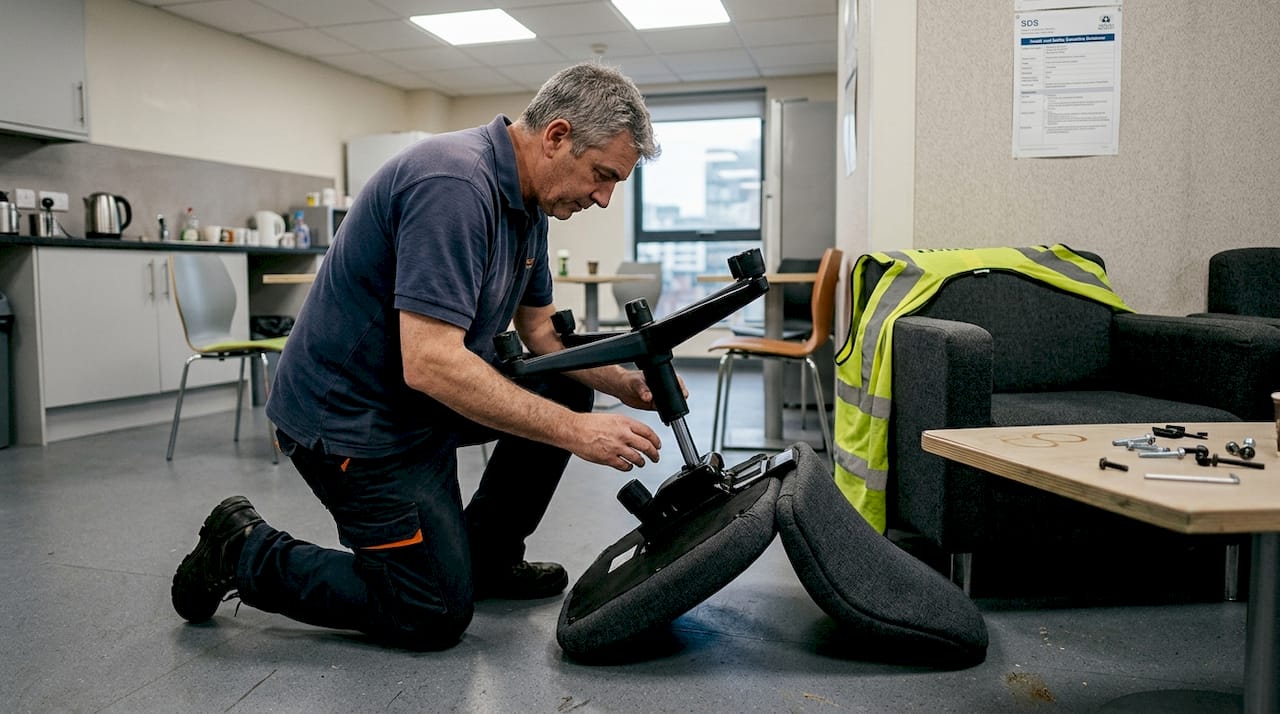
Fabrics and finishes are equally distinct. Industrial-grade upholstery fabrics are specified for high rub counts, stain resistance, and ease of cleaning. Powder-coated or lacquered finishes on frames resist chipping and scratching far better than standard paint.
| Feature | Contract furniture | Domestic furniture |
|---|---|---|
| Frame material | Hardwood or steel | Particleboard or MDF |
| Joinery | Mortise-tenon, dowelled | Cam-lock, stapled |
| Fabric durability | 30,000+ Martindale rubs | 10,000-15,000 rubs |
| Finish | Powder-coat or lacquer | Standard paint |
| Warranty | 5-15 years | 1-2 years |
Key features that define contract-grade build quality:
Pro Tip: Always request FIRA (Furniture Industry Research Association) or BIFMA test reports from suppliers before committing to a bulk order. These independent test results confirm the furniture performs as claimed, not just as marketed. Our guide to collaborative office furniture covers how build quality affects shared workspace performance.
Understanding how contract furniture is built is crucial, but meeting UK standards is what legally sets contract apart. Let’s break down exactly what those are and why they matter.
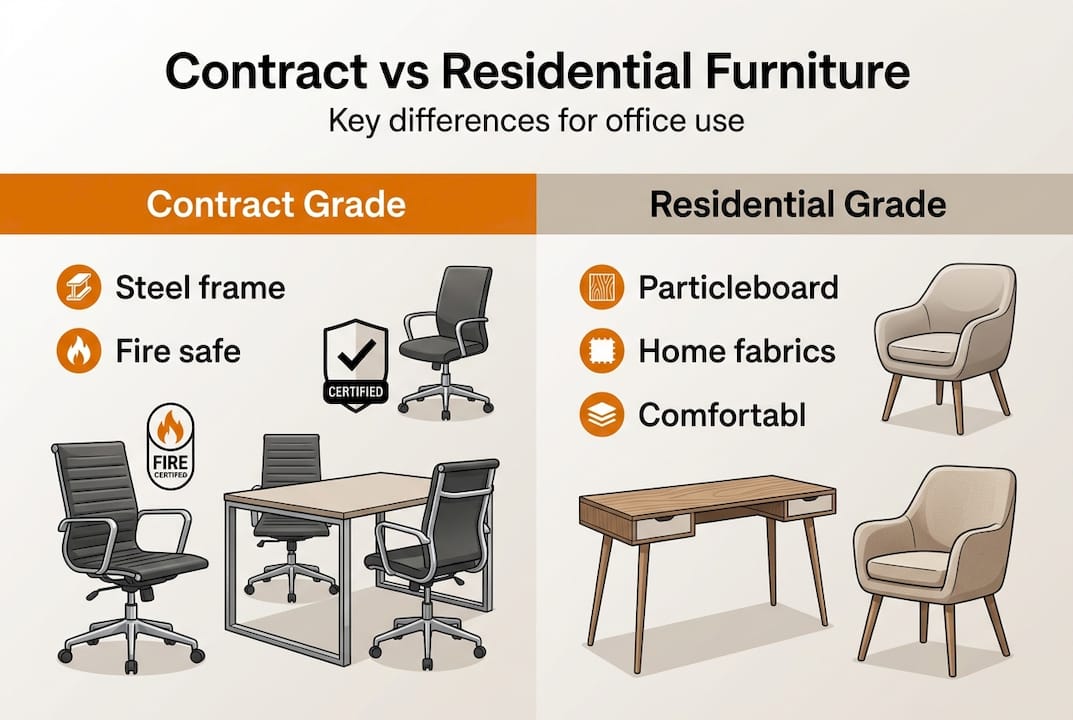
UK contract furniture must meet a specific set of standards that residential products are not required to satisfy. Key certifications include BS EN 16139 for seating strength and durability, BS EN 15372 for tables, Crib 5 or BS 7176 for upholstery fire safety in public spaces, and the Martindale rub test for fabric endurance.
Here is what each standard means in practice:
Failing to specify compliant furniture in a commercial setting can invalidate your building insurance and expose your organisation to liability if an incident occurs. Always request compliance documentation before purchase.
| Criteria | Contract furniture | Residential furniture |
|---|---|---|
| Fire safety standard | Crib 5 / BS 7176 | Crib 3 (domestic only) |
| Seating standard | BS EN 16139 | Not required |
| Table standard | BS EN 15372 | Not required |
| Fabric durability | 30,000+ Martindale rubs | 10,000-15,000 rubs |
| Typical warranty | 5-15 years | 1-2 years |
For offices undergoing refurbishment, our sustainable office furniture guide explains how certified products also support environmental procurement goals. If you are fitting out a senior leadership space, the executive office setup guide covers compliance considerations specific to private offices.
Seeing the standards in black and white, it is clear contract furniture is about more than marketing. Here is the real-world cost reason why it is the smarter choice.
The upfront price of contract furniture is typically higher than comparable domestic products. But the total cost of ownership (TCO) tells a very different story. Contract furniture lasts 10-15 years in office environments, compared to 3-7 years for domestic alternatives. That means fewer replacement cycles, less procurement time, and significantly lower cumulative spend.
| Cost factor | Contract furniture | Residential furniture |
|---|---|---|
| Upfront cost | Higher | Lower |
| Lifespan | 10-15 years | 3-7 years |
| Replacement frequency | Low | High |
| Warranty coverage | 5-15 years | 1-2 years |
| Insurance compliance | Yes | Often no |
The hidden costs of choosing non-contract furniture in a commercial setting include:
For hybrid offices where furniture is used intensively across multiple shifts, the workflow optimisation benefits of durable, well-specified furniture are substantial. Fewer disruptions, fewer replacements, and a workspace that stays functional and professional throughout its lifecycle.
Knowing why contract grade makes business sense, let’s zoom into how it fits and excels in the move to hybrid and flexible workplaces.
Hybrid workplaces require furniture that can be reconfigured quickly, cleaned easily between users, and withstand the intensity of a space that is never truly empty. A fixed-layout office used by the same 20 people every day is a very different challenge from a hot-desking floor where 60 people rotate through 30 workstations across the week.
The features that matter most for hybrid contract furniture:
Pro Tip: Before placing a bulk order, always request physical samples and ask suppliers to provide the original test certificates, not just a summary sheet. Certificates should reference the specific product SKU, not a generic range. Our hybrid office furniture guide walks through the full specification process for flexible workspaces.
Once you know what to look for, here is the step-by-step path to making the right buy for your team, with UK-specific guidance.
Pro Tip: Prioritise suppliers who offer bulk order pricing, clear lead times, and UK mainland delivery as standard. Fragmented sourcing from multiple suppliers increases administrative burden and makes warranty management far more complex. Browse our range of office desks to see how contract-grade specification translates into practical product choices.
After learning what contract furniture delivers, you are ready to source reliable options for your unique space.
At Furniture for Business, every product in our range is selected for commercial durability, compliance, and suitability for the demands of modern hybrid workplaces. Whether you are equipping a single meeting room or fitting out an entire floor, our portfolio covers contract office chairs built to BS EN 16139, contract office desks with height-adjustable options for multi-user environments, and storage solutions designed for busy shared spaces. We offer bulk order pricing, free delivery to the UK mainland, and expert support for procurement teams managing complex fit-outs. Explore the full range of business furniture solutions and get in touch to discuss your requirements with our commercial team.
Contract furniture is built for commercial use, offering greater durability, safety compliance, and longevity than typical home furniture used in shared office settings.
Look for BS EN 16139 or BS EN 15372 for structural strength, Crib 5 or BS 7176 for upholstery fire safety, and a Martindale rating of at least 30,000 rubs for fabric durability.
Domestic furniture fails under constant multi-user use, risking early structural failure, potential insurance invalidation, and safety hazards in commercial environments.
Quality contract furniture lasts 10-15 years in office settings, significantly outlasting residential furniture which typically reaches the end of its useful life within 3-7 years.
Refurbished contract pieces can offer 8-12 years of remaining life at a reduced cost, making them a practical and cost-effective option for many UK procurement teams.

Phone: 0330 043 4114
VAT no. GB 991 8681 60
Company no. 07250570