TL;DR:
- Effective office design focuses on supporting different work activities rather than just desk quantity.
- Ergonomic, adaptable furniture and technology integration are key for productive hybrid work environments.
- Sustainable, space-efficient solutions combined with staff insights lead to successful 2026 office spaces.
More than half of UK businesses now rank workplace design as a direct driver of staff retention and productivity, yet most office refurbishment projects still begin with the wrong question. Instead of asking “how many desks do we need?”, the more powerful question is “what kinds of work happen here, and how do we support them?” That shift in thinking is what separates offices that genuinely work from spaces that simply look modern. This guide breaks down the most important design trends for 2026, with practical, evidence-based strategies for office managers and procurement teams navigating the realities of hybrid working.
| Point | Details |
|---|---|
| Hybrid work shapes design | Modern UK offices now favour flexible layouts and ergonomic furniture to support hybrid teams. |
| Ergonomics boost productivity | Adjustable desks and chairs improve comfort and efficiency in fast-evolving workplace environments. |
| Sustainability and efficiency | Eco-friendly, modular furniture choices help UK businesses balance environmental goals with space optimisation. |
| Tech integration matters | Smart accessories and integrated technology are now central to future-ready office design. |
The open-plan office was once considered the pinnacle of progressive workplace design. Rows of identical desks, maximum occupancy, minimal privacy. For a time, it worked. But hybrid working has fundamentally changed what offices are for. Today, people come in for collaboration, focus, and connection, not simply because they have to. That change in purpose demands a complete rethink of layout, furniture, and function.
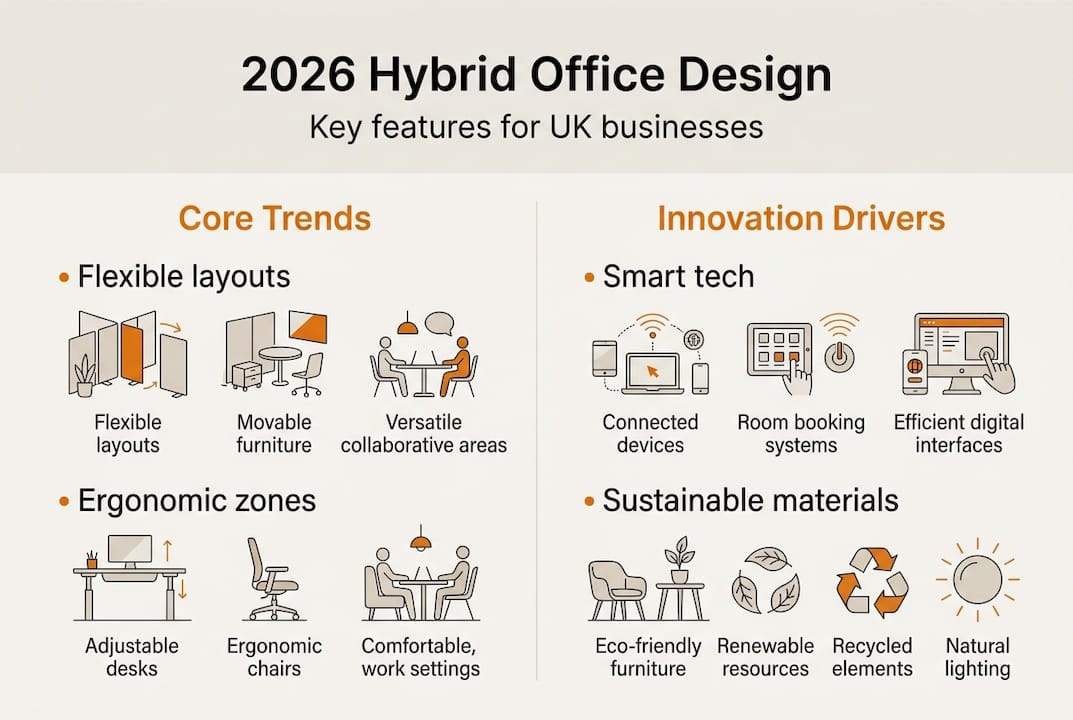
One of the most persistent misconceptions is that hybrid offices just need fewer desks. In reality, they need different desks, arranged in different ways, serving different purposes. A team that splits its time between home and office does not need a traditional assigned-seating plan. It needs a mix of zones: quiet focus areas, informal collaboration spaces, formal meeting rooms, and touchdown points for people who drop in occasionally. Getting that balance right is what hybrid office layouts are all about.
The numbers tell a compelling story. Research from the British Council for Offices found that businesses with activity-based working environments report higher employee satisfaction scores than those with traditional fixed-desk setups. Meanwhile, the Health and Safety Executive continues to emphasise that workstation design must support posture and wellbeing, particularly as staff now often hot-desk across multiple sites.
Here is a summary of how priorities have shifted:
| Office priority | Pre-2020 focus | 2026 focus |
|---|---|---|
| Desk allocation | Fixed, assigned seating | Flexible, activity-based zones |
| Meeting spaces | Formal boardrooms | Mix of formal, informal, and digital |
| Storage | Personal pedestal drawers | Centralised, shared storage |
| Ergonomics | Basic chair adjustability | Full adjustable desk and chair systems |
| Sustainability | Rarely specified | Standard procurement requirement |
The features defining a successful 2026 office environment include:
“The best-performing hybrid offices we see are not the most expensive ones. They are the ones designed around how people actually work, not how designers assume they work.”
Boost productivity with office design by starting with an honest audit of how your teams use space across different days and working patterns. That data is worth more than any mood board. Hybrid work demands flexible layouts and improved ergonomic support in UK offices, and that demand is only growing as hybrid becomes the default rather than the exception.
Once the layout is established, the furniture choices within each zone determine whether the space actually supports staff or simply looks the part. Ergonomics is not a buzzword. It is a legal consideration. The Health and Safety (Display Screen Equipment) Regulations 1992, updated under UK law, require employers to assess workstations and ensure they reduce risk of musculoskeletal injury. For hybrid offices where staff rotate across different desks, this creates a real challenge: how do you ensure every person, regardless of height or working style, is adequately supported?
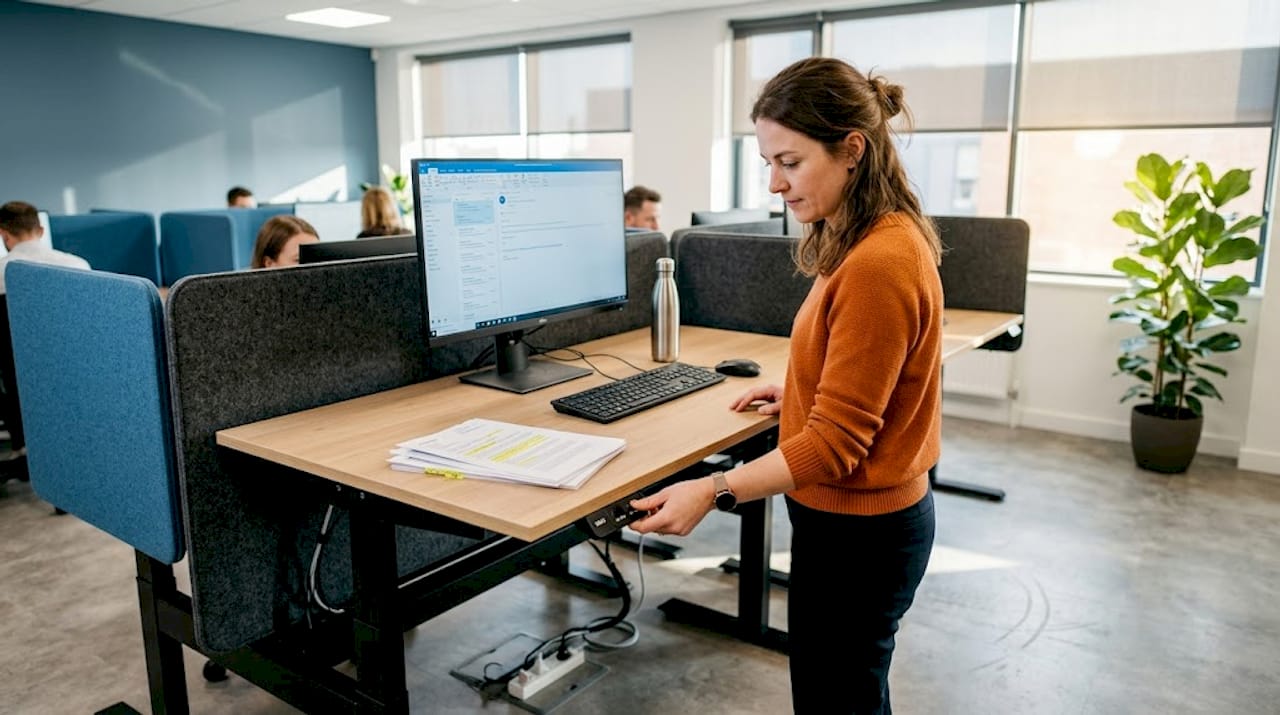
The answer lies in adjustability. Height adjustable desks and ergonomic chairs are key to supporting health in hybrid workplaces, and the evidence for their effectiveness is substantial. Staff who alternate between sitting and standing during the working day report lower rates of back pain, improved concentration, and higher energy levels in the afternoon, the period when productivity most commonly dips.
Here is a comparison of the most common ergonomic furniture options and what to consider for each:
| Furniture type | Key feature to specify | Common oversight |
|---|---|---|
| Height adjustable desk | Motor stability and memory settings | Forgetting to check desk surface depth |
| Ergonomic task chair | Lumbar support and seat depth adjustment | Ignoring armrest width and pivot |
| Monitor arms | Height and tilt range | Compatibility with desk edge thickness |
| Footrests | Non-slip base and adjustable tilt | Often omitted entirely |
| Keyboard trays | Negative tilt capability | Rarely specified in bulk orders |
When specifying ergonomic furniture for a hybrid team, work through these steps to make sure nothing is missed:
Pro Tip: The most commonly overlooked element in ergonomic procurement is the transition between sitting and standing. Staff who receive height adjustable desks but no guidance on how to use them often leave the desk at one height all day. A short, practical guide to sit-stand working, displayed at each workstation, dramatically increases uptake and benefit.
The modern furniture workflow guide offers a practical framework for sequencing furniture decisions so that ergonomics, aesthetics, and budget are all addressed in the right order.
Comfort is only one part of the equation. Sustainability and spatial efficiency round out the 2026 office trend story, and increasingly, procurement teams are being held accountable for both. The UK government’s net zero commitments have filtered through to corporate procurement policies, with many large businesses now requiring environmental criteria to be met before any furniture order is approved.
Sustainable office furniture supports both environmental goals and efficient use of space, and the two objectives are more closely linked than many managers realise. A modular storage system that can be reconfigured rather than replaced, for example, reduces both waste and long-term cost. A chair made from recycled materials that lasts fifteen years instead of five delivers a better lifecycle carbon footprint and a better return on investment.
What makes furniture genuinely sustainable in 2026? Look for these markers:
Space efficiency is the other major driver in 2026. With many UK businesses downsizing their office footprint in response to hybrid working patterns, the ability to do more with less square footage is a genuine competitive advantage. Space-saving office furniture such as nesting chairs, folding tables, wall-mounted storage, and bench desking systems allows procurement teams to maintain headcount capacity without increasing rent.
Pro Tip: When planning a smaller hybrid office, calculate your peak concurrent occupancy rather than your total headcount. If your team of 40 never has more than 24 people in on any given day, plan for 28 workstations with buffer zones rather than 40 fixed desks. The saved space can become a collaboration zone or a quiet room, both of which will see far more productive use.
Modular furniture is particularly valuable here. Systems that allow you to add, remove, or reconfigure components as team structures change mean you are not locked into a layout that may be obsolete in three years. This is especially relevant for growing businesses or those undergoing significant restructuring.
With sustainability and ergonomics addressed, technology’s role in shaping adaptive workplaces deserves equal attention. The 2026 office is expected to function seamlessly as a digital and physical hub, meaning furniture must do more than provide a surface to work on.
Integrated technology and smart accessories are now standard in UK office environments, and the gap between offices that have invested in this area and those that have not is visible immediately. Staff walking into a meeting room with tangled cables, no screen-sharing capability, and inadequate lighting will disengage faster than any policy document can re-engage them.
The most impactful technology integrations for desks and conference rooms in 2026 include:
A recent survey found that digital collaboration tool adoption across UK businesses rose by over 60% between 2022 and 2025, yet many offices still have meeting rooms that do not adequately support video calls. The hardware is often there; the furniture layout and accessory specification are the gaps.
For procurement teams future-proofing their office investment, the key principle is to specify furniture with technology in mind from the start. Retrofitting power modules and cable management after installation is costly and rarely looks as clean. Choose desks with built-in cable ports and routing channels. Choose conference tables with central connectivity modules. And always confirm that your chosen accessories are compatible with your organisation’s existing technology stack before committing to a bulk order.
Most articles about 2026 office trends focus on what to buy. This one tries to focus on how to think. And that distinction matters enormously.
We see businesses invest in beautiful, well-specified furniture and still end up with offices that do not work. The reason is almost always the same: design decisions were made based on what looked good in a showroom rather than what the team actually needed day to day. Trend-chasing is seductive. Biophilic walls, standing desk clusters, and pod seating all photograph brilliantly. But if your team spends 80% of its time on deep-focus individual work, an open collaboration lounge will sit empty while people fight over the two quiet corners.
The UK businesses that get hybrid office design right tend to share one habit: they talk to their teams before specifying a single piece of furniture. Not a survey with five options. An actual conversation about how different people work, when they come in, what frustrates them, and what they genuinely need. That intelligence, combined with considered executive office design advice, produces offices that justify their investment many times over.
Strategic planning beats trend adoption, every time.
If this guide has helped clarify your priorities, the next step is putting that clarity into action.
At Furniture for Business, we supply commercial-grade furniture to UK businesses of every size, from growing five-person teams to enterprise refurbishments across multiple sites. Whether you need a full range of ergonomic office chairs to support a hybrid workforce, a curated selection of adjustable office desks that meet Health and Safety requirements, or practical guidance from our desk setup guide, we have the products and expertise to support your project. Free delivery to the UK mainland, bulk order pricing, and a straightforward returns process mean your procurement team can move with confidence.
Flexible layouts, adjustable ergonomic furniture, sustainable materials, and integrated technology are essential features in 2026 UK offices, reflecting a shift to flexible and ergonomic workspaces that support hybrid teams.
Selecting furniture made from recycled materials and choosing modular, space-saving layouts achieves both goals simultaneously. The 2026 sustainable furniture guide provides practical tips for eco-conscious procurement without compromising performance.
Smart storage solutions, cable management systems, and collaborative digital tools for meeting rooms are the highest-priority additions. The essential office accessories guide highlights the must-have add-ons for efficient hybrid offices across all team sizes.
Yes. Height adjustable desks are vital for supporting staff comfort and compliance with Health and Safety regulations, particularly where multiple employees share workstations across a hybrid rota. The height adjustable desk guide explains the practical benefits and what to specify for UK office environments.

Phone: 0330 043 4114
VAT no. GB 991 8681 60
Company no. 07250570