TL;DR:
- Hybrid working demands adaptable, space-saving furniture to efficiently manage fluctuating office use.
- Desk-bed hybrids and modular solutions offer flexible, multi-purpose spaces for work and overnight stays.
- Successful furniture choices depend on understanding actual office needs, not just minimal size.
Hybrid working has fundamentally changed how UK offices use their square footage. With teams splitting time between home and the office, many workplaces now sit half-empty on certain days yet overflow on others. That inconsistency creates real pressure on office managers to do more with less space, less budget, and less predictability. The right space-saving furniture doesn’t just free up floor area — it lets your layout actively respond to how your team works. This guide walks through the key selection criteria, practical product examples, and a direct comparison to help you make confident, informed decisions.
| Point | Details |
|---|---|
| Multi-function is vital | The most effective space-saving furniture serves several workplace needs at once. |
| Prioritise flexibility | Choose furniture that supports fast changes and reconfiguration for hybrid work. |
| Comparison before purchase | Directly compare size, transformation, and comfort to match your office’s scenario. |
| Workflow comes first | Before selecting compact furniture, ensure it won’t compromise daily productivity. |
Before exploring specific furniture examples, it’s worth understanding what genuinely qualifies as space-saving in a commercial setting. Not every compact piece delivers real value. Some simply shift the problem rather than solve it.
Here are the essential criteria to evaluate before committing to any purchase:
Convertible desks and workstations are especially valuable where floor space demands shift throughout the week. Pairing them with smart workspace storage solutions ensures the rest of your layout stays just as efficient.
Pro Tip: Prioritise multi-use pieces over single-function compact items. A folding meeting table that also serves as an overflow desk during focused work days will stretch your budget further and reduce the number of items you need to procure altogether. Our space-efficient desks guide covers this in more detail if you want to explore further.
With clear criteria established, let’s look at one of the most innovative categories in space-saving office furniture: desk-bed hybrids. These are no longer novelty items. For offices that double as visitor accommodation, serviced workspaces, or multi-use suites, they solve a real operational problem.
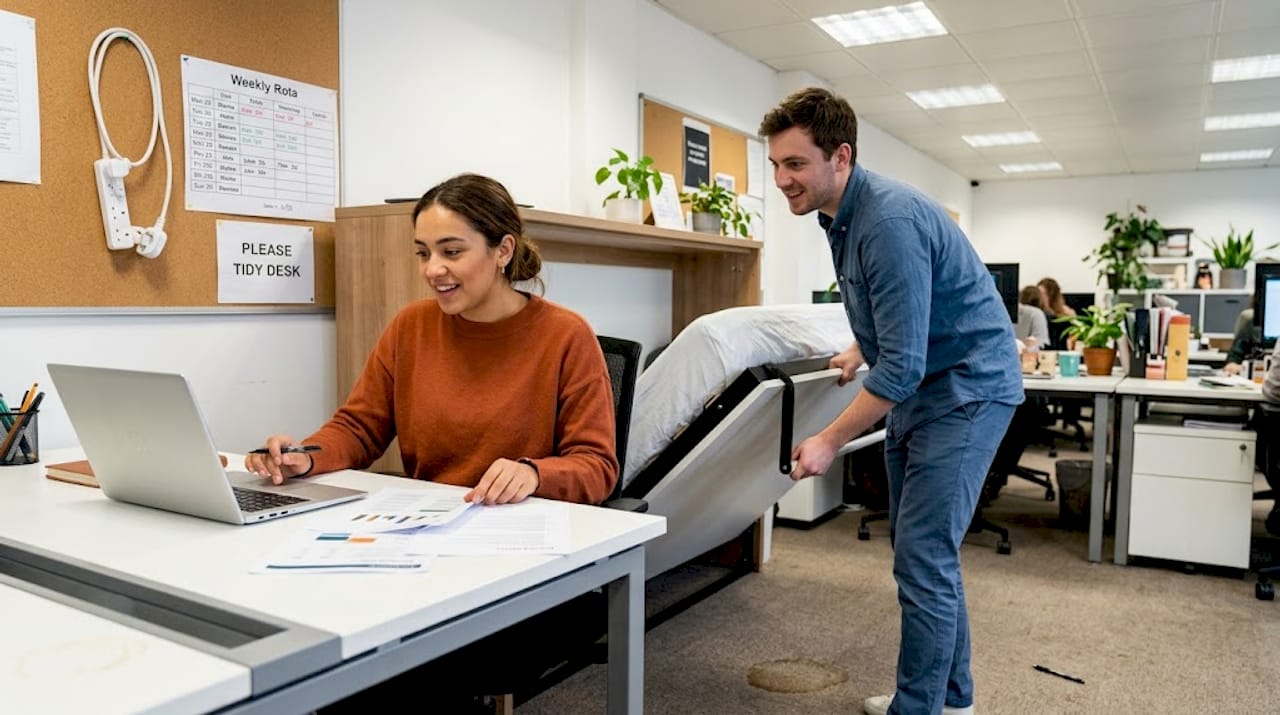
Two standout options in this space are the StudyBed and the Penelope Murphy Bed.
Key features at a glance:
Here’s a quick comparison of the two:
| Feature | StudyBed Small Double | Penelope Murphy Bed |
|---|---|---|
| Desk stability during conversion | Items up to 45cm stay in place | Desk board stays stable throughout |
| Available size | Small double | King size available |
| Best use case | Compact office-guest rooms | Flexible work-and-rest suites |
| Transformation effort | Single person, minimal steps | Motorised or manual fold-down |
Browse our full range of office desks to see how desk-bed solutions fit alongside conventional workstation options for hybrid layouts.
Pro Tip: Use desk-bed rooms as quiet focus zones during peak office days and convert them to guest accommodation for travelling colleagues or clients during quieter periods. This removes the need for a dedicated guest room entirely.
Desk-bed solutions fit certain niches well, but modular and foldable alternatives support a broader range of team activities and office layouts. These are the workhorses of flexible office design.
Common modular furniture types and their best scenarios:
Top three quick-to-deploy folding solutions:
“Flexibility is more valuable than simply minimising size. A piece of furniture that can serve three different team needs in a single week delivers more return on investment than the most compact static desk ever could.”
For a broader view of how modular thinking shapes modern furniture workflow in contemporary offices, or to explore efficient office storage to complement your flexible layout, both resources offer practical, scenario-based guidance.
Having examined individual solutions, it’s vital to compare them directly so you can match the ideal option to your team’s specific needs.
| Criteria | Desk-bed hybrid | Modular system | Foldable furniture |
|---|---|---|---|
| Cost | Higher upfront | Medium to high | Low to medium |
| Installation complexity | Moderate | Low to moderate | Very low |
| Flexibility | High (dual-use) | Very high | High |
| Footprint when in use | Fixed | Adjustable | Fixed or variable |
| Best for | Guest or multi-use rooms | Growing or shifting teams | Event-style or overflow spaces |
| Workflow disruption | Minimal (items stay in place) | Low | Very low |
StudyBed and Murphy Bed variants deliver genuine dual-use in the smallest possible footprint, but modular setups offer greater reconfigurability across a wider range of team scenarios.
Here’s a simple process for matching your needs to the right solution:
Here is the uncomfortable truth that most buying guides skip: the word “space-saving” has become a marketing shortcut. It’s applied to furniture that is simply small, not furniture that is genuinely efficient. And there’s a meaningful difference.
We see it regularly. An office buys compact desks to squeeze in more workstations, then discovers that no one wants to sit there because the surface area is too small for a laptop, a notebook, and a coffee cup. The desks sit empty. Space was technically saved. Productivity wasn’t.
The real gap in most hybrid office layouts isn’t square metres. It’s acoustic privacy, reliable access to power and data, and the ability to shift between focused solo work and collaborative sessions without a 15-minute furniture shuffle. Compact furniture that addresses those needs is transformative. Compact furniture that just reduces the desk surface is a mistake.
Pro Tip: Before purchasing anything, audit how you arrange office desks and map actual usage patterns for two to four weeks. You may find the bottleneck is layout rather than inventory, and the solution is reorganisation rather than new furniture altogether.
Buying smaller isn’t the answer. Buying smarter is.
If this guide has helped clarify what your office genuinely needs, the next step is finding the right products to match. At Furniture for Business, we supply commercial-grade furniture to UK offices of all sizes, with free delivery to the UK mainland and bulk order pricing for larger procurements.
Explore our full range of office storage options to complement any flexible layout, browse our selection of space-saving office desks for hybrid-ready workstations, or read our durable furniture guide to ensure every purchase holds up under commercial use. Our team is ready to help you build a layout that works as hard as your people do.
Desk-bed hybrids and modular folding desks are the most adaptable options, as they allow a single room to serve multiple purposes across a typical hybrid working week.
Models like StudyBed retain items up to 45cm on the desk surface even when switching to bed mode, while the Penelope Murphy Board’s desk remains stable throughout deployment, so there’s no need to clear the workspace.
Adaptability, transformation speed, built-in storage, and daily comfort are the four most critical factors. Convertible and modular furniture also future-proofs your layout as team sizes and working patterns continue to evolve.
Yes. Furniture that is too small can restrict working comfort and reduce productivity, so always balance any space gains against the daily ergonomic needs of the people using it.

Phone: 0330 043 4114
VAT no. GB 991 8681 60
Company no. 07250570