TL;DR:
- Agile working furniture supports flexible layouts and dynamic collaboration in modern offices.
- Key features include mobility, adjustability, modularity, and tech integration for adaptability.
- It offers greater long-term value and responsiveness compared to traditional fixed office furniture.
Most office managers assume furniture is a one-time decision. Buy the desks, bolt down the chairs, and move on. But that fixed mindset is quietly costing UK businesses flexibility, productivity, and staff wellbeing. Agile working furniture turns that assumption on its head. Rather than anchoring your team to a rigid layout, it gives you the freedom to reshape your workspace as your needs evolve. Whether you manage a team of 10 or 300, this guide will walk you through what agile working furniture actually means, the features that matter most, how it compares to traditional setups, and how to choose the right solutions for your organisation.
| Point | Details |
|---|---|
| Supports flexible work | Agile working furniture creates adaptable environments ideal for hybrid and collaborative teams. |
| Prioritises employee wellbeing | Ergonomic and adjustable features help reduce discomfort and improve productivity. |
| Future-proofs investments | Modular and reconfigurable pieces maximise long-term value by adapting to evolving needs. |
| Right choices matter | Selecting furniture based on team size and working patterns boosts office efficiency and satisfaction. |
With the growing demand for flexibility, it is critical to understand exactly what defines agile working furniture.
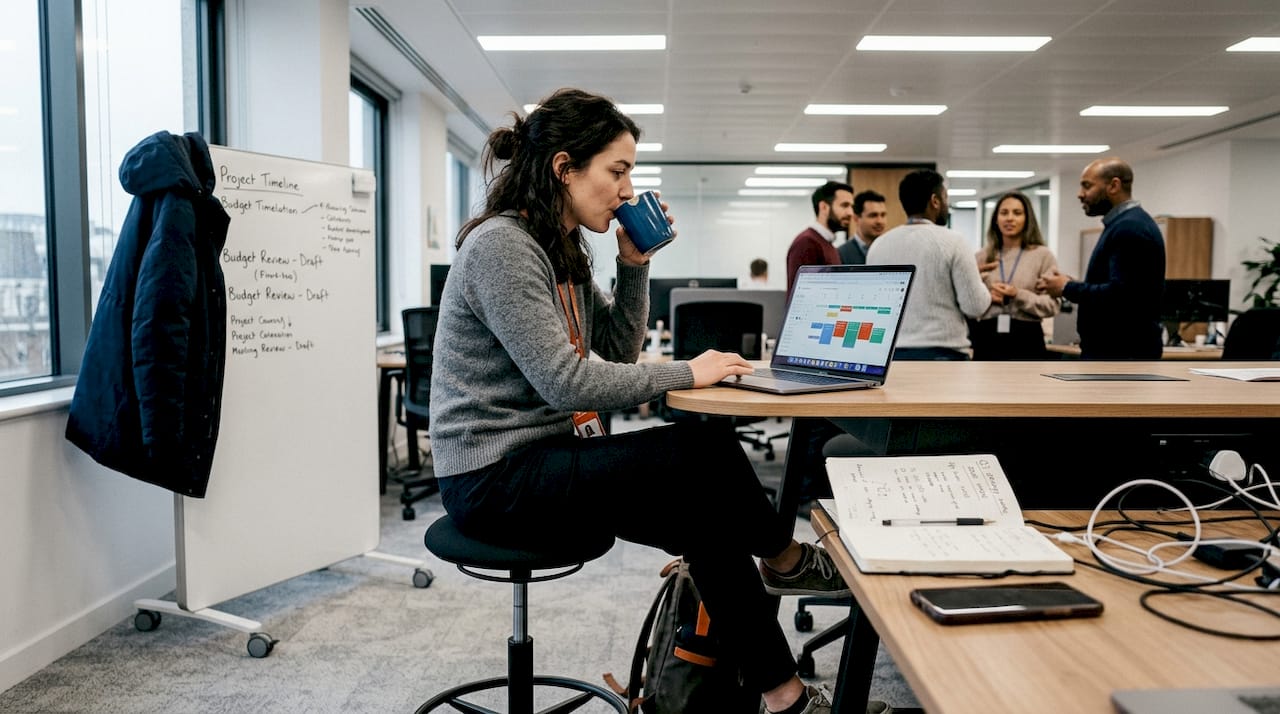
Agile working furniture is not simply furniture that looks modern. It is specifically designed to support flexible, adaptable, and collaborative ways of working. The term reflects a broader shift in how UK businesses think about their offices. Rather than assigning each employee a permanent desk, agile workplaces create environments where people move between different zones depending on the task at hand, whether that is focused solo work, team collaboration, or informal catch-ups.
At its core, agile working furniture shares four defining characteristics:
Traditional fixed furniture simply cannot keep pace with these demands. A bolted-down workstation works well when every employee arrives at 9am and leaves at 5pm with the same role every day. That reality has largely disappeared from British offices. Hybrid working, hot-desking, and project-based teams mean the same space might need to function as a quiet focus zone in the morning and a collaborative workshop by afternoon.
Common types of agile working furniture include reconfigurable modular seating, height-adjustable desks, mobile storage units, lightweight folding tables, and acoustic pods. Each is built to support modern office workflow without locking your layout into a single configuration.
As the agile working factsheet from the CIPD highlights, agile working is fundamentally about giving people greater autonomy over where and how they work. Furniture is the physical infrastructure that either enables or obstructs that autonomy.
“Agile working furniture supports flexible and collaborative office environments, making it a critical investment for businesses adapting to new ways of working.”
When you invest in durable furniture choices built with agility in mind, you are not just buying chairs and desks. You are buying the capacity to respond to change without a costly refit every few years.
Once you know what agile working furniture is, it is useful to understand which key features make it effective in practice.
Not all furniture marketed as “agile” delivers the same value. The features below are what genuinely distinguish high-performing agile pieces from standard office furniture with a modern aesthetic.
The HSE’s workplace furniture guidance reinforces that furniture must support correct posture and reduce musculoskeletal risk. Agile furniture, when chosen carefully, addresses this at every workstation rather than just at dedicated ergonomic desks.
Pro Tip: When outfitting a hybrid team, prioritise reconfigurable seating over fixed chairs first. The ability to quickly shift from rows to clusters is more valuable day-to-day than any single ergonomic upgrade. Pair this with ergonomic seating options that adjust to multiple users, so any team member can sit comfortably regardless of who used the chair before them.
The measurable impact is real. Offices that invest in adaptable layouts and ergonomic furniture consistently report fewer sick days related to posture and back pain, and teams find it easier to boost productivity when their environment matches the task they are performing.
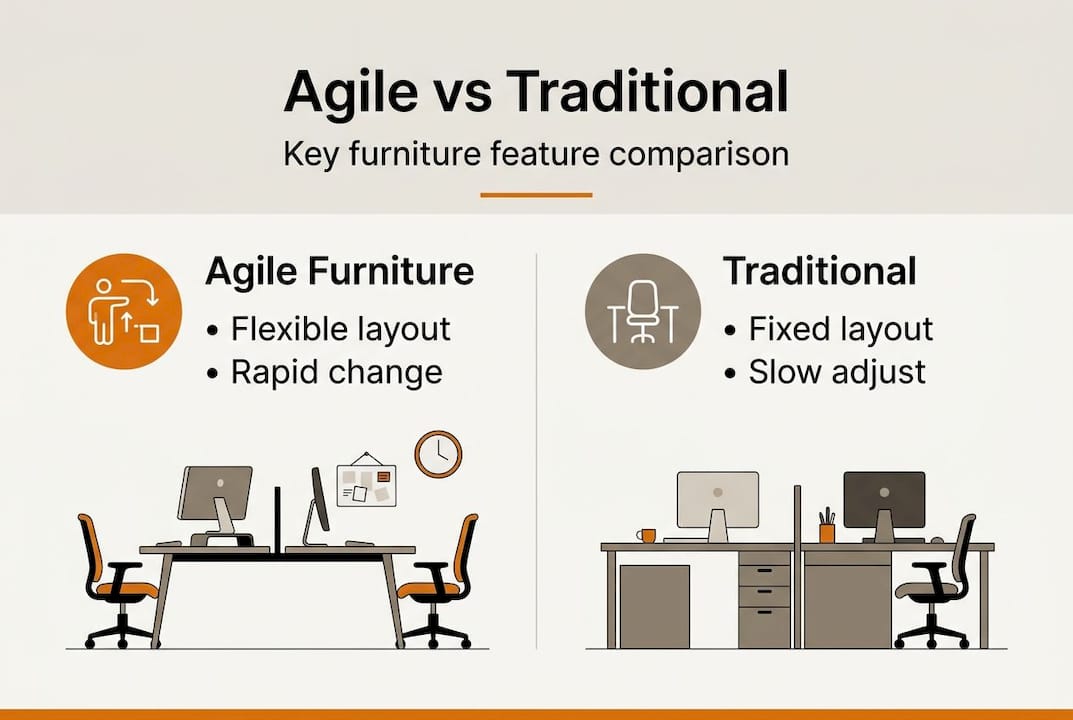
To see why agile solutions are gaining favour, it is helpful to compare them directly with traditional office setups.
| Feature | Agile furniture | Traditional furniture |
|---|---|---|
| Flexibility | High: reconfigures in minutes | Low: fixed layouts |
| Adaptability | Designed for multiple uses | Single-purpose pieces |
| Ergonomics | Adjustable for each user | Often one-size-fits-all |
| Upfront cost | Moderate to high | Low to moderate |
| Lifecycle value | High: adapts as needs change | Lower: replaced at each refit |
| Space efficiency | Excellent: folds, stacks, nests | Poor: fixed footprint |
Modern offices using agile furniture report increased team collaboration, fewer unused spaces, and stronger staff satisfaction scores. Traditional setups, by contrast, often leave meeting rooms empty while teams crowd into corridors for informal discussions.
When should a UK office choose one approach over the other? Here is a practical breakdown:
Consider a practical scenario. A 40-person marketing agency in Manchester moved from fixed desks to a mixed agile layout over six months. By introducing mobile tables, modular seating, and shared office storage options, they reclaimed 20% of their floor space and reduced the time spent reorganising rooms for client workshops from 45 minutes to under 10.
The return on investment case is clear. While agile furniture carries a higher upfront cost per piece, its adaptability extends the usable lifecycle significantly. The agile furniture features that drive this value include stackability, interchangeable components, and compatibility with future technology. Treating office furniture buying as a long-term investment rather than a one-off expense changes the financial calculation entirely.
Now that the differences are clear, here is how to confidently choose agile working furniture to suit your team’s needs.
The right choice depends on your team size, working patterns, and budget. Use the table below as a starting point.
| Team size | Recommended solutions | Key features | Estimated cost range |
|---|---|---|---|
| Small (5 to 20) | Height-adjustable desks, modular seating, mobile pedestals | Compact, multi-functional | £3,000 to £10,000 |
| Medium (20 to 100) | Reconfigurable tables, ergonomic chairs, acoustic pods | Scalable, tech-integrated | £10,000 to £40,000 |
| Large (100 to 500) | Zoned layouts, modular benching, collaborative hubs | Flexible zoning, durable | £40,000 to £150,000+ |
Proper arranging of office desks and modular solutions can optimise workspace efficiency, so plan your zones before placing a single order.
When evaluating specific pieces, use these selection criteria:
The evaluating furniture process should also factor in how your team actually works, not just how you imagine they will use the space. Involve staff in test sessions before committing to a bulk order.
Pro Tip: Do not let budget pressure push you towards the cheapest option. A low-cost chair that breaks within 18 months costs more in replacement and lost productivity than a mid-range ergonomic model that lasts a decade. Ask suppliers about trial periods and bulk pricing, both of which are standard practice in the commercial furniture sector.
For teams with dedicated meeting spaces, also consider how your furniture choices connect with meeting rooms for hybrid working, where the right table and seating configuration can dramatically improve the quality of remote and in-person collaboration.
Beyond selection, it is worth considering why agile working furniture is fundamentally reshaping the future of British workplaces.
Here is an uncomfortable truth most furniture articles skip: the majority of UK offices do not redesign their layouts until something forces them to. A lease renewal, a team restructure, a global pandemic. By that point, the cost of change is far higher than it needed to be.
The businesses that get this right treat furniture as a strategic asset, not a sunk cost. They ask not just “what do we need today?” but “what will we need in three years when our team size, technology, and working patterns have shifted again?”
British work culture is changing fast. Attitudes towards personal space, ownership of a desk, and the purpose of the office itself are all evolving. Younger employees in particular do not expect a fixed workstation. They expect an environment that supports the work they are doing at any given moment. Agile furniture is the physical answer to that expectation.
Investing in office space planning that prioritises reconfigurability today means you will not be scrambling to refit in two years. The era of fixed workspaces is not fading slowly. It is accelerating.
Ready to modernise your office? The right agile furniture does not just look good. It actively supports the way your team works, grows, and collaborates every day.
At Furniture For Business, we supply a wide range of agile-ready office chairs catalogue and agile office desks designed for UK commercial environments, with free delivery to the UK mainland. Whether you are outfitting a small team or managing a large-scale refurbishment, our product range and buying guides are built to support confident, informed decisions. Speak to our team for tailored recommendations based on your team size, budget, and working style.
Agile working furniture refers to adaptable, mobile, and ergonomic office pieces designed to support flexible collaboration and multiple working styles. It is defined by mobility and modularity rather than fixed, single-purpose design.
It enables teams to reconfigure spaces easily, supports ergonomic working, and encourages collaboration, all of which boost efficiency and wellbeing. Modular, ergonomic furniture reduces the friction of moving between different work modes throughout the day.
Look for mobility, height-adjustability, modularity, ergonomic support, and integrated tech features. The top features of agile furniture consistently include castors, adjustable frames, and reconfigurable components.
Yes, its adaptability and space-saving design make it ideal for offices of all sizes, including small teams. Efficient desk arrangements combined with modular pieces allow small offices to maximise every square metre without sacrificing flexibility.

Phone: 0330 043 4114
VAT no. GB 991 8681 60
Company no. 07250570