TL;DR:
- Good design in commercial furniture enhances durability, usability, and employee satisfaction.
- Ergonomic features and employee input are crucial for effective office furniture choices.
- Sustainable, circular designs lower long-term costs and support ESG commitments.
UK businesses spend significant sums on office refurbishments every year, yet Leesman research reveals that roughly 25% of employees remain dissatisfied with their chairs and desks despite those items being rated as highly important to their work. That contradiction should give every office manager pause. Design is frequently treated as a visual exercise, a question of colour palettes and brand aesthetics, when in reality it governs how furniture performs, how long it lasts, and how well it serves the people using it every day. This guide unpacks what design genuinely means in commercial furniture, and how smarter decisions translate into measurable gains for UK workspaces.
| Point | Details |
|---|---|
| Design boosts productivity | Thoughtful, evidence-led furniture design leads to happier, more productive teams and fewer complaints. |
| Ergonomics are essential | Prioritising ergonomic features in chairs and desks is crucial for workplace health and satisfaction. |
| Sustainability cuts costs | Circular and modular furniture can save money and help meet UK environmental goals. |
| Hybrid-ready equals future-proof | Choosing flexible and durable furniture prepares your office for changes and evolving work patterns. |
When procurement teams talk about design, the conversation often gravitates toward appearance. Does it look professional? Does it match the brand? Those questions matter, but they represent only a fraction of what design actually does in a commercial context. Genuine furniture design encompasses usability, adaptability, material selection, structural integrity, and ergonomic performance. A chair that looks striking but forces users into a poor posture is a design failure, regardless of how well it photographs.
Thoughtful design has a direct bearing on productivity and long-term costs. Furniture that is poorly conceived tends to be replaced sooner, generates more complaints, and quietly undermines the working environment. Conversely, well-designed pieces reduce maintenance spend, support employee wellbeing, and adapt to changing team configurations without requiring a full replacement cycle. The commercial office furniture market is growing precisely because businesses are beginning to recognise that quality design is a strategic investment rather than a cosmetic one.
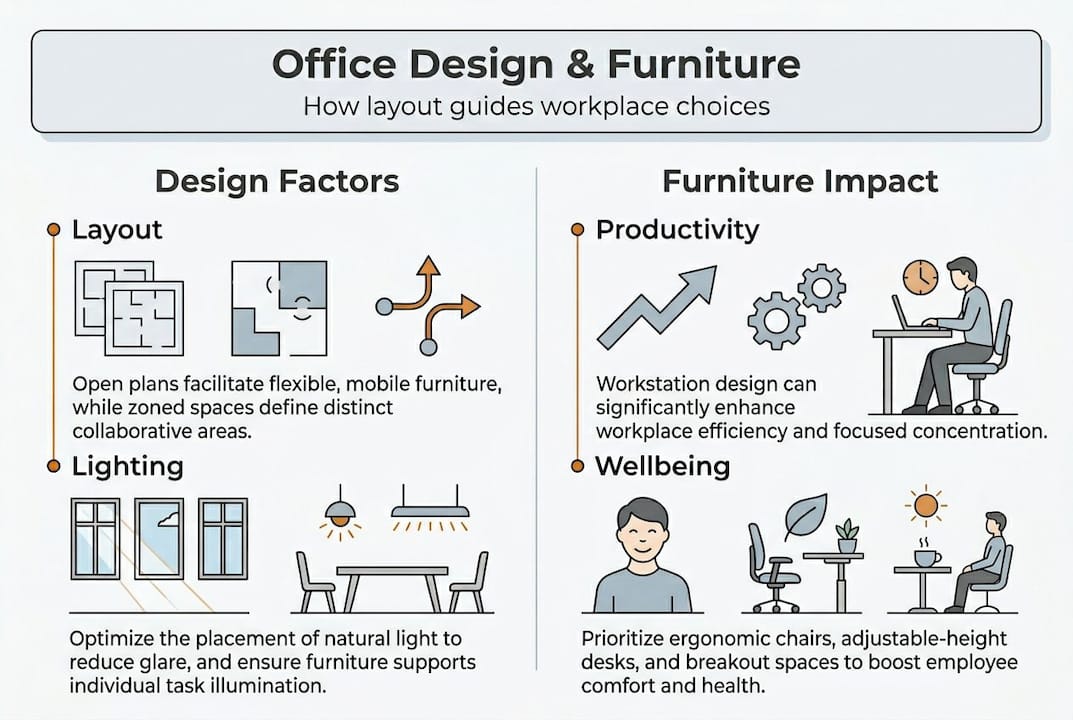
For office managers, the practical challenge is aligning what designers or suppliers present with what employees actually need. A mismatch here is surprisingly common. Leadership selects furniture based on showroom impressions; employees then spend eight hours a day discovering its limitations. The result is underused breakout furniture, chairs adjusted to their lowest setting and never touched again, and desks that cannot accommodate the equipment people actually use.
The priorities that should guide every commercial furniture decision are:
“Design is not just what it looks like and feels like. Design is how it works.” This principle, widely attributed to Steve Jobs, holds particular weight in commercial furniture procurement, where function and form must serve hundreds of people across years of daily use.
Exploring productive office design principles before finalising any procurement decision can save considerable time and budget in the long run.
Ergonomics is one of those terms that gets used frequently and understood rarely. In the context of commercial furniture, it refers to the science of designing products so they fit the people using them, rather than expecting people to adapt to the product. For a desk chair, this means adjustable seat height, lumbar support that can be positioned correctly for different body types, armrests that move independently, and a seat depth that accommodates both shorter and taller users.
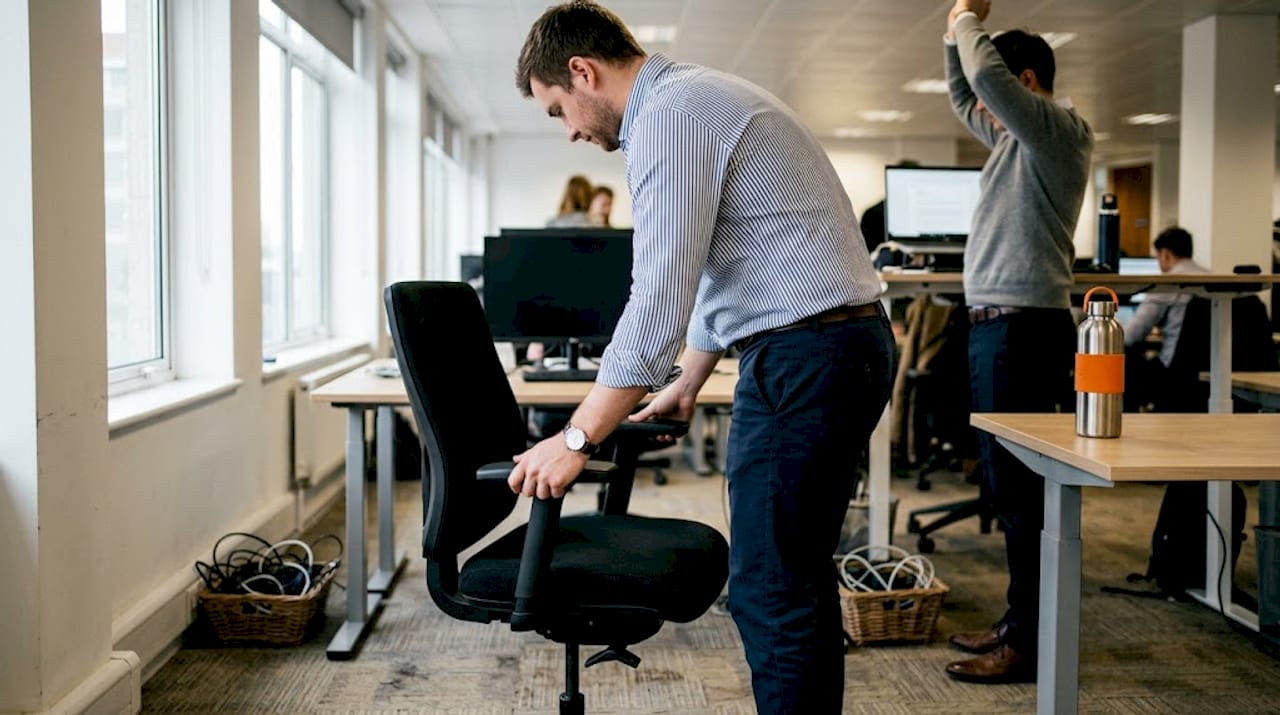
The stakes are considerable. Leesman data consistently links dissatisfaction with chairs and desks to reduced productivity and engagement. When employees are uncomfortable, they lose concentration, take more breaks, and over time experience musculoskeletal issues that contribute to absenteeism. The Health and Safety Executive estimates that work-related musculoskeletal disorders account for a significant proportion of working days lost in the UK each year. Poor furniture is rarely the sole cause, but it is frequently a contributing factor that procurement decisions could address.
Pro Tip: Before purchasing chairs in bulk, request a trial of at least three models across a representative sample of your team. Include people of different heights, body types, and job roles. The model that scores highest in your specific context will almost always outperform the one that looked best in the catalogue.
When evaluating ergonomic credentials, use this practical checklist:
The British Council for Offices (BCO) recommends that satisfaction scores for key furniture items should exceed 70% to be considered acceptable. Many UK offices fall short of this benchmark, which means there is a real and measurable gap between what is being procured and what employees actually need. Reviewing your best ergonomic chairs options with this benchmark in mind is a practical starting point.
| Ergonomic feature | Why it matters | Minimum standard |
|---|---|---|
| Seat height range | Supports correct posture for varied users | 42 to 52 cm |
| Lumbar adjustment | Reduces lower back strain | Height and depth adjustable |
| Armrest flexibility | Prevents shoulder and neck tension | 4-way adjustable |
| Seat depth | Avoids pressure on thighs and knees | Sliding adjustment |
Understanding the full range of ergonomic office chair types available helps procurement teams match the right solution to each workspace zone, from focused individual work to collaborative settings. For a thorough grounding in the subject, ergonomic furniture explained in plain terms is an excellent resource.
Sustainability has moved well beyond a marketing talking point. For UK businesses with environmental, social, and governance (ESG) commitments, the furniture procurement process is now a meaningful part of the conversation. The UK sustainable furniture market is valued at £1.68 billion, with 72% of executives citing ESG significance as a key driver of purchasing decisions. That is a substantial shift in how procurement is being evaluated at board level.
Circular design is the framework that makes sustainability practical rather than aspirational. Where traditional linear procurement follows a straightforward path of manufacture, purchase, use, and disposal, circular design builds in reuse, refurbishment, and modularity from the outset. Furniture designed with circular principles can be disassembled, repaired, reupholstered, or reconfigured rather than sent to landfill at the end of its first lifecycle.
| Linear design approach | Circular design approach |
|---|---|
| Single lifecycle | Multiple lifecycles through repair and refurbishment |
| Fixed configuration | Modular and reconfigurable |
| Disposal at end of use | Components recovered and reused |
| Higher long-term cost | Lower lifecycle cost |
| Difficult to update | Adaptable to changing needs |
For office managers, the practical benefit is twofold. Circular furniture tends to be better constructed in the first place, because it has to withstand disassembly and reassembly. And because components can be replaced rather than the whole piece discarded, the total cost of ownership over five to ten years is often lower than cheaper, disposable alternatives.
Pro Tip: When speaking to suppliers, ask specifically whether replacement parts are available and for how long. A supplier who cannot answer this question clearly is unlikely to support a circular procurement model, regardless of how sustainable their marketing materials appear.
Leading UK firms are achieving 95 to 99% waste diversion rates through careful procurement choices and supplier partnerships. Quick wins for office managers include:
Our sustainable office furniture guide covers the certifications and supplier questions in greater depth for teams ready to formalise their approach.
The modern UK office is rarely static. Hybrid working has fundamentally changed how space is used, with many organisations running at 40 to 60% occupancy on any given day while still needing to accommodate full-team days, client visits, and collaborative sessions. Furniture that cannot adapt to this variability quickly becomes an obstacle rather than an asset.
Durability and flexibility are not competing priorities. The most resilient commercial furniture is also, by design, the most adaptable. Structural engineering principles applied to furniture design, including material density, joint construction, and repairability, determine how well a piece survives high-traffic use and how easily it can be reconfigured without compromising its integrity.
Key durability factors to assess during procurement:
For hybrid offices, zoning is the practical application of flexible design. Quiet focus zones benefit from individual task seating and acoustic screening. Collaborative zones need furniture that can be quickly rearranged, stacked, or folded. Breakout areas require comfortable, durable pieces that can handle informal use throughout the day.
“The best hybrid office layouts are not designed around furniture. They are designed around how people actually work, and then furnished accordingly.”
City offices with limited floor space face additional constraints. Compact modular seating solutions that can be arranged in multiple configurations offer the best return on limited square footage. Similarly, height-adjustable desks serve double duty as both sitting and standing workstations, effectively giving you two workspace types in the footprint of one.
For a structured approach to procurement, our durable office furniture guide and detailed advice on durable furniture comfort provide practical frameworks for evaluating options before committing to large orders.
Most procurement guides focus on specifications, budgets, and supplier comparisons. Those things matter. But the single most common reason well-specified furniture fails to deliver is that nobody asked the people who would use it what they actually needed.
Trend-driven buying is a particular risk in commercial furniture. Open-plan layouts, standing desks, and biophilic design elements have all had their moment as the definitive solution to workplace challenges. Some of these trends have genuine merit. Others suit certain working styles and completely undermine others. The difference between a successful office refurbishment and an expensive disappointment often comes down to whether the design brief was informed by real user data or by what looked impressive in a trade publication.
The most enduring furniture investments we see are made by organisations that pilot before they purchase, gather structured feedback from a cross-section of employees, and treat the procurement process as an ongoing conversation rather than a one-time decision. This approach takes more time upfront but consistently produces higher satisfaction scores, longer furniture lifecycles, and fewer costly replacements.
If you are planning a significant refurbishment, reviewing executive workplace strategies that put user insight at the centre of the design process is a worthwhile starting point before any budget is committed.
Putting people-first design principles into practice requires the right products and the right supplier behind them. At Furniture for Business, we supply ergonomic, sustainable, durable, and flexible commercial furniture to UK organisations of all sizes, with free delivery to the UK mainland.
Whether you are equipping a team of ten or refurbishing a multi-floor headquarters, our curated range of office chairs and office desks is built around the principles covered in this guide. We offer bulk order pricing, expert advice, and easy returns so your procurement process is as straightforward as possible. Explore the full Furniture for Business catalogue or get in touch with our team to discuss your specific workspace requirements and find solutions that genuinely fit your people.
Prioritise ergonomic adjustability, modularity for flexible layouts, durable materials, and sustainable credentials. Ergonomics, durability, and sustainability are now core drivers in the commercial furniture market, reflecting what businesses genuinely need from long-term investments.
Yes. Circular and refurbishable furniture reduces lifecycle costs by enabling repair and reconfiguration rather than full replacement, while also supporting your organisation’s ESG commitments.
Look for ergonomic adjustability ranges, warranty length, third-party certifications, and material standards. Structural engineering benchmarks such as foam density above 0.55 g/cm³ are reliable indicators of commercial-grade durability.
Furniture is frequently selected without meaningful user input or ergonomic evaluation. Leesman research shows that roughly 25% of employees are dissatisfied with their chairs and desks, a direct consequence of procurement processes that prioritise appearance over fit.

Phone: 0330 043 4114
VAT no. GB 991 8681 60
Company no. 07250570