TL;DR:
- Only 26% of UK workers feel their office environment supports their work.
- Partitions effectively reduce noise by 10 to 15 decibels, enhancing productivity and wellbeing.
- Investing in flexible, well-placed partitions offers measurable ROI through improved staff satisfaction and reduced absence.
Only 26% of UK workers feel their office environment supports their work, with noise satisfaction sitting at just 35%. That is a striking gap between what employees need and what most offices actually deliver. For office managers, HR leaders, and procurement teams, this is not just a comfort issue; it is a productivity and retention problem. Office partitions are one of the most practical tools available to close that gap. This article covers how partitions reduce noise, improve layouts, support hybrid working, and deliver measurable returns, so you can make confident decisions for your next office refurbishment or fit-out.
| Point | Details |
|---|---|
| Partitions boost productivity | Well-chosen partitions reduce noise, support focused work, and improve worker satisfaction in UK offices. |
| Flexibility and compliance | Demountable acoustic partitions help businesses stay compliant with HSE, while adapting to hybrid workforce needs. |
| Measure impact for ROI | Benchmark partition investment with Leesman scores and track changes in productivity and wellbeing for smart decisions. |
| Balance light and privacy | Blend glass and solid options to achieve optimal natural light, privacy, and acoustic comfort. |
Noise is the single biggest complaint in open-plan offices across the UK. It is not just irritating; it is measurably harmful to output. 70% of UK workers report that poor office layout and noise affects their productivity. That figure alone should prompt any office manager to take a closer look at how their space is designed.
Partitions address this problem at a physical level. According to HSE workplace design guidance, dense partition materials placed close to the noise source can significantly reduce both direct and reverberant sound. Direct noise travels in a straight line from source to listener; reverberant noise bounces off hard surfaces and fills the room. Effective partitions tackle both.
“The layout of a workplace, including the use of barriers and partitions, plays a critical role in managing noise exposure and supporting employee wellbeing.” — HSE Workplace Design for Noise
Here is what the evidence tells us about partition effectiveness:
Material choice matters enormously. Glass partitions allow light to pass through but offer limited acoustic performance unless they are acoustic-rated. Solid panels with absorptive cores perform better for sound but can make spaces feel enclosed. The best outcomes come from combining materials strategically, which we will cover in the next section.
It is also worth noting that acoustic office furniture works alongside partitions rather than replacing them. Screens, pods, and upholstered panels all contribute to a layered acoustic strategy that no single product can achieve alone. Think of partitions as the structural backbone of your acoustic plan.
Choosing the right partition type is not simply about aesthetics. Each option carries different implications for noise control, flexibility, compliance, and cost. Here is a practical breakdown:
| Partition type | Acoustic rating | Flexibility | Natural light | Best use case |
|---|---|---|---|---|
| Glass (standard) | Low | High | Excellent | Open collaboration zones |
| Acoustic glass | Medium to high (Rw 40+dB) | High | Excellent | Meeting rooms, hybrid offices |
| Solid panel | High | Low to medium | None | Private offices, HR suites |
| Demountable | Medium to high | Very high | Variable | Hybrid, growing teams |
| Fabric/upholstered | Medium | High | None | Desk screening, breakout areas |
HSE guidelines recommend demountable acoustic glass partitions for workplaces that need both flexibility and compliance, particularly those achieving Rw 40 decibels or above. This rating means the partition reduces sound transmission by 40 decibels, which is sufficient for most office environments.
Key considerations when selecting partition types:
Pro Tip: If you are fitting out a space for a growing team, invest in demountable systems from the outset. The upfront cost is higher, but the savings on future reconfiguration are significant, and you avoid the disruption of structural changes.
Style should not be an afterthought. Partitions contribute to your brand environment and influence how visitors and employees perceive the space. Frosted glass with branded graphics, for example, adds privacy without sacrificing light. When reviewing options, consider buying durable office furniture that complements your partition choices for a cohesive finish.
Even the best partitions underperform if they are placed incorrectly. Layout strategy is where many offices fall short, treating partitions as decorative dividers rather than functional tools.
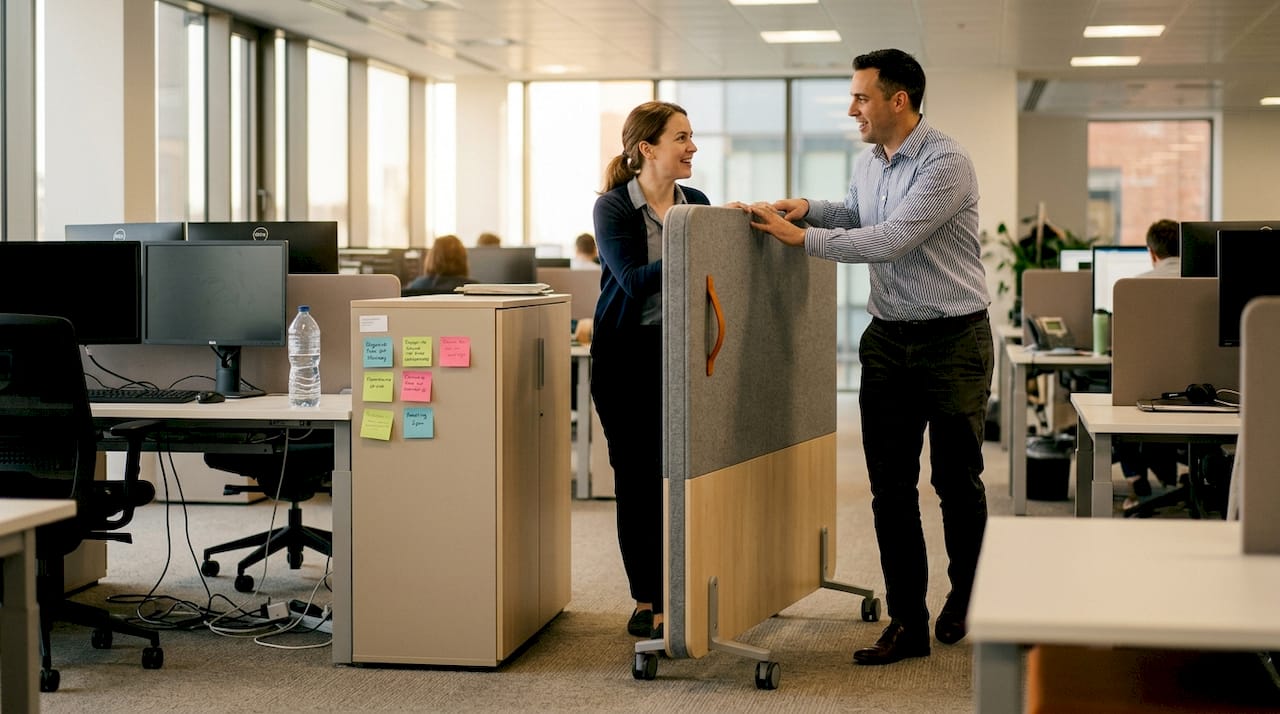
Increasing the distance between workers and noise sources using partitions measurably improves comfort and productivity. The principle is straightforward: the further sound has to travel, and the more barriers it crosses, the quieter the receiving environment becomes.
Here are five practical layout recommendations:
| Layout goal | Partition strategy | Expected benefit |
|---|---|---|
| Noise reduction | Dense panels near source | 10 to 15dB reduction |
| Privacy | Full-height solid or acoustic glass | Improved focus and confidentiality |
| Collaboration | Low-level screens with open tops | Team visibility with some separation |
| Light distribution | Glass partitions along window walls | Reduced reliance on artificial lighting |
For guidance on arranging workstations around partitions, explore how to arrange office desks for efficiency and style. Pairing smart desk layouts with well-placed partitions creates a modern workflow that supports both individual focus and team collaboration.
Pro Tip: Before installing partitions, map your noise sources and your quiet zones on a floor plan. This simple exercise often reveals that the noisiest areas are adjacent to those requiring the most concentration, a problem that partitions can solve with targeted placement.
Do not overlook storage in your layout plan. Tall office storage solutions such as cupboards and shelving units can double as acoustic barriers when positioned strategically, adding function without additional cost.
Investing in office partitions is a significant decision. Knowing how to measure the return helps you justify the spend and identify whether the installation is delivering what you expected.
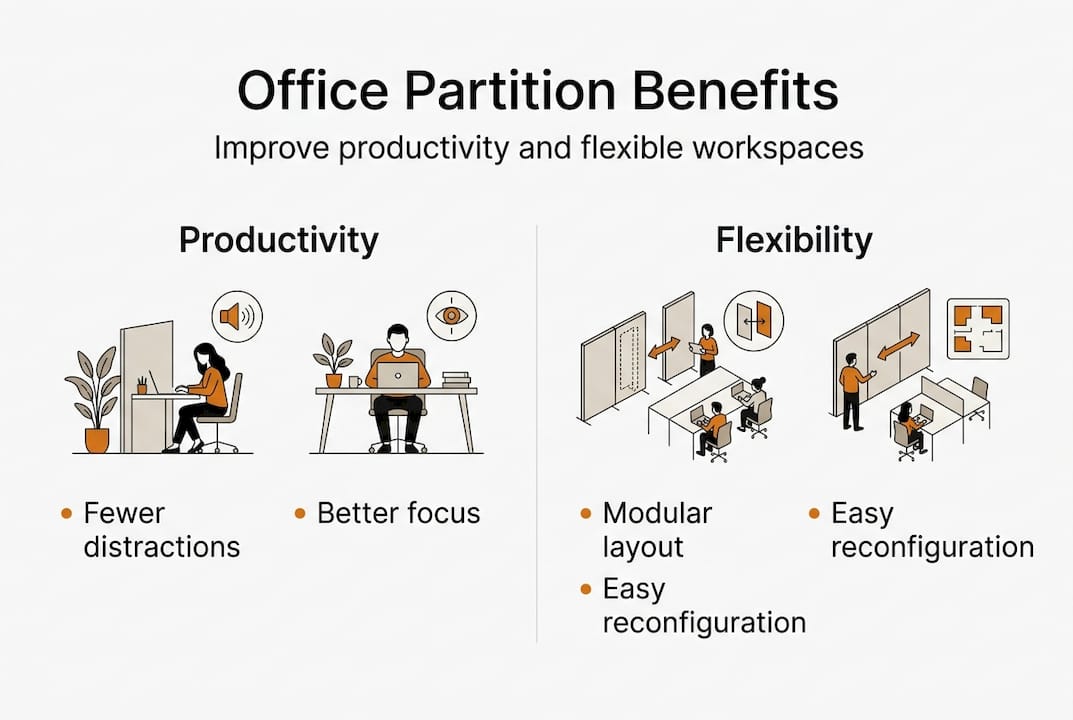
The Leesman Index provides a useful benchmark. The average office scores 69.5 on the Leesman scale, compared to 79.5 for home working environments. That 10-point gap reflects how much the typical office fails to support employees. Partitions, when implemented well, directly address the noise and privacy factors that drag office scores down.
Here is what to track after a partition installation:
| Metric | Before partitions | Target after partitions |
|---|---|---|
| Noise satisfaction | 35% (UK average) | 55% or above |
| Leesman office score | 69.5 (average) | 75 or above |
| Focus work rating | Baseline survey | 15% improvement |
| Absenteeism | Baseline figure | Measurable reduction |
Wellbeing should be part of your ROI calculation, not an afterthought. Consider how colour in office furniture and partition finishes affect mood and energy levels throughout the day. Equally, optimising workspace storage alongside your partition plan reduces clutter, which further supports a calmer, more productive environment.
The financial case is straightforward. If partitions improve productivity by even 5%, the cost of installation is typically recovered within the first year for a team of 20 or more. Factor in reduced absenteeism and improved retention, and the numbers become even more compelling.
Most articles on office partitions focus almost entirely on acoustic ratings and cost per square metre. Those things matter, but they miss the bigger picture.
The most effective partition strategies we see are not the ones with the highest-rated panels. They are the ones that blend glass and solid partitions to balance light, privacy, and acoustic performance simultaneously. A fully solid partition system might score well on noise reduction but creates a bunker-like environment that damages morale. A fully glazed system looks impressive but leaves employees feeling exposed.
ROI calculations also rarely include wellbeing. When you factor in reduced sick leave, improved retention, and the signal that a well-designed office sends to prospective talent, the return on a thoughtful partition investment is far higher than spreadsheets typically capture.
Future-proofing is the third overlooked factor. Hybrid working is not a trend that is going away. Investing in demountable systems now, with proper office space planning, means your layout can evolve without structural disruption. That flexibility is worth more than any fixed partition system, regardless of its acoustic rating.
If this article has prompted you to rethink your office layout, the next step is finding the right products to bring your plan to life. At Furniture for Business, we supply commercial-grade furniture to UK businesses of all sizes, with free delivery to the UK mainland.
Browse our range of office storage solutions to complement your partition layout, or explore our full collection of office desks to build workstations that work alongside your new configuration. If you are still weighing up your options, our office furniture buying guide covers everything you need to make confident, durable choices for your team.
Dense materials close to the source are most effective for noise control, blocking direct sound while absorptive surfaces reduce echoes and reverberant noise throughout the space.
Demountable acoustic glass partitions achieving Rw 40 decibels or above offer the best combination of flexibility, acoustic performance, and HSE compliance for hybrid offices.
Yes. Effective partitions reduce distractions, improve privacy, and help distribute natural light that boosts productivity and reduces sick leave, as evidenced by Leesman Index research.
Use Leesman Index benchmarks to track productivity and noise satisfaction scores before and after installation, and confirm compliance with HSE noise exposure regulations to complete your assessment.

Phone: 0330 043 4114
VAT no. GB 991 8681 60
Company no. 07250570