TL;DR:
- Choosing the right office meeting room furniture enhances collaboration, comfort, and technology integration for effective meetings.
- Proper space planning, ergonomic features, and flexible, modular designs are crucial to creating functional, adaptable spaces that support hybrid work formats.
The right office meeting room furniture shapes more than appearances. It determines whether your team leans in and collaborates or shuffles awkwardly around an oversized table, struggling to see a screen. For office managers and business leaders, the challenge is real: you need furniture that handles daily use, supports different meeting formats, integrates with technology, and still looks the part. This guide cuts through the noise to give you practical criteria, top options, and a clear comparison to help you make confident decisions.
| Point | Details |
|---|---|
| Ergonomics determine performance | Poor lumbar support reduces cognitive performance by 14%, making adjustable chairs a non-negotiable. |
| Clearance prevents frustration | Allow at least 48 inches around your table so people can move freely and access seating without disruption. |
| Table shape drives meeting tone | Round tables build inclusivity; rectangular tables reinforce structure and hierarchy. |
| Modularity future-proofs your space | Modular, stackable furniture adapts to hybrid working patterns without requiring a full refit. |
| Factor in service costs | Assembly and installation add to your total spend. Choosing a supplier who includes these services often delivers better value. |
Most businesses spend considerable time choosing their desks and workstations, then rush the meeting room. That is a mistake. The role of meeting room furniture extends well beyond aesthetics. It affects how long people can sit comfortably, how well they can see each other, and whether technology works with the room or against it.
A meeting room that seats 10 around an ill-proportioned table with no cable management sends a signal. It tells clients you have not thought about their experience. It tells your team the same. Getting this right from the outset is one of the most cost-effective investments an office manager can make.
Before browsing catalogues, anchor your decisions to clear criteria. Here is what actually matters.
Ergonomics and comfort
Unsupported lumbar regions increase disc pressure by 40% within 60 minutes and reduce cognitive performance by 14%. For a two-hour board meeting, that is a serious problem. Chairs need adjustable lumbar support positioned 15 to 25 cm above the seat surface, with a seat pan depth of 38 to 47 cm.
Spatial clearance
Standard clearance between the table edge and walls should be at least 48 inches for comfortable passage. Basic accessibility requires a minimum of 30 inches. Plan 24 to 30 inches of personal table space per person. These numbers sound technical until you see someone squeezing behind a chair to reach their seat.
Table shape and meeting dynamics
Table shape influences meeting dynamics in ways that are easy to underestimate. Round and boat-shaped tables encourage collaborative discussion. Rectangular tables suit formal, executive-led presentations. Choosing the wrong shape for your meeting culture creates subtle friction every single time the room is used.
Technology integration
Boardroom displays for 6 to 12 people typically range from 75 to 85 inches, with microphones needing to be within 4 to 6 feet of participants. Your table needs to accommodate power ports, cable trays, and screen sightlines without trailing wires across the floor.
Durability and modularity
Heavy commercial use demands materials that hold up. Solid wood veneers, powder-coated steel frames, and commercial-grade upholstery all outperform domestic equivalents. Modularity matters too. A room that can shift from a boardroom layout to a workshop configuration in minutes gives you far more from the same square footage.
Pro Tip: Measure your room before shortlisting any furniture. A table that looks proportional in a showroom photograph can be 40 cm too wide for your actual space.
With criteria established, here are the types of furniture that consistently perform well in commercial settings.
Round and oval tables
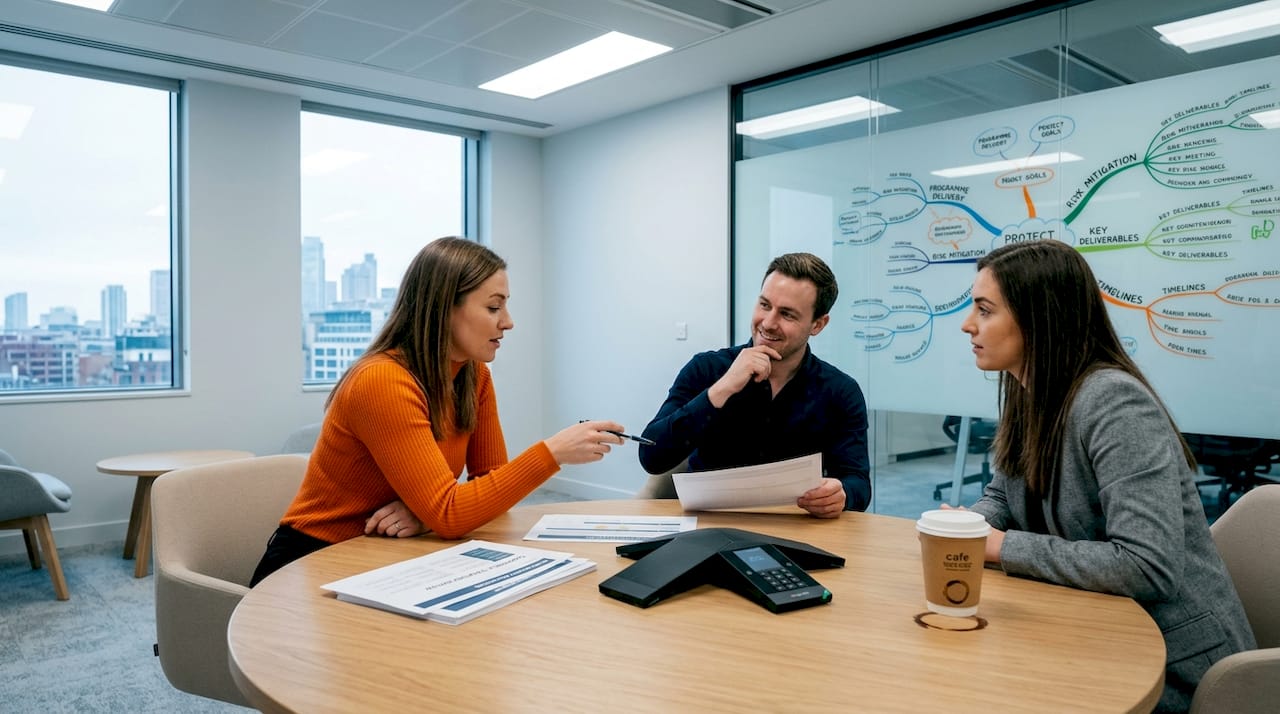
Round office meeting tables remove the implicit hierarchy of head-of-table positioning. Everyone has equal sightlines, which encourages open dialogue. Oval tables offer the same benefit with slightly more seating capacity along the longer sides. Both are particularly effective for creative sessions, team check-ins, and client relationship meetings.
Rectangular and boat-shaped tables
Rectangular tables work well for formal presentations, training sessions, and structured board meetings. The boat shape, which tapers toward the ends, improves sightlines along the length of the table, making it a popular choice for larger executive rooms. Both formats are well-suited to rooms where one or two presenters address the group.
Adjustable and ergonomic chairs
Ergonomic chair features such as lumbar adjustment, seat height, and armrest positioning are not optional extras for meeting rooms used more than an hour at a time. Look for chairs with adjustable lumbar support, 38 to 47 cm seat pan depth, and swivel bases that allow participants to turn toward screens without leaving their seats.
Modular and stackable furniture
Modular tables that link together or separate quickly are worth serious consideration for businesses with varying meeting formats. Paired with lightweight stackable chairs, these configurations allow one room to serve as a 12-person boardroom in the morning and a workshop space for 20 in the afternoon.
Technology-ready tables
Tables with integrated power ports, USB points, and cable management channels keep surfaces clear and presentations running smoothly. Some manufacturers offer modular cable trays that retrofit onto existing tables, which is useful if you are upgrading incrementally rather than replacing everything at once.
Pro Tip: If your team frequently uses laptops during meetings, prioritise tables with at least one integrated power module per two seats. Extension leads on the floor are a trip hazard and a poor impression.
| Furniture type | Best use case | Ergonomic features | Tech integration | Space efficiency |
|---|---|---|---|---|
| Round table | Collaborative, small group | Equal sightlines | Moderate | Compact rooms |
| Oval table | Team meetings, mid-size rooms | Equal sightlines | Moderate to good | Medium rooms |
| Rectangular table | Formal presentations, training | Standard | Good to excellent | Large rooms |
| Boat-shaped table | Executive and board meetings | Improved sightlines | Good to excellent | Large rooms |
| Modular tables | Multi-format, flexible rooms | Variable | Variable | Excellent |
| Ergonomic meeting chair | All meeting types | High: lumbar, height, armrests | N/A | Standard |
| Stackable chair | High-volume, flexible spaces | Low to moderate | N/A | Excellent |
This comparison helps you match furniture to your specific room size, team size, and meeting culture. A small team using a room for weekly stand-ups has very different needs to a boardroom hosting quarterly reviews and client pitches.
Getting your furniture selection right is only half the job. How you arrange and support it determines whether the room actually works day to day.
Pro Tip: Treat your meeting room as a product. Ask: would I be comfortable bringing our most important client into this room today? If the answer is hesitant, that is your brief.
Modular items also support the hybrid working patterns that most UK businesses are now managing. A room that adapts easily to different headcounts and formats reduces pressure on facilities teams and keeps the space genuinely useful rather than sitting empty half the week. Poor furniture choices in breakout zones follow a similar pattern: leftover furniture in breakout zones leads to underused spaces, because successful informal areas need to be designed around behaviour, not just filled with sofas.
Procurement decisions made on price alone tend to be revisited within three years. Here is a more structured approach.
I’ve seen offices spend serious money on reception areas and then cut corners the moment they reach the meeting rooms. The logic seems to be that clients see the reception but only staff use the boardroom. That reasoning falls apart the instant you host an important client meeting, a job interview, or a senior team session in a room with wobbly chairs and a table that blocks the screen.
What I’ve learned from working with businesses across the UK is that the single most common mistake is buying furniture before measuring properly. An oversized table in a modest room makes every meeting feel cramped, regardless of how good the chairs are.
My other observation is about technology. Most businesses are now running hybrid meetings as standard, yet I still see meeting rooms with no integrated power, no cable management, and screens positioned where half the room cannot see them comfortably. The furniture and the technology need to be specified together, not as separate decisions.
Modular furniture is genuinely undervalued in the UK market. The upfront cost is often higher, but the flexibility it provides over a five to seven year fit-out cycle more than justifies the investment. Offices change. Teams grow and shrink. Meeting formats shift. Fixed furniture locks you into a layout that may be wrong within 18 months.
The final thing worth saying plainly: buy from a supplier who offers assembly and warranty support. The savings from choosing unassembled furniture rarely offset the time and frustration of self-installation at commercial scale.
— Furniture
If the criteria and options above have given you a clearer picture of what your meeting room needs, the next step is finding furniture that actually delivers on them.
Furnitureforbusiness supplies a full range of meeting room furniture to businesses across the UK, with free delivery to the mainland. The range includes ergonomic meeting room chairs with adjustable lumbar support, modular conference tables with integrated cable management, and coordinated collections that keep your rooms looking considered rather than cobbled together. Whether you are fitting out a single boardroom or refreshing meeting spaces across multiple floors, bulk order pricing and assembly services are available. Explore the full range and request a quote to see what fits your space and budget.
Office meeting room furniture includes the tables, chairs, and supporting items designed specifically for professional meeting spaces. It differs from standard office furniture in its focus on seating capacity, sightlines, and technology integration.
Allow at least 48 inches between the table edge and the wall for comfortable movement and accessibility. A minimum of 30 inches is required for basic passage.
Round office meeting tables work best for collaborative, discussion-based meetings where equal participation matters. Rectangular tables are more suited to formal presentations and executive-led sessions where a clear head of table is appropriate.
Look for adjustable lumbar support positioned 15 to 25 cm above the seat surface, a seat pan depth of 38 to 47 cm, and adjustable armrests. These features prevent discomfort during meetings lasting longer than one hour.
Yes. Tables with built-in power ports, USB points, and cable management channels prevent trailing wires and support the hybrid meeting formats that most UK businesses now run as standard.

Phone: 0330 043 4114
VAT no. GB 991 8681 60
Company no. 07250570