TL;DR:
- A successful office fit out involves structural, mechanical, electrical, and branding elements, not just decorating.
- Investing in quality, flexible, and sustainable fit outs enhances productivity, talent attraction, and long-term ROI.
- Planning for adaptability, wellbeing, and ESG compliance is essential for future-proofing UK workspaces.
Most people picture an office fit out as a lick of paint, some new carpet, and perhaps a few extra desks. That assumption costs businesses dearly. A well-executed fit out is one of the most powerful strategic decisions a UK company can make, shaping how people work, collaborate, and feel about coming into the office each day. Whether you are preparing for a full CAT B project or simply trying to make sense of the jargon before your first meeting with a contractor, this guide gives you the clarity, context, and practical direction you need.
| Point | Details |
|---|---|
| Fit out definition | An office fit out turns an empty or basic space into a productive, fully functioning workplace. |
| Strategic impact | Quality fit outs boost productivity, attract talent, and improve wellbeing for modern UK offices. |
| Modern trends | Hybrid work, sustainability, and flexible furniture are shaping the future of fit out projects. |
| Future-proofing | Planning for adaptability and ESG makes your investment last and keeps your workspace relevant. |
With an understanding of why fit outs matter, let’s define exactly what an office fit out includes and how it differs from basic refurbishment.
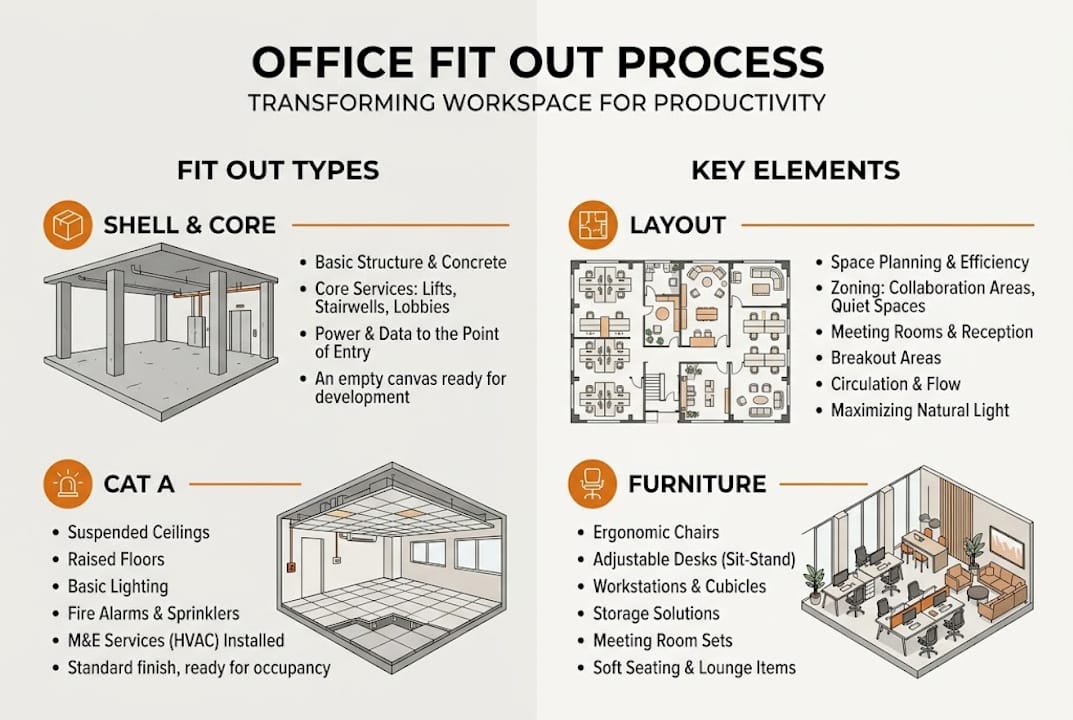
An office fit out is the process of transforming a commercial space, from a bare or partially finished state, into a fully functioning workplace. This goes well beyond decorating. It encompasses structural changes, mechanical and electrical systems, flooring, partitioning, lighting, data infrastructure, furniture, and branding. The result is a workspace aligned with a company’s operational needs and culture.
It helps to understand the industry-standard categories:
| Category | What it includes | Who does it |
|---|---|---|
| Shell and core | Basic structural shell, lifts, stairs, common areas | Developer or landlord |
| CAT A | Raised floors, suspended ceilings, basic M&E, toilets | Landlord or developer |
| CAT B | Full interior design, partitions, furniture, branding | Tenant (your business) |
| Refurbishment | Upgrading or refreshing an existing fitted space | Tenant or occupier |
The distinction between CAT B and a simple refurbishment is important. A refurbishment updates what is already there. A CAT B fit out builds a bespoke environment from scratch, giving you complete control over layout, culture, and workflow.
A typical fit out project moves through several phases:
For UK businesses undertaking a CAT B project in 2026, fit-out best practices make clear that cutting corners on planning invariably creates expensive problems later. The British Council for Offices confirms that hybrid, wellbeing, and sustainability are now the dominant priorities shaping how spaces are designed from the outset. These are not optional extras. They are baseline expectations from employees and regulators alike.
Once you know the definition, it’s essential to understand why fit outs are worth investing in for modern UK organisations.
A poorly designed office is not merely an aesthetic problem. It is an operational liability. Staff in cramped, noisy, or poorly lit environments are measurably less productive, more prone to absence, and less likely to stay with the company long-term. The link between office design and productivity is well established, and UK employers are increasingly treating the workplace as a direct lever for business performance.
The business case for a quality fit out breaks down into several key areas:
| Business driver | Fit out impact |
|---|---|
| Talent attraction | A well-designed office is a recruitment tool |
| Staff retention | Comfortable environments reduce turnover |
| Productivity | Better layouts reduce friction and time waste |
| ESG reporting | Sustainable design supports compliance goals |
| Hybrid working | Flexible spaces support variable occupancy |
The investment required is not small. CAT B fit outs in the UK typically range from £50 to £150 per square foot depending on specification, location, and complexity. However, the return on that investment is increasingly well documented. Research from Kadence shows that fit outs as strategic assets in the hybrid era drive measurable gains in talent attraction and productivity ROI, particularly when flexibility is built in from day one.
“The office is no longer just a place to work. It is a tool for attracting people back, building culture, and signalling what a company values.” This shift in thinking is driving UK businesses to approach fit outs with the same rigour they would apply to any major capital investment.
Wellbeing is also a growing compliance concern. The Health and Safety at Work Act 1974 and associated guidance from the Health and Safety Executive set minimum standards for lighting, ventilation, and workspace dimensions. A thoughtfully planned fit out ensures your space meets these obligations while going further to improve office comfort and support mental health.
Pro Tip: Before approving a fit out budget, calculate your current cost-per-desk alongside your average staff turnover rate. These two figures often make the business case for a higher-specification fit out far more compelling than a simple price-per-square-foot comparison.
Knowing the value, the next step is to understand how a fit out project typically unfolds, from planning to handover.
Every successful office fit out follows a structured process. Skipping or rushing any phase introduces risk. Here is how a well-managed UK fit out project typically progresses:
Procurement teams play a particularly important role at stages three and six. Choosing suppliers who offer bulk pricing, clear warranties, and responsive aftercare protects both budget and programme. Reviewing office design steps before your procurement phase helps ensure furniture decisions align with your broader design intent.
The BCO’s 2025 guidance confirms that smart tech, circular materials, and wellbeing zones are now considered integral to project planning, not optional upgrades. This means specifying AV-enabled meeting rooms, sensor-based lighting, and biophilic elements at the design stage rather than retrofitting them later.
Pro Tip: Set a 10% contingency budget from the outset. Even the most carefully planned fit out encounters unexpected costs, from building condition surprises to supply chain delays. Having that buffer prevents last-minute compromises on the elements that matter most.
Once your project is mapped out, a crucial decision is sourcing the right furniture to optimise the workplace for the future.
Furniture is often one of the last decisions made in a fit out, but it should be one of the first. The right furniture defines how people move through a space, how teams collaborate, and how individuals feel at the end of an eight-hour day. Getting this wrong is an expensive mistake that employees will remind you of daily.
When evaluating furniture for a UK office fit out, consider these criteria:
The BCO makes clear that ESG-aligned furniture choices are now central to fit out decision-making, not an afterthought. This means reviewing supplier credentials, not just product specifications.
In practice, modular seating systems are among the most versatile choices for collaborative zones. Height-adjustable desks are increasingly expected rather than aspirational, particularly in hybrid environments where individuals with different roles and needs share workstations. Reviewing durable office furniture options before signing off on your specification can save significant budget at the replacement stage.
For offices transitioning to agile furniture solutions, the focus should be on pieces that serve multiple functions rather than single-purpose items. A quiet pod that doubles as a call booth and a focused work zone delivers far more value than two separate fixed installations. Where space is limited, space-saving office furniture can dramatically improve both capacity and comfort.
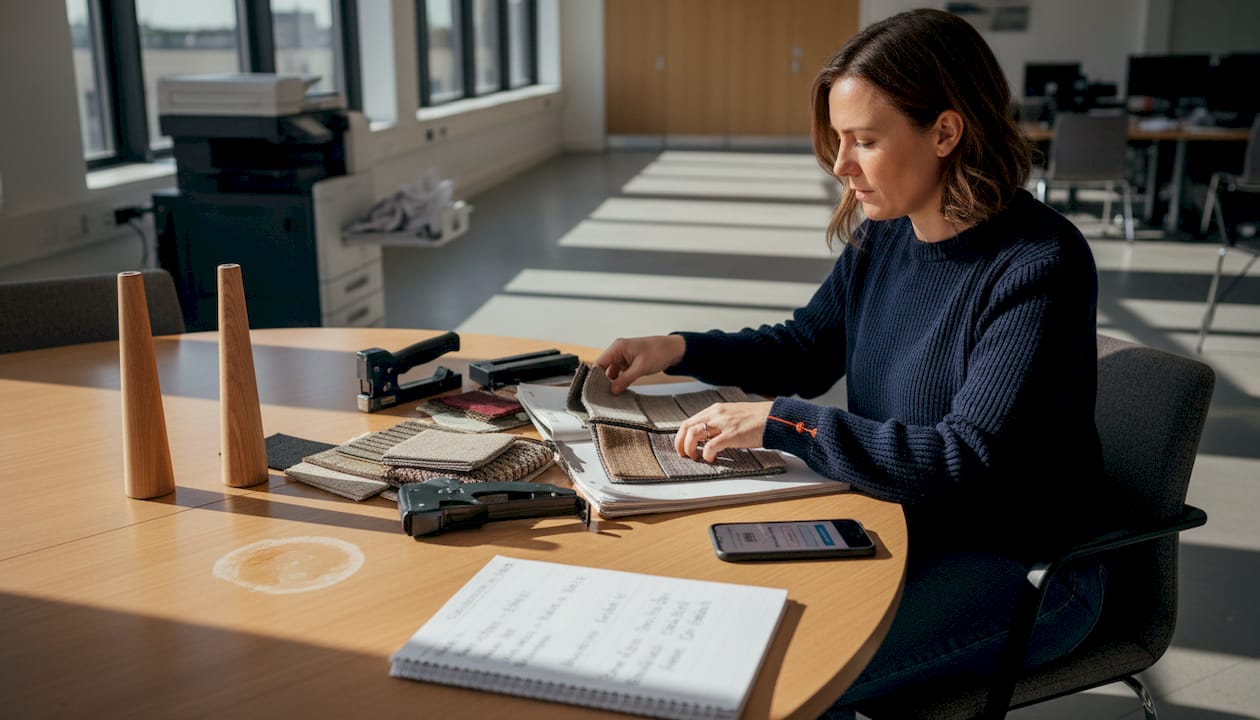
Pro Tip: Request commercial-grade fabric samples and test them under your office’s actual lighting conditions before committing to an order. Colours that look neutral in a showroom can feel harsh or cold in a north-facing open-plan floor.
Securing present benefits is good, but ensuring your fit out stands the test of change is even better.
A fit out that perfectly serves today’s headcount and working patterns may be obsolete in three years if the business grows, contracts, or pivots to a different hybrid model. Future-proofing your fit out is not about predicting the future. It is about designing for adaptability from the start.
Key principles to build in:
The BCO’s guidance is explicit that future-ready designs must allow for changing working patterns, smart solutions, net zero targets, and long-term adaptability. This is not aspirational language. It reflects where planning consents, building regulations, and lease obligations are heading across the UK.
A practical future-fit readiness checklist might include: Can the floor plate be subdivided or expanded? Are power and data systems scalable? Is the furniture covered by a long-term warranty with replacement parts available? Does the space have the acoustic flexibility to serve both collaborative and focused work modes? These questions, answered honestly at the design stage, prevent costly regrets further down the line.
Pro Tip: Review your fit out specification against your five-year business plan, not just your current headcount. If growth or contraction is plausible, design for both scenarios from the outset.
You have seen the frameworks and strategies. Here is our honest assessment of what the data and experience actually tell us.
The most common mistake we see in UK office fit outs is treating wellbeing features and flexible layouts as premium upgrades rather than foundations. Businesses that invest in ergonomic seating, biophilic design, and reconfigurable spaces from the start consistently report better outcomes than those who bolt these elements on after the fact.
Conventional wisdom says keep fit out costs lean. Our experience says that approach almost always costs more in the long run. As Kadence’s research confirms, higher initial investment is frequently offset by greater space efficiency, reduced churn, and long-term flexibility. The savings show up in recruitment costs, absence rates, and the absence of a second fit out within five years.
The businesses that get the most from their fit outs tend to treat the workspace as operational infrastructure rather than overhead. They plan it the way they plan IT systems or logistics: with clear objectives, measurable outcomes, and a long-term view. If your approach to modern furniture and workflow reflects your business strategy, the investment makes obvious sense. If it does not, no amount of beautiful finishes will compensate.
Inspired to create your future-ready workspace? Here is how we can help turn your fit out ambitions into reality.
A successful office fit out depends on making the right decisions at every stage, and furniture is where the day-to-day experience of your workplace is truly defined. Whether you are specifying height-adjustable desks for a hot-desking floor, ergonomic seating for a growing team, or a full suite of meeting room furniture for a new collaboration hub, getting the specification right from the outset saves time, money, and headaches.
At Furniture for Business, we supply commercial-grade office furniture to UK businesses of all sizes, with free delivery to the UK mainland and bulk order pricing available. Browse our full range of office desks, explore our ergonomic chairs range, or discover our meeting room solutions to find the right fit for your project.
A fit out transforms a bare or partially finished shell into a fully operational workspace, while a refurbishment updates or improves what is already there. The two terms are often confused, but the scope and investment involved are very different.
Sustainability and ESG are now central to fit out planning because they help businesses meet regulatory obligations, reduce energy costs, and attract environmentally conscious talent. In the UK, net zero commitments are shaping both planning policy and tenant expectations.
Selecting flexible, ergonomic, and durable furniture ensures your space adapts to future needs and actively supports staff productivity and wellbeing. Poor furniture choices are one of the most common and most expensive fit out regrets.
Despite rising costs, the ROI from a well-planned fit out is significant: Kadence’s research shows that improved productivity and wellbeing regularly offset the initial outlay through lower turnover and greater space efficiency over time.
Phone: 0330 043 4114
VAT no. GB 991 8681 60
Company no. 07250570