TL;DR:
- Office zoning segments spaces based on activity, improving hybrid work efficiency and staff well-being.
- Effective zoning relies on data, adjacency, acoustics, circulation, and technology for success.
- Continuous adjustment and organizational culture are crucial for maximizing the benefits of office zoning.
Most UK office managers assume the big debate is open-plan versus cubicles. It is not. The real question is whether your workspace is divided by habit or by purpose. Office zoning, which means segmenting your floor plan into activity-driven areas, is reshaping how British businesses think about real estate, productivity, and staff well-being. As hybrid work patterns shift occupancy away from the old five-days-a-week model, generic layouts are failing teams. This guide explains what office zoning actually is, how it works in practice, what the UK benchmarks look like, and the most common mistakes procurement teams make when rolling it out.
| Point | Details |
|---|---|
| Activity-based zoning | Smart office layouts use zones matched to tasks, not just open-plan or cubicles. |
| Hybrid benchmarks | Effective zoning means following UK occupancy data and recommended ratios for space, desks, and collaboration. |
| Furniture flexibility | Modular, right-sized, and acoustic furniture enables adaptivity and significant cost savings. |
| Continuous improvement | Successful office zones rely on feedback and adjustment, not static plans. |
Office zoning, in the workplace design sense, means deliberately dividing your interior space into distinct areas, each built around a specific type of work. One area might be configured for deep, focused tasks. Another supports spontaneous collaboration. A third offers a social reset. The goal is that every square metre earns its keep by serving a clear purpose.
It is worth clarifying upfront: this is not the same as UK planning law. Legal zoning and Use Classes are about what a building can be used for under planning regulations. Office zoning, as we use the term here, is entirely about interior layout strategy and has nothing to do with planning permissions or local authority consents.
The reason this matters now more than ever is hybrid working. When staff come in on rotating schedules, a static open-plan with rows of identical desks serves almost nobody well. Some days the office is at 30% capacity. On Tuesdays and Wednesdays, it may be oversubscribed. Hybrid office benchmarks increasingly demand that space fits different work patterns rather than assuming everyone needs a fixed desk from nine to five.
Effective zoning solves this by making the office genuinely useful on both quiet and busy days. It also supports well-being by giving people agency over where they work depending on what they need to accomplish. Understanding the importance of layout for hybrid offices is a foundational step for any procurement team planning a refurbishment.
Common zone types in a modern UK office include:
“Activity-based working and intelligent space planning are no longer aspirational. For hybrid offices, they are the baseline expectation. Organisations that fail to zone their offices around real occupancy patterns are paying for space that is actively working against them.”
The office design impact on productivity and retention is well documented, and zoning is one of the clearest levers available to office managers working within real budget constraints.
Knowing the concept is one thing. Building a zone that actually works requires attention to several interconnected factors. Getting any one of them wrong tends to undermine the others.
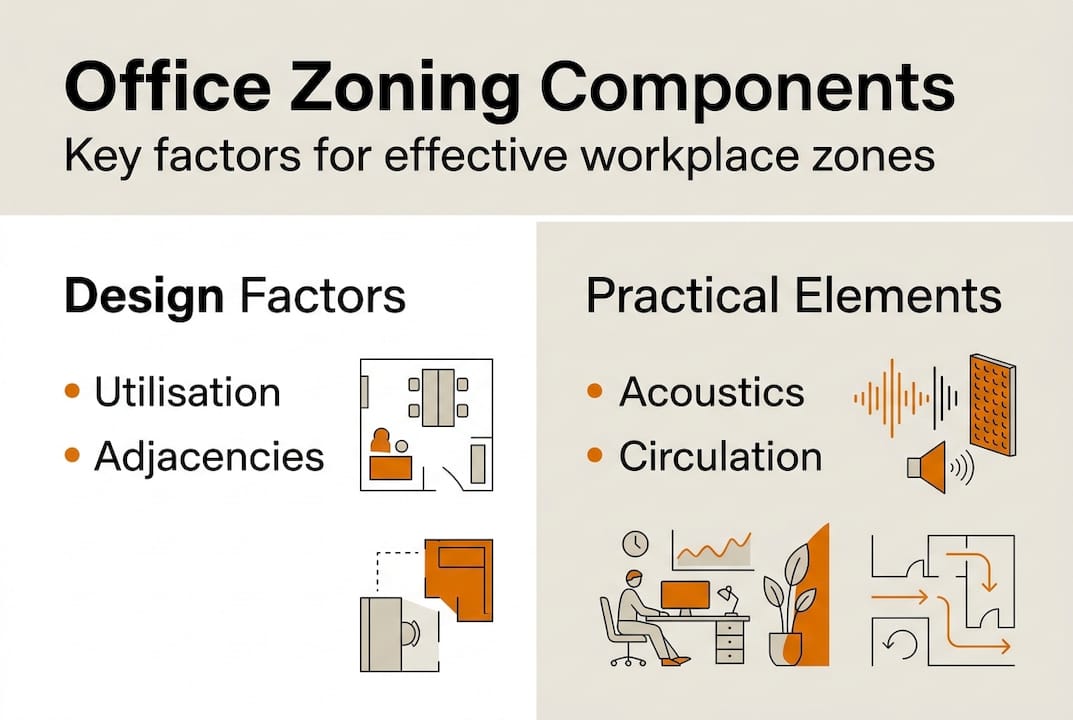
The main components are: utilisation data, spatial adjacencies, acoustic planning, circulation routes, and technology integration. Utilisation data tells you how your space is actually used, not how you assume it is used. Spatial adjacency means placing complementary zones near each other so that moving between them feels natural. Acoustic planning ensures that a noisy collaboration zone does not bleed into a focus zone two metres away. Circulation routes, which should account for 15 to 25% of your floor area, keep movement safe and efficient. Technology means booking systems, AV, and power access that match how each zone functions.
The table below shows UK hybrid benchmarks that can guide your zoning ratios:
| Metric | UK benchmark |
|---|---|
| Space per person | 15 m² |
| Desk ratio (hybrid) | 0.6 to 0.8 desks per person |
| Collaborative and social space | 60% of total area |
| Desk and focus space | 40% of total area |
| Potential space saving | 20 to 40% vs. traditional layouts |
| Recommended circulation | 15 to 25% of floor area |
These numbers are a starting point, not a fixed prescription. Your actual mix will depend on your sector, team size, and working patterns.
Here is a practical sequence for planning your zones, informed by workflow and circulation best practice:
Organisations that follow this process and right-size their zones against actual demand consistently report 20 to 40% space savings compared with maintaining traditional fixed-desk layouts. That is a significant return on a structured planning exercise.
Once you know how your zones should function, furniture becomes the tool that makes those functions real. Choosing the wrong pieces is one of the most common and costly errors in office fit-outs.
The table below compares furniture choices for each zone type:
| Zone | Recommended furniture | Key benefit | Watch out for |
|---|---|---|---|
| Focus | Acoustic pods, privacy screens, height-adjustable desks | Reduces distraction | Poor acoustic seals |
| Meeting | Modular conference tables, stackable chairs | Reconfigurable for group size | Bulky fixed tables |
| Social | Soft seating, lounge chairs, bar-height tables | Encourages informal connection | Hard-wearing materials |
| Breakout | Collaborative soft seating, writable surfaces | Supports creative sessions | Insufficient power points |
| Hot-desk | Lightweight desks, lockers, cable management | Supports flexible working | Lack of personal storage |
Key features to look for when selecting zone furniture include:
Pro Tip: Before placing a bulk order, audit your peak occupancy data. If your office fills to 70% capacity on busy days, you do not need desks for 100% of headcount. Right-sizing to your actual demand, following the 0.6 to 0.8 desk ratio, can cut furniture spend significantly while freeing floor area for collaboration zones that staff actually want to use.
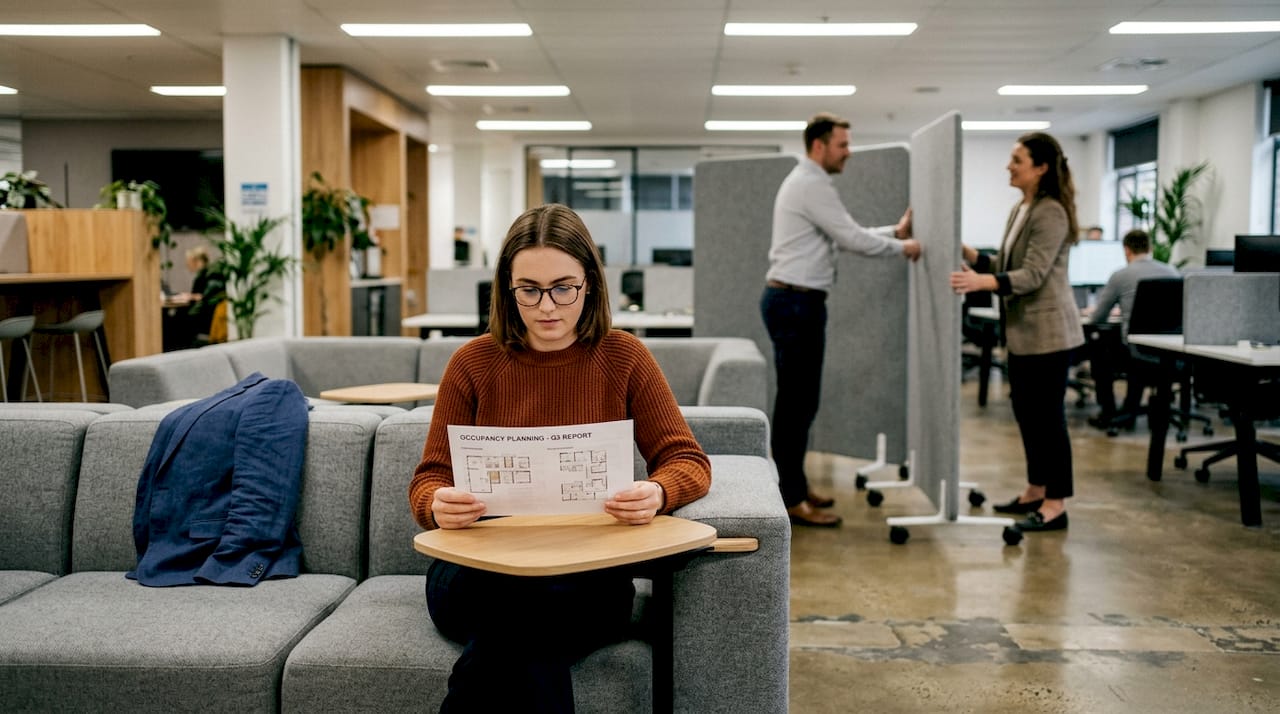
Flexible solutions such as modular seating and agile furniture are particularly well-suited to offices where zone boundaries need to shift over time. Movable acoustic screens and freestanding pods allow you to reconfigure without structural work, which matters enormously when your hybrid policy is still evolving. A step-by-step office design process helps procurement teams sequence these decisions without costly rework, and thinking carefully about arranging office desks can make a significant difference to how each zone actually feels in use.
Even well-researched zoning plans run into real-world friction. Knowing the common pitfalls ahead of time saves budget, time, and staff goodwill.
The most frequent challenges office managers encounter include:
Pro Tip: Never launch a full zone rollout without a pilot. Pick one floor or one team, run the new layout for six to eight weeks, collect structured feedback, and adjust before committing the rest of the organisation. This approach costs very little and prevents expensive mistakes at scale.
“85% of workers report that access to a dedicated quiet zone improves their productivity. Yet in most offices, quiet zones are either absent or poorly enforced. The gap between what employees need and what they get is where zoning earns its value.”
Using acoustic office solutions such as sound-absorbing partitions, upholstered panels, and enclosed pods is one of the highest-impact investments in any open-plan office. The research consistently shows it, and staff surveys reinforce it. Once your zones are running, build a quarterly review into your facilities calendar. Track which zones are overused, which sit empty, and what the booking data reveals about actual versus intended behaviour. Zones that are not working are not failures; they are data points.
Here is what most zoning guides will not tell you: the layout itself is rarely the limiting factor. The bigger challenge is organisational behaviour.
We see it repeatedly. A business invests in a beautifully zoned office, with pods, acoustic panels, and collaborative furniture, and then staff gravitate to the same seats every day, treating the hot-desks as assigned territory. The zones exist physically but not culturally.
The most effective zoning projects we have observed treat the office like a product in continuous development. They collect occupancy data quarterly, act on staff feedback promptly, and are willing to move furniture or repurpose a zone when the evidence suggests it is not serving its intended function. That requires a mindset shift: zones are not a one-time project, they are an ongoing practice.
The businesses that get the most from office zoning are not necessarily those with the most sophisticated furniture or the largest budgets. They are the ones where leadership trusts their teams to guide the evolution of the space, and where facilities managers have both the mandate and the tools to keep adjusting. Build that culture first, and the physical zoning will follow.
If this guide has clarified where your current layout is falling short, the next step is finding the right furniture to bring your zones to life. At Furniture for Business, we supply commercial-grade office furniture to UK businesses of every size, from boutique agencies to large corporate offices planning full refurbishments.
Our range covers every zone type your hybrid office needs. From meeting room furniture built for flexible configurations to office chairs that support long working days in focus zones, every product is selected for durability, design, and real-world functionality. We offer bulk order pricing, free delivery to the UK mainland, and expert guidance to help you right-size your specification. Discover more smart solutions and start building an office that works as hard as your team does.
Office zoning divides space by activity type, creating dedicated areas for focus, collaboration, and meetings rather than one undifferentiated open area where all tasks compete for the same space.
UK guidance suggests 15 m² per person, a desk ratio of 0.6 to 0.8, and a 60/40 split between collaborative and desk space to reflect realistic hybrid attendance patterns.
Flexible, modular desks with integrated personal storage and booking support are essential, as hot-desking breaks down quickly without both elements in place.
Sound-absorbing partitions, acoustic pods, and upholstered panels significantly reduce noise transfer between zones and are among the most impactful investments for open-plan offices.

Phone: 0330 043 4114
VAT no. GB 991 8681 60
Company no. 07250570