TL;DR:
- Office space planning should align with actual utilisation rates rather than pre-pandemic headcounts.
- Space-efficient desks like bench and modular systems help maximize floor area and flexibility.
- Proper layout, storage solutions, and future-proof furniture are key to successful office refurbishments.
Office refurbishments are the perfect moment to rethink how your desks actually work for your team. Too many UK businesses are still planning layouts around pre-pandemic headcounts, leaving floors cluttered with unused workstations while hybrid workers hot-desk on the same three tables. The BCO now calls for a new approach to space planning as office use reaches a critical shift, meaning the old rules no longer apply. This guide walks you through the benchmarks, desk types, layout strategies, and procurement decisions that will help you get far more from every square metre, whether you’re fitting out a space for 5 people or 500.
| Point | Details |
|---|---|
| Updated UK workspace standards | Post-pandemic guidelines require more flexible use of office space, affecting desk layouts and planning. |
| Bench desks optimise floor area | Switching to benching systems can save 30-50% office space compared to fixed desks. |
| Modular designs benefit scalability | Modular desks allow rapid adaptation for teams of any size during office refurbishments. |
| Effective layout boosts productivity | Smart arrangement of space-efficient desks supports collaboration and meets legal minimums. |
| Avoid common procurement errors | Overcrowding and failing to plan for future needs are frequent pitfalls in desk selection. |
To make the right desk choices, you first need to understand the specific space standards and metrics that shape modern UK office layouts.
The starting point for any UK office fit-out is the Health and Safety Executive minimum of 4.6m² per person in open-plan workspaces. That figure has been the legal baseline for years, but it was never designed to reflect how people actually work. The British Council for Offices (BCO) historically recommended 8 to 10m² per person, accounting for circulation, storage, and comfort. Now, following a fundamental shift in how offices are used, the BCO recommends 15m² per person at a 66% utilisation rate, a figure that reflects real attendance patterns rather than theoretical headcount.
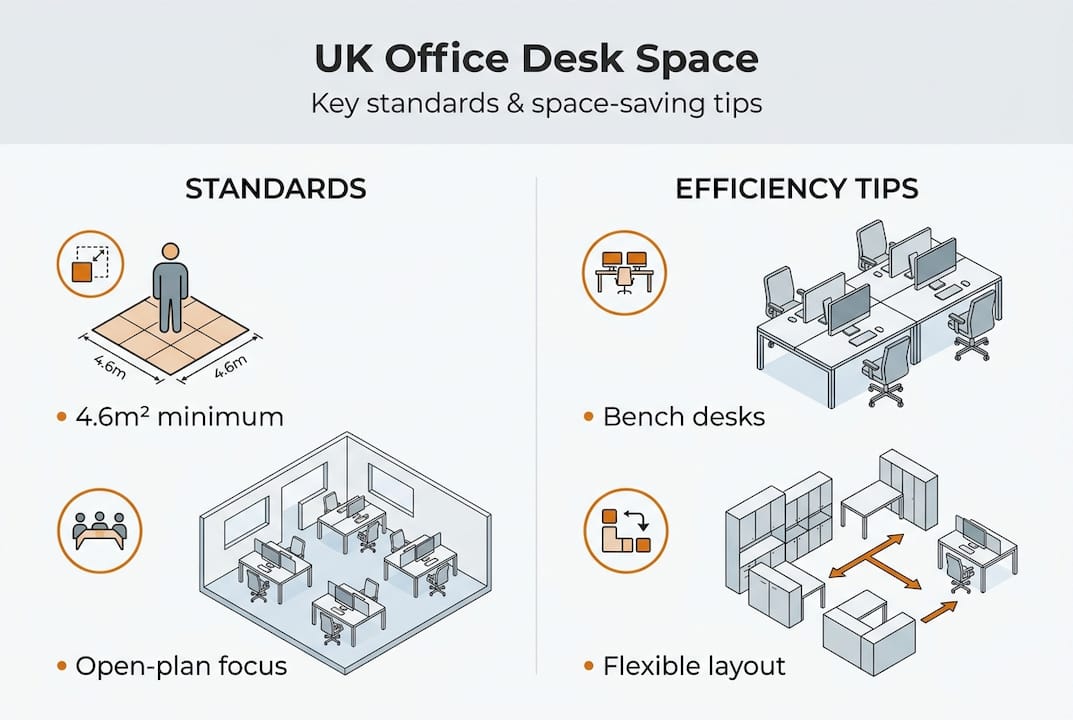
Utilisation is the percentage of desks actually occupied at any given time during the working day. If your office has 100 desks but only 60 people come in on a typical Tuesday, your utilisation rate is 60%. Planning for 100% utilisation is not only wasteful, it creates a cramped environment that drives people back to working from home.
| Space standard | Metric | Context |
|---|---|---|
| HSE legal minimum | 4.6m² per person | Absolute floor, not a target |
| BCO legacy guideline | 8 to 10m² per person | Pre-pandemic standard |
| BCO updated guideline | 15m² per person | Based on 66% utilisation |
Post-pandemic office utilisation data shows that real-world occupancy across UK offices averages around 60 to 66%, with significant regional variation. London offices tend to perform closer to the upper end, while regional cities often see lower sustained attendance. This matters because it directly affects how many desks you actually need.
“Planning for your real utilisation rate, rather than your total headcount, is the single most impactful decision you can make during a fit-out.”
Benching systems play a significant role here. Because bench desks eliminate the bulky pedestals, fixed screens, and wasted side space of traditional workstations, they allow you to fit more workstations into the same footprint without breaching space standards. Before you start rearranging, it is also worth reviewing your existing inventory. Good office cleanout practices can free up surprising amounts of floor space before a single new desk arrives.
For teams that want to align procurement with broader goals, sustainable desk choices are increasingly viable without compromising on density or quality.
Once you’re aware of desk spacing requirements, the next step is choosing the ideal desk types suited to your space and organisational needs.
Not all desks are created equal when it comes to space efficiency. The type you choose will determine how many workstations you can fit, how easily you can reconfigure the layout, and how well the office adapts as your team grows or shrinks.
| Desk type | Space efficiency | Flexibility | Best for |
|---|---|---|---|
| Bench/cluster | Very high | Medium | Open-plan, hot-desking |
| Modular | High | Very high | Growing teams, refits |
| Height-adjustable | Medium | High | Ergonomic, hybrid teams |
| Fixed traditional | Low | Low | Private offices, executives |
Bench systems are the most space-efficient option for open-plan environments. Bench systems save 30 to 50% of floor space compared to fixed desks, making them the go-to choice for teams with moderate to high utilisation. They work particularly well for hot-desking arrangements where employees do not have assigned seats.

Modular systems offer a different kind of value. Rather than pure density, they give you adaptability. Modular systems scale efficiently during refurbishments and support sustainable, high-utilisation workspaces because you can add, remove, or reconfigure units without replacing everything. For procurement teams managing rapid headcount changes, this is a significant advantage.
Height-adjustable desks are worth considering for teams where wellbeing and ergonomics are a priority. Our height-adjustable desk setup guide covers how to integrate these into mixed layouts without sacrificing too much floor space. They take up a similar footprint to a standard desk but deliver considerably more value per workstation.
For teams that need integrated storage without adding separate cabinets, options like the Fleur smart storage desk combine workspace and storage in one unit, reducing the overall furniture footprint considerably.
Pro Tip: When procuring for a team of 20 or more, always ask suppliers about bulk configurations. Many modular systems are priced per run rather than per unit, which changes the cost calculation significantly.
Keep your desk surfaces clear and purposeful. Thoughtful office desk decor can actually improve focus without adding clutter, provided you choose accessories that serve a functional purpose.
With optimal desk types chosen, you need a structured approach to desk layout for maximum impact and compliance.
Layout planning is where most office refurbishments either succeed or fall apart. A good layout balances legal compliance, team collaboration, and individual focus, all within a fixed floor area. Follow these steps to get it right.
“The biggest mistake in office layout is planning for the team you have today rather than the team you’ll have in two years.”
Pro Tip: Avoid placing desks directly under air conditioning units or beside windows without blinds. Both create discomfort that reduces how often those workstations get used, which skews your utilisation data.
For more detailed guidance, our article on efficient desk layouts covers arrangement strategies for a range of floor plans. When choosing furniture for the long term, our durable furniture buying guide helps you avoid costly replacements within the first few years.
The BCO advocates low-density, high-utilisation workspaces as the more sustainable and productive model. That means fewer desks used more often, rather than a full floor of empty workstations.
If you’re considering art or visual elements to make the space feel larger, research on art in small office spaces shows that well-placed pieces can genuinely improve perceived spaciousness.
Even with smart layouts, common challenges crop up during refurbishments. Here’s how to spot and tackle them confidently.
The gap between a well-planned layout and a functional office often comes down to a handful of recurring problems. Knowing what to look for saves you from expensive late changes.
Storage overflow is one of the most common culprits. When desk storage is insufficient, bags, boxes, and personal items end up on the floor, blocking circulation routes and creating a cramped feel. Integrating dedicated office storage into your layout from the start prevents this. Under-desk pedestals, shared lockers, and wall-mounted shelving all reduce the footprint compared to freestanding cabinets.
Circulation bottlenecks occur when desks are arranged without accounting for how people move through the space. A corridor that looks wide on a floor plan can feel narrow once chairs are pushed back. Keep a minimum of 1,200mm for main circulation routes and 900mm for secondary access.
Underutilised desk areas are a waste of both space and budget. If certain zones are consistently empty, it is usually a sign of poor positioning rather than low attendance. Moving those desks closer to natural light or collaborative areas often resolves the issue.
Rapid team changes are a procurement challenge that many office managers underestimate. If your headcount could increase by 20% within a year, buying fixed furniture locks you into a layout that may not work. Modular procurement standards recommend specifying furniture that can be extended or reduced without full replacement.
Pro Tip: Build a 10 to 15% desk surplus into your initial layout. This gives you flexibility for new starters and project teams without a full refit.
For senior staff or private offices, our executive workspace guide covers how to balance privacy with space efficiency. Research also shows that art in workspace design can measurably improve productivity, which is worth factoring into your overall fit-out budget.
Here is a view that often surprises office managers: adding more desks does not make your office more efficient. It usually makes it less so.
When you fill a floor with workstations, you reduce the space available for the informal collaboration, quiet focus, and movement that actually drive productivity. The teams we see getting the most from their offices are not the ones with the highest desk density. They are the ones who have matched their furniture to their real utilisation patterns and built in genuine flexibility.
Sustainable procurement is also under-prioritised in most fit-outs. Buying cheap, fixed desks that need replacing in three years costs more than investing in quality modular furniture that adapts as your team changes. Our guide to sustainable office furniture makes the business case clearly. The most efficient office is not the most densely packed one. It is the one that supports how your people actually work, today and in two years’ time.
Ready to put your space planning into action? Whether you’re equipping a team of 10 or rolling out a 300-desk fit-out, having the right product range behind you makes all the difference.
At Furniture For Business, we supply commercial-grade office desks suited to every layout type, from open-plan bench systems to modular configurations that scale with your team. Our height-adjustable desk guide helps you integrate ergonomic options without compromising on floor space. We also offer a full range of office storage solutions to keep your layout clean and circulation routes clear. Free delivery to the UK mainland is included, and our team is on hand to advise on bulk orders and bespoke configurations. Get in touch to discuss your project.
The HSE minimum is 4.6m² per person in open-plan UK office workspaces. This is an absolute legal floor, not a recommended target for comfortable working.
Bench systems save 30 to 50% of floor space compared to traditional fixed desks, making them the most space-efficient option for open-plan and hot-desking environments.
Yes, modular desk systems scale efficiently during office refurbishments and rapid team changes, as units can be added or reconfigured without full replacement.
The most frequent errors include overcrowding, ignoring real utilisation data, failing to plan for future growth, and overlooking space standards and procurement best practices from the outset.
Phone: 0330 043 4114
VAT no. GB 991 8681 60
Company no. 07250570