TL;DR:
- Bench desking is a shared workspace layout where multiple employees work on a continuous surface without partitions, increasing space efficiency and collaboration. It reduces floor space per person, supports flexible configurations, and facilitates quick reorganization, making it ideal for hybrid environments. However, it requires acoustic management and privacy solutions to address noise, privacy, and focus challenges.
Bench desking is defined as a workspace arrangement where multiple employees share a single, continuous desk surface without traditional cubicle dividers or individual partitions. The industry term for this approach is “benching,” and it has become the default layout in open-plan offices across technology, creative, and financial services sectors. Unlike conventional desks assigned to one person, bench style workstations seat anywhere from 2 to 8 people along a shared frame, consolidating power, data cabling, and surface area into one efficient unit. For office managers weighing up space efficiency and team collaboration, bench desking explained simply is this: more people, less floor space, and fewer barriers between colleagues.

Bench desking replaces the individual desk-and-partition model with long, shared surfaces arranged in rows or pods. Traditional cubicle layouts assign each employee a walled workstation, consuming significant floor area per person. Open-plan benching systems require less floor area per workstation compared with panelled cubicles, freeing space for meeting rooms or collaborative zones within the same office footprint.
The structural difference is significant. A conventional desk stands alone, with its own legs, cable routes, and power supply. A bench system shares a single frame across multiple positions, with power and data running through the frame itself. This shared infrastructure reduces clutter and cuts installation costs considerably.
Bench desks are typically arranged in long continuous rows or pods seating from 2 up to 8 people. The most common configurations are:
| Feature | Bench desking | Traditional cubicle desk |
|---|---|---|
| Floor area per person | Lower | Higher |
| Cabling infrastructure | Shared through frame | Individual per desk |
| Reconfiguration speed | Fast, modular | Slow, fixed |
| Privacy level | Low to medium | Medium to high |
| Collaboration potential | High | Low |
The modularity is what separates benching from simply pushing desks together. Bench systems are engineered to expand or contract, meaning you can add a seat to a pod or remove one without replacing the entire unit.
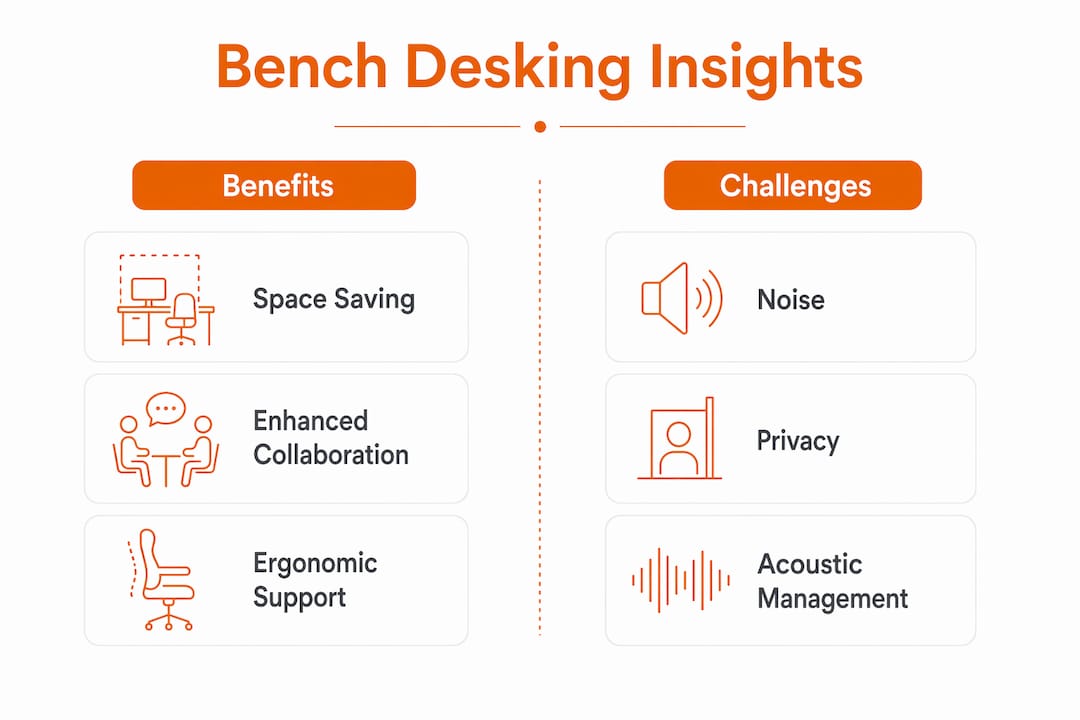
The primary benefit of bench desking in offices is space efficiency. Removing partitions and consolidating frames means you can seat more people in the same square footage. That freed space can become a meeting room, a quiet zone, or a breakout area, all without extending your lease.
Collaboration is the second major advantage. When colleagues sit side by side without visual barriers, communication happens naturally. Questions get answered faster, ideas get shared without scheduling a meeting, and new team members integrate more quickly. Benching is especially suited for industries like technology, creative, and financial services, where collaboration and agility are priorities.
The benefits of bench desking extend to cost as well. Shared frames mean fewer components to purchase, install, and maintain. Benching systems reduce cabling and electrical infrastructure needs by consolidating power and data through shared frames, creating a neater, safer, and more cost-effective workspace.
The challenges are real, though, and ignoring them leads to failed rollouts.
The solutions are well established. Acoustic management in bench setups often involves screen panels between 18 and 24 inches in height, balancing acoustic dampening and visual openness to prevent both distraction and isolation. Pairing bench rows with dedicated quiet rooms or phone booths addresses the focus problem without abandoning the open layout.
Pro Tip: Add a low-profile privacy screen at every other position rather than every position. This preserves the open feel while giving employees a visual anchor when they need to concentrate.
Modern bench desking also supports ergonomic needs. Height-adjustable bench desks meet employee demand for movement while maintaining space efficiency, integrating sit-stand functionality directly into the shared frame. For office managers, this means ergonomic compliance without buying separate standing desks for every individual.
Bench desking is modular by design. Benching systems can be expanded or reduced to match changes in staff numbers and workspace needs, facilitating rapid reorganisation of office layout. This adaptability makes benching a practical long-term investment rather than a fixed commitment.
Configuration decisions break down into four areas:
For offices that need maximum flexibility, mobile battery-powered bench desks with height adjustment enable complete workspace flexibility, allowing managers to rearrange office layouts without rewiring constraints. This is particularly useful for hybrid offices where headcount on any given day varies significantly.
| Configuration type | Best suited for | Key feature |
|---|---|---|
| Linear run | Large open-plan teams | Maximum density |
| Back-to-back pod | Departmental clusters | Shared central spine |
| Face-to-face pod | Collaborative project teams | Direct sightlines |
| Mobile bench unit | Hybrid, variable headcount | No fixed power required |
Pro Tip: When specifying cable management, choose bench frames with integrated spine channels rather than surface-mounted trunking. The result is a cleaner desk surface and far easier maintenance when cabling needs updating.
The first question to answer is whether your team’s work suits an open environment. Bench desking works well for roles that involve frequent communication, shared projects, or rotating attendance. It works less well for roles requiring sustained concentration, confidential client calls, or sensitive data handling. Mapping your team’s daily tasks before committing to a layout prevents costly mistakes.
Infrastructure planning comes next. Consolidated infrastructure in benching reduces installation costs and simplifies maintenance since power and data cables run within the bench frame, avoiding multiple wall connections. Work with your IT and facilities teams early to specify the number of power modules and data ports per position before the furniture is ordered.
Ergonomic compliance is a legal consideration in the UK. The Health and Safety (Display Screen Equipment) Regulations 1992 require employers to assess workstation risks for regular screen users. Bench desks must meet these requirements just as individual desks do. Specify adjustable chairs, monitor arms, and keyboard trays alongside the bench frame to meet your duty of care.
Pro Tip: Run a pilot bench area with one team for four to six weeks before a full rollout. The feedback you collect will be far more useful than any pre-implementation survey.
Bench desking is widely used in hybrid and agile office environments due to its modular frame design that enables reconfiguration within minutes. When headcount on any given day is unpredictable, a bench layout allows you to activate or deactivate positions without moving furniture or rewiring the floor.
Hot-desking and hoteling both rely on bench configurations. Employees book a seat rather than owning one, and the shared surface means no position is wasted when someone works from home. This directly reduces the cost per desk across the office.
The social dimension matters too. Bench layouts create natural opportunities for spontaneous conversation, which remote working erodes. When hybrid workers come into the office, they need reasons to be there. Sitting alongside colleagues at a shared bench, rather than in an isolated cubicle, reinforces the social value of the office day.
Bench desking is the most space-efficient and collaboration-ready desk format available for open-plan offices, provided it is paired with acoustic management and quiet zones.
| Point | Details |
|---|---|
| Definition of bench desking | Multiple employees share a continuous desk surface within a shared structural frame. |
| Space and cost efficiency | Benching requires less floor area per person than cubicles, freeing space for other uses. |
| Acoustic and privacy management | Screen panels between 18 and 24 inches balance privacy and openness effectively. |
| Ergonomic integration | Height-adjustable frames with lifting columns meet sit-stand needs within a shared bench. |
| Hybrid working suitability | Modular, mobile bench units support hot-desking and rapid layout changes without rewiring. |
The biggest mistake I see office managers make is treating bench desking as a purely spatial decision. They calculate desks per square metre, sign off on a layout, and then discover three months later that half the team is wearing headphones all day and productivity has dropped. The furniture was right. The planning was incomplete.
Bench desking works best when it is one component of a layered office design, not the entire solution. The offices that get it right pair bench rows with enclosed phone booths, dedicated quiet rooms, and well-placed office storage so employees are not hoarding belongings at their seats. The bench becomes the engine of collaboration, and the surrounding spaces handle everything the open layout cannot.
The other thing worth saying plainly: employee buy-in is not optional. Teams that feel consulted adapt faster and complain less. A four-week pilot with honest feedback loops will tell you more than any workplace consultant’s report. The data from that pilot, combined with a phased rollout, is the difference between a bench desking success and an expensive refurbishment that gets reversed within a year.
— Furnitureforbusiness
Bench desking performs best when the surrounding furniture matches its quality and flexibility. At Furnitureforbusiness, we supply a full range of office desks suited to open-plan bench configurations, alongside ergonomic seating and accessories designed for shared workstations.

Pair your bench layout with height-adjustable options from our height-adjustable desk range to meet ergonomic requirements without compromising your open-plan design. Our office chairs are selected to complement bench desk heights and support all-day comfort. We offer bulk order pricing and free delivery to the UK mainland, making it straightforward to kit out teams of any size.
Bench desking is a layout where multiple employees share one long, continuous desk surface without individual partitions or cubicle walls. It is designed to increase collaboration and reduce the floor space used per person.
Bench desks typically seat between 2 and 8 people per unit, depending on the configuration chosen. Back-to-back and face-to-face pod arrangements are the most common formats in UK offices.
Bench desking is well suited to hybrid working because its modular design supports hot-desking and can be reconfigured quickly as daily headcount changes. Mobile, battery-powered bench units remove the need for fixed power connections entirely.
Acoustic screen panels between 18 and 24 inches in height reduce noise and visual distraction without isolating employees. Pairing bench rows with quiet rooms or phone booths addresses deeper focus needs.
Bench desks must comply with the Health and Safety (Display Screen Equipment) Regulations 1992, which apply to all regular screen users. Specifying adjustable chairs, monitor arms, and height-adjustable frames alongside the bench ensures compliance.

Phone: 0330 043 4114
VAT no. GB 991 8681 60
Company no. 07250570