TL;DR:
- Office furniture warranties guarantee free repairs or replacements for manufacturing defects during specified periods, but coverage varies by component and use type. Understanding claim processes, exclusions, and non-transferability is essential to avoid unexpected costs and maximize warranty value. Choosing suppliers with local support, clear documentation, and comprehensive coverage offers better long-term protection and cost efficiency for UK businesses.
Office furniture warranties are manufacturer guarantees that cover the repair or replacement of defects in materials and workmanship under normal commercial use, for a defined period after purchase. For UK business owners and office managers, understanding office furniture warranty terms before signing a purchase order is the difference between a protected asset and an expensive liability. The wrong assumptions about furniture warranty coverage can leave your organisation absorbing repair costs, shipping fees, and downtime that no one budgeted for. This guide explains the types of office furniture warranties, how claims work, what gets excluded, and how to factor warranty value into total cost of ownership.
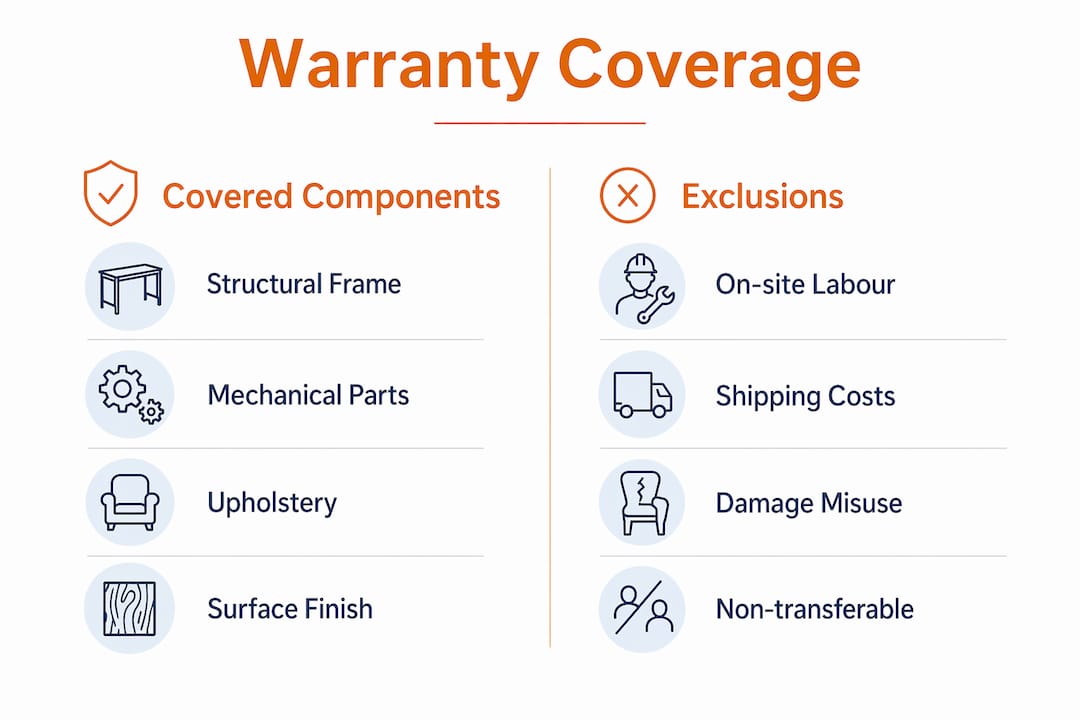
Office furniture warranties are formal commitments from manufacturers that structural and mechanical components will be free from manufacturing defects for a specified period, typically ranging from one year to a limited lifetime depending on the component. Coverage is not uniform across a product. A single office chair, for example, may carry three separate warranty periods for three separate parts.

The four main categories of coverage are structural components, mechanical parts, upholstery and foam, and surface finishes. Each carries a different duration and a different set of conditions. Understanding this split is the foundation of any informed purchasing decision.
| Component type | Typical warranty duration | What is covered |
|---|---|---|
| Structural frame | 5 to 10 years or limited lifetime | Welds, joints, load-bearing elements |
| Mechanical parts | 1 to 5 years | Gas lifts, tilt mechanisms, castors |
| Upholstery and foam | 1 to 5 years | Fabric integrity, foam density retention |
| Surface finishes | 1 to 3 years | Laminates, paint, veneer adhesion |
A limited lifetime warranty sounds reassuring, but it almost always applies only to the structural frame. Gas lifts, foam padding, and fabric are capped at much shorter periods, often between one and five years. This distinction matters enormously in a commercial environment where chairs and desks are used for eight or more hours daily.
Key points to confirm before purchasing:
Pro Tip: Ask your supplier to provide the warranty document before purchase, not after. If they cannot produce it on request, treat that as a signal about their after-sales support.
Knowing how to claim a furniture warranty is as important as knowing what it covers. A well-worded warranty is worthless if the claim process is designed to discourage you from completing it. Successful warranty claims require the original proof of purchase, the product serial number, and photographic or video evidence of the defect. Missing any one of these typically results in a rejected claim.
The standard claim process follows these steps:
The shipping step is where many buyers are caught off guard. Many manufacturers do not cover labour or return shipping for warranty repairs. Sending a heavy executive chair or a height-adjustable desk back to a manufacturer can cost more than the repair itself. This is not a theoretical risk. It is a documented pattern across the industry.
Pro Tip: Keep a digital folder for every furniture purchase: invoice, serial number photo, and delivery note. When a claim arises, you will have everything ready in under two minutes rather than spending hours searching through email archives.
Choosing a supplier with a UK-based service network reduces this friction significantly. Local support means shorter shipping distances, faster turnaround, and a single point of contact rather than navigating an overseas manufacturer’s claims department.
Exclusions define the real boundaries of furniture warranty coverage, and they are where most disputes arise. Normal wear and tear is the most common exclusion. This includes fabric fading from sunlight, foam softening from daily use, surface scratches from routine handling, and colour changes from cleaning products. None of these are manufacturing defects, and no warranty will cover them.
Beyond wear and tear, the following conditions typically void a warranty entirely:
Warranties are also non-transferable in the vast majority of cases. If your business relocates and sells its furniture to the incoming tenant, the warranty does not transfer with the chairs and desks. The same applies when furniture is moved between company sites if the warranty is registered to a specific location or purchaser.
This non-transferability has real implications for businesses that treat office furniture as a resaleable asset. If you plan to recoup value from furniture at the end of a lease, factor in that the warranty will not add to the resale price. For businesses thinking about the full furniture lifecycle and replacement, understanding this limitation early prevents costly assumptions later.
One exclusion that surprises many buyers is the absence of on-site labour coverage. Even when a manufacturer agrees to replace a faulty component, the cost of having a technician attend your office to fit it is usually your responsibility. This is a standard clause, not an oversight.
Warranty duration is the least reliable indicator of warranty value. A ten-year structural warranty on a chair with a one-year mechanical warranty means the frame will be covered long after the gas lift and mechanism have failed and been replaced at your cost. Total cost of ownership, which accounts for purchase price, maintenance, repairs, and replacement cycles, is a more reliable evaluation method than warranty length alone.
When comparing two products, build a simple comparison using these factors:
| Evaluation factor | What to look for |
|---|---|
| Component-level coverage | Are mechanical parts covered for at least three years? |
| Labour inclusion | Does the warranty include on-site repair, or is labour excluded? |
| Claim logistics | Is the supplier UK-based with local service support? |
| Replacement parts availability | Are parts stocked domestically or imported on demand? |
| Claim turnaround | Is the 7 to 15 working day standard met in writing? |
Premium products with shorter but broad warranties and local support often deliver better value than products marketed on a lifetime warranty with complex, costly claims processes. A five-year warranty that covers labour, parts, and on-site service is worth considerably more than a ten-year warranty that covers only the frame and requires you to ship the product at your own expense.
For businesses fitting out larger offices, this calculation scales quickly. Fifty chairs with a poor claims process represents fifty potential shipping costs, fifty potential labour charges, and fifty potential periods of disruption. Reviewing the office furniture buying guide alongside warranty terms gives procurement teams a structured framework for making these comparisons before committing budget.
Pro Tip: Request a sample warranty document from your supplier before placing a bulk order. Compare it line by line against a competitor’s warranty. The differences in labour coverage and exclusion clauses are often significant and rarely discussed during the sales process.
Business owners should also consider whether warranties with on-site support are available, as these eliminate the hidden operational costs that make budget-tier warranties expensive in practice. The upfront price difference between a well-warranted product and a poorly-warranted one is almost always smaller than the downstream cost difference.
Office furniture warranties protect your investment only when you understand exactly what they cover, what they exclude, and how the claim process works in practice.
| Point | Details |
|---|---|
| Warranty coverage varies by component | Structural frames may carry lifetime coverage while gas lifts and fabrics are capped at one to five years. |
| Claims require full documentation | Keep invoices, serial numbers, and photographic evidence ready to avoid rejected or delayed claims. |
| Exclusions are extensive | Wear and tear, user damage, and shipping costs are almost universally excluded from standard warranties. |
| Non-transferability limits resale value | Warranties do not transfer to new owners, which affects furniture asset planning and resale strategy. |
| TCO outperforms duration as a metric | A shorter warranty with labour and on-site support delivers more practical value than a long but restrictive one. |
Reading warranty documents before purchase is not a bureaucratic exercise. It is the only way to know what you are actually buying. After working with UK businesses across a range of fit-out projects, the pattern is consistent: buyers focus on the headline warranty period and overlook the component-level exclusions, the shipping clauses, and the non-transferability terms. Those overlooked clauses are where the real cost sits.
The most common mistake I see is treating a “commercial grade” label as a proxy for strong warranty coverage. Fine print reading is the only reliable method for confirming that commercial grade furniture warranties actually cover all key components. They frequently do not. A chair marketed for commercial use may still exclude mechanical parts after two years, leaving you with a frame warranty on a chair that no longer adjusts properly.
My recommendation is to weight supplier service infrastructure as heavily as product specification. A supplier with a UK-based service team, clear claims documentation, and a track record of honouring warranties is worth more than a marginally cheaper product with a longer headline warranty and an overseas claims process. When you are managing fifty or five hundred workstations, the difference in claims friction compounds fast.
Treat the warranty document as a contract, because that is exactly what it is. Read it, compare it, and negotiate on it if the order size justifies it. The durability and comfort of your furniture matters, but only a well-understood warranty protects that investment over time.
— Furniture
Understanding warranty terms is only half the equation. The other half is choosing a supplier whose products and support infrastructure hold up when a claim is needed.
Furnitureforbusiness supplies commercial-grade office chairs and office desks to UK businesses, with clear warranty documentation and free delivery to the UK mainland. Whether you are fitting out a ten-person office or a 500-seat corporate floor, the product range is built for sustained commercial use, with warranty terms that reflect that. Browse the full range at Furnitureforbusiness and request warranty details for any product before you order.
Office furniture warranties cover manufacturing defects in materials and workmanship under normal commercial use. Structural frames are often covered for five to ten years or a limited lifetime, while mechanical parts, upholstery, and foam carry shorter periods of one to five years.
Submit your original proof of purchase, the product serial number, and photographic evidence of the defect to your supplier or manufacturer. Most claims are processed within 7 to 15 working days, though shipping and labour costs are often excluded and fall to the buyer.
Most office furniture warranties are non-transferable and apply only to the original purchaser. Reselling or relocating furniture to a new owner or site typically voids the remaining warranty coverage.
Exceeding the product’s stated weight limit, making unauthorised modifications, using improper cleaning agents, or having repairs carried out by an unapproved technician will void most office furniture warranties.
Not necessarily. A shorter warranty that includes on-site labour and covers all components often delivers more practical value than a longer warranty restricted to the structural frame with complex, costly claims logistics.

Phone: 0330 043 4114
VAT no. GB 991 8681 60
Company no. 07250570