TL;DR:
- Hybrid working requires a strategic approach to office essentials, balancing compliance, ergonomics, and cost.
- Furniture choices like height-adjustable desks and ergonomic chairs support staff well-being and flexible work.
- Regular review and staff input ensure office supplies and safety measures stay relevant and effective.
Procuring office essentials used to be straightforward. Order paper, pens, a few chairs, done. But hybrid working has changed the game entirely. Today, office managers and procurement teams must balance ergonomic compliance, remote worker obligations, data security, and budget constraints across multiple locations at once. Get it wrong and you risk staff discomfort, legal exposure, and wasted spend. Get it right and you create a workplace that genuinely supports productivity wherever your people happen to be sitting. This guide gives you a structured, evidence-based essentials list built around the realities of modern UK workplaces in 2026.
| Point | Details |
|---|---|
| Focus on functionality | Equip offices for productivity and compliance, not just routine supply. |
| Prioritise ergonomics | Choose height-adjustable desks and quality chairs to protect wellbeing. |
| Comply with legal duties | Meet DSE, COSHH and safety obligations for all on-site and hybrid staff. |
| Procure for hybrid models | Adapt essentials for flexible and remote working, supplying home setups as needed. |
Before you start ordering anything, it pays to step back and define your selection criteria. Without a clear framework, procurement becomes reactive rather than strategic, and that is where budgets spiral and compliance gaps appear.
When evaluating any office essential, weigh it against these five criteria:
Hybrid working has introduced a significant compliance dimension that many procurement teams underestimate. Employers must cover home equipment costs and DSE compliance for hybrid and remote staff, which means your essentials list must extend beyond the office walls.
This has real budget implications. Office fit-out costs in the UK vary widely depending on specification, so understanding what you are legally required to provide versus what is discretionary helps you prioritise spend.
Pro Tip: Run a short staff survey before finalising your procurement list. Employees working from kitchen tables or spare bedrooms often have very different needs from those in a purpose-built office, and their input can prevent costly repeat orders.
“The best procurement decisions are made when compliance and comfort are treated as the same goal, not competing priorities.”
When choosing the right office desk or any other core item, always map the purchase back to these criteria. It keeps decision-making grounded and justifiable to senior stakeholders. For a broader view of how furniture choices fit into operational flow, the modern office furniture workflow guide is worth reviewing before you finalise your list.
With your procurement strategy framed, let us look at the physical core of your workspace: the furnishings that blend comfort with compliance.
Furniture is where the largest capital outlay typically sits, and it is also where poor decisions have the most visible impact on staff wellbeing. Ergonomic, sustainable choices are increasingly prioritised in UK workspaces, reflecting both regulatory pressure and a genuine shift in employee expectations.
Here is a comparison of the two most common desk configurations:
| Feature | Standard fixed desk | Height-adjustable desk |
|---|---|---|
| Cost | Lower upfront | Higher upfront |
| Ergonomic benefit | Limited | High |
| Hybrid suitability | Moderate | Excellent |
| Long-term value | Average | Strong |
| DSE compliance support | Basic | Full |
The case for height-adjustable desks is particularly strong in hot-desking environments, where staff of different heights and working styles share the same stations throughout the week.
For seating, your core options are:
Employers must assess workstations for all DSE users, including those working from home on a hybrid basis. This means the chair and desk at a staff member’s home address is your legal concern, not just the one in your office.
Pro Tip: When procuring for hybrid staff, consider a small home-working equipment allowance rather than sourcing individual items. It reduces admin and ensures staff choose equipment that suits their specific home setup, within your approved home equipment guidelines.
Round out your furniture list with meeting tables, breakout seating, and office storage essentials such as pedestals, lockers, and filing units. Explore the full ergonomic seating options available for teams of all sizes, and browse the complete range of office chairs to find the right fit for each zone in your workplace.
A functional office is nothing without robust IT. Here is how to equip your workspace for seamless work and compliance.
Technology procurement is often handled separately from furniture, but the two are deeply connected. A height-adjustable desk is far less effective without the right monitor arm and screen setup. Plan them together.
Core IT essentials for a modern UK office include:
Dual monitors increase productivity and secure Wi-Fi is essential for data protection, particularly when staff are handling sensitive client or company information from home networks.
Data security deserves its own focus. Hybrid teams introduce new vulnerabilities: personal devices, unsecured home routers, and shared household networks all create risk. A clear Bring Your Own Device (BYOD) policy, combined with mandatory VPN use and regular device audits, significantly reduces exposure.
For home workers specifically, DSE for home workers guidance from the HSE outlines what employers must consider when staff use screens at home for extended periods.
The workflow productivity tips available on our site show how physical workspace layout and technology placement work together to reduce friction and improve daily output.
| IT item | Priority level | Hybrid relevance |
|---|---|---|
| Laptop/desktop | Essential | High |
| Dual monitors | High | Medium |
| Secure Wi-Fi | Essential | Critical |
| Video conferencing kit | High | Critical |
| VPN access | Essential | Critical |
| Cloud storage | Essential | High |
Next, let us turn from tech to the everyday essentials that keep any office running smoothly.
Stationery and consumables are easy to underestimate until you run out of them at the worst possible moment. A well-managed consumables strategy saves time, reduces last-minute spend, and keeps daily operations moving without interruption.
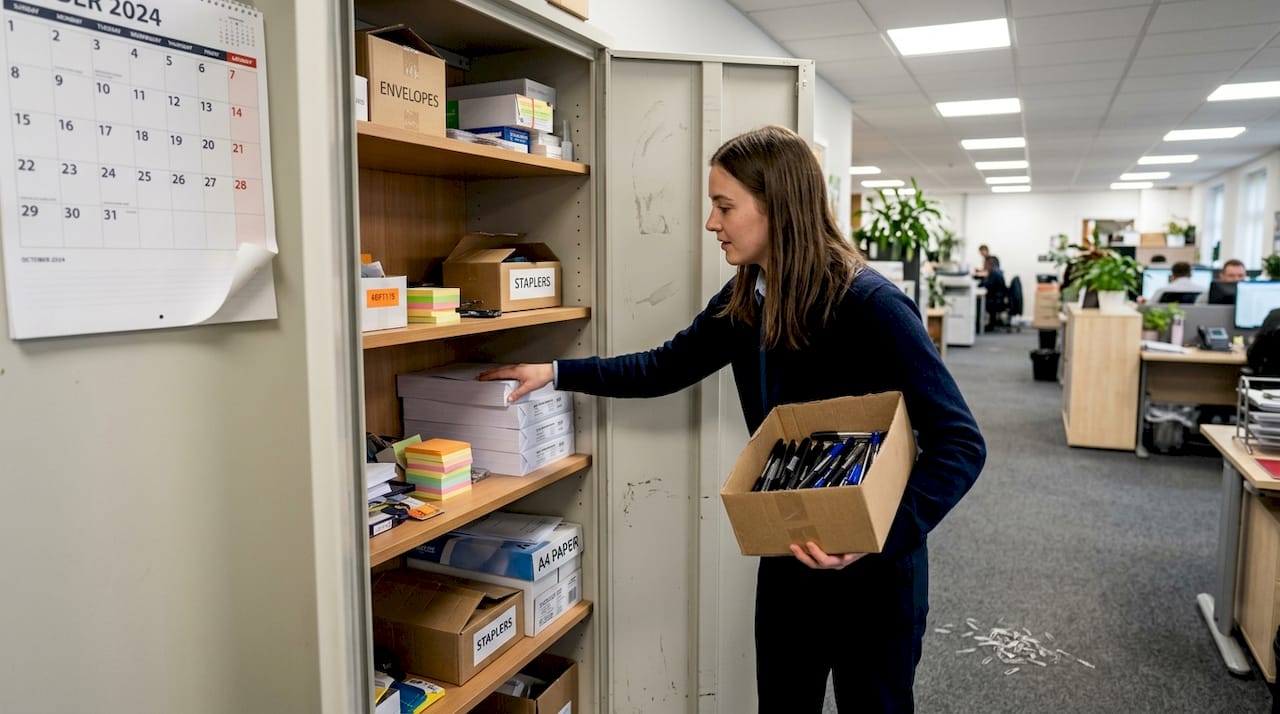
Top items for any UK office include copier paper, pens, notebooks, sticky notes, and envelopes. These are the non-negotiables that every team member reaches for daily.
Beyond the basics, your consumables list should include:
Pro Tip: Set up a subscription order with your preferred supplier for high-volume consumables like paper and toner. Subscription pricing is typically 10 to 15 per cent cheaper than ad-hoc ordering, and it removes the admin burden of reordering every few weeks.
For hybrid teams, consider whether home workers need a small consumables allowance. Printing at home, buying their own pens, and sourcing notebooks from personal funds adds up over a year and is an area where employer support makes a real difference to staff satisfaction.
Browse our office accessory options for practical additions that keep desks organised and teams efficient.
With basic supplies in place, ensure your organisation meets all necessary safety and regulatory standards.
Safety compliance is not optional, and in a hybrid environment it becomes more complex because your obligations follow your employees, not just your building. Here is what every UK office must have in place:
Employers must assess workstations if DSE is used for more than an hour per day, and COSHH regulations apply to cleaning products and office chemicals. These are not administrative formalities. They are legal duties with real consequences if ignored.
For home workers, the picture is slightly different. Low-risk home workers need no extra first aid supplies from their employer, but DSE assessments still apply if they use screens regularly.
“Compliance in a hybrid workplace is not a one-time checklist. It is an ongoing conversation between managers, staff, and the changing nature of how work gets done.”
Wellness essentials are increasingly part of the compliance conversation too. Poor air quality, inadequate lighting, and uncomfortable temperatures all affect concentration and can contribute to staff absence. Investing in air quality monitors, blackout blinds, and adjustable lighting is increasingly seen as a productivity investment, not a luxury.
For a detailed look at how to structure a compliant and comfortable workspace, the executive safety setup guide covers the key considerations for UK office managers. You can also review workstation compliance requirements directly from the HSE.
Most procurement teams inherit an essentials list from whoever held the role before them. They update quantities, maybe swap a supplier, and carry on. It is an understandable approach, but it is also how offices end up full of equipment that no longer matches how people actually work.
Hybrid working has exposed the fragility of static procurement lists. A list built for five days a week in the office simply does not translate to a world where some staff come in twice a week and others work remotely full time. The gaps show up fast: wrong chair heights, missing monitor stands, inadequate storage for hot-desking.
The smarter approach is to treat your essentials list as a living document. Review it every six months. Gather feedback from staff across different roles and locations. Cross-reference it against why ergonomic choices matter and against the latest HSE guidance, which does evolve.
Compliance is not a checklist you complete once. It is a practice that requires genuine staff input to stay relevant. The offices that get this right are the ones where procurement is seen as a service to employees, not just a cost to be minimised.
Building a compliant, productive, and comfortable office in 2026 takes more than a standard supply order. It takes considered choices across furniture, technology, consumables, and safety kit, all mapped to how your specific team works.
At Furniture for Business, we supply commercial-grade modern ergonomic chairs, office desks, and accessories designed for UK teams of all sizes, with free delivery to the UK mainland. Whether you are fitting out a new space or refreshing an existing one, our team can help you source the right pieces efficiently. If you are introducing sit-stand working, our guide to how to set up height-adjustable desks is a practical starting point for getting the configuration right from day one.
Dual monitors increase productivity and adjustable desks support hybrid models, making height-adjustable desks, ergonomic chairs, dual monitors, high-speed internet, and core stationery the top five essentials for most hybrid setups.
Employers must cover home equipment costs and DSE compliance for hybrid and remote staff, meaning the financial responsibility sits with the business, not the employee.
Fire extinguishers, first aid kits, and DSE workstation assessments are legal essentials for UK offices, and COSHH regulations cover the safe storage and use of cleaning chemicals and other office substances.
Office needs and compliance should be reassessed regularly, and reviewing your essentials list annually or whenever you change layout, adopt new ways of working, or update legal guidance is considered best practice.

Phone: 0330 043 4114
VAT no. GB 991 8681 60
Company no. 07250570