TL;DR:
- Home-office crossover furniture is designed to quickly transform a single room into both a workspace and a living area, saving space and increasing functionality. The most effective systems include stay-level desks, Murphy beds, and modular sofa-bed-desk combos, which balance ergonomics, durability, and aesthetics. Choosing the right unit depends on quality, cable management, zone definition, and specific lifestyle needs rather than initial cost alone.
Home-office crossover furniture is a category of multifunctional, space-saving furnishings that enable a single room to serve as both a professional workspace and a living or guest area through quick, ergonomic transformations. The concept has moved well beyond the basic fold-down table. Convertible units in 2026 convert in under 30 seconds, with 3-in-1 sofa-bed-desk combos starting at £179. For remote workers sharing a flat, a spare room, or a studio, this category of furniture solves the most persistent problem in home working: making one room do two jobs without compromising either.
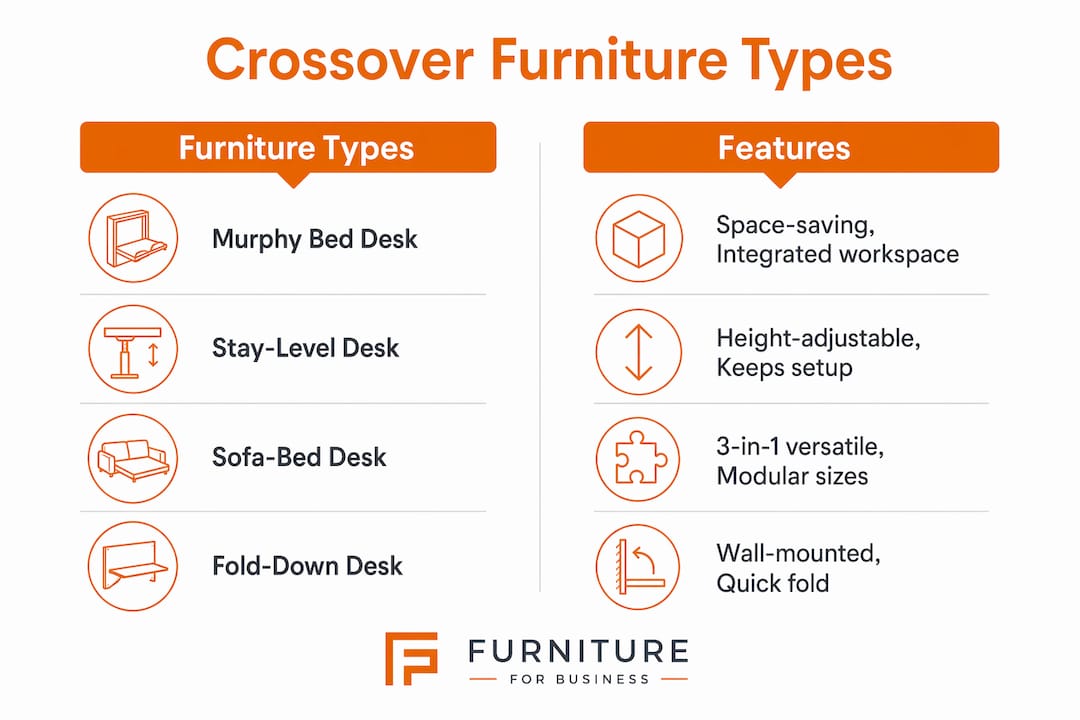
Home-office crossover furniture refers to units engineered to shift between work and living functions within a single footprint. The industry term you will encounter most often is convertible multifunctional furniture, though crossover furniture has become the shorthand used by remote workers and interior designers alike. Four main types define the category.

Murphy bed with integrated desk. A wall-mounted bed folds down over a desk surface, or the desk pivots clear when the bed deploys. Premium Italian-made systems such as the Compatto rotating office unit carry custom lead times of 16 to 20 weeks, which reflects the engineering complexity involved. These are the most space-efficient option for a dedicated guest room that doubles as a daily office.
Stay-level desk systems. The most practically significant engineering advance in this category is the stay-level desk mechanism, which keeps the desk surface horizontal throughout the bed conversion. A laptop, monitor, and coffee cup can remain on the desk while the bed lowers or raises. This feature separates genuinely usable crossover furniture from basic folding tables that require you to clear the surface every time.
Sofa-bed-desk combos. Products like NESLAKO’s Wunder puffer series offer 3-in-1 versatility with modular sizing for singles, couples, and families. Delivery runs two to three days, making this the most accessible entry point for renters who cannot install wall-mounted systems.
Fold-down wall desks. The simplest crossover type: a desk surface mounted to the wall that folds flat when not in use. These suit very small rooms where even a compact desk feels intrusive, and they pair well with a separate sofa bed.
| Type | Best for | Conversion time | Key limitation |
|---|---|---|---|
| Murphy bed with integrated desk | Dedicated guest rooms | Under 60 seconds | High cost, installation required |
| Stay-level desk system | Daily workers needing speed | Under 30 seconds | Premium price point |
| Sofa-bed-desk combo | Renters and small studios | Under 30 seconds | Lower weight capacity |
| Fold-down wall desk | Minimal footprint rooms | Instant | No sleeping function |
Pro Tip: Before measuring for any wall-mounted unit, check whether your walls are solid masonry or stud partition. Murphy bed systems require solid fixing points, and a stud wall will need a reinforced backing board to carry the load safely.
Selecting the right unit comes down to five practical criteria, and upfront price is the least important of them.
Total cost of ownership. Durable crossover furniture lasting 15 years at a higher initial cost is consistently more economical than cheaper alternatives that fail within three years. Calculate cost per year, not cost at checkout.
Mechanism quality. The transformation hardware is the unit’s weakest point. Look specifically for heavy-duty gas pistons and reinforced steel hinges. Cheap plastic fasteners cause early mechanical failures under daily use, and replacement parts for budget units are rarely available. Inspect or request detailed specifications before committing.
Weight capacity. A desk that stays level during bed conversion is only useful if it can hold your actual equipment. A dual-monitor setup, a docking station, and a laptop can easily exceed 15 kg. Confirm the rated capacity of the desk surface, not just the bed frame.
Integrated cable management. Built-in power rails and internal cord channels are a non-negotiable feature for daily use. Movable furniture without dedicated cord routing means unplugging every device each time you convert the unit. That friction compounds quickly over weeks of use.
Ergonomic support for both functions. A desk set at the correct height for seated work and a mattress rated for regular sleep are both required. Many budget units compromise one for the other. If you use the space for guest sleeping only occasionally, you can accept a thinner mattress. If you sleep there nightly, treat the mattress specification as seriously as the desk ergonomics.
Pro Tip: Request a physical sample of the mechanism or visit a showroom before ordering any unit above £800. Watching a conversion on video tells you nothing about the tactile quality of the hardware or the resistance of the gas pistons under load.
Explore multi-purpose furniture options to understand how multifunctional designs translate from home use to commercial environments, which often sets a higher durability benchmark.
The biggest misconception about ergonomic office furniture is that residential style must be sacrificed for professional-grade support. Modern crossover furniture disproves this entirely. Brands like Herman Miller and Humanscale now produce fully adjustable chairs in soft, neutral fabrics that read as living room furniture rather than office equipment. The chair is often the most visually dominant piece in a crossover room, so this shift matters.
Beyond seating, the design principles that make crossover rooms work are consistent across product types:
For seating that bridges both worlds, design soft seating options offer ergonomic support in residential-friendly finishes that suit crossover setups well.
Crossover furniture introduces specific failure points that standard office or home furniture does not share. Knowing them in advance prevents costly mistakes.
Cable management failures are the most frequent complaint from crossover furniture users. A unit without integrated cord channels forces you to disconnect monitors, chargers, and peripherals every time you convert. The solution is to specify internal cable routing as a requirement, not a nice-to-have, during selection.
Mechanism wear under daily use is the second most common issue. Gas pistons and hinges rated for occasional use degrade quickly when cycled twice daily. Ask manufacturers for their rated cycle count. A quality unit should handle 10,000 cycles or more without adjustment.
Mental blur between work and rest is a subtler but equally real problem. When your desk and your bed occupy the same physical space, the psychological boundary between work and recovery weakens. Physical and visual cues such as a specific lamp you switch on only during work hours, or a rug that defines the desk zone, help maintain that separation.
Pro Tip: Set a two-minute conversion routine and stick to it. Fold the desk away, store your notebook, and switch the lighting. The ritual itself becomes a psychological signal that work has ended, which is as valuable as any ergonomic feature.
Home-office crossover furniture works best when mechanism quality, integrated cable management, and zone definition are prioritised over upfront cost.
| Point | Details |
|---|---|
| Definition and function | Crossover furniture enables one room to serve as both a workspace and a living or guest area through quick conversion. |
| Stay-level desk systems | The most practical feature in the category; keeps the desk horizontal during bed conversion without clearing equipment. |
| Total cost of ownership | A durable unit lasting 15 years costs less per year than a cheap alternative replaced every three years. |
| Aesthetics and function | Modern chairs from brands like Herman Miller and Humanscale prove ergonomic support and residential style are not mutually exclusive. |
| Zone definition | Physical and visual boundaries, including lighting layers and room dividers, are as important as the furniture itself for daily wellbeing. |
Working with clients across commercial and home office environments, I have seen the same mistake repeated: buyers focus on the transformation mechanism and ignore everything around it. The Murphy bed folds perfectly, but the room has no cable management, no defined zones, and a chair that belongs in a canteen. The furniture works; the room does not.
The units that genuinely improve daily life share one quality: they were designed around a specific daily routine, not around a marketing photograph. A stay-level desk system is only worth its premium if you actually leave equipment on it during conversion. Integrated cabinetry only earns its cost if you use it to clear the room completely each evening.
My honest view is that most remote workers are better served by a high-quality fold-down wall desk paired with a separate quality sofa bed than by a single all-in-one unit at the same price. The combined solution is more repairable, more replaceable, and easier to reconfigure as your work habits change. The all-in-one is the right choice only when floor space is genuinely critical.
The future of this category is modular. Manufacturers are moving towards systems where the desk, storage, and sleeping components can be specified and upgraded independently. That is the direction worth watching in 2026 and beyond.
— Furniture
If crossover furniture has shown you what a well-considered workspace can do, the next step is getting the individual components right. Furnitureforbusiness supplies commercial-grade office desks and ergonomic office chairs built to the durability standards that crossover setups demand, with free delivery to the UK mainland.
For keeping a dual-use room genuinely tidy, the office storage range includes closed cabinetry and modular units that conceal work clutter completely when the room switches to guest mode. If you are still weighing your options, the 2026 furniture buying guide covers durability benchmarks, ergonomic criteria, and value comparisons to help you make a confident decision.
Home-office crossover furniture is multifunctional furniture designed to convert a single room between a professional workspace and a living or guest area. Common types include Murphy bed and desk combos, sofa-bed-desk units, and fold-down wall desks.
Quality units convert in under 30 seconds. Stay-level desk systems allow users to leave laptops and monitors in place during the transformation, making the process genuinely practical for daily use.
Prioritise mechanism quality, integrated cable management, and total cost of ownership over upfront price. Durable gas pistons and reinforced hinges are the components most likely to determine long-term reliability.
Modern ergonomic chairs from brands like Herman Miller and Humanscale are available in soft, neutral fabrics that suit residential interiors. Closed cabinetry integrated into Murphy bed systems conceals all work equipment when the room is in guest mode.
Use physical and visual cues such as dedicated task lighting, room dividers, and a consistent conversion routine to signal the shift between work and rest. Storing all work materials inside the unit’s cabinetry when not working reinforces the psychological separation.

Phone: 0330 043 4114
VAT no. GB 991 8681 60
Company no. 07250570