Both FSC and PEFC are credible, third party certification schemes accepted as evidence of legal and sustainable timber sourcing, but they differ in governance and how prescriptive their standards are. FSC runs a single international standard, while PEFC endorses national systems that can vary by country. For procurement, the priority is simpler than picking a winner: confirm a valid, unbroken chain of custody and a verifiable certificate number.
TL;DR:
- Check the chain of custody certificate number in the official FSC or PEFC registry, matching the holder name, product scope, and invoice details before signing.
- Certificates typically remain valid for up to five years, with annual audits, so recheck status during long contracts rather than relying on an initial approval.
- Products carrying mixed content claims generally need at least 70% certified or recycled material, so a certification label does not mean every component is certified.
- UK procurement policy accepts both schemes as Category A evidence when an unbroken chain of custody supports the claim; tenders can specify either scheme.
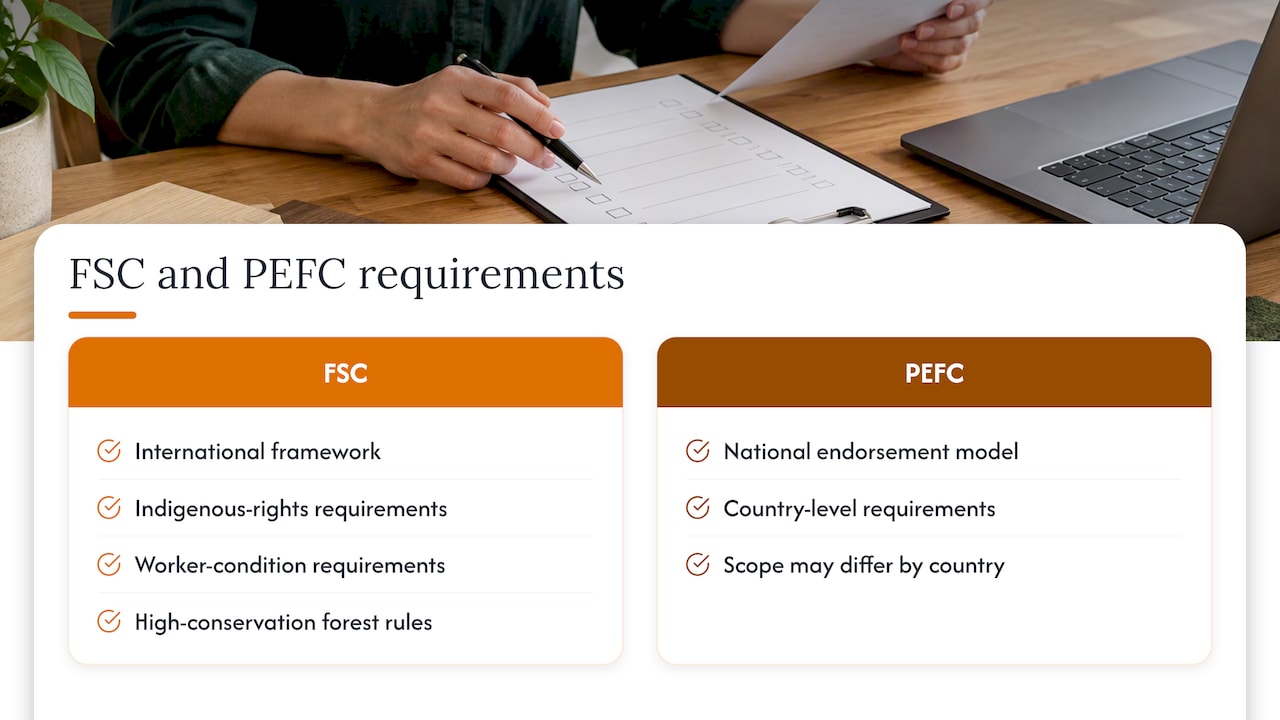
The Forest Stewardship Council issues forest management and chain of custody certificates under a single global framework of Principles and Criteria that applies the same way wherever a forest or factory is certified. Its product labels follow defined categories, including 100%, Mix and Recycled, so buyers can see at a glance how much certified material a product contains.
The Programme for the Endorsement of Forest Certification works differently. Rather than running one worldwide standard, it endorses national forest certification systems against its own international benchmarks, which means the detail of requirements can shift from country to country. PEFC uses its own labelling conventions, including PEFC Certified, Recycled and 100% claims, broadly mirroring FSC’s approach to communicating certified content.
Despite the structural difference, the certificates themselves work in a similar way:
For anyone buying furniture or raw timber, the common ground between FSC and PEFC matters more day to day than the differences. Both run on third party auditing: an accredited certification body, not the forest owner or manufacturer, checks compliance and issues the certificate.
Both also build traceability into the supply chain through chain of custody certification, which tracks certified material from forest to finished product. When that chain is unbroken and properly documented, both schemes are recognised as acceptable procurement evidence under the UK Timber Procurement Policy, provided the paperwork backs up the claim.
That last point is where most procurement mistakes happen: a supplier mentioning “FSC” or “PEFC” on a spec sheet is not the same as holding a verifiable chain of custody certificate.
The practical differences between FSC and PEFC show up less in marketing copy and more in contracts, tender documents and supplier audits.
Pro Tip: Write tender clauses around “valid CoC certificate number, verifiable on the scheme’s public registry” rather than naming a single scheme: it widens your supplier pool without lowering your evidence standard.
Verification takes a few minutes and should happen before, not after, a purchase order is signed.
All chain of custody certificates are listed online with their current status, which is exactly what makes this check possible for procurement staff with no forestry background, according to CPET guidance. A mismatch between the certificate holder’s name and the company issuing your invoice is one of the most common red flags, and it is worth querying before the order goes ahead.
Choosing between FSC and PEFC is rarely about one scheme being objectively “better”; it is about what your supply chain can actually deliver and verify.
Pro Tip: Ask bidders to quote their certificate number directly on the tender response form rather than in a covering letter: it makes verification part of the scoring process instead of an afterthought.
A procurement workflow that builds these checks in early saves time later; our guide to furniture procurement workflows walks through how to structure that process for a typical office fit-out.
Under the UK Timber Procurement Policy, both FSC and PEFC count as Category A evidence of legal and sustainable sourcing, provided the claim is backed by an unbroken chain of custody. The UK Woodland Assurance Standard is used domestically by both schemes, helping to align national forestry practice with their respective international requirements. For procurement purposes, the compliance step that actually matters is validating the certificate number and its current status, not debating which scheme is philosophically stronger.
For office furniture specifically, the environmental and social differences between FSC and PEFC rarely come down to the wood itself; most commercial timber, panel products and veneers can be sourced under either scheme depending on the supplier’s region and mill. FSC’s more prescriptive international framework tends to set out detailed requirements around indigenous rights, worker conditions and high conservation value forests, which can matter for organisations with specific social procurement commitments.
PEFC’s national endorsement model means social and environmental requirements are set at country level, so a PEFC certificate from one country is not automatically identical in scope to one from another. For office furniture buyers this means the certification scheme alone does not tell the full story. The more useful question is whether the certificate’s scope covers the specific timber or board product in your desk, chair frame or storage unit, and whether the chain of custody from forest to finished furniture piece is unbroken. Our guide to sustainable office furniture sets out how certification fits alongside other material choices, such as recycled steel and low-emission finishes, when assessing a product’s overall footprint.
A few misconceptions come up repeatedly in furniture tenders. The first is that a logo on a brochure proves certification: a scheme mark on marketing material is not evidence, a chain of custody certificate number checked against the supplier’s name is.
The second myth is that FSC is always “stricter” and therefore always the right choice. FSC’s international framework is generally more prescriptive, but prescriptiveness does not automatically translate into a better outcome for every product category, and PEFC’s national standards can be equally rigorous within their own market.
A third misconception is that certification covers 100% of a product by default. Many certified products carry percentage claims such as a 70% threshold for mixed content, meaning a meaningful share of the material may come from non certified or recycled sources, which is entirely legitimate under both schemes’ own rules.
Finally, some buyers assume certification status never changes once granted. Certificates are time-limited, typically valid for up to five years with annual audits, so a certificate checked at the start of a contract can lapse before the contract ends if it is not reverified.
Certification status increasingly acts as a filter before price or design even enter the conversation. A tender that requires verifiable FSC or PEFC chain of custody evidence automatically screens out suppliers who cannot produce a real certificate number, regardless of how competitive their quote looks on paper.
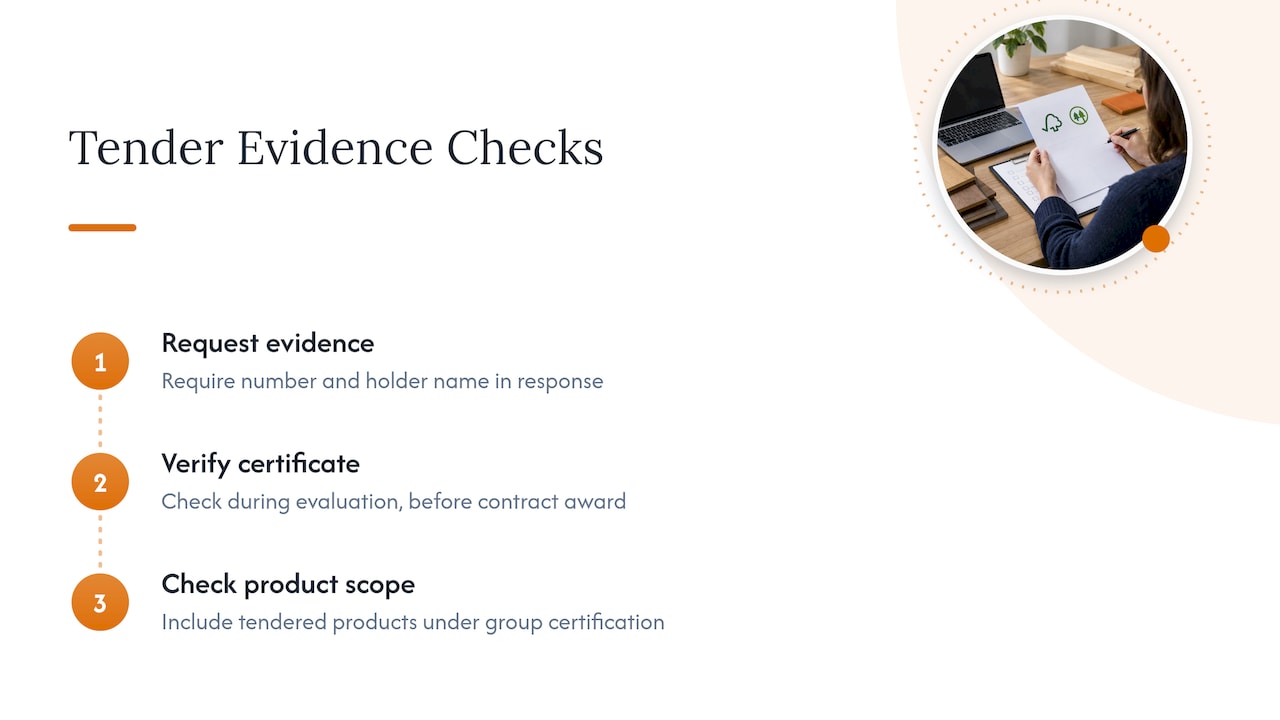
This changes how scoring works in practice. Rather than treating certification as a tick box, well-run tenders ask for the certificate number and holder name as a mandatory field on the response form, then verify it during evaluation rather than after the contract is awarded. Suppliers who hold group certification, common among smaller joinery and furniture manufacturers under PEFC, can still compete on equal terms provided their scope covers the specific products being tendered.
Specifying the evidence standard, rather than naming one scheme, also protects the buying organisation from accidentally narrowing the market to a handful of large suppliers. Our office essentials procurement guide sets out how to structure specification documents so that certificate evidence sits alongside other supplier requirements, such as delivery lead times and warranty terms, without one dominating the scoring at the expense of the others.
Certification earns its value only when someone actually checks it. A valid FSC or PEFC chain of custody certificate backed by a verifiable number carries real weight; a scheme name printed on a product page without a certificate reference does not.
We think buyers do better weighing certification alongside supplier reliability, lead times and total cost, rather than treating one scheme as a moral shortcut. When documentation is asked for clearly and checked properly, both schemes do the job procurement needs them to do.
We supply commercial office furniture and can provide invoice wording and any supplier certification details we hold when a tender or audit requires it.

For readers comparing certification approaches across other furniture categories, this supplier’s guide to FSC verification for wooden decor and this explainer on FSC labelling for garden furniture cover similar checks for different product types.
No, FSC certification is not a legal requirement; it is one of two schemes recognised as Category A evidence under the UK Timber Procurement Policy when supported by a valid chain of custody. Businesses can also demonstrate legal and sustainable sourcing through other accepted evidence routes.
PEFC certification means a forest, supply chain company or product has been independently audited against a national forest certification standard that PEFC endorses against its own international benchmarks. For products, it typically involves a chain of custody certificate and a labelling claim such as PEFC Certified, Recycled or 100%.
FSC certification is independent verification, carried out by accredited third party auditors, that a forest is managed under the Forest Stewardship Council’s global Principles and Criteria, or that a company’s supply chain maintains an unbroken chain of custody for FSC certified material.
Yes, checking certification is worth the few minutes it takes, because a logo alone is not proof of anything. Verifying the chain of custody certificate number against the official registry and matching it to your supplier’s name and invoice confirms the claim is real rather than marketing.
For readers who want to check a claim directly, the Forest Stewardship Council and Programme for the Endorsement of Forest Certification sites both host certificate search tools, including the PEFC certificate finder. UK government guidance on the Timber Procurement Policy and the related timber procurement advice note set out how Category A evidence is assessed in practice.

Phone: 0330 043 4114
VAT no. GB 991 8681 60
Company no. 07250570