TL;DR:
- A well-structured furniture procurement process minimizes costly mistakes, missed deadlines, and supplier disputes. Establish clear scope, align stakeholders, and incorporate sustainability early to ensure smooth project execution. Using digital tools and detailed workflows enhances efficiency and helps embedded procurement best practices over time.
Uncoordinated furniture procurement is one of the most reliably expensive mistakes a business can make. Missed lead times, supplier disputes, and last-minute substitutions are not bad luck. They are the direct result of a poorly structured workflow for furniture procurement. Whether you are fitting out a corporate head office or refreshing a hotel lobby, the difference between a smooth project and a costly one almost always comes down to process, not budget. This guide gives you a clear, stage-by-stage framework covering planning, sourcing, purchasing, logistics, and sustainability, built specifically for procurement professionals and business decision-makers.
| Point | Details |
|---|---|
| Define scope before sourcing | Constraints defined upfront produce a tighter vendor pool and more productive sourcing conversations. |
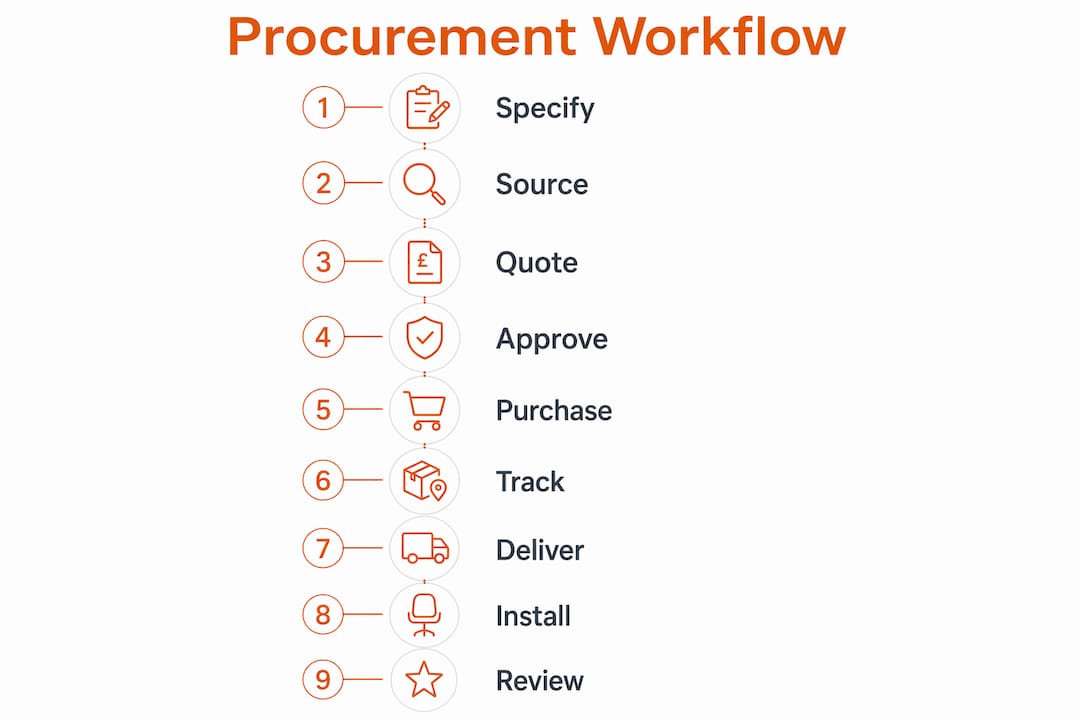
| Use a phased workflow | A well-structured furniture acquisition workflow covers specify, source, quote, approve, purchase, track, deliver, install, and handover. |
| Embed sustainability early | Including lifecycle assessments and certification criteria in tender documents reduces long-term costs and supports BREEAM, LEED, and SKA compliance. |
| Manage logistics proactively | Customs holds, damaged goods, and staggered deliveries are predictable risks. Build mitigation into the plan before orders are placed. |
| Leverage digital tools | Procurement platforms centralise supplier data, automate RFQs, and cut manual errors across the full purchasing cycle. |
In procurement circles, this stage is often called the pre-procurement phase, and it is where most projects are either set up for success or quietly sabotaged. The furniture sourcing process only works smoothly when the foundations are solid.
Start with the non-negotiables. How many workstations, meeting rooms, or bedrooms need furnishing? What is the handover date, and how does that map backwards through delivery, production, and ordering lead times? For corporate offices, you also need to account for phased occupancy if teams are moving in floor by floor. For hospitality, soft-opening dates are fixed and non-negotiable. Treat the timeline as a constraint, not an estimate.

Sourcing constraints defined first including room counts, budget, style, and delivery dates lead to a tighter vendor pool and far more productive conversations.
Specifications should cover aesthetics, materials, ergonomic requirements, durability standards, and any compliance obligations such as fire retardancy ratings or contract-grade certification. This is also the stage to lock in sustainability criteria, which we cover in detail later.
Get procurement, design, facilities management, and finance aligned before a single supplier is contacted. Misalignment between these teams is the number one cause of scope changes mid-project, and scope changes mid-project cost money.
| Requirement area | What to define |
|---|---|
| Functional specs | Dimensions, weight capacity, adjustability, ergonomic standards |
| Aesthetic specs | Colour palette, material finish, brand alignment |
| Compliance | Fire ratings, contract-grade certification, accessibility standards |
| Sustainability | Recycled content targets, certifications required (e.g. FSC, GREENGUARD) |
| Commercial | Budget per unit, contingency percentage, payment terms |
Pro Tip: Set a contingency of at least 10 to 15 percent on top of your furniture budget. Late-stage substitutions, shipping damage replacements, and quantity adjustments are almost inevitable on projects over 50 units.
This is the operational heart of any furniture acquisition workflow, and it is where most time is either saved or lost. The industry term for this end-to-end activity is FF&E procurement (Furniture, Fixtures, and Equipment), a framework widely used in both corporate real estate and hospitality fit-out.
A structured procurement workflow covers distinct phases: specify, source, quote, approve, purchase, track, deliver, install, and handover, with each phase carrying its own lead time sensitivity.
Begin vendor research only after your specifications are finalised. Searching for suppliers without clear criteria is how procurement teams end up with a disorganised shortlist of incompatible products. Use your spec sheet to filter by contract-grade certification, lead times, MOQ (minimum order quantity), and sustainability credentials.
Coordinating vendors across multiple manufacturers requires careful alignment of quoting formats, lead times, and logistics to prevent costly delays. Verify suppliers by requesting references from comparable projects, reviewing their financial stability, and confirming their capacity to fulfil your order within your timeline.
The Request for Quotation is your primary tool for obtaining comparable bids. Send identical specification documents to all shortlisted suppliers so responses can be meaningfully compared. Define the information you require in each response: unit pricing, bulk discount thresholds, lead times, delivery terms, warranty coverage, and sustainability documentation.
Digital procurement platforms automate RFQs, centralise supplier data, and streamline approval flows, reducing manual errors and saving significant time per project.
| Sourcing approach | Best suited to | Key risk |
|---|---|---|
| Direct vendor | Large, straightforward orders | Requires in-house management resource |
| Procurement agent | Complex multi-category projects | Additional cost layer; select carefully |
| Software platform | Teams managing multiple projects | Onboarding time and data migration |
Pro Tip: Ask every shortlisted supplier for their current production schedule before negotiating. A supplier offering a competitive price but with a 16-week lead time when you need 10 weeks is not a viable option, regardless of price.
Procurement agents manage entire furnishing cycles from specification to installation logistics. Without them or automated platforms, teams can spend 40 to 60 percent of their time on operational tasks rather than strategic decisions.
Once suppliers are selected, the workflow shifts from evaluation to execution. This is where financial controls, communication discipline, and logistics planning determine whether your project lands on time.
Every order should be placed via a formal purchase order that references the agreed specification, unit price, total value, delivery schedule, and payment terms. POs create a legal paper trail and prevent suppliers from substituting specifications without authorisation.
Approval workflows matter here. For orders over a defined threshold, require sign-off from finance before issue. Track payment milestones against delivery milestones, not just invoice dates. Paying a deposit for goods that will not arrive for 14 weeks ties up working capital unnecessarily.
| Stage | Action required | Control mechanism |
|---|---|---|
| PO issuance | Reference spec, price, delivery date | Two-person authorisation above threshold |
| Deposit payment | Tied to confirmed production slot | Payment terms in contract |
| Pre-shipment | Inspect or request factory photos | Quality hold before dispatch |
| Delivery | Inspect on arrival, before sign-off | Damage report within 24 hours |
| Final payment | Released after snagging complete | Retention clause in PO |
Staggered delivery schedules are common on large fit-out projects and require warehousing if the site is not ready to receive all goods simultaneously. International sourcing carries real risks: customs holds of up to 30 days, damaged upholstery in transit, and unexpected tariffs are documented challenges that can derail a project’s final weeks.
Pro Tip: For UK-based orders, locally manufactured furniture offers verifiable supply chains and shorter lead times. UK production also simplifies maintenance sourcing and reduces the environmental cost of freight.
Sustainable procurement is now a financial strategy, not just an ethical one. For UK businesses managing Scope 3 emissions, the furniture they specify sits directly in the supply chain and must be accounted for.
The practical case is equally strong. Specifying furniture with longer lifecycle performance reduces replacement frequency. Choosing certified sustainable materials supports building ratings such as BREEAM, LEED, and SKA, which affect the market value and leasing attractiveness of commercial properties.
Here is how to build sustainability into the workflow rather than bolting it on at the end:
Integrating sustainability criteria into tender documentation with weighted scorecards drives supplier innovation and environmental compliance, rather than simply filtering for greenwashing claims.
Sustainable procurement done well does not cost more. It costs differently. The upfront specification work takes longer, but the reduction in early replacements, maintenance calls, and compliance retrofitting more than compensates over a five-year asset cycle.
For a deeper look at how to apply these principles in practice, the sustainable office furniture guide from Furnitureforbusiness covers material selection and certification standards in detail.
Having worked closely with procurement teams across corporate and hospitality environments, I have seen the same failure modes repeat with remarkable consistency. The biggest one is not budget underestimation or poor supplier selection. It is the assumption that a procurement process can be improvised as it goes.
The teams that execute best treat the workflow as a product. They document it, review it after every project, and refine it. They know their standard lead times by product category. They have preferred supplier lists with pre-agreed commercial terms. They do not start sourcing until specifications are locked. These habits sound mundane, but they are what separates a 12-week fit-out from a 20-week one.
I am also sceptical of over-reliance on procurement technology without the process discipline to underpin it. A platform that automates a chaotic workflow just produces chaos faster. The tools are genuinely useful, particularly for tracking and RFQ management, but they are a multiplier of good process, not a substitute for it.
What I would encourage every procurement professional reading this to take seriously is the relationship side. Suppliers who trust you, who know you communicate clearly and pay on time, will solve problems for you that they will not solve for a transactional client. That goodwill is worth more than a 3 percent discount.
Finally, sustainability is moving from a specification checkbox to a genuine sourcing lens. The procurement professionals who get ahead of this, building supplier scorecards and lifecycle criteria into their standard process now, will not be scrambling to retrofit compliance in two years.
— Furniture
If you are putting the workflow from this article into practice, the sourcing phase becomes significantly more straightforward when your supplier has already done the specification work for you.

Furnitureforbusiness supplies commercial-grade furniture across the UK with free delivery to the mainland, covering office chairs, office desks, meeting room furniture, and office storage. All products are contract-grade and suitable for corporate and hospitality environments. Bulk order pricing, clear lead times, and straightforward ordering make the purchasing phase cleaner. Whether you are furnishing five workstations or five hundred, browse the full range at Furnitureforbusiness to find products that slot directly into your procurement plan.
A structured furniture acquisition workflow covers nine phases: specify, source, quote, approve, purchase, track, deliver, install, and handover. Each phase has its own lead time requirements, and skipping phases is the most common cause of project delays.
Use a procurement agent for complex multi-category projects where in-house resource is limited. Direct vendor sourcing works well for straightforward orders where your team has the capacity to manage RFQs and logistics. Agents can manage entire furnishing cycles from specification through to installation, which justifies the additional cost on larger projects.
Include lifecycle assessment requirements, third-party certifications, and recycled content targets in your initial specification document. Weight sustainability criteria in your supplier scorecard alongside cost and delivery. UK businesses managing Scope 3 emissions must account for embedded emissions in furniture procurement as part of corporate governance.
Allow 10 to 15 percent above your base furniture budget to cover late-stage substitutions, transit damage replacements, and quantity adjustments. For projects involving international sourcing, increase this to account for potential customs delays and additional freight costs.
Procurement platforms automate RFQ distribution, centralise supplier data, and manage approval workflows in one place. They reduce manual errors and, according to FF&E procurement research, can save teams hundreds of hours across a single project by eliminating duplicated data entry and chasing.

Phone: 0330 043 4114
VAT no. GB 991 8681 60
Company no. 07250570