TL;DR:
- Managing office procurement without a structured approach leads to unnecessary costs and inefficiencies. Over 80% of leaders admit that indirect spend, such as supplies and furniture, is poorly managed, causing budget leakage. Following category-based strategies, scheduling restocks, and building strong supplier relationships help reduce overspending and streamline procurement processes.
Managing office procurement without a structured approach costs more than most organisations realise. Over 80% of leaders admit that indirect spend, which includes office supplies and furniture, is poorly managed, creating unnecessary inefficiencies and budget leakage. This office essentials procurement guide is written specifically for UK office managers and procurement professionals who want practical, category-based strategies to source what their teams need without overspending, over-ordering, or scrambling at the last minute. From stationery to ergonomic seating, you will find a clear framework covering planning, execution, and quality assurance for every major category.
| Point | Details |
|---|---|
| Categorise before you buy | Classify supplies by criticality and usage frequency to build predictable, policy-driven ordering. |
| Plan restocking on a schedule | Weekly or monthly restocking prevents workflow disruptions and reduces emergency purchasing. |
| Choose suppliers for reliability | Long-term supplier relationships deliver better value than chasing the lowest one-off price. |
| Size furniture to real occupancy | Plan furniture quantities around realistic headcounts, not theoretical maximums, to avoid waste. |
| Use digital tools to control costs | Procurement platforms reduce administrative burden and prevent uncontrolled maverick buying. |
Every credible office supply buying guide starts in the same place: knowing exactly what you are buying and why. Without category clarity, procurement becomes reactive, expensive, and difficult to audit.
Office essentials fall into four broad categories, each requiring a different procurement approach.
Classifying supplies by criticality and consumption frequency gives procurement teams a working framework to apply differentiated policies: automated reorders for mission-critical consumables, quarterly reviews for occasional items, and scheduled bulk buys for high-frequency stationery.
| Category | Criticality | Procurement approach |
|---|---|---|
| Toner and ink | Mission-critical | Automated reorder with safety stock |
| Pens and paper | High frequency | Monthly bulk purchase |
| Technology accessories | Medium, occasional | Quarterly review and planned ordering |
| Office furniture | High value, long cycle | Needs assessment before each purchase |
| Hygiene supplies | Facilities-critical | Weekly or fortnightly restocking |
Pro Tip: Build a simple office essentials checklist in a shared spreadsheet. Assign each item a category, a minimum stock level, and a reorder trigger. Reviewing it monthly takes fifteen minutes and prevents a surprising number of last-minute orders.
Knowing your categories is the foundation. Building a procurement plan on top of them is where you start saving real money.
Many organisations lump all office supply spend into a single budget line. This makes it nearly impossible to identify where overspending is happening. Break your annual procurement budget into the four categories above, then track actuals against each monthly. You will quickly see which categories are consistently over budget and where you have room to negotiate.
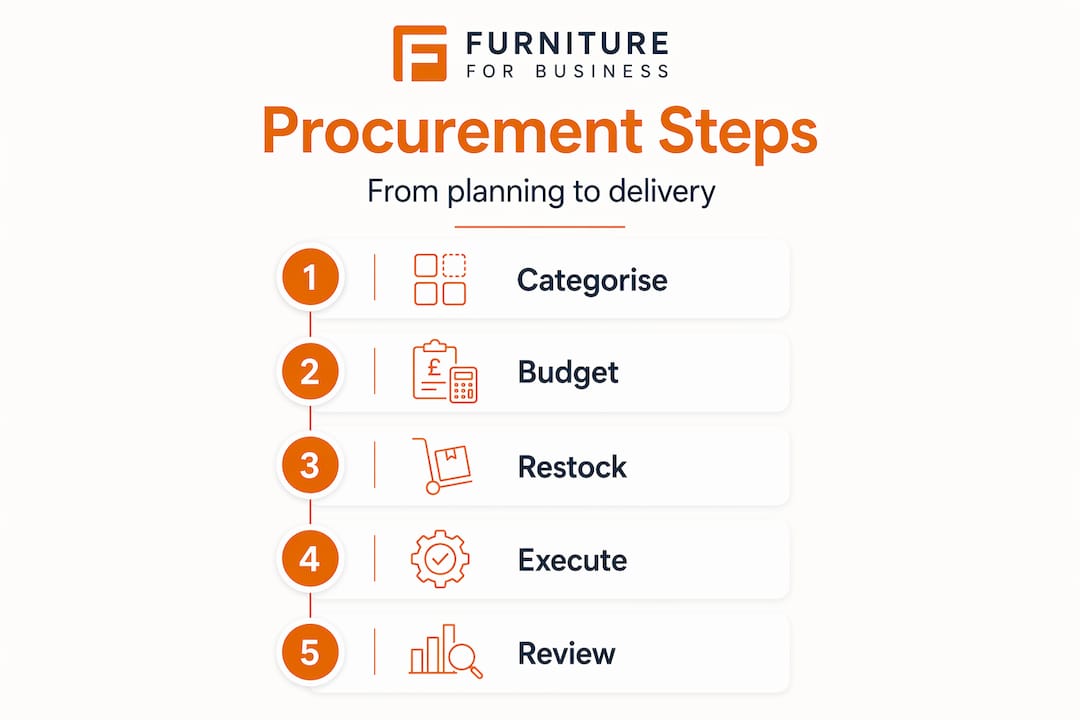
Price matters, but it is not the only thing that matters. Vendor reliability, product range, and relationship quality consistently deliver better long-term value than the supplier offering the lowest bid on a single transaction. When evaluating suppliers, apply these criteria in order:
Restocking office supplies weekly or monthly is widely regarded as best practice for maintaining uninterrupted workflows. The specific frequency depends on your team size and consumption rates, but the critical point is that it should be scheduled, not triggered by someone noticing the supplies cupboard is empty.
Demand planning does not need to be complicated. Track consumption over three months, calculate an average, then set reorder points at roughly 20% above that average to give yourself a buffer.
Pro Tip: Consolidating to two or three preferred suppliers rather than ten different vendors cuts the time your team spends on purchase orders considerably. Processing a single purchase order can cost between £16 and £56 in administrative time alone. Fewer suppliers means fewer orders and lower total processing costs.
Planning is the framework. Execution is where the framework either holds or falls apart. This section covers the practical steps that make best practices for office procurement actually work day to day.
Adopting digital procurement platforms centralises your supplier catalogue, gives you visibility into all spending in one place, and creates an approval workflow that prevents employees from making uncontrolled purchases outside agreed suppliers. This is often called “maverick buying,” and it is one of the most common causes of budget overruns in indirect spend categories.
Digital tools also make it straightforward to compare supplier performance over time, track delivery reliability, and generate spend reports for budget reviews.
One-off price negotiations save money once. Supplier contracts save money repeatedly. For your highest-volume categories, negotiate framework agreements that lock in pricing for six or twelve months. In return, you commit to a minimum order volume. This gives suppliers predictable revenue and gives you a predictable cost base.
Relying entirely on one supplier for a critical category is a genuine operational risk. If they have a stock issue, a delivery delay, or a pricing change, you have no alternative already approved and ready. Maintain at least two approved suppliers for your most critical supply categories, even if you give the majority of your business to your preferred vendor.
Sustainable purchasing is worth weaving into your procurement strategy now rather than treating it as a future concern. Many UK businesses are under increasing pressure to demonstrate responsible sourcing. Choosing suppliers with recognised environmental credentials, opting for recycled paper stocks, and selecting furniture certified to sustainable forestry standards all contribute to environmental goals without necessarily adding cost.
Here are the core cost-control practices that experienced procurement teams apply consistently:
Furniture procurement is where the stakes are highest and the mistakes are most expensive. Poor decisions here are not corrected with a quick reorder. They sit in your office for years.

One of the most consistent errors in office fit-outs is buying furniture to match a theoretical maximum capacity. Realistic occupancy planning, combined with modular furniture, produces workspaces that actually function well on a typical day rather than looking appropriately sized only on the one day a year when the whole team is in simultaneously. With hybrid working now standard across most UK organisations, genuine average occupancy figures are often 40 to 60% of nominal headcount. Procure to that reality.
Modular furniture benefits extend well beyond space efficiency. Modular pieces can be reconfigured as team structures change, reducing the need for large-scale procurement every time the business reorganises.
The furniture market has a well-documented problem with misleading product descriptions. Many listings use terms like ‘natural walnut wood’ to describe products that are veneer over MDF rather than solid wood. For commercial environments where furniture needs to withstand daily use for five to ten years, this distinction matters enormously.
Ask suppliers to confirm whether a product is solid wood, veneer, or engineered board. Check end grain visibility on any exposed edges. Solid wood shows grain patterns throughout. Veneer shows a thin strip of real wood over a very different substrate underneath. For durability and long-term value, solid wood or high-quality commercial-grade engineered products are preferable in high-traffic areas.
Pro Tip: Request a physical sample or showroom visit for any furniture purchase above a certain unit value. Photographs rarely reveal the weight, finish quality, or stability of a piece. What looks solid online can feel flimsy in person.
| Furniture type | Key procurement tip | Quality indicator |
|---|---|---|
| Office chairs | Check weight rating, lumbar adjustment, and warranty length | Five-year minimum commercial warranty |
| Height-adjustable desks | Confirm motor load capacity and stability at full height | Dual-motor for desks wider than 140cm |
| Meeting room tables | Size to realistic occupancy, not room maximum | Check leg position for knee clearance |
| Storage units | Verify load-bearing capacity per shelf | Steel gauge thickness for metal units |
For broader guidance on equipping a productive workspace, the office essentials list for UK workplaces covers everything from desk accessories to storage planning in practical detail.
In my experience, the single biggest mistake procurement teams make is treating office essentials as low-stakes purchasing. Because the individual item values are small, the category gets managed casually. But casual management of high-volume, recurring spend accumulates into significant budget waste across a year.
I have seen organisations cut their indirect supply costs by 20 to 30% simply by implementing category-based ordering, consolidating suppliers, and introducing a basic approval workflow. None of those changes required expensive technology or a large project. They required discipline and a clear process.
On furniture: my view is that quality always wins over price in the medium term. A chair that fails after eighteen months costs more in total than one that lasts eight years, even if it costs twice as much upfront. The calculation is straightforward, but it gets lost when procurement is under pressure to show quick cost savings.
The supplier relationship point is one I feel strongly about. Suppliers who know you, understand your business, and value your ongoing custom will flag stock issues early, prioritise your orders in tight periods, and offer flexibility that a transactional buyer never sees. That reliability has genuine financial value, even if it does not appear on a price comparison spreadsheet.
— Furniture

If you are working through a procurement plan for office furniture and want a supplier that understands bulk ordering, hybrid workspace requirements, and the need for consistent quality across larger teams, Furnitureforbusiness is built for exactly that. Their range covers everything from ergonomic office chairs through to height-adjustable standing desks and office storage solutions, all with free delivery to the UK mainland. They offer bulk order pricing, easy returns, and a product range designed for commercial environments where durability and daily use matter. Whether you are fitting out a new office or refreshing an existing one, their team can support procurement teams with straightforward ordering and product guidance. Explore the full range of office accessories and furniture collections at Furnitureforbusiness to find products that match your workspace requirements and procurement budget.
An office essentials procurement guide is a structured framework covering how to categorise, source, budget for, and manage the ongoing purchasing of office supplies and furniture. It helps office managers and procurement professionals reduce costs and avoid supply disruptions.
Start by categorising supplies by criticality and frequency of use, then set restocking schedules and consolidate to a small number of approved suppliers. Using a digital procurement platform reduces administrative costs and prevents uncontrolled spending.
Best practices for office procurement include category-based ordering, scheduled restocks, supplier framework agreements, and regular performance reviews. Effective category management and long-term supplier relationships consistently outperform reactive, price-only purchasing strategies.
Most businesses benefit from weekly or monthly restocking depending on team size and consumption. Setting minimum stock levels and automated reorder triggers removes the guesswork entirely.
A solid office essentials checklist covers stationery and consumables, technology accessories, hygiene and facilities supplies, and furniture. Each category should have a minimum stock level, a preferred supplier, and a scheduled review date.

Phone: 0330 043 4114
VAT no. GB 991 8681 60
Company no. 07250570