TL;DR:
- Collaborative desks are shared workstations designed to support teamwork and flexible work patterns. Choosing the appropriate type improves communication, space use, and comfort, while wrong configurations cause friction.
Collaborative desks are shared workstations designed for two or more users, built to support teamwork, communication, and flexible working patterns. Choosing the right type directly affects how well your team communicates, how efficiently your space is used, and how comfortable people are throughout the working day. The wrong configuration creates friction. The right one removes it. This guide covers the main types of collaborative desks, how each configuration performs in practice, and what to consider before you buy.
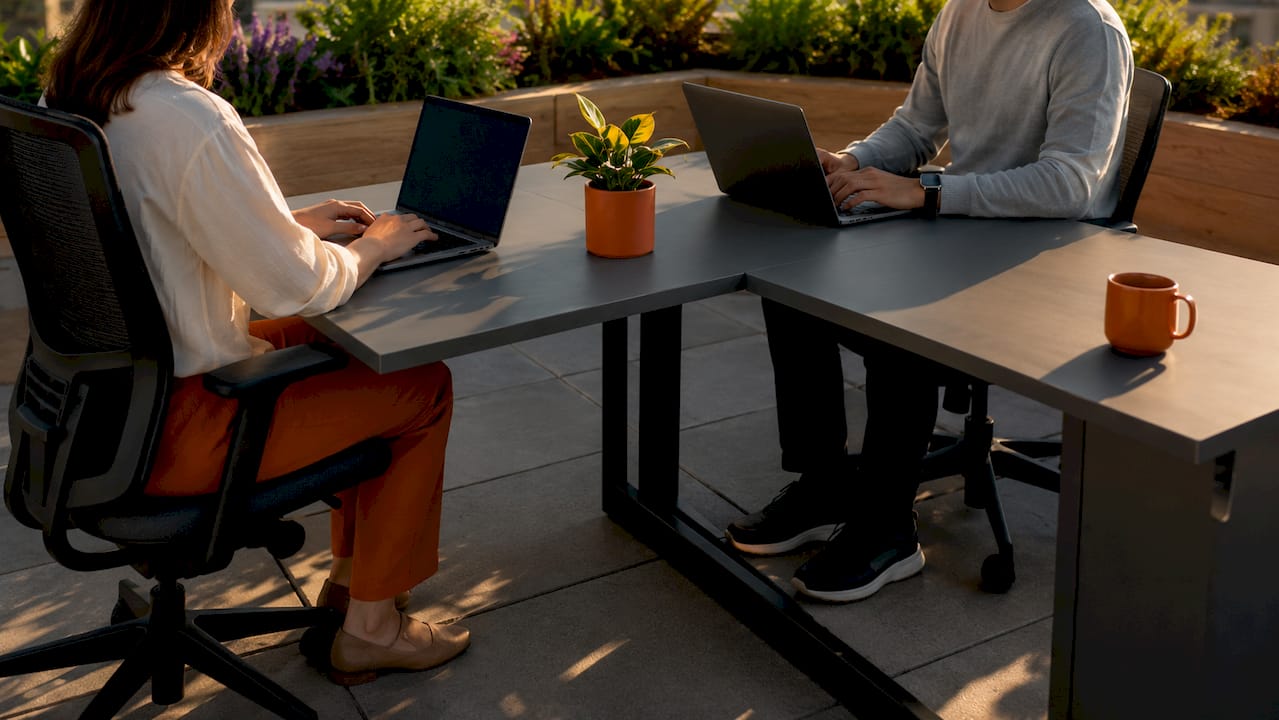
Shared workstations, known in commercial interior design as collaborative desks or benching systems, come in several distinct configurations. Each suits a different team size, workflow, and spatial layout.
Bench desks are the most common format in open plan offices. They feature a continuous worksurface shared by two or more users sitting side by side, with integrated cable management running beneath the surface. They suit high-density environments where space efficiency is the priority.
Face-to-face desks position two users opposite each other across a shared surface. Low-profile screens or modesty panels sit between users to reduce visual distraction without blocking communication. Marketing teams and customer service departments use this format frequently.
L-shaped and T-shaped paired desks give each user a personal zone while sharing a connecting surface. L-shaped desks are preferred when users have overlapping schedules, as the configuration creates natural work zones with less interference than a shared rectangular surface.
Linear benching systems extend the bench desk concept across longer runs, accommodating four, six, or eight users in a single unbroken line. They are the standard format for high-density office layouts and work well in open plan refurbishments.
Round and oval tables encourage eye contact and equal participation in conversation. They remove the hierarchy implied by a rectangular format and work well as informal collaboration points or breakout zones.
Height-adjustable collaborative desks allow each user to set their own working height independently. Sit-stand desks benefit shared use by accommodating users with different postural preferences without requiring a compromise position.
| Desk type | Best for | Key feature |
|---|---|---|
| Bench desk | Open plan, side-by-side teams | Continuous surface, cable management |
| Face-to-face desk | Paired roles, customer service | Privacy screen between users |
| L-shaped paired desk | Managers, multitaskers | Personal zones with shared surface |
| Linear benching | High-density offices | Extended runs for 4–8 users |
| Round or oval table | Breakout, brainstorming | Equal sightlines, open dialogue |
| Height-adjustable desk | Mixed-height users | Independent sit-stand adjustment |
Physical layout is one of the most underestimated factors in office design. The shape and orientation of a desk determines how often people communicate, how easily they can focus, and how comfortable they feel sharing a workspace.
Side-by-side setups, sometimes called the collaboration cockpit, encourage shoulder-to-shoulder communication. This format suits tasks that require constant dialogue, such as creative reviews, coding pairs, or training. The trade-off is that ambient noise and movement are more noticeable.
Back-to-back arrangements, also described as the focus hub format, provide visual privacy and reduce distraction. Analysts, writers, and finance teams benefit from this layout. Users can still communicate easily by turning around, but the default position supports concentration.
Round and oval desks promote open communication by placing all users at equal sightlines. No seat implies authority. This makes them effective for team stand-ups, creative sessions, and client-facing discussions.
Screen height also shapes interaction. Low or mid-height screens facilitate informal collaboration, while high partitions provide visual privacy for focused or sensitive tasks. Choosing the right screen height is as important as choosing the desk itself.
Pro Tip: Before specifying screen heights, observe how your team actually works for a week. Teams that frequently turn to speak to colleagues need low screens. Teams that need deep focus benefit from panels at 400–600 mm above the desk surface.
Ergonomics determines whether a shared workstation is comfortable for one hour or eight. Getting the dimensions wrong creates fatigue, poor posture, and reduced output.
The recommended desk width per user is a minimum of 120 cm, ideally 140–160 cm. Depth should fall between 60 and 80 cm. Standard fixed desk heights sit between 72 and 75 cm, while height-adjustable models range from 65 to 125 cm. These figures matter because a desk that is too narrow forces users to encroach on each other’s space, which increases friction and reduces focus.
Each two-person workstation should allocate 24–30 m² for optimal comfort and accessibility. This figure includes circulation space, storage, and chair movement. Offices that squeeze two users into less than 20 m² consistently report higher dissatisfaction and lower output.
Highly adjustable furniture is vital in shared environments. Monitor arms, adjustable chair height, and foot support accommodate varying user heights without requiring a compromise position. A fixed desk set at one height will never suit two users of different builds equally well.
Pro Tip: Specify monitor arms as standard on every collaborative desk. They cost a fraction of the desk itself but eliminate the single biggest source of postural complaints in shared workstations.
Successful shared desk environments separate permanent communal storage from mobile personal storage. Fixed pedestals or overhead lockers hold shared supplies. Mobile caddy units allow each user to store personal items and move them when the desk is used by someone else. This distinction prevents clutter and keeps the shared surface clear.
The most effective approach to selecting office collaboration furniture is to match the desk type to the actual work being done, not to a generic floor plan. A role and workflow audit before purchasing aligns workstation specifications to specific work modes, occupancy patterns, and growth projections.
Different roles have genuinely different needs. Managers and senior staff typically need more surface area for documents, dual screens, and reference materials. L-shaped and T-shaped desks offer this surface area alongside semi-private zones, making them well suited to people who need to multitask or hold brief one-to-one conversations at their desk.
Knowledge workers who spend most of their day in focused individual work benefit from back-to-back configurations with higher screens. Marketing and creative teams, who rely on frequent peer review and rapid iteration, perform better at side-by-side bench desks where turning to a colleague takes no effort.
Modular and flexible desk designs allow quick reconfiguration as team structures change. This matters particularly for UK businesses managing hybrid working patterns, where desk occupancy varies day by day. A modular benching system can expand from four to eight seats without replacing the entire installation.
Modern office design is moving away from uniform desk layouts toward flexible, role-based configurations that support both sustained focus and spontaneous collaboration. Offices that still operate on a single desk type for every role are leaving productivity on the table.
The most effective collaborative desk strategy matches desk type to team role, allocates adequate space per user, and builds in ergonomic adjustability from the outset.
| Point | Details |
|---|---|
| Match desk type to role | Side-by-side suits creative teams; back-to-back suits focused analytical work. |
| Allocate sufficient space | Each two-person workstation needs 24–30 m² for comfort and accessibility. |
| Prioritise adjustability | Monitor arms and sit-stand mechanisms accommodate users of different builds. |
| Separate storage types | Use fixed communal storage and mobile personal units to prevent clutter. |
| Audit before you specify | A workflow audit prevents costly reconfigurations as teams grow or change. |
The conventional wisdom in office design is that open plan equals collaborative. It does not. Removing partitions and installing long bench runs creates noise and distraction as often as it creates teamwork. The offices I have seen perform best are the ones that treat collaboration as a spectrum, not a binary state.
A well-designed collaborative workspace gives teams the right desk for the right task. A marketing team needs a bench desk for daily stand-ups and creative reviews. The same team needs a quiet focus zone for writing briefs and analysing campaign data. Providing only one desk type for both tasks is a false economy.
The shift toward agile working furniture reflects this. Modular systems that can be reconfigured in an afternoon are worth more than fixed installations that require a contractor to change. UK businesses managing hybrid rotas particularly benefit from this flexibility, because desk occupancy is rarely predictable week to week.
The other thing the market undervalues is ergonomic adjustability in shared desks. A fixed-height bench desk set at 74 cm suits a user of average height. It does not suit the 1.9 m team member or the 1.55 m team member sharing the same surface. Height-adjustable collaborative desks cost more upfront. They cost far less in musculoskeletal complaints, absenteeism, and staff turnover over a three-year period.
Buy for the range of people who will use the desk, not for the average.
— Furniture
Furnitureforbusiness supplies a full range of office desks and office storage suited to collaborative and shared workstation setups, with free delivery to the UK mainland. Whether you are fitting out a new office, reconfiguring an existing floor plan, or sourcing bulk orders for a growing team, the range covers bench desks, height-adjustable models, and storage solutions designed to work together.
Every order comes with access to the Furnitureforbusiness team for specification advice, bulk pricing, and layout guidance. If you are planning a refurbishment or a new fit-out and need help matching desk types to your team’s actual workflows, get in touch directly through the website.
Linear benching systems are the most space-efficient option for high-density offices. They accommodate multiple users in a single unbroken run and integrate cable management to keep the surface clear.
Each two-person workstation should allocate 24–30 m² for optimal comfort, including circulation space, storage, and chair movement.
Height-adjustable desks are particularly valuable in shared environments because they allow each user to set their own working height independently, accommodating different builds without compromise.
Back-to-back configurations with low or mid-height screens work well for teams that need both focus and communication. Users can concentrate by default and turn to speak to colleagues without moving.
Choose bench desks when your team works on shared tasks and benefits from constant side-by-side dialogue. Choose face-to-face desks when users work on separate tasks but need to communicate regularly, and a degree of visual separation is helpful.
Phone: 0330 043 4114
VAT no. GB 991 8681 60
Company no. 07250570