TL;DR:
- Effective workspace layout influences employee wellbeing, productivity, and the success of hybrid work patterns.
- Post-pandemic data shows UK office utilization averages around 66%, requiring flexible, activity-based design approaches.
The assumption that a packed office equals a productive one is losing ground fast. Across the UK, forward-thinking organisations are rethinking how space is designed, used, and measured — not to squeeze more desks in, but to create environments where people genuinely want to work. Whether you manage a team of 20 or oversee a 500-person headquarters, the layout decisions you make today will shape recruitment, retention, and output for years to come. This article gives you the evidence and practical tools to make those decisions with confidence.
| Point | Details |
|---|---|
| Workspace layout impacts wellbeing | Thoughtful layouts directly improve employee health, focus, and productivity. |
| Hybrid work shifts usage patterns | Old occupancy benchmarks are outdated; real-world space needs are now different. |
| Flexible layouts boost satisfaction | A mix of collaborative and private zones supports diverse hybrid teams best. |
| No one-size-fits-all solution | Pair layout choices with technology and policies to ensure success. |
Workspace layout is not simply about where desks go. It shapes how noise travels through a room, how natural light reaches workstations, and whether people spend their day in physical discomfort or ergonomic ease. These are not soft concerns. HSE workplace design guidance confirms that workspace layout carries measurable wellbeing and productivity implications, with environmental factors such as noise, lighting, and ergonomics all treated as part of health and performance risk management.
The connection between office layout and wellbeing is especially important as teams shift to hybrid patterns. When people come into the office less frequently, every visit needs to feel worthwhile. If the environment is chaotic, noisy, or poorly lit, you lose the very benefit of in-person work.
“The physical environment directly influences behaviour, concentration, and mood. When offices are designed with people in mind rather than simply maximising capacity, you see tangible improvements in focus, collaboration, and satisfaction.”
Consider the full range of factors that a thoughtful layout addresses:
Treating layout as a one-off decision is a mistake many organisations make. In reality, workspace design is a living system that should respond to how your team actually works.
One of the most stubborn myths in office planning is the idea that spaces should be designed for near-constant full occupancy. For decades, an 80% utilisation rate served as the gold standard benchmark for sizing office space. Post-pandemic reality tells a very different story.
According to the BCO post-pandemic review, realistic UK office utilisation now sits at around 66%, replacing the old 80% benchmark that shaped a generation of space planning decisions. That 14-point gap is significant. It means that if you design for 80% occupancy, you are regularly creating a cramped, overcrowded environment for the days when attendance is higher, while wasting resource on days when it is lower.
| Benchmark | Utilisation rate | Planning implication |
|---|---|---|
| Pre-pandemic standard | ~80% | High-density, fixed desking common |
| Post-pandemic reality | ~66% | Flexible zones and activity-based working needed |
| Overcrowded risk threshold | Above 85% | Noise, stress, and wellbeing deterioration |
| Underused space risk | Below 50% | Costly, difficult to justify to senior leadership |
Understanding this gap should directly inform how you approach optimising your office for hybrid teams. Rather than fitting as many fixed desks as possible, successful offices are replacing static rows with a mix of collaboration areas, focus booths, social spaces, and bookable hot desks. This is not about reducing the importance of the office. It is about making the space work harder and smarter for everyone who uses it.
A core part of getting this right is office space planning best practices. Data-informed planning replaces guesswork with evidence. Desk booking systems, badge data, and simple headcounts on different days of the week all help build an accurate picture of how your space is genuinely used.
Pro Tip: Do not redesign your office based on a single week of observations. Collect at least four to six weeks of occupancy data across different seasons and business cycles before committing to a layout change. This gives you a far more reliable baseline than a snapshot.
Once you have accurate utilisation data, the next challenge is turning it into a layout that genuinely serves a hybrid workforce. This requires moving beyond the binary debate of open-plan versus private offices and thinking instead about zones that serve different types of work.
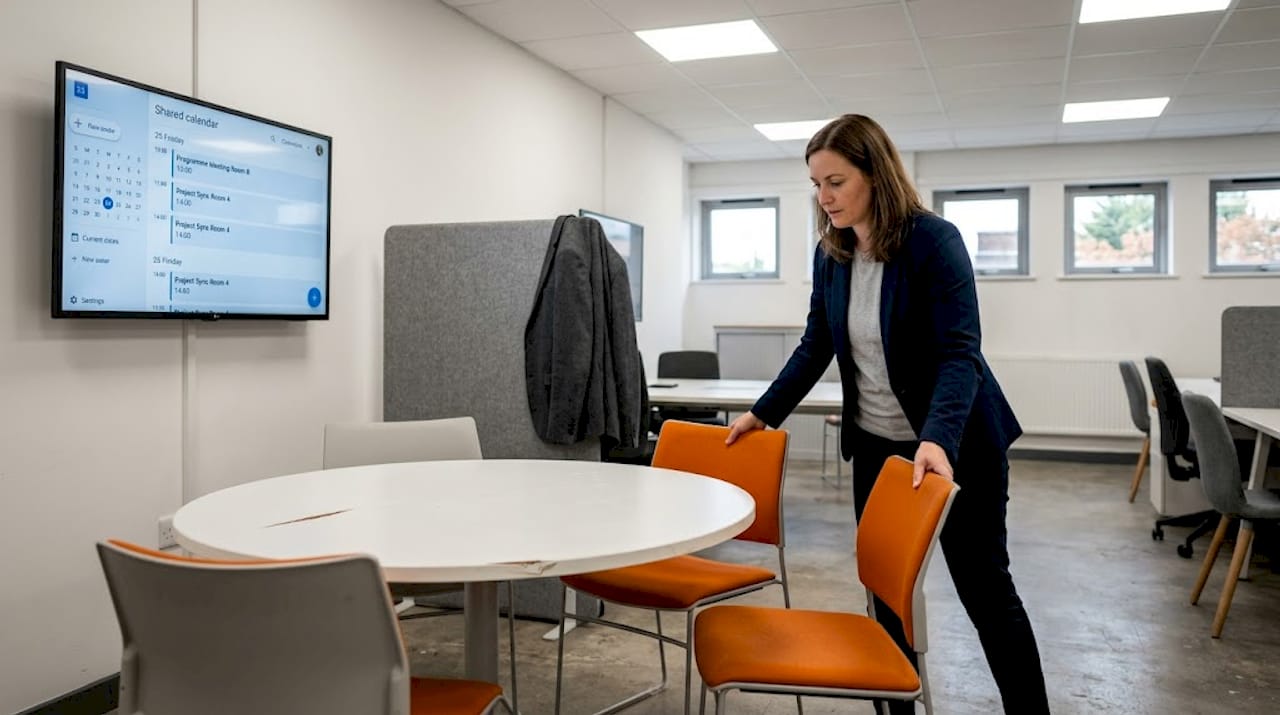
Research from the London School of Economics on hybrid work suggests that an intermediate hybrid arrangement, where employees split time between home and office rather than committing fully to either, tends to produce better outcomes for job satisfaction and social connection. Neither fully remote nor fully in-office fits all teams equally well. For office managers and procurement leads, this finding matters: it means your physical office still needs to deliver genuine value when people choose to come in.
| Layout type | Best for | Key advantages | Limitations |
|---|---|---|---|
| Fixed assigned desking | Stable, mostly on-site teams | Predictable, personal | Poor for hybrid, inflexible |
| Fully hot-desking | High-volume hybrid teams | Space-efficient, flexible | Can feel impersonal, disorganised |
| Activity-based working | Mixed task profiles | Supports focus and collaboration | Requires cultural shift and management buy-in |
| Intermediate hybrid zones | Most modern UK offices | Balances flexibility with belonging | Needs ongoing measurement and iteration |
To build a layout that genuinely supports your team, work through these steps:
Explore current hybrid work design trends to understand what leading UK employers are doing, and look at agile furniture solutions that can be reconfigured as your team’s needs evolve.
Pro Tip: Involve team leads in a layout pilot before rolling out changes across the whole floor. A single team trialling a new zone arrangement for four weeks gives you far richer feedback than a consultant’s report, and it builds internal buy-in before any major investment is made.
Strategy only creates value when it translates into action. Use this checklist to evaluate your current office or plan a new one, keeping hybrid needs, wellbeing, and flexibility firmly at the centre.
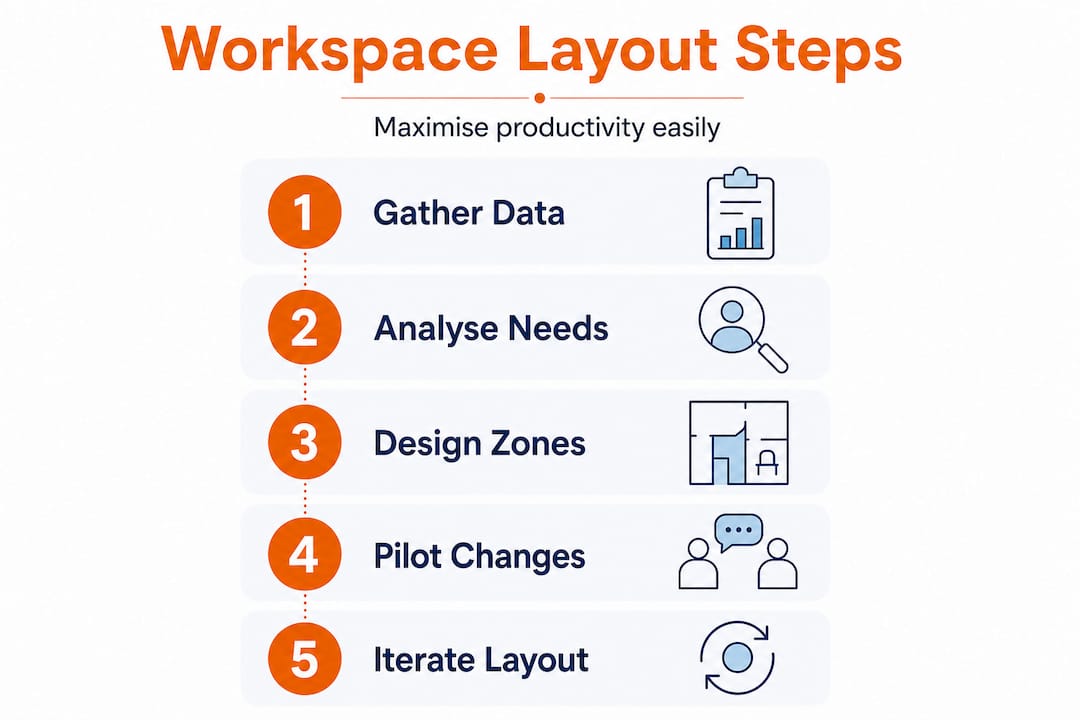
As HSE guidance makes clear, treating layout as part of health and performance risk management is not optional for UK employers. The checklist below reflects that responsibility.
Zone planning:
Furniture and environment:
Process and iteration:
The most effective layouts are never finished. They are iterated. Teams change, technology evolves, and work patterns shift. Building a habit of reviewing and adjusting your layout is just as important as the original design decisions you make.
Here is something that does not get said enough: a beautiful, well-planned hybrid office layout can still fail. And it often does, not because the furniture was wrong or the zones were poorly positioned, but because the rest of the organisation did not keep pace with the space.
We have seen this pattern repeatedly. A business invests in an activity-based layout, installs collaborative zones, removes assigned desks, and then six months later, staff are frustrated, attendance has dropped further, and managers are quietly asking whether the whole thing was a mistake. The culprit is rarely the layout itself.
Research on hybrid work models and job performance highlights a crucial limitation: hybrid benefits are not guaranteed across all teams or all outcomes. Technology fatigue, unclear expectations about when to come in, and a culture that has not genuinely embraced flexibility can all undermine performance regardless of how well-designed the physical space is.
The uncomfortable truth is that layout is an enabler, not a solution. A thoughtfully designed space gives people the conditions to do their best work. But if the technology lets them down during hybrid calls, if the culture subtly penalises remote days, or if team managers have not been trained to work effectively with dispersed groups, no amount of ergonomic furniture or acoustic panelling will compensate.
Our view is that the most resilient approach treats layout as one component of a broader operational strategy. This means pairing spatial changes with policy clarity, technology investment, and genuine management development. It also means resisting the temptation to follow fashionable office design trends that look impressive in photographs but do not fit your team’s actual workflow.
Explore durable office furniture choices that will serve your team well through multiple iterations of your layout rather than pieces that need replacing every time you reconfigure the space. The most sustainable investment is furniture that adapts, lasts, and continues to support performance as your organisation evolves.
Putting these principles into practice is far easier when you have the right products behind your planning decisions. Whether you are redesigning a floor, fitting out a new site, or simply upgrading key zones to support hybrid patterns, the furniture choices you make will directly shape the experience your team has every working day.
At Furniture for Business, we supply commercial-grade office furniture to UK businesses of all sizes, with free delivery to the UK mainland. From flexible office storage solutions that keep workspaces organised to height-adjustable office desks built for hybrid working patterns, and a full range of ergonomic chairs designed for extended daily use, our collections are built around the real needs of working teams. We offer bulk order pricing and easy returns, so procurement decisions carry less risk and deliver better value.
Thoughtful layout design controls how sound travels through a space, with quiet zones and acoustic separation reducing noise-related stress. HSE guidance confirms that noise, lighting, and ergonomics all carry direct wellbeing and productivity implications for UK employers.
Post-pandemic data from the British Council for Offices shows UK office utilisation running at approximately 66%, meaning the old 80% benchmark that shaped most pre-2020 space planning decisions is no longer a reliable guide.
LSE research on hybrid working indicates that an intermediate arrangement, typically around two to three days per week in the office, tends to produce better outcomes for job satisfaction and reduced feelings of isolation compared to either extreme.
No. While layout creates the conditions for effective hybrid work, research on job performance shows that technology quality, management culture, and operational policy all play equally important roles, and layout changes without these supporting elements frequently underdeliver.
Phone: 0330 043 4114
VAT no. GB 991 8681 60
Company no. 07250570