TL;DR:
- Multi-purpose furniture enhances space efficiency and reduces costs through easy reconfiguration.
- It supports hybrid work models and quickly adapts to changing office functions.
- Investing in durable, certified modular furniture offers long-term flexibility and environmental benefits.
Space constraints are often treated as a fixed, unavoidable cost of doing business in the UK, where commercial rents rank among the highest in Europe. Yet the assumption that you need more square footage to accommodate a growing or changing team is, in most cases, simply wrong. Multi-purpose furniture is quietly transforming how forward-thinking office managers approach layout, refurbishment, and long-term planning. This article explains what it is, why it matters for hybrid workplaces, and how to choose and implement it effectively across your organisation.
| Point | Details |
|---|---|
| Unlock true workspace flexibility | Modular, multi-purpose furniture allows rapid adaptation to evolving office needs without disruption. |
| Achieve significant cost savings | Reconfigurable furniture can reduce office refit costs by as much as 60 percent, delivering long-term ROI. |
| Prioritise accreditation and modularity | Opt for BIFMA-certified, modular pieces to ensure quality, safety, and seamless future office changes. |
| Support hybrid working with ease | Multi-purpose designs empower your team to use space efficiently for meetings, solo work, and collaboration. |
Multi-purpose furniture, at its most basic, is any piece designed to serve two or more distinct functions within a workspace. That sounds straightforward, but the commercial reality is more nuanced. A residential fold-out sofa and a BIFMA-certified modular seating system are both technically “multi-purpose,” yet they differ enormously in durability, adaptability, and long-term value for a business environment.
In a commercial context, multi-purpose furniture typically shares several core characteristics:
Traditional office furniture tends to be static. A fixed desk is a fixed desk. Multi-purpose pieces, by contrast, are designed around the idea that the same space will need to serve different purposes at different times of day or week. A meeting table that folds flat and nests with others allows a single room to host a board meeting in the morning and a training workshop in the afternoon.
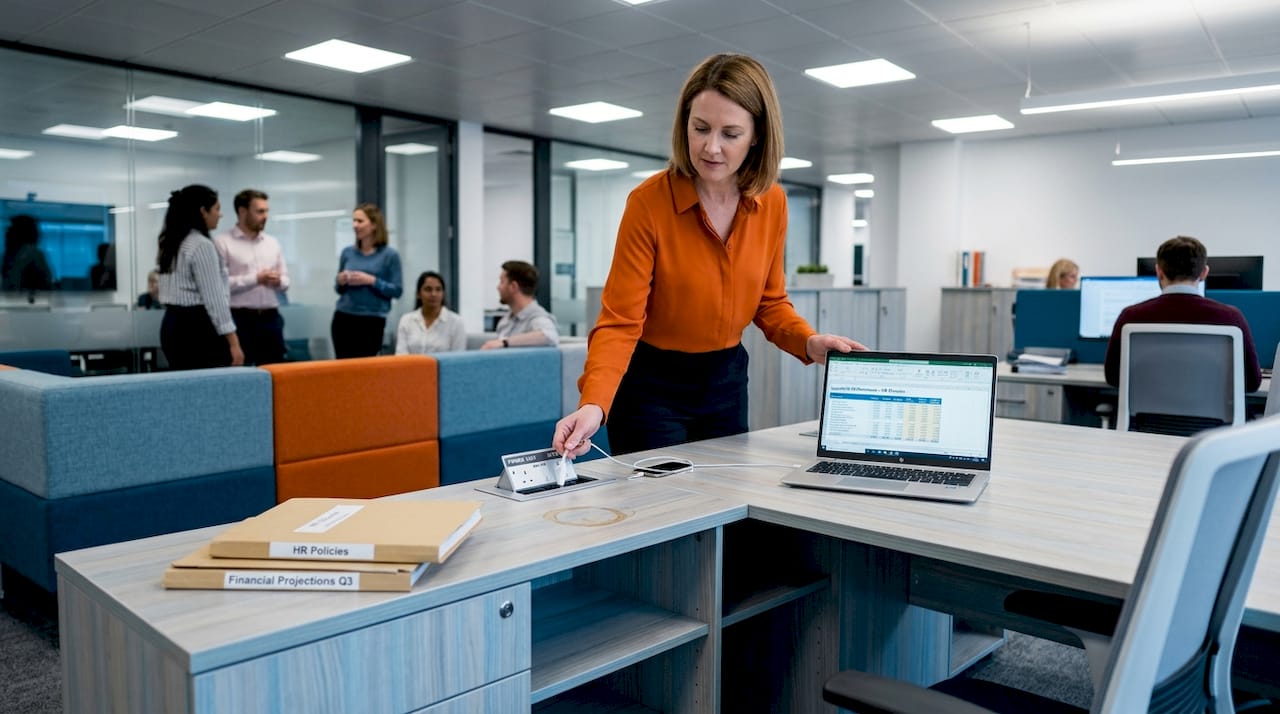
The space-saving furniture examples used in high-performing UK offices range from height-adjustable desks with integrated pedestals to acoustic pods on castors that reconfigure into collaborative zones in minutes. Certification matters too. BIFMA-certified pieces with modular compatibility are a priority for UK office managers who need assurance that their investment will hold up across thousands of use cycles.
Pro Tip: Always request load ratings and cycle-test data from suppliers before purchasing. A desk that folds 500 times before the mechanism fails is not suitable for a busy hot-desking environment. Look for pieces rated to at least 50,000 cycles.
With the definition clear, it is worth examining why so many UK office leaders are actively switching to versatile furniture. The business case stretches well beyond aesthetics.
Cost versus traditional office refits
Standard office refurbishments in the UK are expensive. Ripping out fixed furniture, rewiring for new layouts, and sourcing replacement pieces adds up quickly. Multi-purpose furniture dramatically reduces that cycle. Because pieces reconfigure rather than require replacement, the upfront investment pays back across multiple layout changes.
| Challenge | Traditional approach | Multi-purpose approach |
|---|---|---|
| Room repurposing | Full refit required | Reconfigure in hours |
| Staff growth | New furniture ordered | Existing pieces rearranged |
| Hybrid work flex | Fixed desks unused | Hot-desking activated |
| Budget per refit | High (£10k+) | Low (labour cost only) |
| Environmental impact | High waste | Minimal waste |
Hybrid and remote work adaptability
Hybrid working has fundamentally changed how UK offices are used. On any given day, occupancy can range from 30% to 90%. Fixed, dedicated desking wastes money on empty space. Modular seating for flexibility and foldable tables allow the same office to function as a collaborative hub on busy days and a focused heads-down space on quieter ones, without a single additional purchase.
Employee experience
Staff satisfaction is increasingly linked to the quality and flexibility of their working environment. Giving employees agency over how they use a space, whether that means switching from a standing to a seated configuration or rearranging a breakout area for a team workshop, has a measurable effect on engagement. This matters in 2026, when attracting and retaining talent remains a core challenge for UK businesses.
“A Parisian firm saved €80k on three reconfigurations by using modular, certified furniture rather than traditional fixed pieces, demonstrating that the investment in quality pays back rapidly across multiple layout cycles.”
Thinking through office fit out strategies before committing to specific pieces is essential. The most successful office managers we work with treat furniture selection as a spatial strategy, not a purchasing task.
Not all multi-purpose furniture is created equal. The right category depends on your office size, team structure, and how your space is actually used throughout the week. Here is an overview of the most impactful types available to UK businesses.
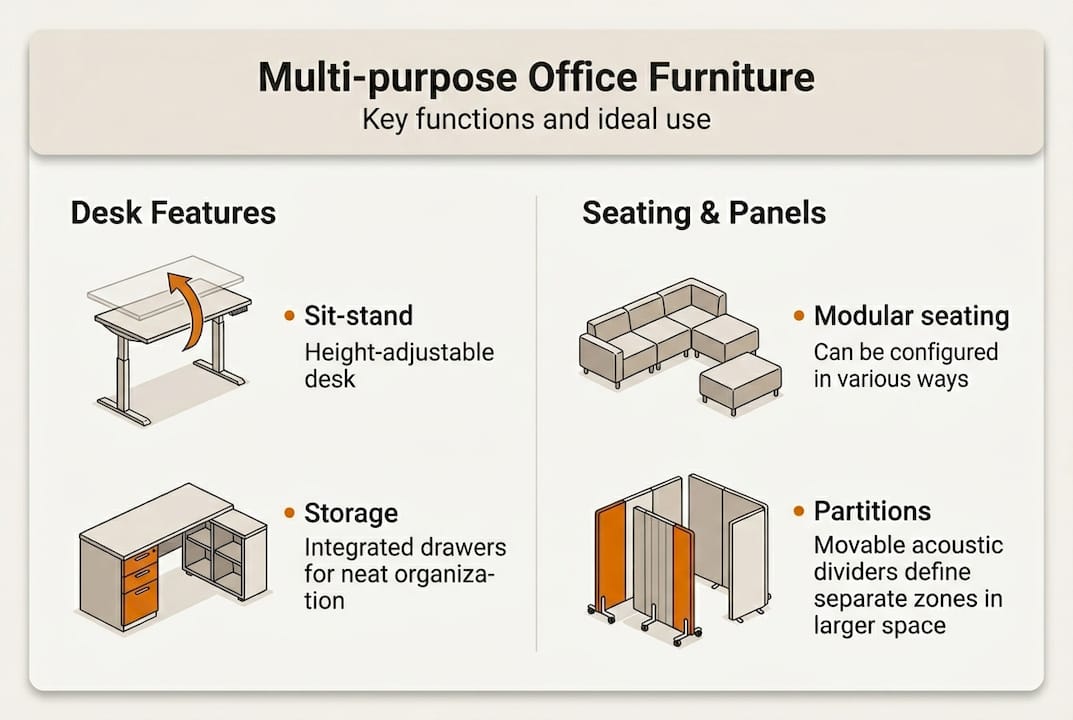
Sit-stand desks
Height-adjustable desks serve a dual function by accommodating both seated and standing work. They also support hot-desking, as users of different heights can quickly personalise the desk position. These are arguably the most widely adopted multi-purpose piece in modern UK offices, and prioritising modular compatibility when specifying them can lead to significant refit savings when your team grows or restructures.
Modular seating systems
These are systems where individual chairs, sofas, or benches connect together or separate depending on need. A row of six connected seats becomes a breakout lounge; separated and rearranged, those same pieces form a reception area or a casual meeting space. Modular seating eliminates the need to buy separate furniture for every different room function.
Storage-integrated desks and workstations
Desks with built-in pedestals, drawers, and cable ports reduce the number of individual pieces needed in a workspace. Instead of a desk plus a separate storage unit plus a cable tray, you have a single coherent piece. This reduces clutter, saves floor space, and makes office storage solutions far more practical in tighter environments.
Moveable partitions and acoustic panels
These are not furniture in the traditional sense, but they function as spatial furniture. Acoustic panels on castors can divide a large open-plan floor into smaller meeting rooms, then roll away to reveal a large training space. They add a layer of flexibility that structural walls simply cannot provide.
| Furniture type | Primary function | Secondary function | Ideal office size |
|---|---|---|---|
| Sit-stand desk | Individual workstation | Hot-desking support | Any size |
| Modular seating | Lounge or breakout | Meeting configuration | Medium to large |
| Storage-integrated desk | Workstation | Filing and cable management | Small to medium |
| Foldable/nesting tables | Meeting table | Compact storage | Any size |
| Acoustic partitions | Privacy screen | Room divider | Large open-plan |
Understanding optimising office furniture workflow before selecting specific pieces helps you avoid buying items that look good in isolation but create bottlenecks in practice. The key question is always: does this piece actively improve how people move through and use the space?
Choosing multi-purpose furniture involves more scrutiny than selecting standard office pieces. Because these items are expected to perform across multiple functions over many years, a poorly chosen piece can cost far more than its purchase price in maintenance, replacement, and lost productivity.
Here is a practical checklist to apply when evaluating any piece:
Reviewing the office furniture buying guide before approaching suppliers puts you in a stronger negotiating position and helps you ask the right questions. Similarly, understanding how office design shapes furniture choices ensures your selections support rather than undermine your wider workplace strategy.
Pro Tip: Invest for future reconfigurations, not just today’s needs. A piece that perfectly solves your current problem but cannot expand or adapt as your team grows will cost you more in the long run than a slightly more expensive modular alternative bought once and reconfigured repeatedly.
Knowing what to buy is only half the challenge. The other half is rolling it out effectively so that it genuinely improves how your office functions, rather than adding complexity.
Follow these steps for a smooth implementation:
Involving staff in the process is not a soft extra. It is a practical necessity. People who understand why the furniture works the way it does are far more likely to use it correctly and to flag when something is not functioning as intended.
To measure success, track room utilisation rates before and after, monitor whether hot-desking uptake increases, and gather staff satisfaction scores at three and six months post-implementation. A Parisian firm’s phased implementation demonstrated that structured rollout, with clear measurement at each phase, is what separates a transformative refit from a costly experiment.
Agile office solutions work best when teams are genuinely empowered to use them. That means training, clear signage in shared zones, and a culture that treats flexible furniture as an asset rather than an inconvenience.
Most offices we speak with focus on the immediate cost saving when they think about multi-purpose furniture. That saving is real, but it is actually the smallest part of the return on investment.
The deeper value lies in what we call strategic agility. When your furniture can be reconfigured in hours rather than weeks, your business can respond to change without a capital expenditure request. A team expands, a new client requires a dedicated project space, or a post-pandemic shift in working patterns demands a different kind of environment. With modular, multi-purpose furniture, none of those changes require a refit. They require an afternoon and a motivated facilities manager.
There is also an environmental dimension that is becoming increasingly important for UK businesses with sustainability commitments. Reuse potential and modularity can reduce refit costs by 60%, and the associated reduction in furniture waste directly supports corporate sustainability targets. Boardrooms care about this now in a way they simply did not five years ago.
We have observed consistently that clients who invest in premium, compatible furniture systems at the outset spend substantially less over a five-year period than those who buy cheaply and replace frequently. The value of commercial-grade furniture is not just in the piece itself but in the decisions it enables. That is the hidden ROI most procurement teams miss entirely.
The uncomfortable truth is that cheap, fixed furniture is almost never the budget-friendly choice it appears to be. It locks you into a layout, generates waste at every refit, and signals to staff that their working environment is not a priority. Multi-purpose furniture, chosen well, does the opposite on every count.
If the principles in this article resonate, the natural next step is to explore what genuinely versatile, commercial-grade furniture looks like in practice.
At Furniture for Business, we supply UK organisations with furniture built for exactly this kind of strategic thinking. Whether you are sourcing multi-purpose office desks for a hot-desking rollout, updating your seating with ergonomic office chairs that suit multiple users throughout the day, or rethinking your storage with adaptable office storage that works across different zones, our range is designed with modularity and longevity in mind. We offer bulk order pricing, free mainland UK delivery, and a team that understands the practical demands of commercial refurbishment. Get in touch to discuss your requirements or browse the full range online.
Multi-purpose furniture serves two or more functions, such as combining seating and storage or enabling rapid room reconfigurations for meetings and collaborative work. In commercial settings, BIFMA-certified pieces with modular compatibility are a particular priority because they ensure both quality and long-term adaptability.
Firms have reported cutting refit costs by up to 60%, with one example showing €80k saved on three reconfigurations through the use of modular, certified furniture rather than traditional fixed pieces.
Look for BIFMA certification and clear evidence of modular compatibility to ensure both quality and future adaptability. BIFMA-certified pieces with modular compatibility are widely regarded as a priority for UK office managers specifying commercial furniture.
Yes, its core strength is adaptability, making it ideal for spaces that change function regularly throughout the week. Prioritising modular compatibility ensures that furniture can support both hybrid and agile work practices without requiring costly additional purchases as your team’s needs evolve.

Phone: 0330 043 4114
VAT no. GB 991 8681 60
Company no. 07250570