TL;DR:
- Managing office furniture throughout its lifecycle enhances cost efficiency and reduces environmental waste. It involves strategic decisions at procurement, maintenance, refurbishment, and end-of-life disposal, emphasizing refurbishment over replacement whenever possible. Proper tracking and compliance ensure sustainable practices that benefit both finances and planetary health.
The office furniture lifecycle is the process of managing office furniture assets from the point of purchase through active use, maintenance, refurbishment, and responsible end-of-life disposal or reuse. Understanding this process is not a facilities management nicety. It is a financial and environmental discipline that directly affects your operating costs, your sustainability reporting, and your ability to plan workspace changes without waste. For UK businesses navigating office fit-out planning or procurement in 2026, a lifecycle approach is the difference between strategic asset management and expensive, repetitive replacement.
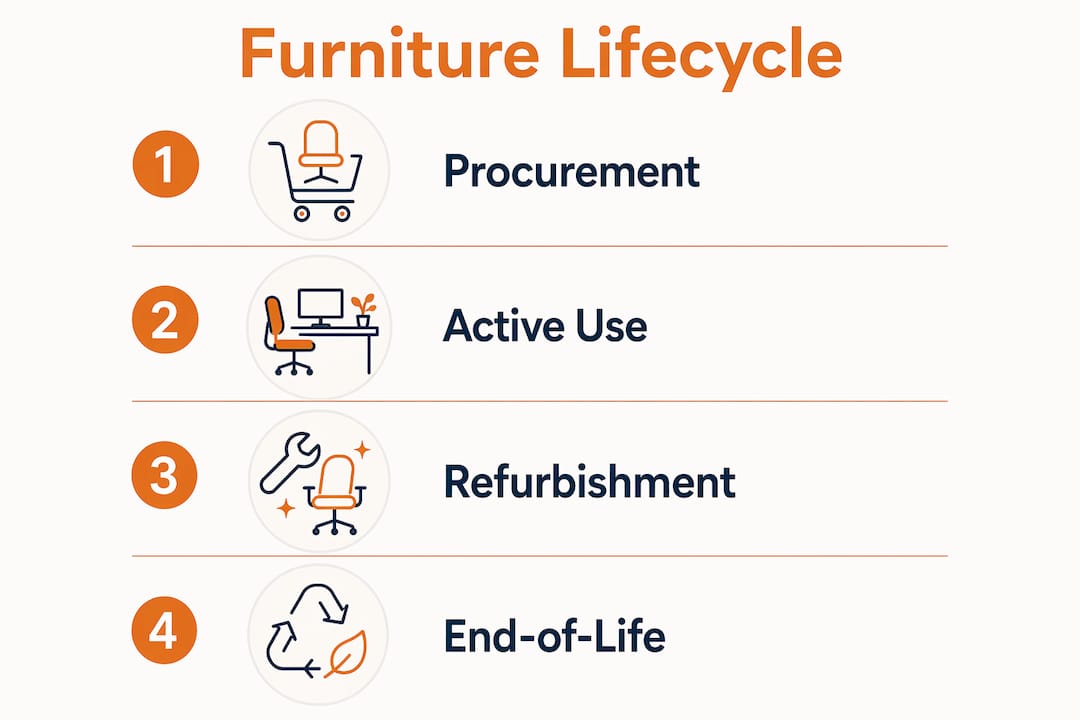
The office furniture lifecycle is defined as the complete management of furniture assets across four distinct phases: procurement, active use and maintenance, refurbishment, and end-of-life disposal or reuse. The industry term for this structured approach is furniture lifecycle management, and it draws on the same asset management logic used for capital equipment in manufacturing and facilities sectors. Each stage has specific decisions attached to it, and getting those decisions right compounds value over time.
Here is how each stage works in practice:
Procurement. This is where lifecycle value is won or lost. Buying decisions made at this stage determine how long a piece of furniture will remain functional and how easy it will be to maintain or repair. Durability, serviceability, and the availability of replacement parts are the metrics that matter here, not just upfront price. A procurement guide for UK teams should account for these factors before a single order is placed.
Active use and maintenance. Once furniture is in service, its lifespan is shaped by how it is cared for. Routine inspections, prompt minor repairs, and consistent cleaning all extend functional life significantly. A regular office cleaning schedule, including furniture surfaces and mechanisms, is a practical maintenance tool that many facilities teams underestimate.
Refurbishment and upgrading. Refurbishment is a workflow involving reupholstering, repainting, and component swapping, not a one-off event. Chairs can be reupholstered and have their gas cylinders replaced. Desks can be refinished or reconfigured for new layouts. This stage is the most underused in UK offices, yet it offers some of the highest returns on existing asset investment.
End-of-life management. Disposal is the last resort, not the default. Furniture that cannot be refurbished should be assessed for reuse, donation, or recycling before any landfill route is considered. 80 to 90% of office furniture can be recycled when properly processed, which means most end-of-life furniture has a viable alternative to landfill.
Pro Tip: When specifying furniture at procurement stage, ask suppliers directly whether replacement parts are stocked and for how long. A chair with no available replacement gas cylinder or castors has a fixed, short lifecycle regardless of its build quality.

Lifecycle cost includes procurement, delivery, installation, maintenance, replacement, disruption, reconfiguration, and disposal expenses. This means the sticker price of a desk or chair is only one input in a much larger financial equation. A budget chair purchased at half the price of a commercial-grade alternative may cost more over five years once you factor in replacement frequency, staff disruption during swaps, and disposal fees.
The table below illustrates how lifecycle cost thinking changes the comparison between two common procurement approaches:
| Factor | Budget approach | Lifecycle approach |
|---|---|---|
| Upfront cost | Lower per unit | Higher per unit |
| Replacement frequency | Every 2 to 3 years | Every 7 to 10 years |
| Maintenance cost | Minimal (replace instead) | Moderate (repair and refurbish) |
| Disposal cost | Recurring | Infrequent |
| Total 10-year cost | Often higher | Often lower |
The environmental case is equally clear. Over 1.2 million desks and 1.8 million office chairs are sent to landfill in the UK every year. That figure represents not just wasted material but wasted embodied carbon: the energy and resources already consumed in manufacturing those products. Every year a piece of furniture remains in active use rather than going to landfill, its embodied carbon cost is spread further, improving its environmental performance.
Life-cycle assessment methodology, governed by ISO 14040 and ISO 14044, models environmental impact from raw material extraction through to end-of-life disposal or incineration. For businesses with sustainability reporting obligations, understanding where your furniture sits in its lifecycle is directly relevant to scope 3 carbon accounting. Refurbishment and reuse delay the point at which new manufacturing emissions are triggered, which is a measurable benefit.
“Sustainable office furniture management requires integrating lifecycle assessment with practical asset management and compliance processes.” — Scientific Reports, 2024
UK law imposes clear obligations on businesses disposing of office furniture, and non-compliance carries financial and reputational risk. The disposal hierarchy under UK waste regulations prioritises reuse, resale, and donation before recycling, and treats landfill as the last resort. Following this hierarchy is both a legal expectation and a practical cost-saver, since reuse and donation routes are often free or revenue-generating.
The legal requirements for compliant disposal in the UK include:
Pro Tip: When planning an office move or refurbishment, schedule your furniture clearance assessment at least eight weeks in advance. Coordinating reuse, donation, and compliant disposal for a full office takes longer than most facilities teams anticipate, and rushed clearances almost always result in avoidable landfill.
Lifecycle planning treats furniture as tracked assets with registers detailing purchase date, location, condition, and repair history. This data is what enables informed repair, refurbish, or retire decisions rather than decisions based on how a chair looks on a given day. Without it, most organisations default to replacement when refurbishment would have been cheaper and faster.
Practical steps for effective furniture lifecycle management include:
Procurement decisions benefit directly from this data, because lifecycle choices depend on evidence, not appearance. A chair that looks worn but has had only three years of use and a recent service is a refurbishment candidate. A chair that looks fine but has had repeated mechanism failures over seven years is a retirement candidate. The asset register tells you which is which.
Effective furniture lifecycle management reduces long-term costs, cuts landfill waste, and gives UK businesses the data they need to make procurement and disposal decisions with confidence.
| Point | Details |
|---|---|
| Four lifecycle stages | Procurement, active use, refurbishment, and end-of-life disposal each require distinct decisions. |
| Lifecycle cost over sticker price | Total cost includes maintenance, disruption, and disposal, not just the purchase price. |
| UK legal compliance | Licensed waste carriers, Waste Transfer Notes, and POPs rules apply to all commercial disposals. |
| Refurbishment before replacement | Reupholstering, repainting, and component swapping extend asset life and reduce spend. |
| Asset registers drive decisions | Tracking purchase date, condition, and repair history enables data-led repair or retire choices. |
Most UK businesses I speak with treat furniture replacement as a routine budget line rather than a decision that deserves scrutiny. The pattern is familiar: a chair looks tired, a desk wobbles, a meeting room feels dated, and the response is a purchase order. What rarely happens is a structured assessment of whether that item could be repaired for a fraction of the cost, or whether the reason for replacement is genuinely functional rather than aesthetic.
Many organisations replace furniture prematurely due to aesthetics or preference rather than actual failure. This is the most expensive habit in facilities management, and it is entirely preventable. A chair reupholstered in a new fabric does not just save money. It also avoids the embodied carbon cost of manufacturing a replacement, and it keeps a functional asset in circulation rather than contributing to the 1.8 million chairs that reach UK landfill annually.
The businesses that manage this well do not treat refurbishment as an emergency measure. They treat it as a scheduled workflow, the same way they treat IT hardware refresh cycles or building maintenance contracts. That shift in framing changes everything. It means refurbishment is budgeted for, planned in advance, and executed without disruption to the working environment.
My honest view is that sustainable furniture management is not a values exercise. It is a financial discipline that happens to have strong environmental outcomes. The businesses that adopt it do so because it saves money and reduces risk, and the sustainability benefits follow naturally from that. If you are waiting for a compelling sustainability argument to change your procurement habits, the financial case is already there and it is stronger.
— Furniture

Furnitureforbusiness supplies commercial-grade office chairs and office desks built for long-term use in UK workplaces, with free delivery to the UK mainland. Every product in the range is specified for durability, serviceability, and adaptability, the three qualities that determine how long furniture remains in productive use. Whether you are equipping a new fit-out, replacing end-of-life stock, or planning a phased refurbishment programme, Furnitureforbusiness can support procurement decisions that reduce your total cost of ownership and keep your workspace performing for years rather than months. Browse the full range or contact the team to discuss bulk order pricing and bespoke fit-out requirements.
The office furniture lifecycle is the structured management of furniture assets from procurement through active use, maintenance, refurbishment, and responsible end-of-life disposal or reuse. Its purpose is to maximise asset value, reduce costs, and minimise environmental impact.
Commercial-grade office chairs and desks are typically designed for seven to ten years of active use when properly maintained. Budget furniture often requires replacement within two to three years, making lifecycle cost significantly higher despite the lower upfront price.
UK businesses must use licensed waste carriers, issue a Waste Transfer Note for every load removed, and retain those records for at least two years. Foam-filled furniture made before 2021 is subject to POPs regulations and requires specialist disposal routes.
Refurbishment is almost always more cost-effective than replacement for structurally sound furniture. Reupholstering, repainting, and replacing worn components typically costs a fraction of new procurement and avoids the embodied carbon of manufacturing a replacement.
A furniture lifecycle assessment, governed by ISO 14040 and ISO 14044, models the environmental impact of a furniture product from raw material extraction through manufacturing, use, and end-of-life disposal. It is used by businesses with sustainability reporting obligations to quantify scope 3 emissions from their furniture assets.

Phone: 0330 043 4114
VAT no. GB 991 8681 60
Company no. 07250570