Furniture lifecycle management is the practice of tracking and managing every office furniture asset from the moment it is purchased through daily use, maintenance, refurbishment, and eventual disposal — with the explicit goal of cutting costs and reducing waste. Done properly, it replaces reactive, guesswork-driven replacement with a structured, evidence-based process that most UK procurement teams can implement without specialist software from day one.
Three reasons UK offices adopt it:
Your immediate next step: run a single-site asset inventory this quarter. List every item, note its condition, and record where it is. That register is the foundation on which everything else builds.
The furniture lifecycle follows a consistent arc regardless of organisation size. Understanding each stage tells you which team owns it and where the biggest losses typically occur.

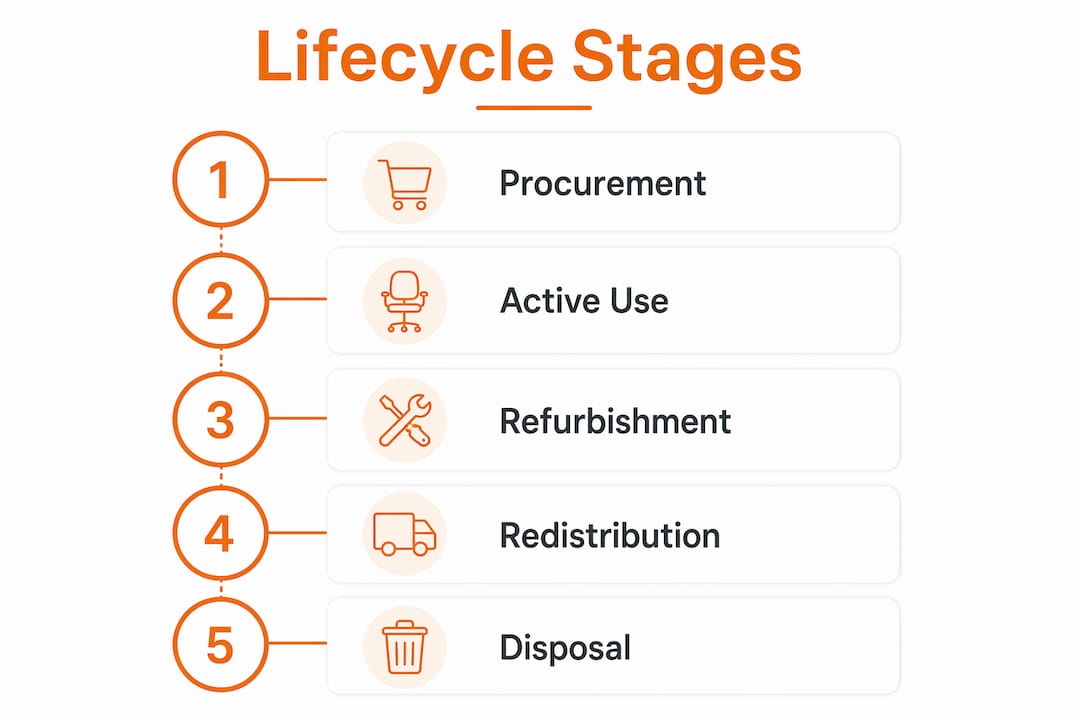
This is where lifecycle decisions are made, not just buying decisions. The items you specify at this stage determine how long assets will last, whether they can be repaired, and whether a manufacturer will take them back at end-of-life. Procurement teams own this stage.
Checklist:
Once installed, furniture enters its longest phase. Most organisations manage this reactively — a chair breaks, someone reports it, someone orders a replacement following flexible cleaning schedules. That reactive model is precisely where costs accumulate. Facilities teams own this stage.
Checklist:
Pro Tip: Tag every item at installation, not retrospectively. Tagging a chair when it arrives takes thirty seconds; tagging it two years later, when it has been moved three times and the invoice is lost, takes considerably longer and often never happens.
Refurbishment is the stage most UK offices skip entirely, defaulting instead to replacement. A task chair with worn upholstery but a sound mechanism can be reupholstered for a fraction of the cost of a new one. Facilities and sustainability teams share ownership here.
Checklist:
Before any asset is disposed of, the question should be whether another part of the organisation can use it. Office moves and refurbishments routinely generate surplus furniture that ends up skipped rather than redeployed. A simple internal marketplace or surplus register prevents that.
Checklist:
Disposal is not the end of a lifecycle programme — it is where the programme’s environmental credentials are tested. Certified recycling, manufacturer take-back, and donation all produce evidence for ESG reporting. Skipping due diligence here creates legal exposure under UK duty-of-care rules.
Checklist:
The financial case for lifecycle management is straightforward once you move from purchase price to total cost of ownership (TCO). Purchase price is what you pay on day one. TCO is what you pay across the full usable life of an asset, including maintenance, refurbishment, storage, and disposal.
A worked example — task chair:
A task chair purchased for £300 with a ten-year usable life costs £30 per year at face value. Add two reupholstering cycles at £80 each, annual maintenance of £10, and disposal at £15, and the true annual cost is closer to £48. Replace that chair after five years instead of ten — as many offices do — and the annual cost rises to roughly £75, because you absorb the full purchase price twice and the disposal cost twice. The maths favour keeping furniture longer, provided it is maintained.

Organisations that replace furniture reactively pay an estimated 18–30% more per cycle in rush procurement and downtime costs compared with planned renewal. That premium compounds across a large estate.
The stakeholder benefits break down clearly:
Beyond the numbers, there are real operational benefits that rarely appear in a business case. A planned refurbishment cycle means staff are not sitting on broken chairs for three months while a replacement order works through approval. Redeployment rather than disposal means a new-site fit-out can be partially funded from existing stock. These are not marginal gains — for a 200-person office, they can represent tens of thousands of pounds over a five-year period.
Start small. A single-site pilot is far more likely to succeed than an estate-wide rollout, and the data it generates will make the business case for broader adoption far more convincing.
Choose one site or floor. Walk every room and capture the following fields in a spreadsheet:
This audit typically takes half a day for a 50-person floor. The output is your baseline register.
Assign clear ownership before you build any process. Lifecycle management fails most often because procurement and facilities each assume the other is managing the asset register.
Digital product passports and pre-tagging at source make furniture traceable after sale and support warranty, refurbishment, and take-back management. For existing stock, QR code labels (printable, self-adhesive, under £0.10 each) linked to a shared spreadsheet or asset platform are sufficient for a pilot. NFC tags offer the same benefit with a tap-to-read function that works without a camera.
Pro Tip: Ask your next supplier to pre-tag deliveries before they leave the warehouse. Many will do this at no extra cost if you specify it in the purchase order. It removes the tagging burden from your facilities team entirely.
High-use items (task chairs, height-adjustable desks) warrant a quarterly visual check. Lower-use items (meeting room chairs, storage units) can be inspected annually. Record every inspection in the register with a date, condition score, and any action taken.
Before you need them, identify:
A structured procurement workflow should include short, plain-language clauses covering:
These clauses do not need to be lengthy. Two or three sentences per point, included in the purchase order or supplier agreement, is enough to create accountability.
The right level of tooling depends on your estate size and the maturity of your programme. There is no single correct answer, and starting with a spreadsheet is entirely legitimate.
Suitable for: single-site organisations, pilot programmes, estates under 200 assets.
A well-structured spreadsheet with columns for asset ID, location, condition score, last inspection date, and next action covers the basics. The limitation is version control — when multiple people edit the same file, data quality degrades quickly. Use a shared cloud document (Google Sheets or Microsoft Excel Online) and assign one owner.
Computer-Aided Facilities Management (CAFM) and Computerised Maintenance Management System (CMMS) platforms add structured work-order management, inspection scheduling, and reporting dashboards. They are appropriate for multi-site organisations or those with dedicated facilities management teams.
| Feature | Spreadsheet | CAFM/CMMS | PLM platform |
|---|---|---|---|
| Asset register | ✓ | ✓ | ✓ |
| Condition scoring | Manual | Structured | Automated |
| Work-order management | ✗ | ✓ | ✓ |
| Depreciation/RUL reporting | Manual | Partial | ✓ |
| Redeployment workflows | ✗ | Partial | ✓ |
| ESG/sustainability reporting | Manual | Partial | ✓ |
| Cost to implement | Low | Medium | High |
Purpose-built FF&E lifecycle systems replace spreadsheet guesswork with condition scores, replacement forecasts, and depreciation-aligned capital budgets. Asset-management platforms that combine inventory, service work-orders and reporting enable redeployment workflows and produce outputs that link directly to sustainability metrics. These are appropriate for large estates, multi-site organisations, or those with formal ESG reporting obligations.
Feature checklist for any platform you evaluate:
Pro Tip: When onboarding a new supplier, include a data-handover requirement in the purchase order: the supplier must provide a digital asset list (item type, model, serial number, warranty expiry) in a standard format at delivery. This eliminates the manual data-entry step that most organisations find is the biggest barrier to maintaining an accurate register.
End-of-life is where lifecycle management either earns its environmental credentials or quietly fails. The options, in rough order of preference from a sustainability standpoint:
Under the Environmental Protection Act 1990, any business that produces, carries, or disposes of controlled waste has a legal duty of care. For office furniture, this means:
Failure to comply can result in an unlimited fine. Retaining waste transfer notes is not optional — it is the evidence that your duty of care was discharged.
Evidencing waste diversion for ESG reporting: record the weight or volume of each disposal, the destination (recycling, donation, resale), and the date. A simple log alongside your waste transfer notes gives you the diversion rate figure that sustainability reports and procurement questionnaires ask for.
The furniture sector generates significant waste volumes across Europe, and the circular economy framework increasingly shapes both regulation and client expectations in the UK. Documenting your end-of-life routes now positions your organisation ahead of likely future reporting requirements.
The honest answer is: less often than most offices do, and based on condition rather than a calendar. Calendar-driven replacement — “we replace chairs every five years” — wastes money on assets that are still serviceable and sometimes replaces items prematurely simply because a policy says so.
| Item | Typical lifespan | Condition-based trigger |
|---|---|---|
| Task/operator chair | 10 years | Score below 2/5; mechanism failure; foam collapse |
| Executive chair | — | Score below 2/5; structural instability |
| Height-adjustable desk | 10–15 years | Motor failure; surface damage beyond repair |
| Fixed-height desk | — | Structural damage; surface irreparable |
| Meeting room chair | — | Score below 2/5; upholstery beyond refurbishment |
| Storage unit (pedestal/cupboard) | — | Structural failure; lock/mechanism failure |
| Soft seating (sofa/lounge) | — | Foam collapse; frame damage |
Before authorising a replacement, ask three questions:
Durable upholstery choices at procurement stage extend the point at which refurbishment becomes necessary, which is why material specification and lifecycle management are inseparable disciplines.
A lifecycle programme without measurement is just good intentions. These are the metrics that matter to finance, facilities, and ESG teams respectively.
Core KPIs to track:
Linking KPIs to finance and sustainability reporting:
RUL data feeds directly into capex forecasting — if your average chair has 3.2 years of useful life remaining, finance can model the replacement budget with precision rather than guesswork. Reuse and diversion rates feed into sustainability reports and, increasingly, into supplier questionnaires from clients who want evidence of responsible procurement practices.
A condition-based renewal approach aligns maintenance and finance by mapping condition scores to depreciation schedules and forecasted replacement costs, which shortens audit preparation time and makes budget requests far easier to defend.
Sample month-on-month metric: track reuse rate quarterly. If your reuse rate moves from 22% to 35% over two quarters, that is a concrete, reportable improvement — and it represents real avoided procurement spend.
Furniture lifecycle management cuts costs and reduces waste by treating every asset as a managed resource from purchase to disposal, not a one-time capital expense.
| Point | Details |
|---|---|
| Start with a single-site audit | Capture asset ID, location, condition score, and action required before building any process. |
| Tag at installation, not retrospectively | Pre-tagging at delivery costs nothing and prevents the blind spots that make redeployment impossible. |
| Condition-based renewal saves money | Reactive replacement costs more per cycle than planned, condition-led renewal. |
| Retain waste transfer notes | UK duty of care requires you to keep waste transfer notes for at least two years — non-compliance carries unlimited fines. |
| Furnitureforbusiness supports lifecycle buying | Bulk pricing, clear warranty terms, and free UK mainland delivery make planned, condition-led procurement straightforward. |
The most common mistake is not choosing the wrong software or setting the wrong KPIs. It is the gap between the maintenance register and the fixed-asset register.
Here is what that looks like in practice. A facilities team runs inspections and logs repairs in their own system. Finance holds a fixed-asset register for depreciation purposes. Procurement buys replacements based on requests from facilities. None of these three registers talk to each other. The result: assets that finance considers fully depreciated are still in active use; assets that facilities have flagged for replacement are not in the capital budget; and procurement is buying new items for locations that already have surplus stock sitting in a storeroom.
This is not a technology problem. It is a governance problem, and it is solved by assigning a single owner for the asset register and requiring all three functions to update the same source of truth.
The other pitfall worth naming: treating lifecycle management as a sustainability initiative rather than a financial one. Sustainability teams rarely have budget authority. Finance does. Frame the programme in TCO terms, show the cost-per-year calculation, and attach it to capex forecasting — that is what gets it funded and sustained beyond the first quarter.
Procurement and facilities teams that collaborate from the specification stage, rather than handing off at delivery, consistently achieve better outcomes. That single structural change — shared ownership from day one — is worth more than any platform.
Replacing furniture reactively is expensive. Furnitureforbusiness is designed for UK procurement teams who want to buy well once, track assets properly, and avoid the rush-order premium that comes with unplanned replacement.
Every order comes with free delivery to the UK mainland, clear warranty terms, and the product information you need to build a proper asset register from day one. The office chairs range covers everything from heavy-duty task seating to executive chairs specified for long service lives, and the meeting room collection includes options suited to high-utilisation environments where durability directly affects replacement frequency. Bulk pricing and bundle deals mean planned procurement cycles cost less per unit than reactive one-off orders. If you are starting a lifecycle programme or planning a refurbishment, browse the full range or get in touch to discuss bulk order requirements.
These are the sources worth consulting when building a business case, drafting supplier clauses, or preparing ESG evidence:
GOV.UK — Duty of care for waste: the primary reference for UK waste duty-of-care obligations, including waste transfer note requirements. Consult this before engaging any disposal contractor.
Environment Agency — Register of waste carriers: use this to verify that any waste contractor you engage holds a valid licence. A quick check before signing a disposal contract is the simplest due-diligence step available.
WRAP (Wrap.org.uk): WRAP publishes practical guidance on circular economy approaches for commercial interiors, including furniture reuse and waste reduction. Useful for ESG reporting frameworks and supplier engagement.
European Commission — Digital product passports: the EU’s framework for product-level traceability. UK organisations trading with EU clients or specifying from EU manufacturers should understand how digital product passports work and what data they carry.
European Commission — Circular economy in the furniture industry: a sector-specific report covering lifecycle approaches, material flows, and circular business models. Useful background for procurement teams building a lifecycle policy.
BIFMA (bifma.org): the Business and Institutional Furniture Manufacturers Association publishes durability and sustainability standards that inform specification decisions and supplier evaluation.
Use these sources as evidence when presenting a lifecycle programme to finance or sustainability stakeholders — a business case that cites primary regulatory and industry sources is considerably harder to dismiss than one that does not.
This article provides general information about furniture lifecycle management practices. It is not legal or professional advice. For your specific situation, consult the relevant primary sources or a qualified professional.

Phone: 0330 043 4114
VAT no. GB 991 8681 60
Company no. 07250570