TL;DR:
- Collaboration furniture supports group work, shared decision-making, and spontaneous interactions in professional spaces. Effective designs combine modular configurations, ergonomic standards, and acoustic privacy to enhance teamwork and prevent noise disruptions. Proper placement, uniform seating, and flexible surfaces help create functional, adaptable environments for diverse collaboration needs.
Collaboration furniture is defined as any piece or system designed specifically to support group work, shared decision-making, and spontaneous interaction in a professional setting. The top collaboration furniture ideas combine modular flexibility, BIFMA G1-2013 ergonomic standards, and acoustic privacy to create spaces where teams genuinely want to work together. Getting this right matters because 60% of collaborative workspace footprint should serve structured group zones, with the remaining 40% reserved for flexible overflow. Office managers who understand this ratio make better purchasing decisions from the outset.
Modular furniture is the foundation of any effective collaborative workspace. The three most common arrangements are U-shape, L-shape, and linear (I-shape), and each serves a different group dynamic.
A U-shaped layout places participants around three sides of a central open space. This works well for presentations, workshops, and structured discussions where everyone needs a clear sightline to a focal point. The Rule of 8 applies here: communication breaks down in U-shaped configurations beyond eight participants. For larger teams, break the group into multiple smaller U-shaped clusters rather than extending a single arrangement.
L-shaped configurations suit smaller groups working on shared tasks. The 90–120 degree angle between the two arms is regarded as the gold standard for collaborative layouts. That angle facilitates natural eye contact and conversation while preserving enough personal space to avoid discomfort.
Linear or I-shaped arrangements work best for side-by-side collaboration, such as code reviews, design critiques, or document editing. They suit narrow rooms and pair well with mobile screens or writable partitions placed at one end.
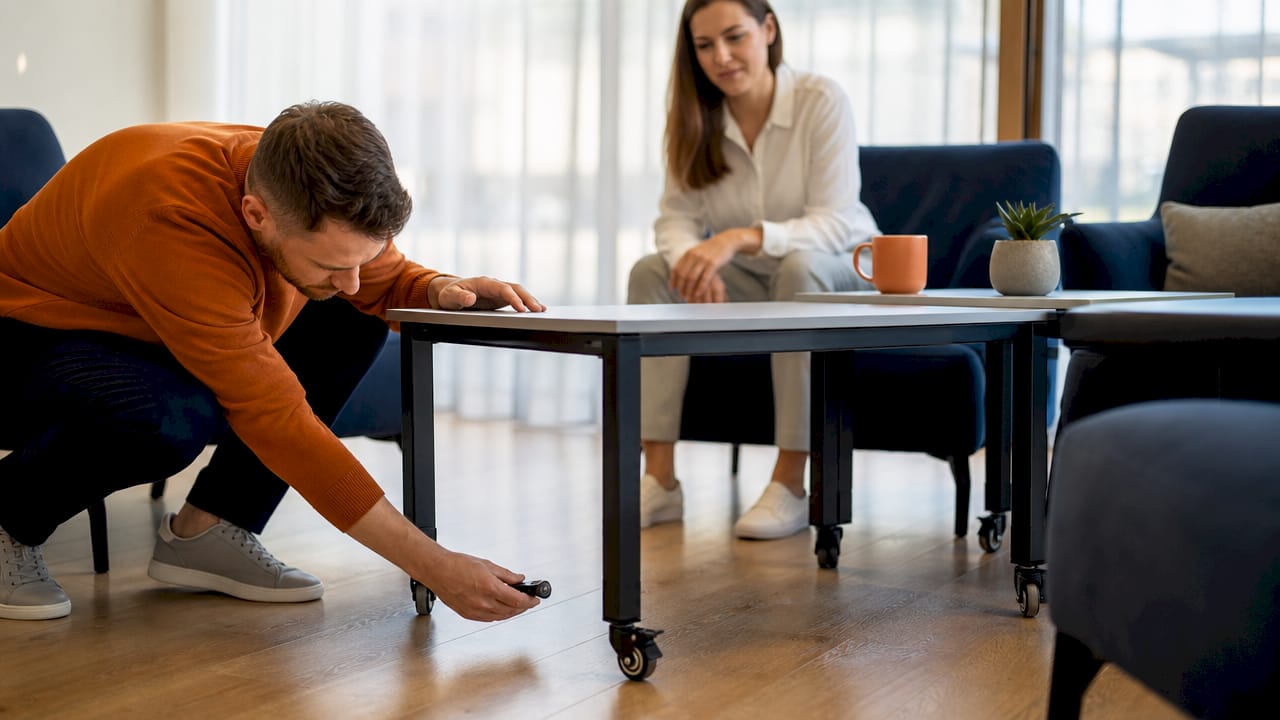
Pro Tip: Buy modular units with lockable castors so teams can reconfigure the layout between sessions without needing facilities support.
Ergonomic quality directly affects how long teams can collaborate before fatigue sets in. Chairs with proper lumbar support, adjustable seat height, and armrests reduce physical discomfort during extended sessions. Standardising chair quality across a collaboration zone also eliminates the distraction of “seat swapping,” where people abandon their position to find a more comfortable chair elsewhere.
BIFMA G1-2013 standards require height-adjustable collaboration tables to accommodate the 5th to 95th percentile of users, with effective operating heights ranging from 25 to 51 inches. That range covers the vast majority of the UK workforce, from shorter seated users to taller standing ones. A table that cannot adjust across this range will exclude some team members from comfortable participation.
For a practical guide to collaborative desk configurations, the key features to prioritise are:
Pro Tip: When specifying chairs for a collaboration zone, order one size range rather than mixing models. Uniform seating removes the hierarchy signal that different chair grades can create in a shared space.
Open-plan offices create noise problems that undermine the very collaboration they are meant to support. Small group breakout zones of two to four people require acoustic treatments such as sound-masking panels or enclosed booths. These provide the privacy levels that open-plan furniture simply cannot achieve.
Acoustic booths serve a dual purpose. They contain sound so that sensitive conversations stay private, and they block incoming noise so that participants can focus. This matters most in financial services, legal, and HR environments where confidentiality is not optional.
Placement is as important as the product itself. Furniture positioned along natural traffic paths encourages spontaneous interaction and prevents areas from becoming unused “ghost zones.” Acoustic booths placed in low-traffic corners tend to go unused because people do not naturally walk past them. Position them near kitchen areas, stairwells, or main corridors instead.
Sound-masking panels work differently. Rather than enclosing a space, they introduce a low-level background sound that makes nearby conversations less intelligible. This is particularly useful in open collaboration zones where full enclosure is not practical.
Height-adjustable desks are the single most versatile piece of best furniture for teamwork. They allow the same surface to serve a seated brainstorm in the morning and a standing review session in the afternoon. That flexibility reduces the need for multiple dedicated room types. A height-adjustable desk setup also supports hybrid working patterns, where different people use the same desk on different days at different heights.
The practical benefit for office managers is space efficiency. One adjustable table replaces what might otherwise require two separate furniture configurations. For teams that move between focused work and group discussion throughout the day, this is a significant advantage.
When specifying adjustable tables for group use, look for models with memory presets so that multiple users can save their preferred heights. Cable management ports are equally important in collaboration settings, where multiple laptops and devices need power simultaneously.
Floor-to-ceiling magnetic or dry-erase surfaces turn walls into collaborative canvases, enabling teams to move between digital and physical brainstorming without losing momentum. This is one of the most cost-effective creative office furniture solutions available because it repurposes existing wall space rather than requiring additional floor area.
Modular seating with built-in power outlets and USB ports, combined with mobile whiteboards and writable partitions, supports a wide range of collaboration styles. A team running a design sprint needs different tools from a team conducting a client review. Multi-function furniture serves both without requiring a room change.
| Furniture type | Primary function | Best suited for |
|---|---|---|
| Magnetic wall panels | Idea capture and display | Brainstorming and planning sessions |
| Mobile whiteboards | Flexible visual communication | Agile teams and daily stand-ups |
| Writable partitions | Divide space and capture notes | Workshop and training environments |
| AV carts | Screen sharing and presentation | Client meetings and remote collaboration |
| Modular seating with power | Flexible seating with device charging | Touchdown and breakout zones |
Tactile mood boards and branded magnetic graphics add a layer of identity to collaboration spaces. Teams that feel ownership of their environment tend to use it more consistently. This is a small investment with a measurable effect on space utilisation.
Breakout zones are distinct from formal meeting rooms. They are designed for short, unplanned conversations rather than scheduled sessions. The best furniture for group activities in these zones includes low-back sofas, ottomans, high stools, and poseur tables. These pieces signal informality, which lowers the social barrier to starting a conversation.
Touchdown spots serve a different need. They are single-person or two-person surfaces where someone can sit briefly to share a screen or review a document. Mobile ottomans and small café-height tables work well here. The 60/40 spatial allocation principle places these flexible overflow areas as 40% of the total collaboration footprint. That proportion ensures there is always somewhere to land without booking a room.
For meeting room furniture that bridges formal and informal settings, look for tables with folding or nesting legs. These can be pushed aside to create open floor space when a session calls for standing or movement-based activities.
Storage is often overlooked in collaborative workspace furniture planning. Cluttered surfaces reduce the usable area of any collaboration table and create visual noise that distracts teams. Mobile pedestal units and under-table storage keep materials close without occupying surface space.
Shared storage in collaboration zones should be accessible to everyone in the group, not assigned to individuals. Open shelving units, labelled bins, and mobile storage trolleys all support this. The goal is to make it easy for any team member to retrieve materials without interrupting the group’s flow.
Lockable storage matters in shared spaces where sensitive documents or equipment need to be secured between sessions. A collaboration zone that doubles as a training room, for example, may need to store presentation materials, cables, and branded assets securely overnight.
The most effective collaborative workspace furniture combines modular flexibility, BIFMA G1-2013 ergonomic compliance, and acoustic privacy to support both structured and spontaneous teamwork.
| Point | Details |
|---|---|
| Apply the 60/40 rule | Allocate 60% of space to structured zones and 40% to flexible overflow areas. |
| Meet BIFMA G1-2013 standards | Specify height-adjustable tables with a 25–51 inch range to accommodate all users. |
| Position furniture on traffic paths | Place breakout zones near natural walkways to prevent ghost zones and encourage use. |
| Standardise ergonomic seating | Uniform chair quality removes seat-swapping distractions and signals equal status. |
| Integrate writable surfaces | Magnetic and dry-erase walls extend collaboration beyond the table without using floor space. |
The most common mistake I see is offices that prioritise how a collaboration space looks over how it actually functions. A beautifully styled room with fixed furniture, poor acoustics, and no power access will sit empty. Teams are practical. They use spaces that work, not spaces that photograph well.
The second mistake is placing collaboration furniture in corners or dead ends. Furniture along natural traffic paths generates spontaneous use. A cluster of soft seating near the coffee point will see more genuine collaboration in a week than a dedicated “innovation room” at the end of a corridor sees in a month.
The third mistake is going entirely mobile or entirely fixed. A space with only mobile furniture feels unstable and temporary. A space with only fixed furniture cannot adapt as team sizes and working patterns change. The right balance is a fixed anchor piece, such as a central table or acoustic booth, surrounded by mobile elements that teams can rearrange themselves.
My practical recommendation is to start with the traffic map of your office before you buy a single piece of furniture. Walk the routes your team actually takes. Then place your collaboration furniture where those paths naturally converge. The furniture itself matters less than its position in the flow of the working day.
— Furniture
Whether you are fitting out a single breakout zone or refurbishing an entire floor, Furnitureforbusiness supplies commercial-grade furniture built for exactly this kind of use.
The ergonomic office chairs range covers everything from task seating for long collaboration sessions to executive chairs suited to boardroom settings. For flexible group work, the office desks collection includes height-adjustable models that meet BIFMA G1-2013 operating ranges. The meeting room furniture range is designed specifically for teamwork environments, with options for both formal and informal settings. Free delivery to the UK mainland is included on all orders.
Collaboration furniture is any seating, table, or partition system designed to support group work and shared interaction in a professional setting. It prioritises flexibility, ergonomic comfort, and acoustic function over individual workstation use.
The 60/40 spatial allocation principle is the most effective starting point: 60% of the space for structured group zones using U or L-shaped configurations, and 40% for flexible overflow areas with mobile seating and touchdown surfaces.
Specify chairs that meet BIFMA G1-2013 standards, with adjustable seat height, lumbar support, and armrests. Standardising the model across the zone removes seat-swapping distractions and ensures all team members are equally comfortable.
Small group zones of two to four people require acoustic panels or enclosed booths to achieve the privacy levels that open-plan furniture cannot provide. Without acoustic treatment, sensitive conversations are audible to the wider office.
The Rule of 8 applies: communication in a U-shaped layout breaks down beyond eight participants. For larger teams, use multiple smaller U-shaped clusters rather than extending a single arrangement.

Phone: 0330 043 4114
VAT no. GB 991 8681 60
Company no. 07250570