TL;DR:
- Open plan offices involve layered spaces that encourage communication while requiring careful acoustic and zoning planning. Proper design integrates silent zones, acoustic treatment, and adaptable furniture to address privacy and noise challenges effectively. Success depends on an ongoing system of acoustic management, not just furniture choices, tailored to specific organizational needs.
Most people assume a what is open plan office question has a simple answer: remove the walls, add desks, and you are done. The reality is considerably more involved. Open plan offices are shaped by acoustic physics, human psychology, and spatial logic in ways that determine whether your team thrives or struggles. This guide cuts through the noise to explain what an open plan office actually is, how UK space standards apply, where projects typically fail, and what you can do about it before a single piece of furniture arrives on site.
An open plan workspace definition describes a workplace layout that minimises internal walls and enclosed rooms, using large shared areas where desks are typically arranged in clusters, benching systems, or activity-based zones with clear sightlines across the space. That last detail matters more than people realise. Sightlines are not just aesthetic; they reflect a deliberate choice to make communication visible and accessible.
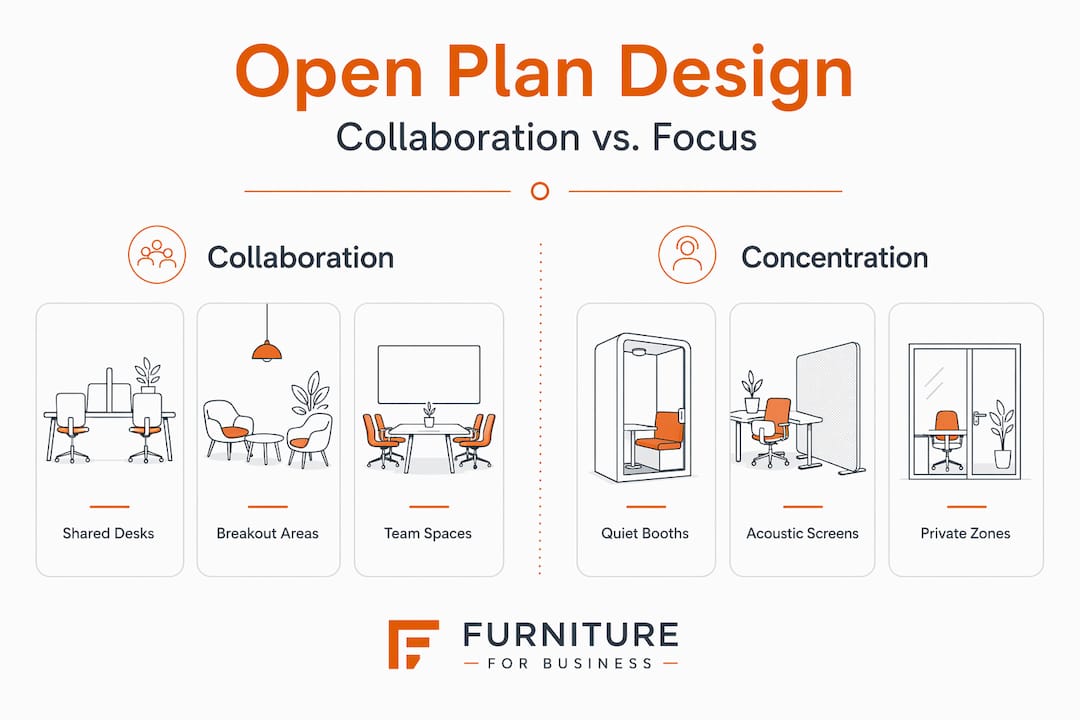
But equating an open plan office with one big room is where most misconceptions begin. A well-considered open plan design includes layers:
What distinguishes open plan office design from a traditional cellular layout is not the absence of all enclosure, but the inversion of the default. In a cellular office, private rooms are the norm and shared areas are exceptions. In open plan, shared space is the norm and enclosed areas are deliberate, purposeful supplements.
This matters for procurement decisions because it means your furniture brief cannot start and end with desks. You need to account for office zoning guides that inform how different areas of the floorplate serve different behavioural needs. The role of open plan office design is not simply to pack more people into a space. Done properly, it creates a visible, connected environment that reduces silos and encourages spontaneous interaction.
With an understanding of what an open plan office is, let us examine how space standards influence its practical design.
UK workplace planning guidance commonly starts from recommended workstation areas of approximately 80 to 100 square feet (around 7.4 to 9.3 square metres) per standard workstation, with support space often accounting for 5 to 8% of the total floorplate and circulation typically 15 to 25%. Those percentages add up quickly on a typical London or Manchester floorplate.
Here is how that looks across different team sizes:
| Team size | Workstation area (sq m) | Circulation + support (sq m) | Estimated total (sq m) |
|---|---|---|---|
| 10 people | 74 to 93 | 22 to 46 | 96 to 139 |
| 25 people | 185 to 232 | 55 to 116 | 240 to 348 |
| 50 people | 370 to 465 | 111 to 232 | 481 to 697 |
| 100 people | 740 to 930 | 222 to 465 | 962 to 1,395 |
These figures assume a standard open plan configuration without large collaborative zones. If your design includes substantial breakout or meeting provision, add at least 10 to 15% on top.
To calculate your actual space requirement, follow these steps:
Our office space planning guidance covers these ratios in further detail if you are working through a refurbishment brief.
Pro Tip: Do not size your open plan office purely for current headcount. Design for your anticipated team size 18 to 24 months from now, factoring in modular furniture that can be reconfigured as needs change.
You will also find that space-efficient desk planning becomes critical when benching systems replace individual workstations. Benching reduces the per-desk footprint but concentrates people more closely, which directly amplifies the acoustic challenges we turn to next.
While planning space is crucial, open layouts also present acoustic and privacy challenges we must understand before committing to a design.
Here is a finding that surprises many office managers:
Lack of privacy contributed approximately 25% more than noise disturbance in predicting acoustic dissatisfaction in open plan offices, based on occupant surveys across 28 offices.
This is counterintuitive. Most managers focus on reducing volume, investing in soft furnishings and carpets to dampen sound. But what employees actually find most disruptive is not decibel level; it is the sense that their conversations can be overheard and that they can hear others’ conversations clearly enough to follow them. That is a privacy problem, not simply a noise problem.
The distinction has real design implications. The key acoustic risk factors in open plan offices include:
That last point is particularly notable. Medium-sized offices (roughly 20 to 60 workstations) often show worse acoustic dissatisfaction than very large ones. In a large office, ambient noise from many conversations creates a natural masking effect. In a medium office, individual voices stand out against a quieter background. If your floorplate falls in that range, acoustic planning deserves extra attention.
Pro Tip: Before specifying furniture, commission a basic acoustic assessment of your space. Ceiling height, floor finish, and partition placement all interact with speech propagation in ways that no furniture arrangement alone can fix.
Investing in acoustic office furniture such as screen panels, upholstered booths, and pod seating can meaningfully reduce perceived lack of privacy when positioned correctly relative to workstations.

Understanding acoustic challenges leads naturally to exploring design solutions that balance collaboration and concentration.
Zoning and acoustic controls including focus and quiet zones, phone and call areas, are foundational to supporting both types of work in open plan offices. Zoning is not just about drawing lines on a floor plan; it is about creating clear behavioural contracts with your team about where different kinds of work happen.
Effective design strategies include:
Here is a practical comparison of design approaches for managing the collaboration/concentration tension:
| Design approach | Collaboration support | Privacy/focus support | Cost implication | Flexibility |
|---|---|---|---|---|
| Open benching only | High | Low | Low | Moderate |
| Benching with acoustic screens | Moderate | Moderate | Moderate | Moderate |
| Activity-based zoning | High | High | Moderate to high | High |
| Modular booths and pods | Moderate | High | High | High |
| Fixed quiet rooms | Low to moderate | High | High | Low |
The table above shows why activity-based zoning tends to be the preferred approach for UK offices of 20 people or more. It provides both modes of working without the fixed cost of building permanent quiet rooms for everyone.
Pro Tip: Movable and modular partitions give you the ability to reconfigure zones as your team’s work patterns shift. This matters especially if you are managing a hybrid workforce where team composition changes day to day.
Exploring office fit-out best practices alongside your furniture brief will help you align zone placement with the structural realities of your building. Your office zoning guide can then translate those zones into specific furniture requirements.
Having explored design strategies, let us consider practical steps and common errors to avoid when implementing open plan layouts.
The most frequent error we see is treating open plan design as a furniture and layout exercise alone. Acoustic performance must be treated as a system combining absorption, blocking, and masking at the desk level. Moving desks around without addressing ceiling absorption, for example, shifts the problem rather than solving it.
Equally important is the micro-environment. Screen placement and background noise masking significantly impact speech privacy and distraction at the individual workstation level. A high-quality acoustic screen at the right height does more for perceived privacy than an entire redesign of zone layout.
Follow this implementation checklist to avoid the most common pitfalls:
It is also worth setting realistic expectations. Acoustic dissatisfaction varies by office size, ceiling height, and user experience, so no two open plan offices perform identically even with similar layouts and furniture. Teams accustomed to private offices will take longer to adjust than those moving from an older open plan environment.
The quality of your office desks matters here too. A desk with integrated cable management and a modesty panel at the front reduces clutter and provides a subtle acoustic and visual barrier, making the workstation feel more contained without adding formal screening.
Pro Tip: Background noise masking systems, which emit a low-level broadband sound through ceiling speakers, are one of the most cost-effective interventions in medium-sized open plan offices. They raise the ambient noise floor so individual conversations become less intelligible. Consult an acoustic specialist before specifying one. Our office furniture tips resource covers related ergonomic considerations alongside acoustic ones.
Here is the uncomfortable reality for procurement teams: the majority of open plan office projects that underperform do so because the acoustic system was never properly designed. The furniture catalogue gets signed off, the desks arrive, and six months later the manager is fielding complaints about concentration and privacy. The furniture itself is rarely the problem.
Lack of privacy impacts occupant satisfaction significantly more than noise alone, and conversations in open spaces become louder and less controllable as a self-reinforcing cycle. People speak up to be heard over ambient noise, which raises the ambient noise level, which causes others to speak louder still. Furniture cannot interrupt that cycle. Only a proper acoustic system can.
What a proper acoustic system looks like is three things working together: absorption (soft surfaces that trap sound energy), blocking (screens and panels that interrupt sound propagation at the source), and masking (ambient sound that reduces the intelligibility of overheard speech). Most refurbishments deliver one of these three, occasionally two. Rarely all three.
The other thing we would challenge is the idea that there is a standard open plan solution. Office size, ceiling geometry, and the type of work your team does create vastly different acoustic conditions even on identical floorplates. A call-heavy sales team and a writing-focused marketing team have entirely different requirements in the same space. Designing to one template and hoping for the best is how you end up with a space that serves nobody well.
Small changes at the workstation level, adjusting screen height by 100 millimetres, reorienting a desk cluster by 45 degrees, adding an acoustic tile to the underside of a shelf, can produce measurable improvements in perceived privacy. These are not expensive interventions. They require attention and a willingness to treat the open plan environment as an ongoing system to manage rather than a one-time installation. Explore acoustic furniture insights to understand which products serve each layer of that system.
At Furniture for Business, we supply commercial-grade furniture to UK businesses planning or refurbishing open plan offices, from five-person teams to organisations with 500 or more workstations.

Our range of office chairs includes ergonomic seating suited to benching and cluster arrangements, with options across a wide price range and bulk order pricing available. Our office desks include space-efficient benching systems, height-adjustable options, and models with integrated cable management to keep open plan areas tidy and functional. For storage, our office storage solutions help you manage the clutter that open plan layouts are often criticised for, with under-desk pedestals, lockers, and mobile units that serve hybrid workforces well. Free delivery to the UK mainland is included as standard.
No. An open plan office minimises walls but typically includes meeting rooms, breakout areas, quiet zones, and collaboration spaces that balance openness with functionality.
Open plan workspaces typically allocate 10 to 12 square metres per person when circulation (15 to 25% of floorplate) and support areas are included, though hybrid utilisation ratios can reduce the actual desk count needed.
Lack of speech privacy is more disruptive than general noise levels, making it the primary driver of occupant dissatisfaction in open plan environments rather than overall volume.
They cannot be eliminated entirely, but combining absorption, blocking, and masking as a designed acoustic system significantly improves comfort and perceived speech privacy across the floorplate.
Not automatically. Dissatisfaction varies by ceiling height, workstation count, and employee work type, so careful planning aligned to your specific team’s needs is essential before committing to an open plan layout.

Phone: 0330 043 4114
VAT no. GB 991 8681 60
Company no. 07250570