TL;DR:
- Office furniture in listed buildings must meet strict legal requirements including consent, fire safety, and accessibility standards. The best approach involves choosing period-inspired designs with materials, finishes, and installation methods that preserve the building’s historic fabric and allow for future flexibility. Early collaboration with heritage officers and bespoke suppliers ensures compliance, reduces delays, and creates a cohesive, respectful workspace.
Selecting office furniture for a listed building is defined by one non-negotiable constraint: every choice must respect the building’s historic character while meeting modern workplace standards. Listed buildings in England and Wales are protected under the Planning (Listed Buildings and Conservation Areas) Act 1990, which means alterations affecting their character require formal consent. For architects and interior designers, this creates a precise brief. The furniture must look right, perform well, and pass regulatory scrutiny. This guide covers the legal framework, design strategies, installation methods, and ergonomic considerations that make heritage office projects succeed.
Listed Building Consent applies to any alteration that affects the character of a listed structure. That scope extends further than most designers expect. Hardware items such as door handles, locks, and hinges all fall within its remit. Furniture that is fixed to walls, floors, or ceilings counts as an alteration. Even freestanding pieces can attract scrutiny if they obscure original architectural features.
Beyond consent, two further regulatory layers apply:
A common misconception is that reproduction heritage hardware will automatically satisfy these requirements. Catalogue reproduction pieces frequently fail fire safety ratings, accessibility standards, and finish consistency checks. Period-appropriate aesthetics require bespoke engineering, not catalogue sourcing.
Pro Tip: Engage your local heritage officer before finalising any furniture specification. Their informal guidance at pre-application stage can prevent costly redesigns after consent is submitted.
The most successful heritage office interiors do not attempt to recreate the past. They create a dialogue between the original fabric and contemporary function. The 170 Piccadilly project in London demonstrates this at scale: a 55,000 sq ft workplace in a Grade II listed building balanced professional workspace demands with historic preservation through bespoke dark-stained oak joinery that echoed the building’s original panel proportions. The result reads as contemporary but feels entirely at home in its setting.
Four design principles guide furniture selection in period buildings:
Pro Tip: Commission a sample board showing all proposed finishes alongside photographs of the existing architectural details. Present this to the heritage officer as part of your consent application. It demonstrates design intent and reduces the risk of objections.
The design-led approach to office furniture that works in a standard commercial fit-out applies here too, but with tighter constraints on material choice and finish consistency.
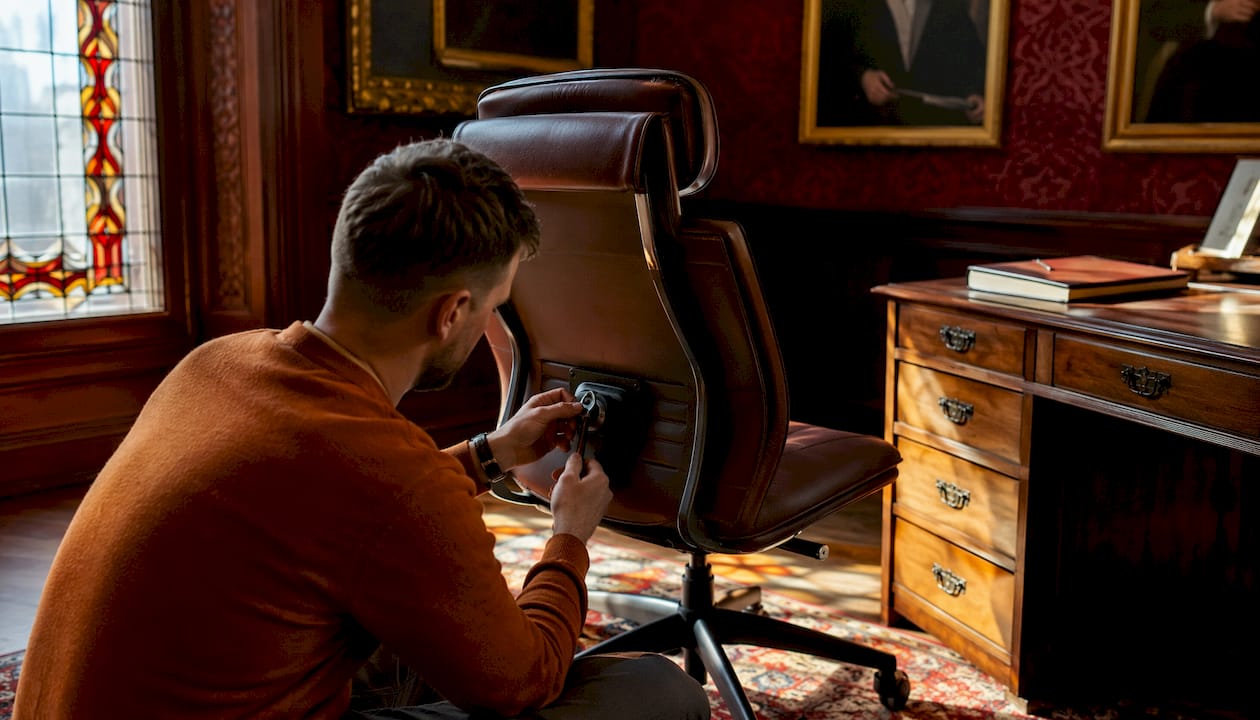
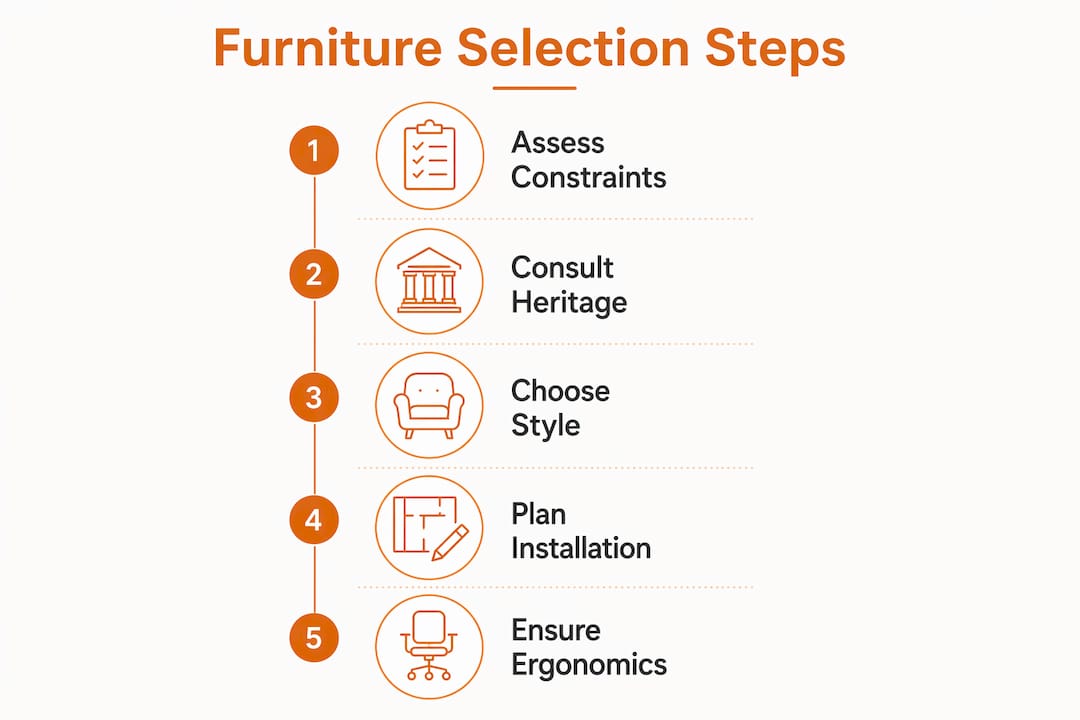
Installation is where heritage projects most often go wrong. Heritage projects prohibit drilling and adhesives as standard. Any fixing that penetrates original plaster, stonework, timber panelling, or flooring requires Listed Building Consent and risks irreversible damage to the historic fabric.
The practical alternatives are well established:
Reversible installation is not a compromise. It is the standard of care that heritage buildings require. Every fixing avoided today preserves options for future conservation, future tenants, and future generations. The buildings that survive longest are those treated with the greatest restraint.
Where thermal performance is a concern, vacuum-sealed glazing retrofits applied to original window sashes improve energy efficiency without replacing the historic fabric. This approach preserves the appearance of original glazing while meeting modern building performance standards.
Ergonomic compliance is not optional in any UK workplace, regardless of the building’s listed status. The Health and Safety (Display Screen Equipment) Regulations 1992 apply equally to a Georgian townhouse and a modern office block. The challenge in heritage settings is meeting those requirements without introducing furniture that looks out of place.
The following approach resolves most conflicts:
Pro Tip: Specify furniture with concealed cable management as standard. Visible cable runs are the single most common detail that undermines the visual quality of a heritage office interior.
The private office furniture guide from Furnitureforbusiness covers desk and seating configurations that work well in enclosed, character-sensitive spaces.
The most frequent cause of project delay is late furniture and hardware specification. Specifying hardware and furniture late in the design process delays heritage approvals and extends lead times for bespoke manufacture. Bespoke joinery and engineered heritage hardware typically require 12–20 weeks from order to delivery. If specification happens after consent is submitted, the programme collapses.
The other recurring challenges are:
The bespoke office desks guide from Furnitureforbusiness explains why custom specification often delivers better value in complex settings than catalogue sourcing.
Office furniture for listed buildings succeeds when legal compliance, period-appropriate design, and reversible installation are treated as a single integrated brief from the outset.
| Point | Details |
|---|---|
| Consent scope is broad | Hardware, fixed furniture, and anything obscuring original fabric all require Listed Building Consent. |
| Catalogue reproductions fail compliance | Reproduction pieces rarely meet fire safety or DDA standards; bespoke engineering is the reliable route. |
| Reversible installation protects fabric | Weighted layouts and removable hanging systems avoid fixings and preserve the historic structure. |
| Material palette drives coherence | Dark oak, walnut, and mahogany with consistent hardware finishes create a unified period aesthetic. |
| Early specialist engagement saves time | Heritage officers and bespoke suppliers brought in at concept stage prevent programme delays. |
The instinct in heritage office projects is often to do too much. Clients want the building to feel “updated,” and designers feel pressure to demonstrate their contribution. The buildings that work best are the ones where the furniture sits quietly and lets the architecture speak.
The most effective approach I have seen treats the historic fabric as the dominant voice and the furniture as a supporting cast. That means choosing a period-style desk that echoes the room’s proportions rather than competing with them. It means specifying statement furniture pieces selectively, so that each one earns its place rather than adding visual noise. It means resisting the urge to fill every corner.
The collaboration between designer and heritage officer is not adversarial. The best heritage officers I have worked alongside are genuinely interested in good design. They push back on lazy choices, not on thoughtful ones. Bring them a well-reasoned material palette and a clear installation strategy, and the consent process becomes a conversation rather than a negotiation.
The furniture choices made in a listed building also shape how the organisation is perceived by everyone who works there. Traditional material palettes communicate stability and authority in ways that laminate and mesh cannot. That is not nostalgia. It is a considered use of the building’s existing cultural capital.
— Furniture
Furnitureforbusiness supplies office chairs and office desks suited to the precise demands of period and heritage settings. The range includes executive seating with traditional profiles and modern ergonomic adjustment, slimline height-adjustable desks with timber-effect surfaces, and solid timber storage solutions that align with period material palettes.
Every order comes with free delivery to the UK mainland, and the team handles bulk orders for fit-outs of all scales. For architects and interior designers working on listed building projects, Furnitureforbusiness offers a practical starting point for specification, with product dimensions and finish details available to support consent applications and design presentations.
Fixed furniture, hardware, and any piece that obscures or damages original fabric requires Listed Building Consent. Freestanding furniture generally does not, but building control officers interpret the boundary conservatively.
Reproduction heritage hardware frequently fails fire safety, accessibility, and finish consistency requirements. Bespoke engineering is the reliable route to period-appropriate aesthetics that also meet modern regulations.
Weighted furniture layouts and removable hanging systems are the standard approach. Drilling, adhesives, and permanent fixings require consent and risk irreversible damage to historic fabric.
The Health and Safety (Display Screen Equipment) Regulations 1992 apply regardless of listed status. Traditional-profile executive chairs with lumbar adjustment and slimline height-adjustable desks meet ergonomic requirements without visual disruption.
Early involvement of heritage specialists at concept stage prevents programme delays. Bespoke furniture and engineered heritage hardware typically require 12–20 weeks lead time, making late specification a significant project risk.

Phone: 0330 043 4114
VAT no. GB 991 8681 60
Company no. 07250570