Sit fully back against the backrest. You should be able to slide 2 to 3 fingers between the front edge of the seat and the back of your knee; this gap helps maintain circulation and lumbar contact. Any tighter and circulation suffers; any looser and you lose lumbar contact. Check this now, then adjust seat depth or add a footrest before touching anything else on the chair.
TL;DR:
- Seat depth should be set so that there is a two to three finger gap between the front of the seat and the back of the knee to ensure proper circulation and lumbar contact.
- If seat depth exceeds the popliteal length, lumbar support becomes ineffective and the backrest cannot be properly reached, negating its benefits.
- Measure your popliteal length and subtract 1.5 to 2 inches to determine the correct seat depth, and consider using a footrest or towel if adjustments are limited.
- Signs of incorrect seat depth include pins and needles behind the knees, difficulty reaching the backrest, and lower back pain mid-afternoon.
- For team furniture, prioritize chairs with sliding seat pans, a stated adjustable range, and a generous returns policy to accommodate varying leg lengths.
Seat depth adjustment only works if you tackle it in the right order. Do it out of sequence and you’ll spend ten minutes chasing a comfort problem that a two-minute fix would have solved.
Once you’ve got the gap right, check that your lower back still touches the lumbar pad when you lean back to answer the phone or twist towards a second monitor. If it doesn’t, the depth is still slightly off.
Pro Tip: Make small adjustments of 5 to 10 millimetres at a time rather than one big swing, and jot the final lever position down somewhere. Shared desks and hot-desking setups mean you’ll be resetting this more often than you’d think, and a quick note saves you re-measuring from scratch every time.
Get seat depth wrong and every other adjustment on the chair becomes irrelevant. Cornell’s ergonomics research is blunt about this: if the seat is deeper than your buttock to popliteal length, you physically cannot reach the backrest without perching on the front edge.
That perching posture does two things. First, it removes lumbar contact entirely, which increases pressure on the spinal discs because your lower back is doing structural work the backrest was meant to handle. Second, if the front seat edge presses into the back of your knees, it restricts blood flow through the popliteal area, the classic cause of pins and needles after an hour at your desk. NHS clinical guidance specifically flags checking knee clearance for this reason.
A seat that’s too deep doesn’t just feel wrong, it makes the backrest structurally useless, however expensive the lumbar mechanism behind it.
Lumbar support only functions when your back is actually against it. A statistic worth remembering: once seat depth exceeds a user’s popliteal length, the backrest becomes unreachable, no adjustment elsewhere compensates for that.
Grab a tape measure and sit on a firm, flat surface with your back against a wall. Measure from the back of your buttocks to the back of your knee, that’s your popliteal length. Then apply the standard conversion.
Most adults fall somewhere in that range, which is why better adjustable chairs feature a sliding seat pan wide enough to accommodate varying leg lengths.
Your body usually flags the problem before you consciously notice it.
Short-term fixes are cheap: lower the seat height slightly if you’re perching, add a footrest so you can sit back without your feet dangling, or slide a rolled towel behind your lower back to test whether a shallower position relieves the ache. If the towel test genuinely helps, that’s a strong signal you need a chair with a sliding seat pan rather than a fixed shell, not just a better cushion.
Procurement decisions get harder once you’re buying for fifteen people rather than one desk, because popliteal length varies more across a team than most buyers expect.
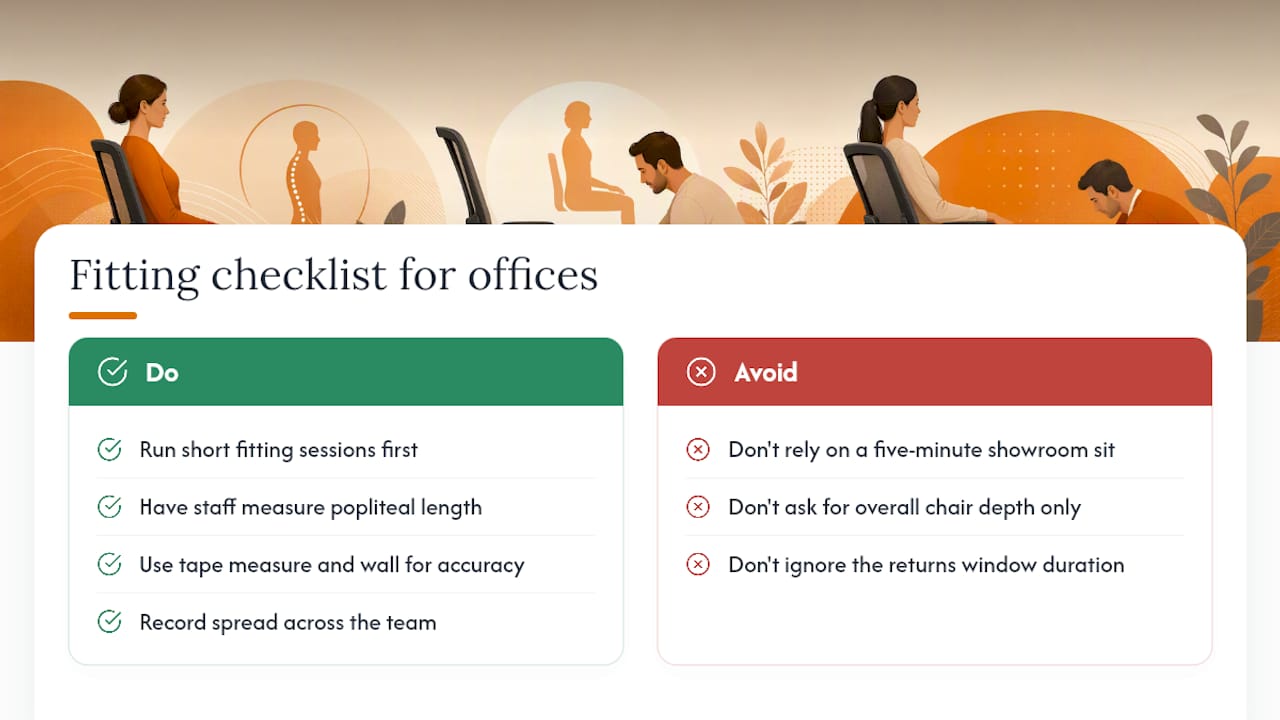
Running short fitting sessions before a bulk order pays for itself. Have staff measure their own popliteal length with a tape measure and a wall, it takes two minutes per person, and record the spread across the team. A group of twenty people will usually show more variation in leg length than in height, which is the detail most buyers miss.
When you ask suppliers about seat-depth range, ask for the adjustable range specifically, not the overall chair depth, and confirm the returns window covers individual staff finding the fit wrong after a week of real use rather than a five-minute showroom sit.
Most seat depth problems get solved with a £15 footrest or a rolled towel, not a new chair. Measure first. If the towel test genuinely fixes the ache, you’ve found your answer before spending a penny, and you’ll know exactly what to ask for when you do eventually replace the chair.
— Furniture
A productivity case for correct seating is easy to make once you’ve seen how many afternoon slumps trace back to a chair that’s simply the wrong depth for the person sitting in it. Ergonomic chairs with sliding seat pans and adjustable backrests are available from certain suppliers, often with delivery options to the UK mainland.

For teams sizing chairs across a mixed group, the Austin heavy duty task chair covers a wide seat-depth range at a price built for bulk ordering, while browsing the full office chairs range or the curated best ergonomic seating picks gives a fuller sense of what’s available for larger fit-outs. Before you order, send suppliers a short checklist: stated seat-depth range in millimetres, on-site trial availability, and a returns window that covers individual comfort, not just faults. Request a quote or arrange a trial for your team through the office chairs category page, and get the measurement right before the invoice lands.

Phone: 0330 043 4114
VAT no. GB 991 8681 60
Company no. 07250570