TL;DR:
- External storage provides UK offices with a cost-effective way to downsize and repurpose space in hybrid work environments. Properly managing off-site archiving and surplus furniture reduces rent costs, enhances flexibility, and improves employee well-being by eliminating clutter. Strategic storage decisions enable offices to optimize space, cut expenses, and support hybrid work models effectively.
Office rent in the UK costs between £50 and £80 per square foot annually, yet a comparable external storage unit can run as little as £100 per month. That gap is enormous, and most procurement teams never think to exploit it. As hybrid working reshapes how UK offices operate, storage is emerging as one of the sharpest tools in the cost-reduction armoury. This article unpacks why that matters, how to act on it, and what separates smart storage decisions from ones that quietly drain your budget.
| Point | Details |
|---|---|
| Hybrid is here to stay | Most UK offices now operate on hybrid models, requiring flexible storage solutions. |
| Significant cost savings | Commercial storage units cost substantially less than traditional office rent and reduce overhead. |
| Optimised workspace | Storing surplus assets creates space for teamwork and boosts productivity. |
| Smart selection matters | Choosing the right storage solution ensures security, flexibility, and long-term gains. |
| Avoid hidden costs | Archiving and reviewing assets helps prevent waste—more isn’t always better. |
The shift to hybrid working is not a passing phase. Over 50% of London workers now work in hybrid arrangements, and around 40% of UK employers formally offer hybrid as a standard option. That is a seismic change from five years ago, and it carries a direct consequence for how office space is used, or rather, how much of it sits idle.
Traditional offices were designed around full occupancy every day. Rows of desks, banks of filing cabinets, shelves loaded with archived documents. When you build for maximum attendance, every square metre is accounted for. Now, with attendance averaging two or three days per week for many teams, a large portion of that space is empty most of the time. You are paying premium rent on a room nobody sits in on a Tuesday.
“The smartest hybrid offices are not the ones with the most space. They are the ones where every square metre earns its keep.”
Commercial storage sits at the heart of this recalibration. Moving surplus furniture, archived files, and seasonal equipment off-site allows you to repurpose valuable floor space for what the hybrid model actually needs: collaborative zones, bookable desks, and informal meeting areas. Staying ahead of these office design trends means acknowledging that the office is now a destination rather than a default, and the layout must reflect that.
Businesses benefiting most from this approach are typically those:
If your office falls into any of those categories, external storage is not an optional extra. It is a structural part of how your workspace operates. When optimising your office for hybrid teams, storage planning should sit alongside desk ratios and booking systems as a core consideration.
The financial logic of hybrid work is compelling, but the spatial logic is where many managers hesitate. How exactly does moving things out free up value inside?
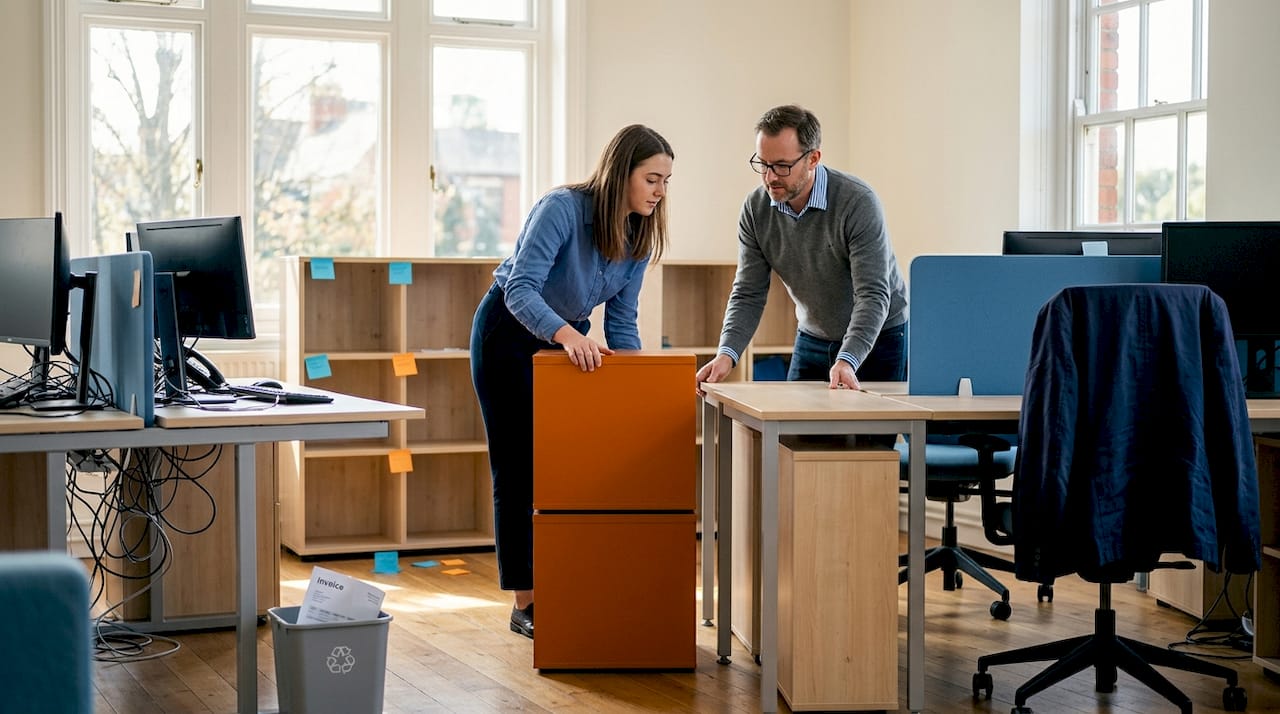
Commercial storage enables downsizing in hybrid models by removing surplus furniture, outdated equipment, and document archives from prime office floor space, directly reclaiming that area for collaboration and flexible working. In practical terms, removing six redundant desks and their associated storage pedestals from a mid-sized London office could free up 20 to 30 square metres. At £60 per square foot annually, that is meaningful savings or, if you retain the space, a worthwhile investment in better-used square footage.
Research also supports a hybrid sweet spot of 6 to 10 office days per month where employee efficiency peaks. At that attendance level, offices rarely need full permanent desk allocation. Storage solutions are a practical enabler of that efficiency model, letting teams focus when in the office rather than navigating cluttered or cramped layouts.
| Space use scenario | Annual cost at £60/sq ft | Action with storage |
|---|---|---|
| 6 redundant desks (approx. 20 sqm) | ~£12,900 | Move to storage, repurpose for collaboration |
| Filing cabinet bank (approx. 8 sqm) | ~£5,160 | Archive off-site, save floor space |
| Seasonal equipment zone (approx. 12 sqm) | ~£7,740 | Rotate to external unit as needed |
| Total potential saving | ~£25,800/year | Significant reinvestment opportunity |
Exploring your office storage options reveals a wide range of on-site solutions too, from compact under-desk units to full tambour cupboards, that help you manage what stays in the building more effectively. The goal is not simply to push everything off-site but to be strategic about what earns a place in your premium space.
Pro Tip: Keep a running digital inventory of everything in storage. It sounds obvious, but many businesses pay for units filled with items they have since replaced or no longer need. A quarterly audit of your storage manifest can eliminate redundant costs and prevent duplicate purchases.
Alongside external storage, space-saving furniture examples show how modular, stackable, and multi-function pieces inside the office itself reduce the physical volume of furniture needed for a given headcount. Combined with off-site storage, this two-pronged approach is the most efficient way to reclaim usable square footage.
Now for the figures most procurement teams find surprising when they see them laid out clearly.
Office rent in the UK varies enormously by location, but the core issue is that every square foot you use for storage rather than productive work is effectively dead space. Filing cabinets alone cost between £47 and £100 per square foot in occupied office space, plus the staff time required to manage physical documents. Switching to off-site archiving reduces that to roughly £4 to £6 per box per year, a reduction so significant it often pays for the entire storage arrangement.
Comparing the broad cost picture:
| Storage option | Monthly cost (approx.) | Best suited for | Flexibility |
|---|---|---|---|
| Self-storage unit | £100 to £300 | Mixed office overflow, documents | High |
| Container storage | £75 to £200 | High-volume, consistent needs | Medium |
| Office floor space | £400 to £800+ (per 10 sqm) | Active daily use items only | Low |
| On-site filing cabinets | Hidden in rent + staff time | Frequently accessed documents | High but costly |
Pro Tip: Before signing any storage contract, identify which of your current office contents you access fewer than four times per year. Those items are prime candidates for off-site archiving. In most UK offices, that category is larger than you expect and includes archived contracts, old IT equipment, seasonal décor, and surplus seating.
The financial case for efficient storage solutions becomes clearest when you account for the full cost of in-office storage, not just the rent. Staff time retrieving documents, the opportunity cost of cluttered collaboration space, and the morale impact of cramped working conditions all add real value to the off-site alternative.
Workspace storage optimisation also involves reviewing how on-site storage furniture is configured, ensuring that what remains in the building is genuinely earning its place.
Once you accept that external storage is worth pursuing, the practical question is which type fits your situation. Not all storage arrangements are equal, and choosing poorly can introduce new costs and complications.
Containers offer lower monthly costs for high-volume storage but tend to be less flexible for offices that need to retrieve or rotate items regularly. Traditional self-storage units suit businesses with varied or unpredictable storage needs, where access frequency matters.
Key factors to assess before committing to any commercial storage arrangement:
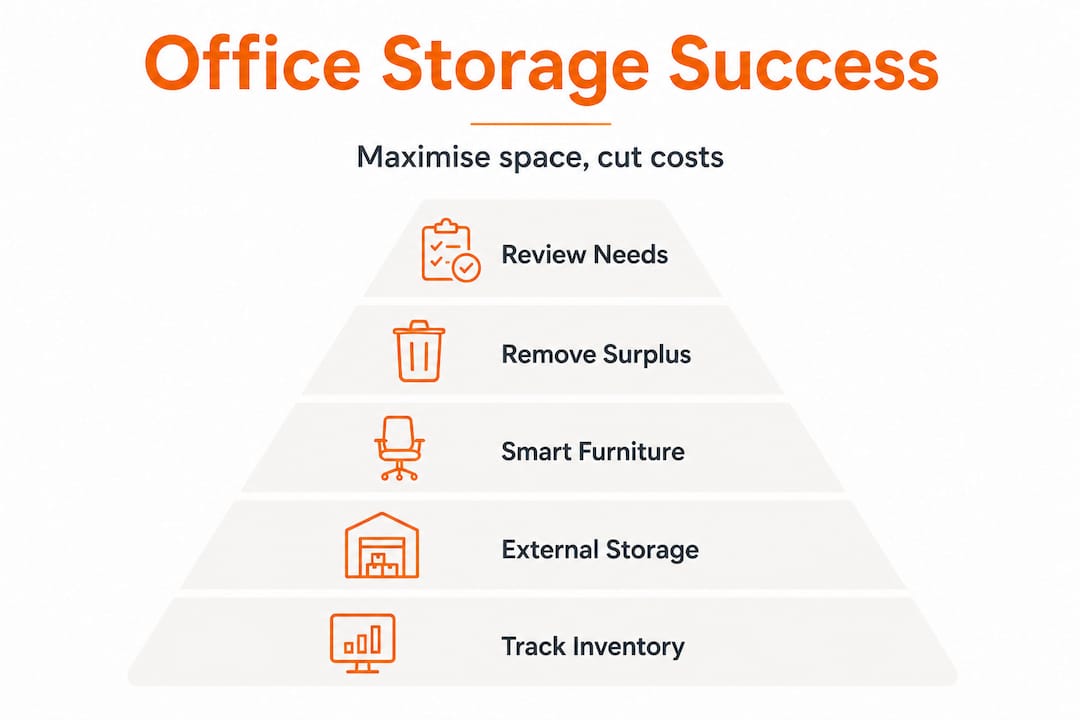
The right office storage solutions strategy blends external storage for low-access items with smart on-site furniture for everyday needs. An optimised workspace storage approach treats both as part of the same system rather than separate concerns.
Pro Tip: Before booking a storage unit, conduct a physical audit of your office. Walk through every storage area, every under-desk cabinet, every cupboard, and every shelf. Categorise each item as daily use, occasional use, or rarely accessed. This single exercise typically reveals that 30 to 40% of stored items could leave the building without affecting day-to-day operations.
Scalability deserves particular attention in hybrid environments. As team sizes shift with hiring cycles, project phases, or site consolidations, your storage footprint will change too. Providers with a range of unit sizes and flexible terms make that adjustment far simpler than being locked into a fixed volume at a fixed price.
There is a persistent assumption in office management that bigger storage equals better organisation. More cabinets, more shelves, more boxes. In reality, it tends to mean more clutter, more wasted space, and more time lost searching for things.
The offices that run most efficiently are not the ones with the most storage capacity. They are the ones that have done the hard work of deciding what genuinely needs to be kept, where it needs to live, and how quickly it needs to be accessible. That clarity changes everything.
What often gets missed is the morale cost of over-storage. Cluttered offices feel chaotic. Staff navigating piles of surplus furniture or squeezing past filing cabinets that should have been cleared years ago experience a subtle but real friction every single day. Office layout and wellbeing are directly linked, and storage is a bigger factor in that relationship than most managers acknowledge.
The filing cabinet problem is a useful illustration. Research shows that filing cabinets cost the equivalent of £47 to £100 per square foot when you factor in the office floor space they occupy. Many offices continue running entire rows of them because no one has taken the time to digitise documents or arrange off-site archiving. The cost is invisible because it is bundled into the rent. But it is real, and it is significant.
Our strong view is that procurement teams should resist the instinct to solve storage problems by acquiring more space or more furniture. The better instinct is to audit, reduce, and reorganise. Do more with less. External commercial storage is a tool that enables that discipline by removing the friction of excess from your main workspace, not by allowing indefinite accumulation off-site.
The hybrid office, at its best, is a curated environment where everything present serves a purpose. Storage is part of that curation, not an afterthought.
If this article has prompted a closer look at your current storage setup, the next step is straightforward. Review your existing inventory, identify what can move off-site, and then look at what stays in your office and whether it is doing its job efficiently.

At Furniture for Business, our range of commercial office storage covers everything from compact pedestals and mobile caddy units to full tambour cupboards and open shelving systems designed for high-use environments. All orders include free delivery to the UK mainland. If you want guidance on how to structure your on-site storage to complement an off-site arrangement, our optimising workspace solutions guide walks through the practical decisions step by step. You can also browse our curated picks for boosting office efficiency through smarter storage configurations. Get in touch if you need help specifying the right options for your team size and layout.
Commercial office storage enables downsizing by removing surplus furniture and archived documents from prime floor space, making room for collaboration zones and flexible desking arrangements that suit hybrid teams.
Storage units cost a fraction of standard office rent, with no business rates payable and no long lease obligations, making them a substantially cheaper option for holding items that do not need to be on-site daily.
Off-site archiving at £4 to £6 per box per year makes archived documents particularly cost-effective to store externally, alongside surplus furniture, seasonal equipment, and IT assets not in active rotation.
Containers cost £75 to £200 per month for high-volume needs, which is cheaper long-term than traditional units, but self-storage units remain more practical where frequent access or item rotation is required.
Research identifies a hybrid efficiency peak at 6 to 10 office days per month, and storage aids that model by freeing up space for productive use without requiring a full return to the office or expensive lease expansions.

Phone: 0330 043 4114
VAT no. GB 991 8681 60
Company no. 07250570