Boardroom table cost in the UK usually varies from low hundreds of pounds for small stocked tables, several hundred to a few thousand pounds for mid-range commercial or semi-bespoke tables, and higher for handcrafted solid timber or large bespoke designs. Before ordering, ask every shortlisted supplier for a line-item quote that separates the table, power modules, delivery and installation, so you’re comparing like with like rather than a vague headline figure.
TL;DR:
- Larger tables with more seats, especially over 10, can significantly increase costs due to material quality, shape, and integrated features like power modules.
- Custom-made and bespoke tables tend to be more expensive and take longer to produce than stock options, which are faster and more predictable in pricing.
- Adding integrated power and data modules can raise the initial price by hundreds of pounds, with retrofitting later being more disruptive and costly.
- Using recycled or modular tables offers cost savings, but may sacrifice warranty, finish quality, or flexibility for future expansion.
- Delivery options, order lead times, and installation complexity influence final costs, with full white-glove service being the most expensive choice.
The honest answer is that price tracks seating capacity almost as closely as it tracks material quality. A two to four-seat huddle table is a different budgeting exercise entirely from a fourteen-seat boardroom centrepiece, and suppliers price accordingly.
As a working guide:
Two real-world listings illustrate the spread. A basic 1200mm square boardroom table in beech with a steel frame is listed at around £432.90 ex VAT, with delivery to UK mainland ground-floor reception in three to five working days. At the other end, a solid walnut boardroom table is sold from around £1,876.50, with UK mainland shipping widely offered as part of the deal. These are examples, not price guarantees. Exact figures shift with size, edge profile and current supplier stock.
Pro Tip: If your quote comes back suspiciously round, ask what’s excluded. A “£950” table can become £1,400 once power, delivery and installation are added, and that gap catches out a lot of first-time buyers.
The biggest single jump in price tends to come from adding integrated power and data modules, which can add anywhere from a modest fixed sum for a simple socket unit to several hundred pounds for a full cable management and AV-ready system, depending on the specification.
Size drives cost in a fairly predictable way. Suppliers often price per linear metre or per seat, so a 3.6-metre table for ten people will always cost meaningfully more than a 2.4-metre table for six, even in the same finish. Shape matters too. Boat, oval and corner-radius tops cost more to manufacture than a plain rectangle or square, because of the extra cutting, edge-banding and, for veneered tops, the cross-grain matching involved.
Material is the next lever, and it moves in fairly clear steps:
Integrated power and data modules add cost at the point of manufacture but usually cost less than retrofitting sockets into a finished table later, since cutting and rewiring an existing top is disruptive and often requires the table to leave site. Bespoke touches such as waterfall edges, cable boxes flush-mounted into the top, or matched veneer grain across a multi-panel table all add both cost and lead time, sometimes by several weeks.
Choose stock for speed, bespoke for fit, used for budget, and hire when the need is temporary.
A comparable quote depends on giving every supplier the same brief. Before you request pricing, have these details ready:
A sample budget line-up looks like this: table price ex VAT, power/data module, delivery charge, installation charge, VAT at the standard rate, and a contingency of around 10% for last-minute changes. Furniture For Business’s guide to selecting conference tables for UK offices sets out sizing and specification questions in more depth, worth working through before you send out requests for quotes.
Once quotes land, ask specifically about lead time, delivery level, installation scope, warranty length and the returns policy. Checking supplier reviews on platforms such as Trustpilot is a sensible extra step, since aftercare and warranty honesty vary more between suppliers than headline prices do. Treat vague delivery terms, unspecified installation costs, or the absence of a named warranty period as red flags worth querying before you sign anything.
Stock tables typically ship within a few days to two weeks. Bespoke orders, particularly in solid timber or with custom veneer matching, commonly run from six weeks to three months, so timing your order against a fit-out deadline matters more than it might for a stock desk.
Delivery terms vary by supplier, and it’s worth checking which level applies to your postcode:
Many suppliers advertise free delivery above a set order value, but that threshold and postcode coverage vary, so confirm it applies to your delivery address rather than assuming. Installation complexity, such as routing power cables through a raised floor or boxing in legs against a glazed partition, can add meaningfully to on-site costs, so ask for that as its own quote line rather than an estimate folded into the table price.
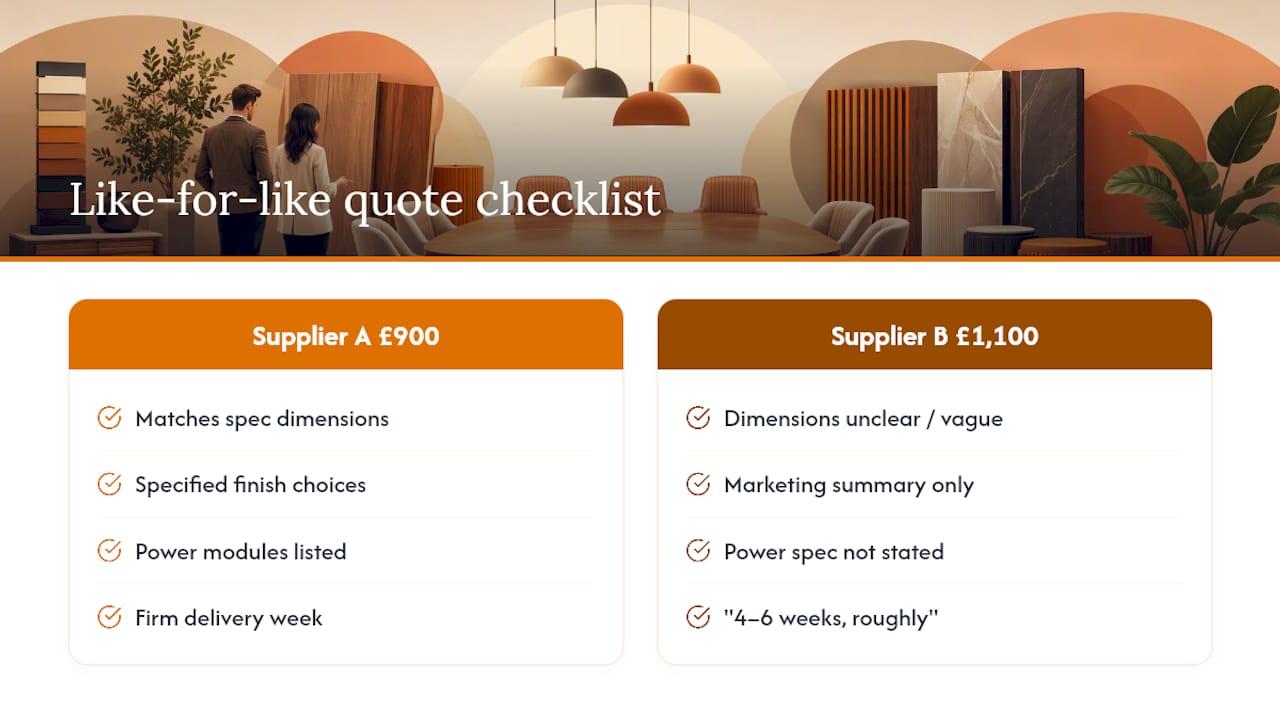
The most reliable way to compare boardroom table suppliers isn’t the sticker price. It’s whether each quote covers the same ground: identical dimensions, matching finish, the same power specification, and clearly stated delivery and installation terms. Two suppliers quoting £900 and £1,100 for what looks like the same table often aren’t quoting the same job at all, once you check whether installation and VAT are included in one and not the other.
Product listing pages are a useful starting point because they show real specification detail rather than a marketing summary. Furniture For Business’s meeting room category lists power module options and finish choices alongside pricing, which gives you a benchmark to hold other quotes against. When you request quotes elsewhere, ask suppliers to match that level of specification detail so you’re not left guessing what’s included.
Beyond price, weigh lead time honesty (a supplier who commits to a firm delivery week is generally more reliable than one who says “four to six weeks, roughly”), aftercare terms, and whether the quote separates disposal of your old furniture as an optional extra. Suppliers who bundle everything into one number without breaking it down are harder to compare and often hide the more expensive line items inside a seemingly competitive headline price. A supplier’s willingness to itemise a quote without being pushed is, in itself, a reasonable signal of how straightforward the rest of the transaction will be.
Modular boardroom tables, built from separate sections that bolt together, are one of the more underused ways to control cost. A modular 3.6-metre table built from three matched sections often costs less than an equivalent solid one-piece top, and sections can be reconfigured or extended later if your team grows, which avoids buying a second table from scratch.
Refurbished and used tables offer the steepest discount, sometimes at less than half the price of a new equivalent in similar condition, but the trade-off is real: no manufacturer warranty, inconsistent stock availability, and finishes that may not match existing office furniture. These suit satellite offices, meeting rooms used infrequently, or businesses bridging a gap before a full refurbishment.
A middle path worth considering is buying a simpler stocked table now and adding a power module or upgraded finish later if budget allows, rather than delaying the purchase entirely while chasing a fully-specified bespoke design. Stocked, modular tables with laminate finishes represent the lowest total-cost route for standard meeting rooms and get you into a working room far faster than a bespoke order.
If budget is the primary constraint, prioritise spending on structural quality (frame strength, top thickness) over cosmetic finish. A laminate top on a solid frame will outlast a veneered top on a weak frame, and refinishing a scratched laminate surface is far cheaper than repairing damaged veneer.
The purchase price is only part of the bill. A well-built boardroom table with a laminate or solid timber top typically needs little beyond occasional cleaning and the odd tightened bolt, but veneer tops are more vulnerable to scratching, water rings and sun fading over a typical seven to ten-year office lifecycle. Recoating or refinishing a damaged veneer surface can cost a meaningful fraction of the table’s original price, whereas a laminate surface is usually cheaper and quicker to repair or simply replace as a top panel.
Integrated power modules are the other long-term cost variable. Sockets, USB ports and cable trays occasionally need replacing as connector standards change, and retrofitting power into a table that didn’t originally have it is more disruptive and expensive than specifying it upfront. Bespoke solid timber tables generally hold their value and appearance better over a decade, but they also cost more to move or repair if damaged, given the specialist joinery involved.
Factor lifecycle thinking into your initial budget rather than treating the purchase price as the whole cost. Furniture For Business’s office furniture buying guide covers durability trade-offs across materials in more detail, useful reading before committing to a finish you’ll be living with for the best part of a decade.
Most procurement teams over-index on finish and under-index on power. A modest laminate top with integrated power built in from day one will usually serve a hybrid meeting room better than a striking veneer table with no cabling, because the cost of retrofitting power later almost always exceeds the premium of specifying it upfront.
Furniture For Business supports this kind of decision with clear spec sheets, bulk pricing for multi-room fit-outs, and honest lead-time information rather than vague delivery promises. Buyers who ask for that detail upfront tend to get quotes that hold up once the invoice arrives.
— Furniture
Furniture For Business is the straightforward alternative to chasing five separate suppliers for five different quote formats. Every boardroom and meeting room table listing sets out the specification, finish and power options clearly, so you can request a like-for-like quote without decoding a vague product description first.
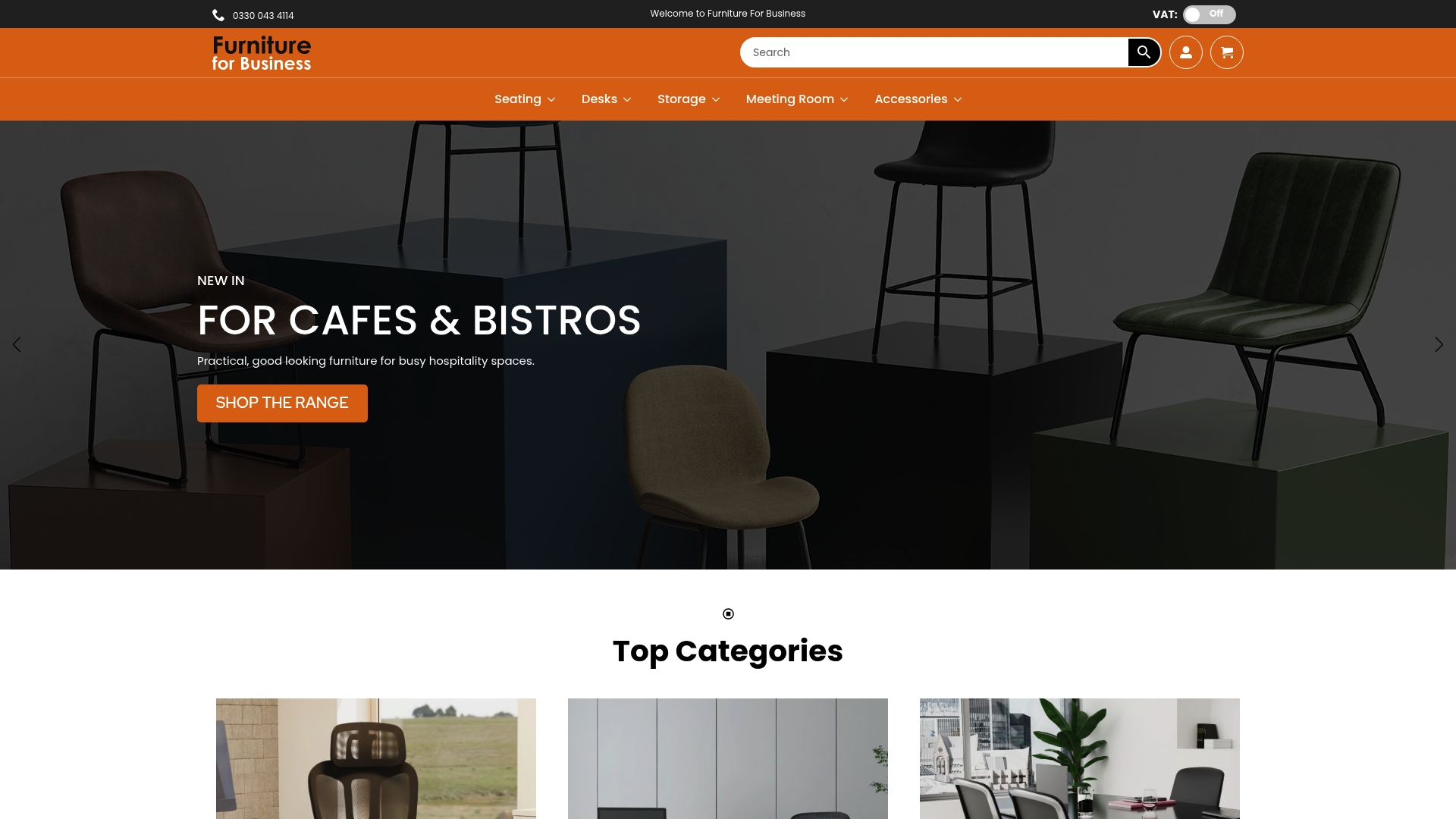
The supplier offers stocked boardroom tables available for delivery to the UK mainland, as well as bespoke sizing and integrated power options for larger fit-outs. The meeting room range covers table shapes and sizes from small huddle tables to full boardroom suites, with power modules specified upfront rather than added as an afterthought. Bulk order pricing is available for businesses fitting out multiple rooms at once.
If you’re ready to move, use the procurement checklist to gather your dimensions, seating count and power requirement, then request a quote through the meeting room category or contact the team for a bulk pricing conversation. It’s a faster route to a comparable, itemised price than working through supplier websites one by one.
Boardroom table cost in the UK usually varies from low hundreds of pounds for small stocked tables, several hundred to a few thousand pounds for mid-range commercial or semi-bespoke tables, and higher for handcrafted solid timber or large bespoke designs.
Conference table pricing follows the same bands as boardroom tables, since the terms are largely interchangeable in the UK market, with seating capacity and material the two biggest cost drivers.
“Boardroom table” and “conference table” are used interchangeably in the UK; some suppliers also describe larger versions as “meeting room tables” or “executive conference tables” depending on size and finish.
The UK office furniture market includes a wide range of established manufacturers and retailers; Furniture For Business is one of them, supplying boardroom tables, meeting room furniture and related office furniture with UK mainland delivery.

Phone: 0330 043 4114
VAT no. GB 991 8681 60
Company no. 07250570