TL;DR:
- Acoustic panels primarily reduce echo and reverberation within a space but do not block sound transmission between rooms.
- Implementing targeted acoustic treatments can significantly improve focus, speech clarity, and reduce productivity losses caused by noise.
Open-plan offices look great on a floorplan. In practice, they often feel like working inside a drum. The question of why acoustic panels in offices deserve serious budget consideration comes down to one uncomfortable fact: noise is not just annoying, it is measurably expensive. Echoing voices, ringing phones, and the general hum of a busy floor eat into focus time and drive up stress levels before lunch. This article cuts through the confusion about what acoustic panels actually do, what they cannot do, and how to use them as part of a sound strategy that genuinely improves how your office feels and functions.
| Point | Details |
|---|---|
| Panels absorb, not block | Acoustic panels reduce echo and reverberation inside a room but do not prevent sound travelling between rooms. |
| Productivity losses are measurable | Poor office acoustics cost businesses an average of 86 minutes of productive time per employee every day. |
| Placement beats quantity | Prioritising the largest reflective surfaces, particularly ceilings and main walls, delivers better results than covering every surface. |
| Privacy needs more than panels | Achieving speech privacy requires blocking strategies such as mass and sealing, not absorption alone. |
| Diagnosis before specification | Identify whether reverberation, privacy, or external noise is the dominant problem before spending on treatment. |
This is where most office managers spend money in the wrong place. Acoustic panels and soundproofing are not the same thing, and mixing them up leads to costly mistakes.
Sound absorption and soundproofing address fundamentally different problems. Absorption is measured by the Noise Reduction Coefficient (NRC), which tells you how much sound energy a material soaks up rather than reflecting it back into the room. Soundproofing, or sound blocking, is measured by the Sound Transmission Class (STC) rating, which tells you how well a partition or wall prevents sound from passing through it to an adjacent space.
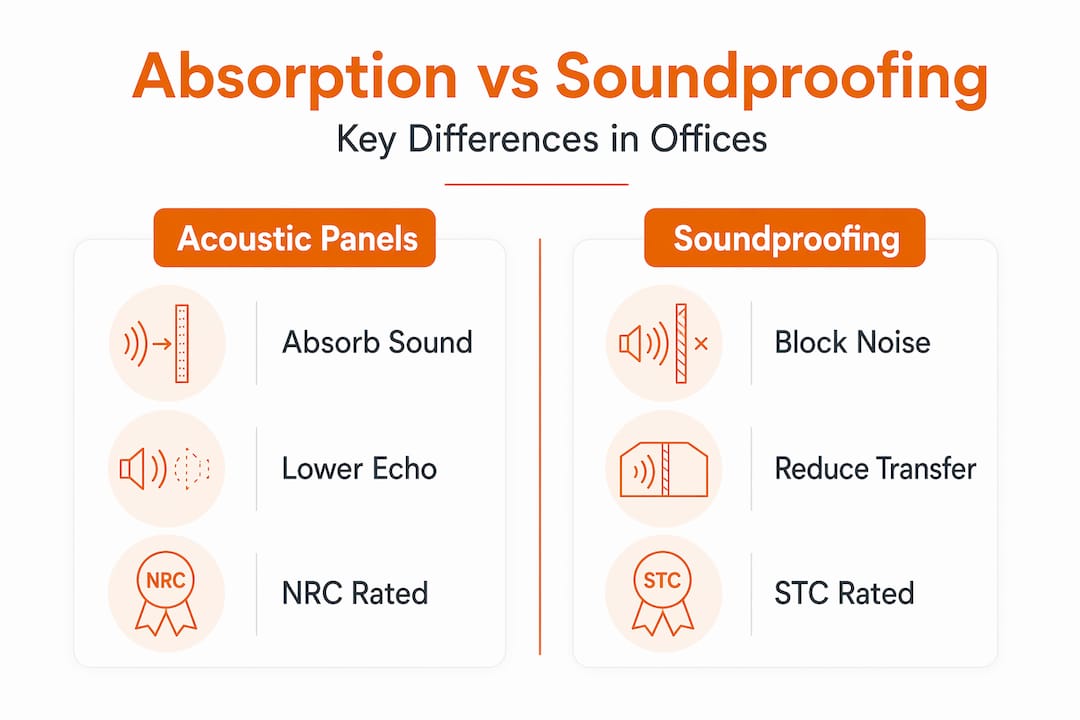
Acoustic panels sit firmly in the absorption camp. Panels reduce reverberation and echo inside a room by catching reflected sound energy before it bounces around and builds up. What they do not do is stop sound from travelling through walls, floors, or ceilings into the next room.
| Property | Acoustic panels (NRC) | Soundproofing (STC) |
|---|---|---|
| What it measures | Sound absorbed within a space | Sound blocked between spaces |
| Primary effect | Reduces echo and reverberation | Reduces transmission between rooms |
| Typical materials | Fabric-wrapped fiberglass, foam, felt | Dense plasterboard, mass-loaded vinyl, sealing |
| Best office use | Open-plan floors, meeting rooms, reception | Private offices, boardrooms, call centres |
| Installation | Wall and ceiling mounted panels | Structural partition upgrades |
Pro Tip: If your concern is colleagues overhearing confidential calls through the wall, that is a soundproofing problem. If your concern is a room that sounds echoey and hard to hear across, that is an absorption problem. Solve the right one first.
The productivity case for improving office acoustics is straightforward once you see the numbers. Open-plan office noise causes an average loss of 86 minutes of productive time per employee per day, according to an IPSOS study commissioned by Steelcase. Across a team of 30, that is the equivalent of losing more than four full-time employees to distraction every single working day.
The mechanism behind this is reverberation time, often expressed as RT60. This is the time it takes for a sound to decay by 60 decibels after it stops. A room with a long RT60 (anything above 0.8 to 1.0 seconds in a typical office) sounds cluttered, echoey, and fatiguing. Speech becomes harder to understand because each word overlaps with the reflections of the previous one. The WELL Building Standard targets a maximum RT60 of 0.5 seconds for open workspaces, and acoustic panels are one of the most practical tools for getting there.
Untreated office acoustics reduce creativity, attention, and increase stress, as confirmed by a 2022 study published in Scientific Reports. The research is unambiguous: the acoustic environment is not a comfort nicety, it is a cognitive performance variable.
The benefits of installing acoustic panels for office use include:
Pro Tip: Before purchasing panels, clap once sharply in the middle of your office and listen. A long, fluttery decay means you have significant reverberation to address. A short, dead sound means panels will have limited additional impact and the issue may be sound transmission instead.
Good office design and acoustic comfort work together. Reducing reverberation is one of the highest-return interventions you can make in an existing open-plan space without structural work.
Not all panels perform equally, and the material matters a great deal when you are specifying for a commercial space.
Fabric-wrapped fiberglass panels are the gold standard for office acoustic treatment. They outperform foam on almost every practical dimension: NRC rating, fire safety compliance, longevity, and the ability to cover them in a fabric that suits your interior scheme. Fiberglass panels achieve NRC values from around 0.85 at one inch thickness up to 1.15 at two inches, meaning they absorb more sound energy than they receive at certain frequencies. That seemingly counter-intuitive NRC above 1.0 occurs because thick panels also capture diffracted sound energy at their edges.

The frequency absorption profile matters too. Speech intelligibility depends on mid-range frequencies, roughly 500Hz to 4000Hz. Thicker panels (50mm or more) address lower frequencies as well, which is useful in rooms with HVAC noise or in spaces where bass frequencies build up noticeably.
Here is a practical process for evaluating and selecting panels:
For open-plan office design, a mix of ceiling baffles and wall-mounted panels typically provides the broadest coverage with minimal impact on floor space.
Here is a nuance that rarely appears in product-focused articles. Adding absorptive panels without proper blocking can worsen speech privacy in some scenarios. When you reduce reverberation inside a room, voices become cleaner and more intelligible, which makes it easier for those sounds to travel clearly through gaps, plenums, and flanking paths to adjacent spaces.
A common culprit is the ceiling plenum. Standard acoustic ceiling tiles are porous and lightweight, designed for absorption, not blocking. Sound travels up through them, across the plenum void above, and back down through the ceiling tiles in the next room. No amount of additional wall panels will solve that path.
Improving absorption without sealing leakage paths can increase sound audibility in adjacent spaces. This is why treating acoustic complaints should begin with diagnosis rather than immediate specification.
Practical tips for building a complete acoustic strategy:
For a broader view of how acoustic strategy fits into a complete fit-out, the office fit-out best practices guide covers layout, zoning, and surface treatment together.
Effective acoustic treatment prioritises the largest reflective surfaces first. In most offices that means the ceiling, which is simultaneously the largest hard surface and the one most sound reflects off during normal conversation. Ceiling-mounted baffles or clouds should be your starting point, not wall art panels.
After the ceiling, identify the primary reflection points on walls. These are typically the surfaces directly beside workstations, behind screens, and at the ends of meeting rooms. A simple reflection point test involves holding a mirror flat against the wall while a colleague sits at the workstation; if you can see their monitor, that surface is contributing to reflections that need treatment.
Coverage percentage matters. A rough guide for office spaces is that 15 to 25 percent of total surface area should be absorbent to reach acceptable RT60 values. Covering every surface is unnecessary and visually oppressive.
Pro Tip: In meeting rooms, start with ceiling treatment and the wall behind the primary speaker position. Add panels to the side walls only if residual echo persists after the ceiling and end walls are treated. This saves budget and avoids over-damping the room, which makes it feel uncomfortable in a different way.
Acoustic panels work best when integrated with the furniture and fixtures already in the space. Upholstered seating, carpet tiles, and acoustic office furniture all contribute to the overall absorption budget. Account for them before over-specifying panels.
I’ve seen too many office refurbishments where acoustic panels were purchased as an afterthought, bolted to walls as a cosmetic gesture, and then the team complained three months later that nothing had improved. The panels were real. The problem was that nobody had diagnosed the actual issue first.
What I’ve learnt is that the benefits of acoustic panels are entirely real, but they are specific. Panels fix reverberation. They make rooms sound less cluttered and conversations more intelligible. They reduce fatigue. What they do not do is fix confidentiality problems or stop the sound of a phone conversation carrying into the next office. Those are structural problems requiring structural answers.
My honest view is that most UK offices are under-treated acoustically, and the cost of doing nothing is far higher than most managers realise. Losing 86 minutes per employee per day to noise distraction is not a soft wellbeing metric. It is a direct line item on your labour cost. Spending on proper acoustic diagnosis and treatment is almost always a better return than another round of ergonomic chair upgrades.
The mistake I see most often is buying panels on appearance rather than performance data. Ask for NRC ratings at octave bands, not just a single averaged figure. Specify based on your room’s dimensions and target RT60. And do not forget that acoustic treatment is one component of a broader design approach, not a standalone fix.
— Furnitureforbusiness
If this article has helped clarify what acoustic treatment can and cannot achieve, the next step is looking at the physical environment as a whole. Acoustic panels work harder when the rest of the space supports good sound management, and that starts with the right furniture.

At Furnitureforbusiness, we supply commercial office furniture designed for real working environments across the UK, with free delivery to the UK mainland. Our meeting room furniture range is particularly relevant if you are addressing acoustics in high-use rooms where speech clarity and privacy both matter. We also offer office chairs with upholstered finishes that contribute to overall room absorption. Whether you are fitting out a new space or upgrading an existing one, our team can help you source what you need efficiently, with bulk pricing available for larger orders. Browse the full range at furnitureforbusiness.co.uk or get in touch to discuss your project.
Acoustic panels absorb reflected sound energy, reducing echo and reverberation inside a room. This improves speech clarity, lowers perceived noise levels, and reduces listening fatigue for staff.
No. Acoustic panels reduce reverberation but do not block sound transmission between rooms. Soundproofing requires mass, sealing, and structural solutions with a focus on STC ratings, not NRC.
A practical starting point is treating 15 to 25 percent of the total hard surface area, prioritising ceilings and main walls. Panel placement matters more than sheer quantity for achieving effective reverberation control.
Yes. Office noise costs an average of 86 minutes of productive time per employee daily. Reducing reverberation through acoustic treatment directly addresses the concentration difficulties and auditory fatigue that drive those losses.
Fabric-wrapped fiberglass panels are widely considered the most effective choice for commercial offices. They offer NRC values between 0.85 and 1.15 depending on thickness, meet UK fire safety requirements, and can be finished to match office interiors.

Phone: 0330 043 4114
VAT no. GB 991 8681 60
Company no. 07250570