TL;DR:
- Most office fit-outs fail because full workflow mapping is overlooked before contractors start work.
- Early alignment on project scope, legal constraints, and stakeholder success criteria reduces delays, scope creep, and misunderstandings.
- Effective management of procurement, compliance, contractor roles, and handover documentation is essential for completing a successful office fit-out.
Most office fit-outs don’t fail because of bad design. They fail because nobody mapped out the full workflow before the first contractor arrived. This office fit-out workflow guide exists to fix that. Whether you’re refurbishing a single floor or relocating an entire organisation, the same pattern of problems tends to appear: procurement timelines that clash with construction schedules, compliance duties nobody thought to assign, and handover documentation gathered at the last minute. This guide walks you through every stage, from defining your brief to receiving sign-off, with specific guidance on procurement frameworks, CDM 2015 duties, and what to do when a defect appears six months after occupancy.
| Point | Details |
|---|---|
| Clear project vision | Define success criteria and building constraints early to reduce risks and misalignment. |
| Use public frameworks | Leverage frameworks like NHS Supply Chain for compliant, efficient office furniture procurement. |
| Plan procurement lead times | Include 2–4 week mini-competition periods in timelines to avoid delays. |
| Understand legal duties | Fulfil CDM 2015 requirements including appointing principal contractors and maintaining safety plans. |
| Manage handover thoroughly | Obtain all compliance certificates, manuals, and manage defects liability to ensure smooth completion. |
Every delayed or over-budget fit-out shares one root cause: the brief was vague, and nobody caught it early enough. Before a single drawing is produced or a supplier is approached, your team needs to agree on what a successful fit-out actually looks like.
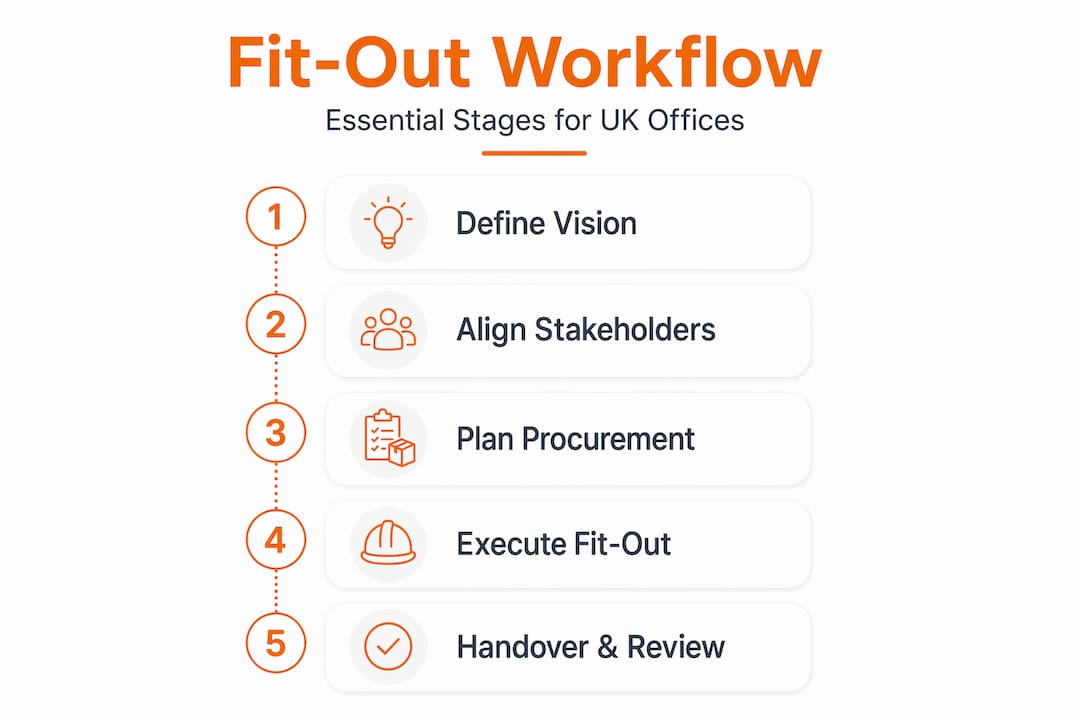
That conversation is harder than it sounds. “Success” means different things to the finance director, the HR lead, and the person who will manage the building once it’s occupied. Make it concrete. Are you prioritising acoustic separation for focus work, collaborative open zones, brand expression through material choices, or all three? Write it down and separate your must-haves from the features you’d welcome but could live without. This distinction matters when costs shift, as they always do.
Alongside vision, confirm the physical and legal constraints of your building early. Office fit-out best practices consistently point to the same lesson: lease conditions, landlord consent requirements, building access restrictions, and reinstatement obligations caught late cause redesign, programme delays, and occasionally legal disputes. Check your lease before a designer produces anything worth paying for.
Aligning vision and success criteria early reduces programme risk by controlling changes and confirming building facts. The checklist items worth pinning to your brief at this stage include:
The practical office fit-outs guide for UK workspaces notes that the single biggest driver of scope creep is stakeholders raising requirements they assumed were included. An early alignment workshop, even a short one, closes those gaps before they become expensive.
Once your brief is solid, procurement is the next place projects quietly fall apart. The gap between “we need furniture” and “furniture is on site” is longer than most fit-out programmes allow for, particularly in the public sector.

If your organisation sits within the NHS, local government, education, or any other public body, you likely need to procure through a compliant framework rather than going directly to market. The NHS Supply Chain office furniture framework runs from 2025 to 2028 and covers office and outdoor furniture for NHS settings, offering both direct award and mini-competition routes across 28 pre-qualified suppliers. Direct award suits straightforward purchases within defined parameters; mini-competitions suit more complex requirements or higher-value orders where best value needs demonstrating.
Here is where many teams underestimate their timeline. Mini-competition processes typically take 2 to 4 weeks from invitation to award. Add supplier manufacturing lead times and delivery scheduling, and you’re looking at 6 to 10 weeks from procurement decision to furniture on site. In a fit-out programme where the construction phase is 8 weeks, that overlap needs to be planned precisely.
Procurement frameworks also bring embedded sustainability and governance criteria, which reduces the compliance burden on your team but requires documentation that satisfies your own organisation’s procurement policies. Build that documentation time into your schedule.
Pro Tip: Map your procurement milestones backwards from your target occupancy date. If furniture needs to arrive in week ten of a twelve-week programme, your mini-competition process needs to begin in week two, not week seven.
Key procurement planning actions include:
Understanding how a modern office furniture workflow integrates with construction scheduling prevents the painful scenario of finished offices sitting empty because chairs haven’t arrived yet.
The Construction (Design and Management) Regulations 2015, commonly referred to as CDM 2015, apply to the vast majority of office fit-outs in the UK. If your project involves more than one contractor, or if construction work is expected to last longer than 30 working days with more than 20 workers simultaneously, or exceed 500 person-days, the project must be notified to the Health and Safety Executive (HSE).
As the tenant client, you carry specific legal duties that cannot be delegated away. Under CDM 2015, almost all office fit-outs require you to appoint both a principal contractor and a principal designer in writing, provide pre-construction information, and ensure a construction phase plan is prepared before site work begins. These are not bureaucratic formalities. The construction phase plan is a live document that contractors must follow to manage site risks.
“Clients must take reasonable steps to ensure that the principal designer and principal contractor comply with their duties. The client remains responsible for the health and safety of the project throughout its duration.” — CDM 2015, Regulation 4
Failure to comply exposes you, not just your contractors, to enforcement action and legal penalties from the HSE. This is a common misconception: tenants sometimes assume that appointing a principal contractor transfers all CDM liability. It does not.
In practice, good contractor management during a fit-out means:
The UK office fit-outs guide and office setup tips both reinforce that active client engagement during the construction phase, not passive oversight, is what keeps programmes on time and on the right side of the law.
Handover is where many fit-out projects lose discipline. The building looks finished, the client is eager to move in, and the paperwork gets treated as an afterthought. This is a mistake with consequences that can run for years.
Commercial refurbishment handover should include completion certificates, statutory compliance certificates covering electrical installation, gas safety, and building regulations, operation and maintenance manuals for all installed systems, warranty documents for materials and equipment, and a clearly stated defects liability period. Each of these documents has a purpose beyond compliance. Warranty documents define who pays when something fails at month eight. O&M manuals tell your facilities team how to service equipment without voiding cover.
The essential handover document checklist:
Key handover documents and their purpose:
| Document | Purpose | Typical validity |
|---|---|---|
| Completion certificate | Confirms project scope and handover date | Permanent record |
| Building Regs certificate | Statutory compliance for structural/building work | Permanent record |
| EICR / installation certificate | Electrical safety compliance | 5 years (EICR) |
| Gas Safe certificate | Gas installation safety record | Annual inspection due |
| O&M manuals | Maintenance and warranty reference | Life of installation |
| Defects liability statement | Defines period and notification process | 6 to 12 months |
The defects liability period (DLP) typically runs for 6 to 12 months after practical completion. During this period, the contractor is obliged to return and remedy genuine defects at no cost. The key word is genuine. Snags arising from normal wear and tear, or from your own use of the space, are not the contractor’s liability.
Pro Tip: Create a shared snagging log from day one of occupancy. Log every defect with a photo, date, and location. Send formal written notices to the contractor rather than relying on verbal conversations. Your office refurbishment handover practices documentation becomes your evidence if a dispute arises over retention release.
There is a version of fit-out project management that treats workflow as a compliance exercise. You run through the checklist, tick the boxes, and call it done. In our experience, that approach produces technically compliant but practically problematic outcomes.
The most common failure pattern is this: the checklist was followed, but nobody was actually in charge of the connections between stages. Procurement was planned, but not against the construction programme. CDM appointments were made, but the principal designer was never meaningfully consulted during the design stage. Handover documentation was collected, but nobody reviewed it against what was actually installed.
Locking the brief early and controlling change significantly reduces programme risk and costly overruns. But locking the brief is a leadership act, not a form-filling exercise. It requires someone with authority to say “no” when a late stakeholder adds requirements after design is signed off.
The hidden critical path problem in procurement is equally telling. Most fit-out programmes show construction as the critical path. Procurement sits in a separate column, managed by a different team, running to a different calendar. When those two tracks are not synchronised at the milestone level, furniture arrives after occupancy, or the building sits idle waiting for delivery.
The office fit-out best practices that genuinely work share one characteristic: there is a single accountable person who owns the workflow across all stages, from brief alignment through to defects resolution. That person does not need to be a fit-out specialist. They need to understand that each stage has dependencies, and that the programme fails when those dependencies are treated as someone else’s problem.
Treat handover as a collaboration, not a confrontation. Contractors who are engaged early in what good handover looks like tend to produce better documentation. Clients who set realistic snagging expectations retain final payments appropriately rather than using them as leverage. Both sides benefit from treating the end of the project as a professional conclusion rather than a negotiation.
Completing a well-managed fit-out process means nothing if the furniture you’re sitting in on day one fails to support the way your team actually works.
At Furniture For Business, we supply commercial-grade office furniture to UK businesses of all sizes, from growing teams of five to organisations equipping five hundred workstations. Our office chairs collection covers ergonomic task seating and executive chairs suited to long working days, while our office desks range includes height-adjustable options built for hybrid teams who need flexibility built into the fabric of their workspace. For everything from filing to collaborative zones, our office storage options complete the picture. We offer bulk order pricing, free delivery to the UK mainland, and product guidance to help you make the right sourcing decisions within your programme timeline.
Under CDM 2015, tenants must appoint a principal contractor and designer in writing, provide pre-construction information, ensure a construction phase plan is in place before work begins, and receive a health and safety file at handover.
Mini-competitions typically take between 2 and 4 weeks from invitation to award, which must be factored into your overall procurement timeline alongside supplier manufacturing and delivery lead times.
Key documents include signed completion certificates, statutory compliance certificates for electrical and gas installations, operation and maintenance manuals, warranty papers, and a clear statement of the defects liability period covering duration and notification process.
Locking the brief early reduces programme risk by controlling scope changes and confirming building facts before procurement and construction begin, preventing costly redesigns and delays later in the project.

Phone: 0330 043 4114
VAT no. GB 991 8681 60
Company no. 07250570