TL;DR:
- A strategic office refurbishment extends a building’s lifecycle by 15 to 20 years through upgrades and compliance improvements. It involves a structured process addressing physical, technical, and functional aspects, supporting modern workstyles such as hybrid and flexible layouts. Proper planning, early assessments, and a focus on infrastructure and design ensure effective, cost-efficient transformation.
A well-executed office refurbishment is one of the most powerful investments a business can make, yet it is routinely misunderstood as a cosmetic exercise. In reality, a strategic refurbishment extends your building’s lifecycle by 15 to 20 years through mechanical, electrical, and plumbing upgrades, while simultaneously protecting you from compliance risk under the UK’s Minimum Energy Efficiency Standards. For office managers and procurement teams steering these projects, understanding exactly what refurbishment involves, how it unfolds, and where the real value lies is essential before a single wall comes down.
| Point | Details |
|---|---|
| Strategic value | Office refurbishment extends building life, avoids compliance risks, and gears spaces for hybrid work. |
| Step-by-step approach | Careful planning and staged delivery reduce disruption and costly surprises. |
| Hidden challenges | Older and heritage offices demand special attention to compliance and may incur extra costs. |
| Modern workstyles | Refurbishment is the ideal opportunity to optimise workplace layouts for productivity and wellbeing. |
Office refurbishment is not the same as repainting the walls or replacing the carpet. It is a deliberate, structured process that addresses the physical, technical, and functional condition of a workspace from top to bottom. The scope can range from reconfiguring floor layouts and upgrading mechanical and electrical systems, through to improving acoustic performance, enhancing employee wellbeing, and meeting the latest fire safety and energy efficiency regulations.
The key objectives of a modern UK office refurbishment typically include:
It is also worth distinguishing refurbishment from a fit-out. A fit-out typically equips a new or empty shell, whereas refurbishment updates and improves an existing occupied or recently vacated workspace. The two processes share tools and trades, but refurbishment carries the added complexity of working within an existing structure with its own legacy of decisions, materials, and systems.
“A refurbishment that focuses solely on aesthetics while ignoring MEP infrastructure risks leaving a business in exactly the same compliance and efficiency position it started in.”
Keeping pace with current office design trends is increasingly important, particularly as hybrid working has permanently altered how people use office space. The most successful refurbishments treat space optimisation and agile layout design not as optional extras, but as core objectives.
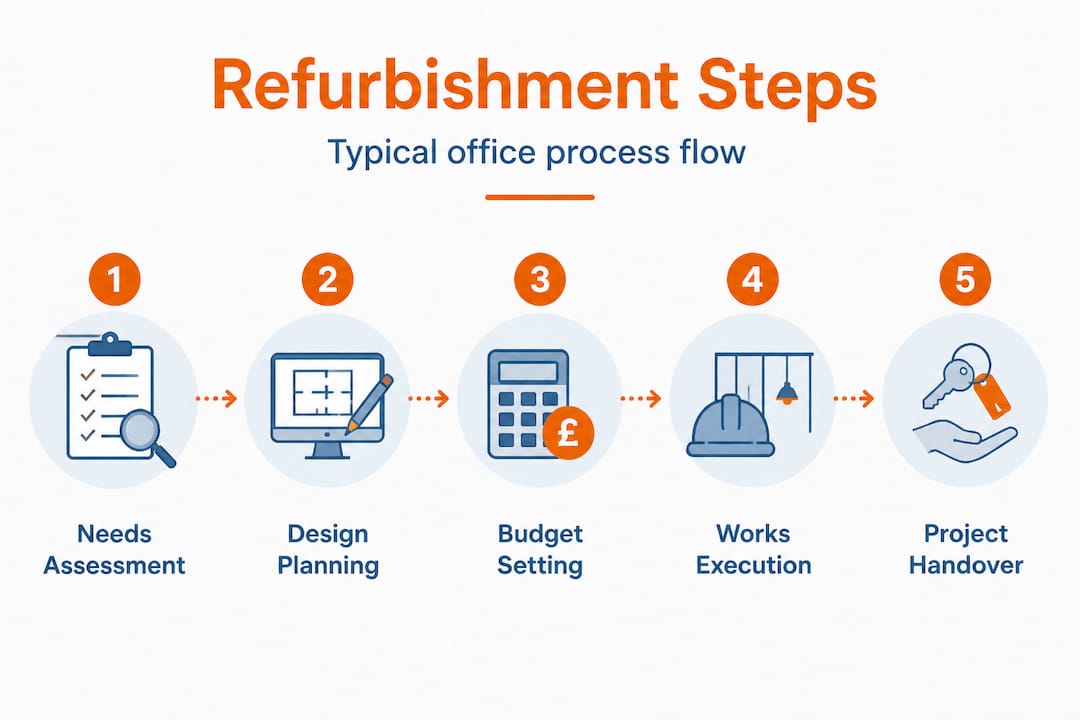
Understanding the sequence of an office refurbishment project helps you plan realistically, allocate budget properly, and avoid costly missteps. Projects vary in scale, but the broad stages remain consistent.
Initial needs assessment. This is where the project truly begins. You evaluate the current state of the office: what is working, what is failing, and what business objectives the refurbishment must serve. This stage includes compliance checks, lease reviews, structural surveys, and stakeholder consultation.
Design and space planning. Architects, interior designers, and workplace consultants translate the needs assessment into proposed layouts, material specifications, and furniture strategies. This is when decisions about zone types, circulation routes, and technology integration are made.
Budget approval and procurement. A detailed cost plan is agreed, regulatory permissions are sought where necessary (particularly for listed buildings or significant structural changes), and suppliers are appointed. Furniture, fixtures, and equipment are ordered at this stage to protect lead times.
Implementation and construction. Works are carried out, often in phases to manage disruption. On occupied sites, trades are scheduled around business hours wherever possible. This is also the stage where unforeseen issues tend to surface.
Handover, testing, and review. Systems are tested, snagging is addressed, and a post-occupancy evaluation helps identify whether the refurbishment has met its stated objectives.
The table below illustrates typical timeframes and key dependencies at each stage:
| Stage | Typical duration | Key dependencies |
|---|---|---|
| Needs assessment | 2 to 4 weeks | Access to building, stakeholder input |
| Design and planning | 4 to 8 weeks | Sign-off on brief, budget approval |
| Procurement | 2 to 6 weeks | Lead times for furniture and materials |
| Construction | 4 to 12 weeks | Site type, complexity, occupancy |
| Handover and review | 1 to 2 weeks | Snagging clearance, systems testing |
A critical point worth noting: heritage buildings require sensitive adaptations, and occupied or live sites need phased works with out-of-hours scheduling. Older structures may also reveal hidden issues such as asbestos or non-compliant services, which can significantly extend both timeline and budget.
Pro Tip: Build a contingency of at least 15 to 20% into your budget specifically for unforeseen structural or compliance issues. This is not pessimism; it is standard practice on any project involving an existing building.
Following clear refurbishment planning steps from the outset significantly reduces the risk of scope creep and budget overruns. Projects that skip the needs assessment phase almost invariably spend money solving the wrong problems.
Even with a well-structured plan, real-world office refurbishments regularly surface complications. Knowing where the risks cluster helps you build appropriate mitigations into your project from day one.
One of the most significant variables is whether your team will remain in the building during works. An occupied site demands careful phasing, noise management, dust control, and out-of-hours scheduling for the most disruptive tasks. A vacant site is faster and cheaper to work in, but not all businesses have the flexibility to relocate entirely for several months.
| Factor | Occupied site | Vacant site |
|---|---|---|
| Cost | Higher due to phasing and scheduling | Lower, simpler logistics |
| Speed | Slower, more complex coordination | Faster overall delivery |
| Disruption risk | Significant without careful planning | Minimal |
| Continuity | Business continues operating | Requires temporary relocation |
| Flexibility | Lower, constrained by working hours | Higher, unrestricted access |
Working within historic frameworks brings a distinct set of requirements. Listed buildings may restrict the materials you can use, the changes you can make to façades, and even internal structural interventions. Older buildings of any age can conceal asbestos-containing materials, outdated wiring, poor insulation, and fire systems that no longer meet current Building Regulations.
Pro Tip: Engage a specialist building surveyor at the assessment stage, not halfway through construction. Early discovery of structural or compliance issues is always cheaper to resolve than late discovery.
When refurbishing for hybrid teams, the challenges compound. You need not only to manage the physical works but also to ensure the resulting layout genuinely supports the way your people now work, with fewer assigned desks, more varied zones, and stronger technology integration throughout. Referring to proven fit-out best practices can help you avoid common layout mistakes that only become apparent once staff return to the space.
Scope creep is the single most common cause of office refurbishment projects going over budget. It happens when small, seemingly reasonable additions accumulate, each one justified individually but collectively blowing the original cost plan. Maintaining a formal change control process, where every addition to scope is documented and costed before approval, is the single most effective discipline you can impose on a project.
The shift to hybrid working has fundamentally changed what offices need to do. When people attend the workplace by choice rather than obligation, the office must justify its existence by offering something that home working cannot. That means variety, collaboration, and quality of environment.
A refurbishment designed with hybrid and agile working in mind typically incorporates:
Space planning for productivity becomes a central discipline here, because the ratio of zone types needs to reflect how your specific team actually uses the building. A finance team with high concentration demands will need a very different layout from a creative agency that thrives on open collaboration.
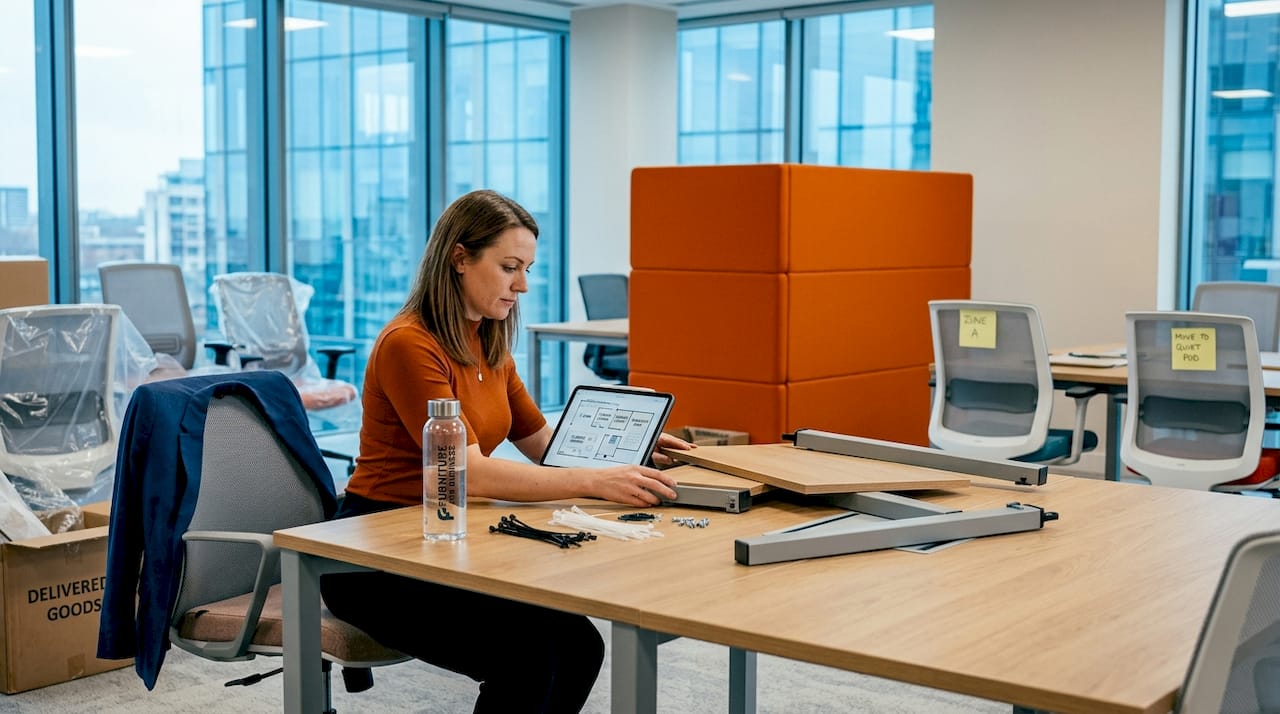
A well-executed refurbishment that optimises space for hybrid working can extend the building’s effective lifecycle by 15 to 20 years, avoiding the risk of the building becoming functionally obsolete before its structural lifespan is reached. That is a compelling financial argument to take to senior stakeholders when making the case for investment.
Furniture selection is equally critical to the success of agile layouts. Modular, lightweight pieces that can be reconfigured quickly serve hybrid teams far better than heavyweight, fixed installations. Reviewing your furniture buying choices early in the design phase ensures that procurement aligns with the layout intent, rather than contradicting it. The two decisions, layout and furniture, must be made together, not sequentially.
Wellbeing is another dimension that refurbishment directly addresses. Improved natural light, better air quality, reduced noise, and ergonomic furniture all contribute to measurable improvements in staff health, concentration, and retention. These are not soft benefits. They translate into reduced absenteeism and lower turnover, both of which carry hard financial value.
Here is something we see repeatedly: businesses invest in an office refurbishment, spend considerably on new finishes and furniture, and then discover within 18 months that the project has not solved the underlying problems. Staff still complain about noise, the heating is still unreliable, and the layout still does not support how people actually work. The aesthetics have changed. The function has not.
The reason this happens is almost always the same. The refurbishment was led by design rather than strategy. Decisions about colour palettes and furniture finishes were made before the fundamental questions had been answered. What are the compliance gaps? What are the MEP systems doing, and what do they need to do? How is the workforce actually using the space, and how will that change over the next five years?
A genuinely strategic refurbishment starts with those questions and builds every subsequent decision around the answers. MEP upgrades lead; design follows. Space planning is informed by occupancy data, not instinct. Budget is allocated according to impact, not visibility. The results are consistently better because the investment is directed at the problems that actually matter.
We also see businesses resist investment in MEP infrastructure because it is invisible once complete. Nobody admires the new ventilation system or the upgraded distribution board. But these are the components that determine whether the building performs well for the next decade or requires another expensive intervention in three years. Investing in a modern furniture workflow that supports the strategic intent reinforces the whole project, because the physical environment and the supporting infrastructure need to work as a system.
Short-term thinking in refurbishment is genuinely expensive. A strategic mindset consistently delivers better outcomes in cost avoidance, compliance confidence, and the ability to adapt as workforce needs continue to evolve.
Planning a refurbishment and want to make sure your furniture choices match the ambition of the project?

At Furniture for Business, we supply commercial office furniture to businesses across the UK, with free delivery to the UK mainland. Whether you are reconfiguring for hybrid working, upgrading a boardroom, or equipping an entirely new layout, our range covers everything from ergonomic seating and height-adjustable desks to meeting room furniture and office storage. We offer bulk order pricing and account management support for procurement teams managing large or phased projects. Browse the full range or get in touch to discuss your project requirements with our team.
Office refurbishment updates an existing workspace by upgrading layouts, systems, and compliance, while a fit-out typically refers to equipping a new or empty shell with furniture, services, and finishes from scratch.
Most projects run for 4 to 12 weeks, but complex or older buildings may take considerably longer due to hidden structural issues, heritage constraints, or compliance requirements that emerge during surveys.
Not always. Phased works and out-of-hours scheduling make it practical to refurbish while remaining in occupation, although this approach requires careful coordination and typically adds some time to the overall programme.
Refurbishment allows you to reconfigure space around the actual patterns of hybrid attendance, introducing flexible zones, collaboration areas, and technology infrastructure. Done well, it can extend building lifecycle significantly while making the office a genuinely compelling place to work.
Older offices frequently carry hidden risks including asbestos, outdated electrical systems, and compliance gaps that only become apparent once surveys or initial works begin, making thorough pre-project surveys and generous budget contingencies essential.

Phone: 0330 043 4114
VAT no. GB 991 8681 60
Company no. 07250570