TL;DR:
- Many UK office managers face challenges balancing empty desks on quiet days with overcrowded peak times. Redesigning for hybrid work requires a clear framework emphasizing space standards, well-being, and flexibility, not mere desk removal. Regular assessment and staff consultation ensure workspaces evolve to meet changing team needs and enhance productivity and satisfaction.
Many UK office managers are caught in a difficult position: half the desks sit empty on quieter days, yet the busiest days feel chaotic and overcrowded. Wasted space, disengaged staff, and layouts that made sense five years ago are now holding businesses back. Designing for hybrid working is not simply a matter of removing a few desks. It requires a clear framework that covers space benchmarks, well-being factors, furniture choices, and an ongoing process of measurement. This guide walks you through every stage, from defining what a productive workspace actually looks like to monitoring whether your changes are delivering results.
| Point | Details |
|---|---|
| Hybrid space benchmarks | Plan for 15 m² per person at 66% occupancy to balance productivity and well-being. |
| Data-driven audits | Assess usage, ergonomics, and staff feedback before redesigning your workspace. |
| Well-being compliance | Meet HSE requirements for light, air, and supportive management to foster well-being. |
| Flexible layouts win | Adapt and review office designs regularly to reflect ongoing hybrid working needs. |
| Monitor and optimise | Track workspace effectiveness and adjust using satisfaction surveys and utilisation data. |
Before rearranging a single desk, it pays to define what you are actually trying to achieve. Productivity in an office context is not just about output per hour. It includes focus quality, collaboration effectiveness, and the degree to which people feel comfortable and supported in their environment. Well-being, in workspace terms, means the physical and psychological conditions that allow people to do their best work without suffering harm. Hybrid-readiness means the space functions well whether 40% or 90% of your team is in on any given day.
Space allocation is a good place to start. BCO guidance recommends 15 m² per person for hybrid offices running at 66% utilisation, up from the previous 12.5 m² at 80% occupancy. That shift is significant. It reflects the reality that hybrid workers need more varied space types, not simply a desk.
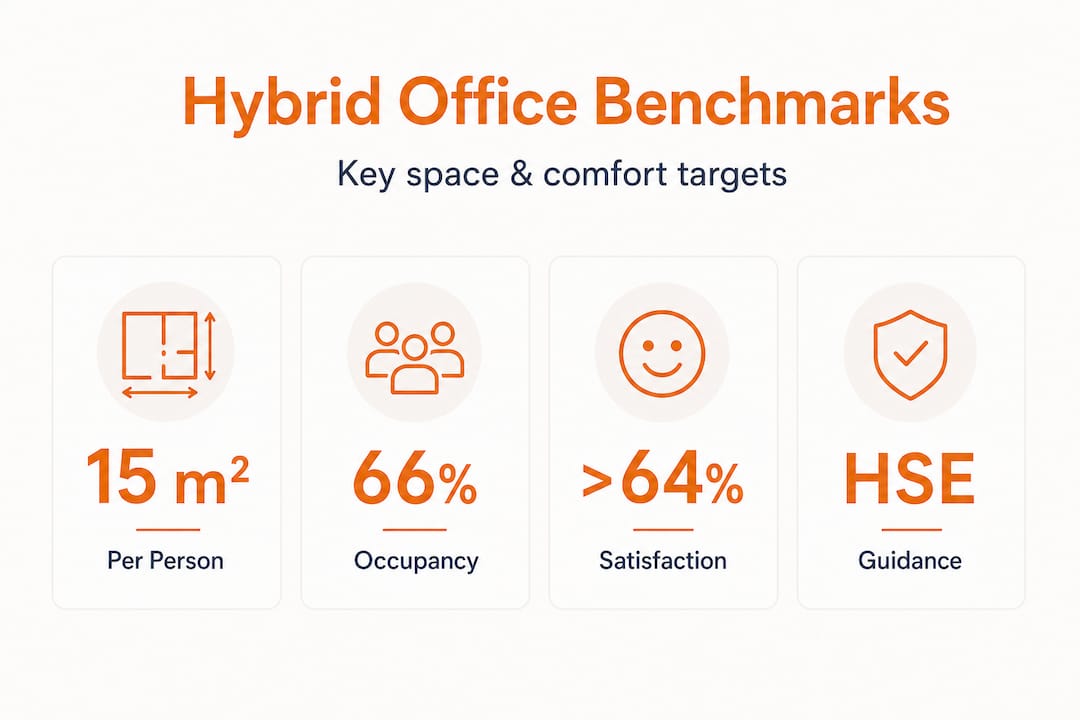
Beyond square metres, comfort benchmarks matter enormously. Research into occupant satisfaction benchmarks suggests using percentile thresholds as quality markers. For example, a score of at least 64% positive responses on temperature indicates a three-star comfort rating, while acoustic satisfaction tends to be harder to achieve than cleanliness scores. These benchmarks give you measurable targets rather than vague ambitions.
The elements with the greatest impact on productivity and satisfaction are:
“The most effective offices are not the most expensive ones. They are the ones that consistently meet the basic comfort thresholds that allow people to focus.”
Pro Tip: Review your space planning best practices before committing to any layout changes. Firms that skip this step often redesign the same space twice.
| Comfort factor | Minimum benchmark | Notes |
|---|---|---|
| Temperature | ≥64% satisfaction | Three-star threshold for hybrid offices |
| Acoustics | Harder to achieve | Requires active zoning and soft materials |
| Cleanliness | Easier to achieve | Baseline expectation, not a differentiator |
| Lighting | ≥65% satisfaction | Natural light prioritised, LED supplement recommended |
| Air quality | CO2 below 1000 ppm | Key indicator for cognitive performance |
Understanding office layout for hybrid work is the foundation on which all subsequent decisions rest. Get this thinking right and every later choice becomes easier.
Once you know what defines a high-performing space, the next logical step is to thoroughly audit your existing environment and identify what truly needs improving. Many office managers skip this phase and jump straight to speculative layouts or furniture catalogues. That approach almost always results in wasted budget and recurring complaints.
A structured discovery phase, as highlighted in furniture procurement guidance for hybrid workplaces, covers room data, ergonomic needs, cable management requirements, and acoustic issues. It aligns every furniture and layout decision to actual use patterns rather than assumptions.
Here is a practical numbered checklist for conducting a thorough space audit:
Comparing planning approaches helps clarify which model suits your organisation:
| Planning model | Key characteristics | Best suited for |
|---|---|---|
| Traditional fixed desks | Assigned seating, predictable layout | Teams with consistent 5-day attendance |
| Activity-based working | No fixed desks, zones for different tasks | Teams with varied task types |
| Hybrid-optimised | Flexible zones, bookable desks, collaboration hubs | Teams with mixed remote and in-office patterns |
Avoid the common mistake of surveying only managers rather than the full team. Front-line staff often identify practical issues, such as poor cable routing near quiet zones or insufficient breakout space, that leadership simply does not notice.
For a detailed step-by-step approach to this audit phase, the office design step-by-step guide offers a structured framework. Similarly, if your team relies heavily on collaborative work, reviewing collaborative space strategies before drawing up requirements will sharpen your brief considerably.
Armed with an understanding of your workplace’s current strengths and weaknesses, you are ready to translate requirements into a concrete, flexible office design. The most effective hybrid layouts move away from thinking in terms of headcount and towards thinking in terms of activities.
Zone your office around what people actually do, not where they are nominally assigned. A typical hybrid office benefits from four zone types: focus zones for deep individual work, collaboration zones for team discussion and workshops, social zones for informal connection and breaks, and quiet zones for sensitive calls or confidential tasks. Each zone should have furniture and environmental conditions matched to its purpose.
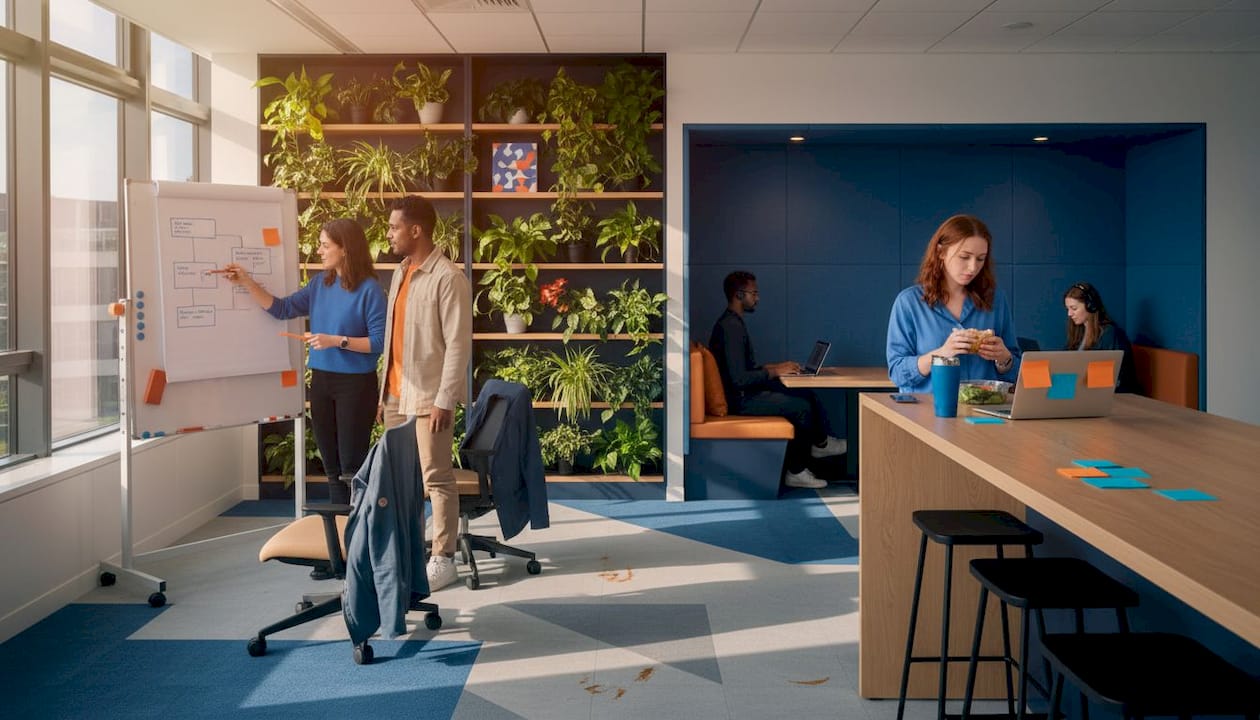
Key well-being and compliance considerations include the HSE’s guidance on ventilation, lighting, ergonomics, and psychosocial risk management. HSE mandates go beyond the physical. Managing workload, giving staff control over their environment, and ensuring adequate support are all part of your legal and ethical duty. Ignoring psychosocial factors like excessive workload or lack of autonomy will undermine any physical redesign.
When planning flexible services, the BCO’s updated guidance flags modular services such as lift provision and toilet ratios for variable occupancy as important edge cases. If your building sees wide swings in daily attendance, ensure that core facilities can cope with peak loads without creating bottlenecks that frustrate staff.
Key design principles for a hybrid-ready, well-being-focused office:
Mistakes to avoid include overcommitting to large fixed meeting rooms that sit empty on low-occupancy days, failing to provide enough individual focus spaces for the days when attendance peaks, and neglecting cable management when transitioning to flexible layouts.
Pro Tip: Explore 2026 hybrid office design trends to identify which layout innovations are gaining traction among UK businesses, and cross-reference them with your own audit findings before finalising any floor plan.
For teams navigating the practical challenges of scheduling and space allocation, the hybrid team optimisation guide provides concrete tactics that complement your physical design choices.
Once a new office configuration is in place, systematic measurement and adjustment are needed to ensure the space meets its productivity and well-being aims. Many organisations treat implementation as the end of the project. In reality, it is the beginning of a continuous improvement cycle.
Follow these steps for a structured rollout:
Measuring results requires a small but consistent set of KPIs. Using occupant satisfaction benchmarks as your framework, build a measurement dashboard that covers the following:
| KPI | Target benchmark | Measurement method |
|---|---|---|
| Space utilisation rate | 60 to 75% on peak days | Booking data or sensor counts |
| Temperature satisfaction | ≥64% positive | Quarterly occupant survey |
| Acoustic satisfaction | ≥50% positive | Quarterly occupant survey |
| Absenteeism rate | Reduction of 5 to 10% | HR records, compared to baseline |
| Desk booking conflicts | Less than 5% of peak days | Booking system reports |
| Staff well-being score | Upward trend quarter on quarter | Anonymous pulse surveys |
A consistent well-being score that improves by just 10 percentage points across your team typically correlates with measurable reductions in absenteeism and staff turnover, both of which carry significant financial cost for UK businesses.
Acting on findings is what separates organisations that genuinely improve from those that simply collect data. If acoustic complaints remain high after three months, a survey response alone is not enough. It should trigger a physical intervention, such as adding acoustic panels, reorganising zone boundaries, or introducing desk screens.
For guidance on the physical side of the rollout, the office fit-out best practices guide covers contractor briefing, phased delivery, and quality checking at each stage. If you are refining furniture choices to better support your workflow, the modern office furniture workflow guide offers a practical selection framework.
Here is an uncomfortable truth that most workspace guides will not tell you. The vast majority of UK office managers overspend on an initial redesign trying to achieve the perfect layout, only to find that the same space needs changing again within 18 months. Hybrid working patterns shift. Teams grow, shrink, or change their habits. The office that felt exactly right in January can feel poorly matched to actual needs by October.
The most productive offices we see are not the ones with the most sophisticated design briefs. They are the ones where managers have built in the expectation of regular change. That means choosing space-efficient desks that reconfigure easily over statement furniture that is difficult to move. It means buying modular storage rather than built-in joinery. It means treating the office as a living system rather than a finished product.
The second thing most guides miss is the importance of team dialogue. The offices that improve fastest are the ones where staff are genuinely consulted, not just surveyed once at the start of the project. Scheduled quarterly conversations about what is working and what is not, with actual authority to act on feedback, produce environments that keep pace with real needs.
Pro Tip: Put a recurring quarterly workspace review into your calendar now, before any redesign work begins. Give a small cross-functional group, including junior staff, genuine input on the outcomes. The insights you gather will be more valuable than any benchmarking report.
Now you are equipped with a blueprint for building productive, healthy workspaces, it pays to have the right partners and tools to realise your goals.
At Furniture for Business, we supply durable, design-led commercial furniture to UK businesses of all sizes, from growing startups to large corporate teams. Whether you need ergonomic office chairs that support staff through long hybrid working days or height-adjustable office desks that flex with your team’s schedule, our range is built for real workplace demands. We offer bulk order pricing, easy returns, and free delivery to the UK mainland, so your next fit-out or refresh stays on budget and on schedule. Browse our full range and speak to our team about matching furniture solutions to your specific workspace brief.
The BCO recommends 15 m² per person for hybrid offices operating at 66% utilisation, an increase from 12.5 m² at 80% occupancy. This reflects the need for more varied space types in hybrid environments.
Combine physical zoning, soft furnishings, and acoustic panels to reduce ambient noise and hit recognised satisfaction thresholds. Acoustic benchmarks are harder to meet than cleanliness scores, so active intervention is usually needed rather than layout alone.
Follow HSE guidance on ventilation, lighting, ergonomics, and psychosocial risk management as your baseline for UK legal compliance and best practice. These standards cover both physical conditions and management factors like workload and control.
Quarterly reviews are the practical minimum for hybrid offices, as occupancy patterns and team needs shift regularly throughout the year. Building review cycles into your annual facilities calendar ensures changes are made proactively rather than reactively.

Phone: 0330 043 4114
VAT no. GB 991 8681 60
Company no. 07250570