TL;DR:
- Commercial grade furniture is designed for high traffic, durability, and long-term performance.
- It offers better value over time due to its longer lifespan and lower replacement costs.
- Proper certification and standards are essential when choosing commercial office furniture.
Not all office furniture is built the same way. Walk into any high-street furniture retailer and you will find desks and chairs that look perfectly serviceable. But place them under the daily pressure of a busy corporate office and they can fail within months, leaving you with repair costs, staff complaints, and a procurement headache you did not budget for. Commercial grade furniture is purpose-designed for exactly those conditions: high frequency, demanding users, and the expectation that it will still perform well years down the line. This article explains what commercial grade actually means, why it matters for UK businesses, and how to choose the right pieces for your workplace.
| Point | Details |
|---|---|
| Built for business needs | Commercial grade furniture is engineered for demanding office environments and regular use. |
| Cost-effective in the long run | Investing in commercial options reduces repair and replacement costs over time. |
| Boosts workplace wellbeing | Choosing quality, compliant furniture supports staff comfort, safety, and productivity. |
| Supports hybrid working | Modern commercial furniture adapts to changing office layouts and hot-desking. |
| Ensures compliance | Commercial furniture typically meets UK health and safety standards. |
Commercial grade furniture is not simply office furniture with a higher price tag. It is a distinct category, engineered from the outset for professional, high-traffic environments where pieces are used far more intensively than anything in a home setting. A domestic chair might seat one person for a few hours in the evening. A commercial chair in a hot-desking office could be occupied by multiple users across a ten-hour working day, five days a week, for several years.
Commercial grade furniture is built to stringent quality standards for durability and performance. That typically means reinforced frames, higher-grade upholstery, tighter component tolerances, and materials selected specifically for their resistance to wear, moisture, and UV exposure. You will also find compliance with recognised standards such as British Standard BS EN, which sets out requirements for strength, stability, and durability across office furniture categories. These are not optional extras for reputable suppliers. They are the baseline.
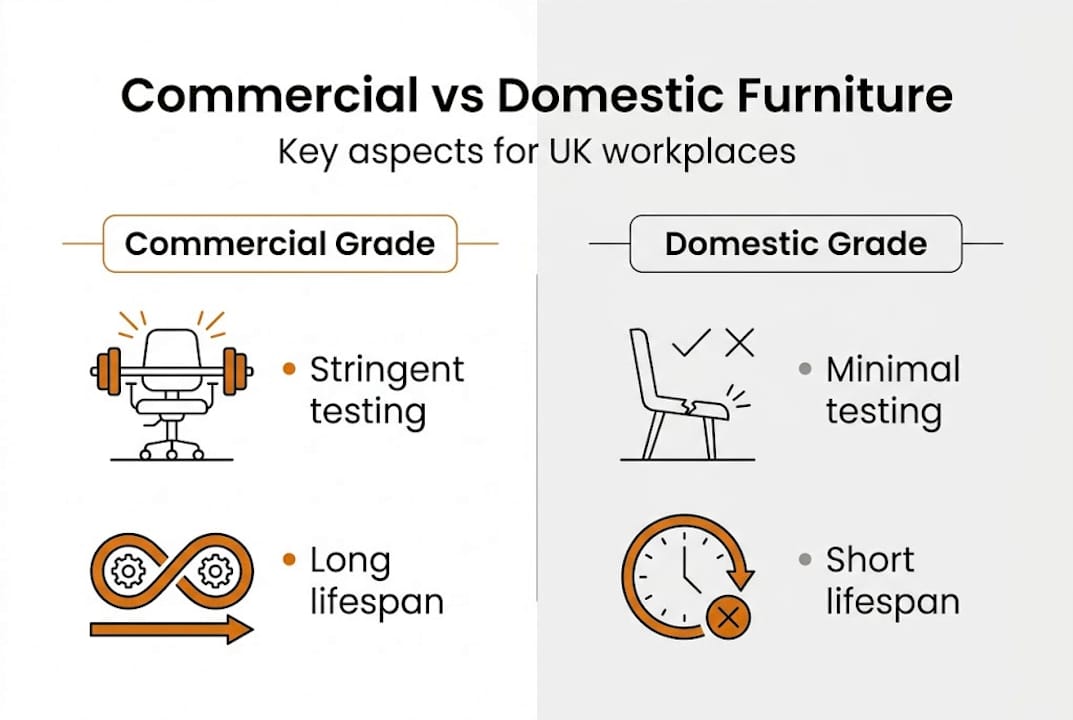
To put the differences in perspective, the table below compares commercial and domestic grade furniture across the most important procurement criteria:
| Feature | Commercial grade | Domestic/retail grade |
|---|---|---|
| Daily usage intensity | High (multiple users) | Low (single household user) |
| Build tolerances | Tighter, load-tested | Looser, light-use focus |
| Compliance standards | BS EN certified | Minimal or none |
| Warranty period | Typically 5+ years | Often 1-2 years |
| Lifecycle cost | Lower over time | Higher due to replacement |
| Repairability | Modular, serviceable | Often disposable |
The key features that distinguish commercial options include:
For a practical overview, our durable office furniture guide covers how to specify pieces that will genuinely stand up to business use. If you are looking specifically at seating, our range of executive chairs for business illustrates what contract-grade build quality looks like in practice. For an authoritative reference point on what the industry expects, commercial furniture standards published by FIRA (Furniture Industry Research Association) are worth reviewing.
Understanding the distinctions is useful. But knowing the practical, bottom-line reasons that offices across the UK make this investment is what drives the right procurement decision.
The most immediate benefit is cost efficiency over time. Commercial grade furniture reduces long-term replacement costs significantly. A desk that costs 30% more upfront but lasts three times as long is not an expense. It is a saving. When you factor in avoided downtime, reduced maintenance calls, and the staff disruption caused by broken or uncomfortable furniture, the numbers stack up quickly.

For hybrid offices specifically, the advantages multiply. Furniture in a hybrid setup sees variable, often intense use as employees rotate through shared workstations. A poorly built chair or desk in that context will degrade rapidly and unevenly, creating safety and comfort issues. Well-specified commercial pieces maintain their performance regardless of how many different users pass through them each week.
Employee comfort and productivity are directly linked to furniture quality. Poor seating, in particular, contributes to musculoskeletal problems, which remain one of the leading causes of workplace absence in the UK. The HSE workplace furniture guidance is clear that employers have a duty to provide suitable, adjustable workstation equipment. Commercial grade furniture makes it far easier to meet and document that obligation.
“Investing in quality office furniture is not a luxury. It signals to your team that their health and comfort matter, which in turn supports retention, focus, and morale.”
There is also a reputational dimension. Meeting rooms and reception areas furnished with durable and stylish office furniture communicate professionalism to clients and partners before a word is spoken. Worn or mismatched furniture does the opposite.
Pro Tip: When evaluating whole-life costs, add up the unit price, expected lifespan in your specific environment, probable repair costs, and replacement frequency. Commercial grade consistently wins that calculation for offices with more than ten users.
For procurement teams also sourcing leadership workstations, our selection of top executive desks shows how commercial build standards translate into executive-level aesthetics without sacrificing longevity.
Modern office environments require flexibility and multifunctionality from commercial furniture, and the market has evolved to match. Whether you are fitting out a collaborative open-plan space, a series of quiet focus pods, or a formal boardroom, there is a commercial grade solution designed for that specific function.
The table below outlines the core categories and their key performance characteristics:
| Category | Key features | Typical application |
|---|---|---|
| Height-adjustable desks | Electric mechanisms, weight-rated frames, anti-collision | Hybrid hot-desking, sit-stand workstations |
| Ergonomic task chairs | Lumbar support, multi-point adjustment, contract upholstery | Open-plan, hot-desk, call centre |
| Executive chairs | High-back, premium materials, sustained comfort | Leadership offices, boardrooms |
| Conference tables | Cable management, modular or fixed, durable surfaces | Meeting rooms, training spaces |
| Office storage | Lockable, fire-rated options, modular configurations | Admin areas, secure document storage |
| Soft seating | High-density foam, durable fabric, collaborative design | Breakout zones, reception areas |
When matching furniture type to workspace function, it helps to work through priorities in a logical order:
For storage, the correct specification depends on whether you need general filing, secure document retention, or IT equipment housing. Our range of office storage options covers all three scenarios with commercial-grade build throughout. For a broader standards reference, office furniture standards from the British Standards Institution set out the testing frameworks relevant to each category.
Now that you know the types of furniture available, here is exactly how to select pieces that deliver both form and function in a UK corporate setting.
Choosing the right furniture involves assessing durability, comfort, and compliance together, not as separate tick-box exercises. The following numbered process keeps procurement structured and avoids the most common mistakes:
Pro Tip: Always ask a supplier for their specification sheets, not just the brochure. Specification sheets list the actual tested load ratings, fabric grades, and compliance certifications. That is the information that matters for procurement sign-off.
Common pitfalls include prioritising aesthetics over certifications, underestimating usage intensity in hybrid setups, and failing to budget for installation. Our guide to office design and furniture choices addresses how layout decisions affect which furniture types to specify. For the full procurement framework, refer to our guide to durable office furniture. UK government workplace wellbeing regulation also provides a useful compliance baseline for office managers putting together their specification documents.
Here is something the procurement guides rarely say plainly: most expensive furniture mistakes happen not because someone bought the wrong product, but because they asked the wrong question. Asking “what is the cheapest desk that looks professional?” almost guarantees a replacement purchase within two years. Asking “what is the most cost-effective desk for our specific usage pattern?” leads to a fundamentally different answer.
We have seen offices save significant budget by paying more upfront. The logic is straightforward but easy to dismiss when capital budgets are tight. Domestic-grade pieces bought in bulk can feel like a win at the point of purchase. By month eighteen, the repair calls, the wobbly chairs, and the staff complaints tell a different story.
Another underappreciated factor is supplier relationship. Buying commercial grade furniture from a reputable UK specialist rather than a generic marketplace means you have someone to call when a component needs replacing or a specification query arises. That relationship has real value. Our office furniture buying guide is a good starting point for understanding what that quality baseline should look like before you begin any supplier conversation.
Ready to put this knowledge to work and create an office environment that lasts?

At Furniture For Business, we supply commercial grade office furniture to organisations across the UK, from growing SMEs to large corporate refurbishments. Our product range is curated specifically for professional environments, with every piece meeting the durability and compliance standards your procurement team needs. Browse our full selection of commercial office chairs and commercial office desks, or explore our full range of commercial furniture to find solutions that fit your space, your budget, and your team. Free delivery to the UK mainland is included, and our team is on hand to support bulk orders and bespoke configurations.
Look for certifications such as BS EN standards and verify the product’s intended usage and lifespan in the supplier’s specification documentation rather than relying on marketing descriptions alone.
It is not always a legal requirement, but HSE workplace guidance strongly recommends suitable, compliant furniture to protect employee health and meet employer duty-of-care obligations.
Warranties of 5 years or more are standard for commercial grade products, reflecting their tested longevity and the manufacturer’s confidence in their build quality.
Domestic furniture is not built for the intensity of office environments and typically fails faster, creates safety risks, and generates higher long-term costs than commercial alternatives.
Yes. Longer lifespans and recyclable components mean less waste going to landfill, which supports corporate environmental commitments and reduces the frequency of replacement purchasing.

Phone: 0330 043 4114
VAT no. GB 991 8681 60
Company no. 07250570