TL;DR:
- Hospitality furniture is engineered for heavy daily use, cleaning, and safety compliance.
- It features durable materials, safety certifications, and designs optimized for bulk procurement.
- Properly specified furniture reduces long-term costs and maintains brand consistency.
Choosing furniture for a café, bistro, or corporate event space is nothing like buying a few chairs for a home dining room. Many procurement teams assume that any attractive, reasonably priced seat or table will hold up under daily commercial use. It rarely does. Residential and standard office pieces simply are not engineered for the punishment that hospitality environments dish out: hundreds of guests, repeated cleaning cycles, accidental spills, and the constant pressure to look polished. This guide explains exactly what hospitality furniture is, what separates it from other furniture categories, and how UK procurement teams can source it efficiently at scale.
| Point | Details |
|---|---|
| Highly durable design | Hospitality furniture is engineered for constant heavy use and lasting quality. |
| Procurement efficiency | Bulk buying and tendering can reduce costs and improve consistency across venues. |
| Easy maintenance | Surfaces and construction are made for rapid cleaning and frequent turnover. |
| Brand impact | The right furniture supports a cohesive image and a professional customer experience. |
Hospitality furniture refers to seating, tables, storage, and ancillary pieces designed specifically for commercial settings where members of the public interact repeatedly with the space. Think hotel lobbies, café dining areas, bistro terraces, corporate breakout zones, conference venues, and event halls. The defining factor is not style; it is purpose.
Unlike furniture bought for a private home or a quiet office meeting room, hospitality pieces must perform consistently under intense, unpredictable use. A single café chair might be sat on by thirty different people over the course of one day, each with different weight, posture, and habits. That same chair will likely be wiped down with commercial cleaning products several times a week. Over a year, that adds up to a level of stress that would ruin most residential furniture within months.
The core purposes hospitality furniture must serve include:
As higher usage intensity drives the specification, suppliers design these products with ROI, brand image, durability, and safety as primary considerations rather than purely aesthetic appeal.
“Hospitality furniture is not just furniture that looks good in a commercial space. It is furniture engineered around the reality of commercial life: constant use, constant cleaning, and constant scrutiny.”
For corporate environments that blend office functionality with guest-facing spaces, pieces like a well-specified executive chair can bridge both worlds when the right materials and certifications are in place. The key is understanding that the specification, not the look, determines suitability.
Now that you know what hospitality furniture is, let us break down the features that set it apart from the rest.
Materials and surface treatments are where hospitality furniture earns its keep. Fabrics must carry fire-retardant treatment meeting UK Furniture and Furnishings (Fire)(Safety) Regulations 1988. Hard surfaces should resist staining, scratching, and the bleach-based cleaners common in food service environments. Vinyl, treated leatherette, and commercial-grade woven fabrics tend to dominate because they balance comfort with practicality.
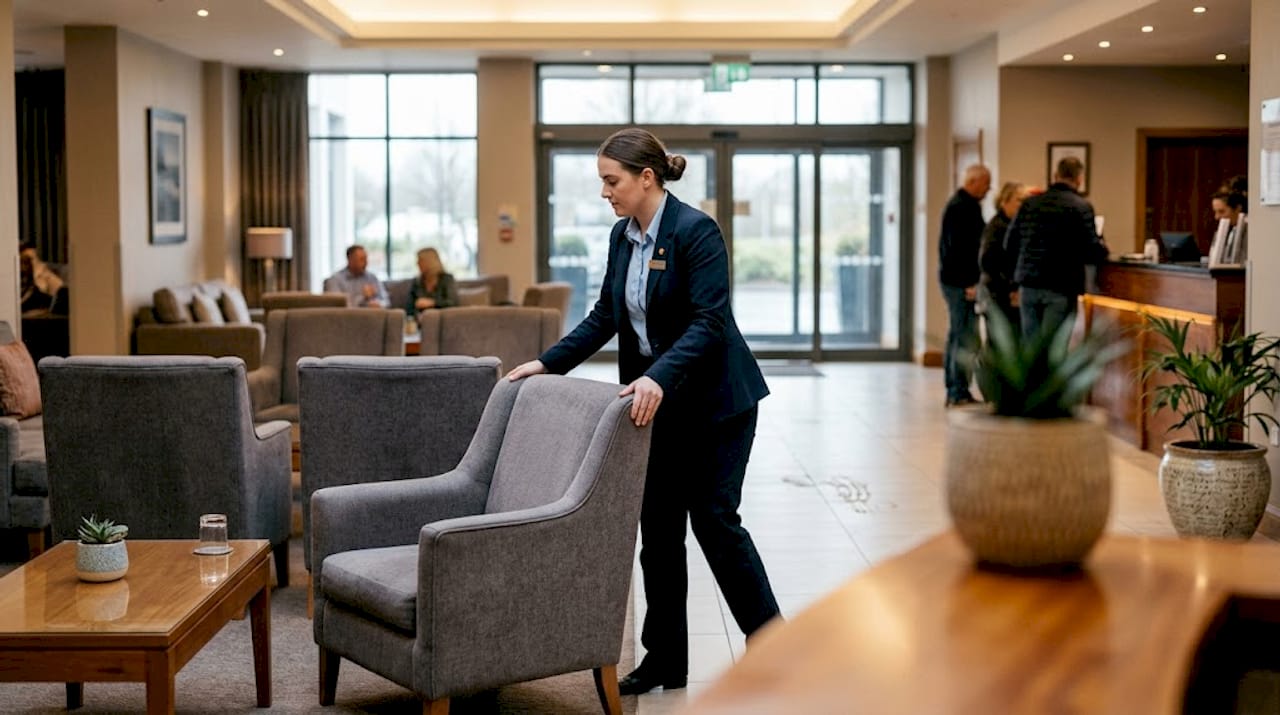
Safety certifications matter enormously in the UK context. Any upholstered piece used in a commercial setting must comply with BS 7176 fire resistance standards. Structural integrity is also tested under EN 16139 for seating, ensuring frames can endure repeated loading without failure. Skipping this step can expose your business to liability and insurance complications.
| Feature | Hospitality furniture | Residential furniture |
|---|---|---|
| Fire resistance | BS 7176 compliant | Basic domestic standard |
| Surface durability | Commercial grade | Light domestic use |
| Cleaning tolerance | Bleach and chemical safe | Mild detergents only |
| Frame strength testing | EN 16139 certified | No commercial standard |
| Lifespan under heavy use | 3 to 12 years | 1 to 3 years |
Design for bulk procurement is another critical factor. Hospitality-grade ranges are deliberately engineered for uniformity and logistics efficiency. Chairs that stack fifteen high, tables that nest compactly, and modular booth configurations all reduce storage demands and simplify large-scale fit-outs. This is not possible with typical residential or entry-level office ranges.
Pro Tip: When specifying furniture for a large venue or multi-site rollout, always confirm that the chosen range will remain in production for at least five years. Discontinuation mid-contract leaves you unable to match replacements and destroys brand consistency.
Resilience under accidental damage is equally important. Scuffs, chips, and wobbly legs are daily hazards in busy hospitality spaces. A piece with a longer service life supports better asset planning and reduces the total cost of ownership over time. For further reading on selecting pieces built to last, the durable furniture guidance from Furniture for Business covers key principles well.
Brand consistency is the final piece. When your furniture looks the same across all zones of a venue, it signals professionalism. Design-led office furniture that carries through a cohesive palette and form language reinforces the identity of the space without additional marketing spend. For broader purchasing decisions, reviewing durable choices for offices helps teams align specification with both aesthetics and longevity.
With these features in mind, it is helpful to see how hospitality furniture stacks up against contract and residential options.
The terms “hospitality furniture” and “contract furniture” are often used interchangeably, but they are not identical. Contract furniture is the broader category: it encompasses any furniture specified for commercial use under a contract, including office workstations, healthcare waiting rooms, and educational seating. Hospitality furniture is a subset of contract furniture that specifically addresses guest-facing, food and beverage, and event environments.
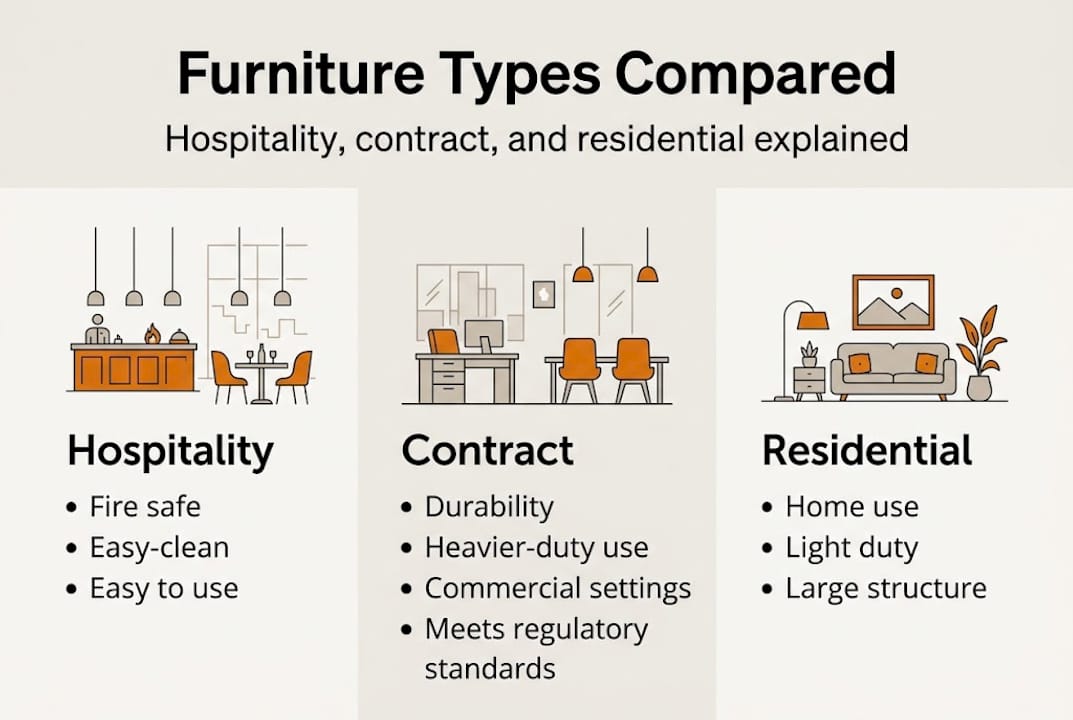
Residential furniture sits entirely outside both categories. It is designed for light, predictable use by a consistent household. The higher usage intensity seen in commercial environments, where dozens of different users interact with a piece each day, simply overwhelms residential specifications.
| Category | Typical setting | Key standard | Lifespan (heavy use) | Bulk pricing |
|---|---|---|---|---|
| Residential | Home | Domestic regulations | 1 to 3 years | No |
| Contract | Office, healthcare | BS/EN standards | 5 to 10 years | Sometimes |
| Hospitality | Cafés, events, hotels | BS 7176, EN 16139 | 3 to 12 years | Yes |
Choosing the right category for your space comes down to four clear steps:
For businesses fitting out hybrid office spaces that also host clients or external guests, understanding contract furniture explained helps clarify where specifications overlap and where hospitality-grade requirements take priority.
Making an informed choice is easier with clear comparisons, but success depends on your procurement approach.
Procuring hospitality furniture at scale is a different discipline from buying a handful of desks. It requires forward planning, clear specifications, and a structured tendering process. The upside is real: competitive tendering for a large furniture contract can deliver savings of 3 to 6 percent on rates, as demonstrated in Whitbread’s multi-site refurbishment programme.
Lifespan benchmarks help with asset planning. Under heavy use, chairs last 3 to 5 years while tables and booth seating hold up for 8 to 12 years. Building these figures into your depreciation schedule and replacement budget prevents unpleasant surprises mid-contract.
Key procurement principles to follow:
Pro Tip: Structure your tender to evaluate total cost of ownership rather than unit price alone. A chair that costs 20% more but lasts twice as long is significantly cheaper over a five-year period.
Bundling categories together, such as seating and tables in a single order, often unlocks better terms. The value of bundle procurement is well established for businesses ordering at volume. Working with trusted furniture suppliers that understand B2B logistics ensures smoother delivery and reduced site disruption. For teams new to commercial furniture buying, understanding B2B furniture health benefits and the broader commercial context supports better decision-making from the outset.
Here is an uncomfortable truth most suppliers will not tell you: the majority of procurement mistakes in hospitality furniture happen before anyone visits a showroom. Teams get drawn in by a mood board or a low unit price, then discover six months into operation that the chairs cannot be wiped down properly, the fabric is pilling, or replacement parts are unavailable.
The single most overlooked factor is repairability. A chair that costs £180 but can have its seat pad replaced for £20 is far more valuable than a £120 chair that must be discarded when the fabric fails. Modular construction and accessible spare parts should be non-negotiable criteria in your specification.
Equally, buyers underestimate the total cost of cleaning. Fabrics that require specialist treatment rather than a simple wipe add labour cost every single week. Over five years, that adds up to more than the original price difference between a practical and an impractical fabric choice.
Flexibility matters too. Café and event spaces evolve. Furniture that cannot be reconfigured quickly becomes a liability. Getting the café layout optimised from the start, with pieces that can be rearranged to accommodate different group sizes and events, protects your investment long after the fit-out is complete. Longevity beats trend-chasing every time.
If you are planning a café refurbishment, outfitting a corporate event space, or upgrading breakout furniture across multiple sites, the specification decisions you make now will determine your costs and guest experience for the next decade.
At Furniture for Business, we supply durable, design-led commercial furniture to UK businesses of all sizes, from single-site bistros to multi-site corporate estates. Explore our meeting room furniture for guest-facing spaces, browse our full range of office chairs built for all-day commercial use, or visit Furniture for Business to see the complete range. Free delivery to the UK mainland is included as standard, and our team can advise on bulk orders and bespoke project requirements.
Under busy conditions, chairs last 3 to 5 years while tables and booths remain serviceable for 8 to 12 years, making asset planning straightforward when you factor in these benchmarks from the outset.
Hospitality furniture is built for all-day, heavy use with commercial fire-resistant materials, easy-clean surfaces, and logistics designed for bulk delivery and installation across large spaces.
Yes; structured tendering and bulk procurement can deliver savings of 3 to 6 percent on rates upfront, and longer service lifespans reduce replacement frequency significantly compared with residential or entry-level office pieces.
Any venue expecting constant visitor use, including cafés, bistros, event halls, conference centres, hotel lobbies, and corporate breakout spaces, requires hospitality-grade furniture to meet safety standards and withstand daily operational demands.

Phone: 0330 043 4114
VAT no. GB 991 8681 60
Company no. 07250570