TL;DR:
- Office layouts must adapt to support hybrid work by offering flexible zones for different activities.
- Creating distinct collaboration, focus, and social zones enhances productivity and employee well-being.
- Involving staff in design and ongoing adjustments ensure layout optimally supports modern working patterns.
Walk through most UK offices today and you will find rows of desks designed for a world that no longer exists. Hybrid working has fundamentally changed why people come in: staff now arrive for connection, collaboration, and focused work they cannot do at home, not to sit in silence at an assigned seat. Yet the physical layout of most offices has barely kept pace. Research, practical guidance from bodies such as the British Council for Offices (BCO), and mounting workplace evidence all point to the same conclusion: getting your layout right is one of the highest-impact decisions you can make for productivity, satisfaction, and long-term retention.
| Point | Details |
|---|---|
| Multiple work modes matter | Modern office layouts should support collaboration and quiet work in flexible, adaptable spaces. |
| Well-being drives productivity | Zoning, biophilic design, and psychosocial involvement all contribute to happier, more effective teams. |
| Staff input is crucial | Engaging employees in design choices and providing ongoing support prevents productivity loss during layout changes. |
| Small pilots win | Test changes with small groups before rolling out whole-office transformations for best results. |
The average UK office no longer hums with the same daily rhythm it did before 2020. Occupancy has dropped, peak days have clustered, and the fundamental reason people travel to an office has shifted. Staff do not come in to do the same work they would do at home. They come for workshops, team catch-ups, mentoring, and the kind of spontaneous conversation that accelerates problem-solving. This is not a temporary blip; it is a structural change.
The implications for layout are significant. A room full of identical desks sends a clear signal: this space expects routine, individual work. That signal is wrong for most hybrid teams. Office design impacts behaviour far more than most managers realise, because the physical environment quietly dictates how people move, interact, and concentrate throughout the day.
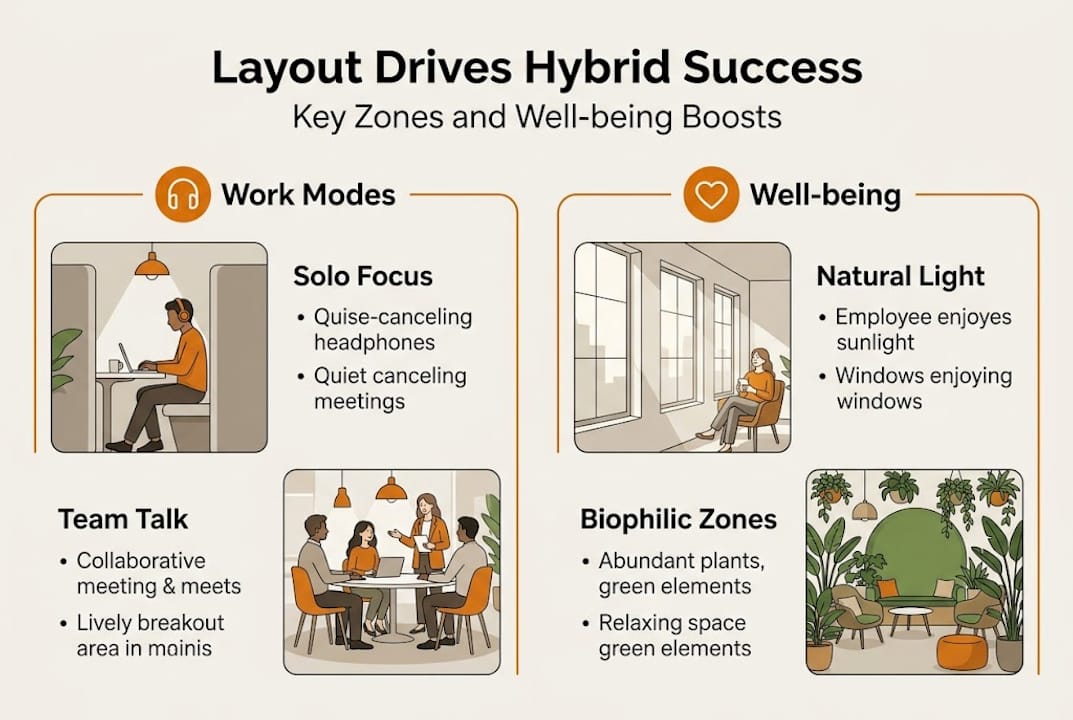
One of the most persistent misconceptions is that hybrid workers want the same environment as before, just with a hot-desking policy bolted on. In reality, they want tailored zones. The BCO’s updated guidance makes this explicit: offices must now provide flex spaces for collaboration alongside environments designed specifically for focused, heads-down work. Neither alone is sufficient.
Consider what this means in practice:
Managers who want to boost office productivity should start by questioning whether their current layout serves any of these modes effectively, let alone all of them. The odds are it does not.
Now that we understand why the role of the office has shifted, let us examine how layout directly influences productivity and staff well-being, not just on paper but in measurable outcomes.
New layouts do not automatically deliver gains. Research published in BMC Public Health found that well-being and productivity depend on both the physical environment and psychosocial factors. Trust, genuine staff involvement, and clear processes during the transition all act as protective factors. Without them, even a beautifully designed office can trigger higher stress and reduced output.
The data tells an instructive story:
| Factor | Impact on productivity | Key action |
|---|---|---|
| Staff involvement in design | Strong positive | Run consultation workshops |
| Clear zone purposes | Moderate positive | Label spaces clearly |
| Noise control | Strong positive | Invest in acoustic panels |
| Poor change communication | Negative | Brief teams before changes go live |
| Activity-based zoning | Moderate positive | Design for multiple work modes |
Activity-based working (ABW) is the principle behind many modern office redesigns. Rather than assigning fixed desks, ABW offers a variety of environments matched to task type. The logic is straightforward: if you need to write a detailed report, sit in a quiet pod. If you need to brainstorm, move to an open collaborative bench. Following fit-out best practices ensures these environments are properly resourced and not just cosmetically different.
“The relationship between a new office design and productivity loss is moderated by psychosocial factors including collaboration quality, trust in management, and involvement in change processes.”
Pro Tip: Before making any physical changes, run a short survey or workshop asking staff what types of work they struggle to complete in the office. Their answers will almost always reveal a layout gap you had not noticed.
Improving acoustic comfort is consistently underestimated. Noise is the single most cited productivity killer in open-plan offices. Strategies around improving office comfort should sit alongside any layout redesign, not follow it as an afterthought.
Understanding the link between layout and productivity, the next step is to make these benefits real through intelligent zoning, balancing the need for both group and solo work.

Zoning simply means creating distinct areas within the same office, each with a clear, communicated purpose. BCO guidance identifies a variety of flexible environments, from open collaborative areas to enclosed quiet rooms, as essential for hybrid offices. Without deliberate zoning, every space becomes a compromise that serves nobody particularly well.
| Layout type | Strengths | Weaknesses |
|---|---|---|
| Traditional open plan | Easy to supervise, cost-efficient | Noisy, poor focus, no variety |
| Cellular (private offices) | High focus, low distraction | Poor collaboration, expensive per head |
| Zoned hybrid layout | Supports all work modes, flexible | Requires careful management and signage |
Here is a practical process for implementing effective zoning:
Common pitfalls include creating beautiful quiet zones with no acoustic treatment, and labelling a space as “collaborative” without providing the technology or furniture to support it. Your furniture design choices are inseparable from zoning success.
Alongside zoning, another powerful way office layouts support well-being is through nature. Biophilic design brings natural elements, plants, daylight, views, and organic materials, into the built environment to meet a deep human need for connection with the natural world.
The evidence is striking. A peer-reviewed study from the University of Reading found that office plants improvedclean%20version%20FINAL%20with%20tables%20and%20figures%20included.pdf) perceived attention, creativity, and productivity among office workers. Critically, when those plants were removed, the positive effects reversed and stress indicators rose. This is not a soft benefit; it is a measurable outcome that any manager can replicate with thoughtful plant placement.
That said, not every well-being measure improves automatically. The same research noted that motivation, tiredness, and overall well-being were not reliably lifted by plants alone. Biophilic design works best as one layer of a broader well-being strategy, not a standalone fix.
Key principles for incorporating biophilic elements:
Pro Tip: If budget is tight, start with a few large, low-maintenance plants in the areas where staff spend the most time rather than spreading small pots thinly across the whole floor. Concentration of greenery in one zone is more effective than diluted effort. Pairing plants with agile working furniture in relaxed collaboration areas creates a noticeably different atmosphere from a standard open-plan floor.
With the essential elements clarified, managers and HR leaders should follow a structured process in applying research to their specific layouts.
The BCO’s fit-out guidance recommends starting by linking space strategies directly to business goals, not just headcount. That principle translates into a clear sequence:
Pro Tip: Involve a cross-section of staff in the pilot, not just senior leadership. The people who use a space every day notice problems and opportunities that management surveys miss entirely.
The checklist for a well-designed hybrid office is straightforward: variety of environments, alignment with culture, acoustic and environmental comfort, reliable technology in every zone, and furniture that can be reconfigured without specialist help. Tick those boxes and your layout will outlast several rounds of hybrid policy changes.
Synthesising these best practices, it is worth reflecting on why getting layout right matters even more than most organisations realise.
Most businesses approach hybrid working as a headcount and hardware problem. They count desks, order laptops, and set a policy. What they miss are the behavioural cues embedded in the physical environment. Layout is not decoration; it is instruction. It tells people whether they are expected to collaborate or concentrate, whether informal conversation is welcome or disruptive, and whether the organisation trusts them to choose how they work.
The BCO guidance makes clear that layout must support how people actually work, not how an organisational chart suggests they should. Competitive organisations will start treating layout as a strategic asset, not an overhead cost to minimise. The ones that do will find recruitment, retention, and collaboration improve in ways that are hard to attribute to any single cause, but are nonetheless real.
The real secret, in our experience, is not a single expensive refurbishment. It is small, continual adjustments based on observational feedback. Move a plant, shift a partition, add a screen. Test, observe, repeat. That iterative approach, grounded in productive fit-out practices, delivers a far better return than any one-off redesign.
Ready to put these layout strategies into action? The right furniture is the foundation of every zone you create, and choosing pieces designed specifically for hybrid environments makes the difference between a space that works and one that merely looks good on a floor plan.
At Furniture for Business, we supply UK businesses with everything needed to build a genuinely flexible, productive office. From office desks configured for hot-desking and focus work, to ergonomic office chairs that keep staff comfortable through longer in-office days, and meeting room solutions that make collaboration effortless, our range is built for the way modern teams actually work. Free delivery to the UK mainland and bulk order pricing mean equipping your entire office does not have to be complicated.
Prioritising a variety of flexible spaces for both collaboration and quiet focus is essential, and it works best when staff have genuine input into the design process from the outset.
Yes, real plants have been shown to boost perceived attentionclean%20version%20FINAL%20with%20tables%20and%20figures%20included.pdf) and creativity, with living plants outperforming artificial ones; the effect reverses when plants are removed, underscoring that quality matters.
Layout changes can meaningfully improve well-being and reduce stress, but psychosocial factors such as staff involvement and management trust must accompany the physical redesign or gains will be limited.
Audit how your current space is actually used, then consult staff directly; BCO fit-out guidance consistently recommends mapping zones to real work patterns and business goals before buying a single new piece of furniture.
Phone: 0330 043 4114
VAT no. GB 991 8681 60
Company no. 07250570