Up to 90% of office workers experience musculoskeletal discomfort without proper ergonomic support, leading to reduced productivity and increased absenteeism. Ergonomic furniture addresses these issues by supporting natural posture and reducing physical strain. This guide explains what ergonomic furniture is, its proven benefits, key features to look for, and how to select solutions that enhance employee comfort and workplace performance.
| Point | Details |
|---|---|
| Definition and design | Ergonomic furniture supports natural body posture and movement patterns through adjustable features. |
| Health and productivity gains | Reduces musculoskeletal complaints significantly whilst boosting concentration and output by up to 15%. |
| Essential features | Adjustable lumbar support, seat height, armrests, and compliance with ISO 9241-5 standards. |
| Cost misconceptions | Effective ergonomic solutions exist across price ranges without sacrificing quality or aesthetics. |
| Selection framework | Assess employee needs, verify adjustability, check standards compliance, and provide proper training. |
Ergonomic office furniture is designed to maximise comfort and minimise musculoskeletal disorder risk by supporting proper posture and body mechanics. This approach recognises that the human body needs specific support to maintain neutral positions during prolonged sitting or standing. Without ergonomic design, office workers face significant health risks.
Research shows that 60 to 90% of office workers experience musculoskeletal discomfort when using standard furniture. These issues range from minor aches to chronic conditions requiring medical intervention. Ergonomic furniture tackles this problem through deliberate design choices that align with natural body mechanics.
The core principles focus on several key aspects:
Proper office chair ergonomics means employees can maintain healthy postures without conscious effort. When furniture fits the body correctly, muscles work less to maintain position, reducing fatigue and strain. Understanding these principles helps office managers recognise genuine ergonomic solutions versus marketing claims.
The measurable outcomes from ergonomic furniture use extend beyond simple comfort improvements. Studies demonstrate that ergonomic furniture significantly reduces musculoskeletal complaints and related sick leave among office workers. These reductions translate directly into lower absenteeism rates and healthcare costs for employers.
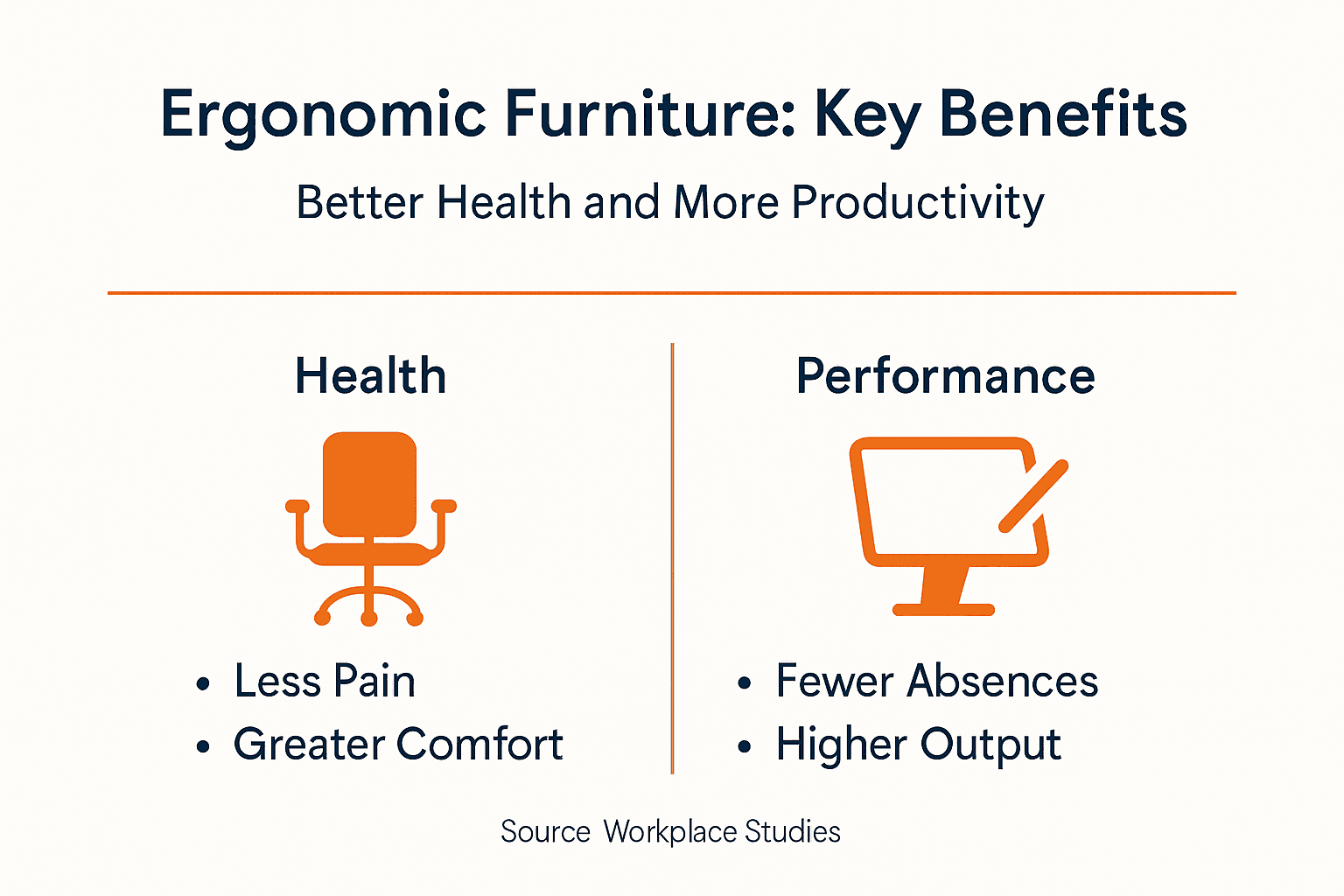
Employee comfort improvements lead to better concentration and sustained performance. When workers aren’t distracted by back pain or neck strain, they maintain focus on tasks longer. This enhanced attention produces measurable productivity gains.
Key benefits include:
Research shows offices implementing ergonomic solutions see productivity improvements of 15% alongside 20% fewer musculoskeletal complaints.
These statistics demonstrate clear return on investment for ergonomic furniture purchases. The initial cost becomes negligible when compared to ongoing savings from reduced sick leave and improved output. Modern office furniture productivity benefits extend across all business sectors.
Employees working in comfortable environments also report higher job satisfaction. This psychological benefit complements the physical improvements, creating a positive workplace culture. Understanding office chair ergonomics benefits helps managers justify investments to senior leadership.
Identifying genuine ergonomic furniture requires understanding specific features that deliver health benefits. Not all furniture marketed as ergonomic meets proper standards. Office managers need clear criteria for evaluation.
| Feature | Standard furniture | Ergonomic furniture |
|---|---|---|
| Lumbar support | Fixed or absent | Adjustable height and depth |
| Seat height | Limited range | Extensive adjustment range |
| Armrests | Fixed position | 3D or 4D adjustable |
| Desk height | Fixed at 73cm | Height-adjustable 65-125cm |
| Material quality | Basic foam | High-density supportive foam |
Adjustable lumbar support represents the most critical chair feature. This mechanism must move vertically and horizontally to match individual spine curves. Without proper lumbar support, users experience lower back pain within hours.
Seat height adjustment accommodates different leg lengths and desk heights. Proper adjustment allows feet to rest flat whilst maintaining 90-degree knee angles. This positioning reduces pressure on thigh muscles and improves circulation.

Armrests need multiple adjustment points to support forearms properly. Look for height, width, and angle adjustments. Correct armrest positioning reduces shoulder and neck tension during keyboard work.
Height-adjustable desks enable alternating between sitting and standing positions. This variation reduces spinal load by up to 40% compared to continuous sitting. The ability to change positions combats fatigue and maintains alertness.
Pro Tip: Check that furniture complies with ISO 9241-5 ergonomic requirements which set measurable criteria for adjustability and support. This standard ensures products meet scientifically validated ergonomic principles.
Material durability matters alongside ergonomic features. High-quality foam maintains support properties over years of use. Cheap materials compress quickly, losing ergonomic benefits.
Explore ergonomic office chairs and ergonomic office desks to compare features across price ranges. Choosing office chairs 2026 guidance provides detailed evaluation criteria.
Several persistent myths prevent businesses from investing appropriately in ergonomic solutions. Addressing these misconceptions helps office managers make informed decisions based on facts rather than assumptions.
Myth: Ergonomic furniture costs prohibitively.
Reality: Effective ergonomic options exist across price ranges. Entry-level ergonomic chairs starting around £200 provide significant benefits over standard seating. The investment returns through reduced absenteeism and improved productivity.
Myth: Ergonomic furniture alone solves all musculoskeletal problems.
Reality: Furniture must combine with proper usage training and regular breaks. Even the best chair causes issues if adjusted incorrectly. Employee education on posture and movement remains essential.
Myth: Ergonomic furniture looks clinical and unattractive.
Reality: Modern ergonomic designs complement contemporary office aesthetics. Manufacturers offer sleek, professional appearances alongside functional features. Smart office furniture integrates ergonomics with style.
Myth: One ergonomic chair fits everyone.
Reality: Body diversity requires adjustable features. What works for a 180cm person fails for someone 160cm tall. Extensive adjustability accommodates different users.
Myth: Ergonomic furniture provides immediate results.
Reality: Bodies need adaptation time to new postures. Benefits accumulate over weeks as muscles strengthen and adjust. Initial discomfort during transition periods is normal.
These misconceptions often stem from limited exposure to quality ergonomic furniture. Businesses evaluating options should prioritise functionality over appearance whilst recognising that modern designs achieve both. Understanding true costs versus benefits prevents penny-wise but pound-foolish decisions that ultimately cost more through health issues and productivity losses.
A structured approach ensures procurement teams choose furniture that delivers genuine ergonomic benefits whilst fitting budgets and workspace requirements. Follow these steps for optimal results:
| Evaluation criteria | Importance level | Key considerations |
|---|---|---|
| Adjustability range | Critical | Must accommodate 5th to 95th percentile users |
| Lumbar support | Critical | Vertical and horizontal adjustment required |
| Standards compliance | High | ISO 9241-5 certification preferred |
| Material durability | High | Minimum 5-year warranty on mechanisms |
| Cost-effectiveness | Medium | Calculate total cost of ownership including maintenance |
Pro Tip: Many procurement teams prioritise appearance over ergonomic functionality, leading to poor long-term outcomes. Test furniture with actual employees across different body types before large purchases.
Integration with existing workspace layout affects furniture effectiveness. Consider desk arrangements, monitor positioning, and movement patterns. Framework for choosing chairs provides detailed evaluation checklists.
Employee training often receives insufficient attention despite its importance. Workers need instruction on adjusting features properly and recognising correct postures. Without training, even excellent furniture fails to deliver benefits. Budget time and resources for ongoing education alongside furniture purchases.
Office desk selection should follow similar evaluation criteria, focusing on height adjustability and surface dimensions that accommodate equipment whilst maintaining proper reach distances.
UK businesses implementing ergonomic furniture report measurable improvements across multiple metrics. These examples demonstrate practical outcomes that office managers can expect.
A London financial services firm replaced 200 standard chairs with ergonomic models featuring adjustable lumbar support and armrests. Within six months, they recorded:
A Manchester technology company implemented height-adjustable desks across three floors. Their results showed:
Key lessons from these implementations include:
Explore UK office ergonomic case studies for additional examples across industries. UK B2B ergonomic furniture success stories provide implementation insights.
These real outcomes validate ergonomic furniture investments. The documented health improvements and productivity gains demonstrate clear business value beyond simple comfort enhancements.
Contemporary office trends emphasise flexibility, collaboration, and employee wellbeing. Ergonomic furniture integrates seamlessly with these priorities whilst enhancing their effectiveness.
Flexible working arrangements including hot-desking require highly adjustable furniture. When different employees use the same desk throughout the week, extensive adjustment ranges become essential. Ergonomic furniture supports this flexibility through quick, intuitive adjustment mechanisms.
Collaborative spaces benefit from ergonomic seating that encourages movement and varied postures. Mobile chairs with proper support enable employees to shift between individual work and team discussions comfortably. This versatility maintains health benefits across different work modes.
Key benefits for modern offices include:
Pro Tip: Choose modular ergonomic furniture that adapts to changing office layouts. This flexibility future-proofs investments as workspace needs evolve.
Height-adjustable desks particularly suit flexible environments. Employees can personalise settings quickly when moving between workstations. This adaptability maintains ergonomic benefits regardless of office layout changes.
Modern workspace ergonomic furniture combines health benefits with aesthetic appeal. Current designs prove that ergonomic functionality and contemporary style aren’t mutually exclusive. Forward-thinking office managers recognise ergonomic furniture as essential infrastructure for productive, healthy workplaces.
Now that you understand ergonomic furniture principles and benefits, exploring practical solutions becomes your next step. Furniture For Business offers comprehensive ranges designed to enhance workplace comfort and productivity across budgets and requirements.
Our office chairs collection includes ergonomic models with adjustable lumbar support, armrests, and seat heights that accommodate diverse body types. Browse office desks featuring height-adjustable mechanisms that enable healthy position changes throughout the workday.
Complement your furniture selections with office accessories including monitor arms, footrests, and keyboard trays that complete ergonomic workstation setups. These additions optimise the benefits from your primary furniture investments.
Pro Tip: Consult our detailed product specifications and guidance sections to match furniture features with your specific workspace needs and employee requirements.
Whether you’re furnishing a small startup or equipping a large corporate office, our solutions balance ergonomic performance with budget considerations. Free UK mainland shipping and easy returns support confident purchasing decisions.
Ergonomic furniture is designed to support natural posture and body movements, reducing physical strain during work activities. It features adjustable components that accommodate individual body dimensions and working preferences. This design approach prevents musculoskeletal disorders common in office environments.
By reducing physical discomfort and fatigue, ergonomic furniture enables employees to maintain focus and concentration longer. Studies show productivity improvements of up to 15% following ergonomic implementations. Reduced absenteeism from musculoskeletal issues further enhances overall team output. Explore ergonomic furniture and productivity connections.
Prioritise adjustable lumbar support with vertical and horizontal positioning, seat height adjustment spanning at least 15cm, and multi-dimensional armrests. Verify compliance with ISO 9241-5 ergonomic standards through manufacturer documentation. High-density foam and durable mechanisms ensure long-term performance. View ergonomic office chair features in detail.
No, effective ergonomic options exist across price ranges starting from around £200 for quality chairs. The key is identifying essential features that match your specific needs rather than assuming highest prices guarantee best results. Calculate total ownership costs including reduced absenteeism when evaluating investments. Browse affordable ergonomic furniture options.
Provide comprehensive training on proper adjustment techniques and healthy posture principles when introducing new furniture. Conduct workspace assessments to verify correct setup including monitor height and keyboard positioning. Schedule regular check-ins to address questions and reinforce best practices. Learn about staff training on ergonomic furniture implementation.

Phone: 0330 043 4114
VAT no. GB 991 8681 60
Company no. 07250570