TL;DR:
- Bulk furniture procurement offers UK businesses significant cost savings through volume discounts, VAT reclaim, and tax deductions. It requires integrated management to prevent errors, assess supply chain risks, and ensure consistent quality and sustainability standards. Proper planning ensures timely delivery, batch uniformity, and long-term supplier relationships, maximizing value and minimizing disruptions.
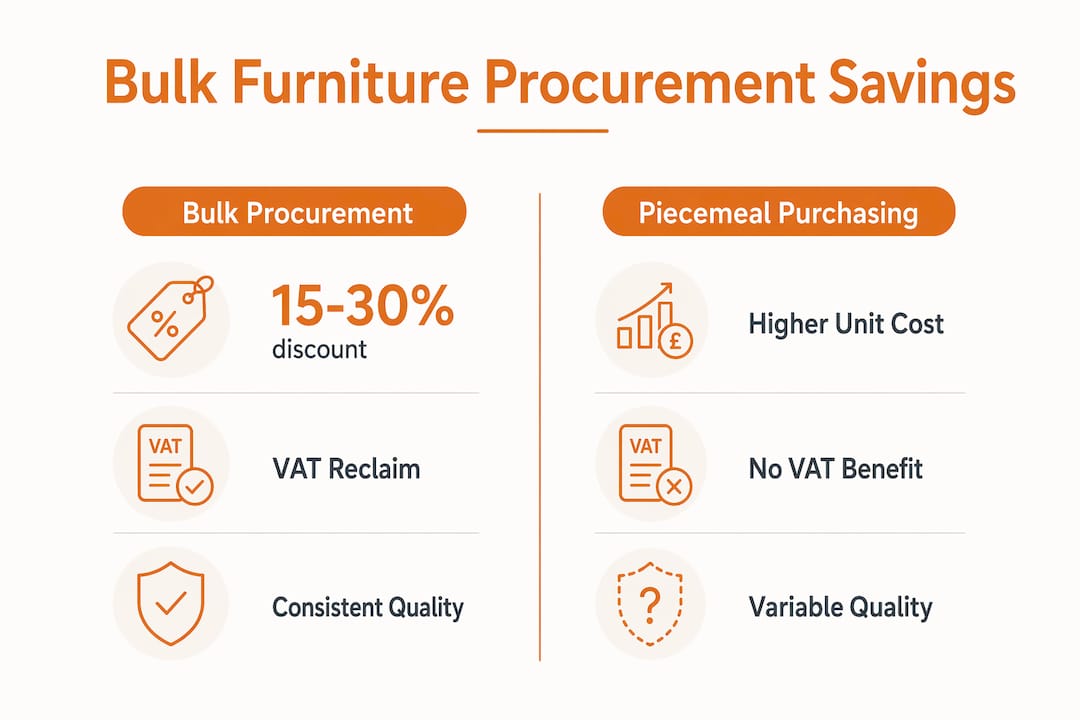
Bulk furniture procurement is defined as the strategic acquisition of large furniture volumes to reduce per-unit costs, maintain quality consistency, and control supply chain risk across business environments. For UK procurement managers overseeing office fit-outs or refurbishments, this approach delivers measurable advantages that piecemeal purchasing cannot match. Volume discounts of 15–30% are standard for large orders, and UK VAT-registered businesses can reclaim 20% VAT on qualifying purchases. The Annual Investment Allowance (AIA) allows furniture to be treated as a capital asset, deducting the full cost from taxable profits before tax is calculated.
The financial argument for bulk purchasing furniture is direct: buying more units at once reduces what you pay per unit. Cost reductions of 15–30% are achievable through volume discounts alone, with further savings from consolidated truck deliveries replacing multiple smaller shipments. That difference compounds quickly across a 50-desk order.

UK businesses gain two additional financial levers that individual buyers cannot access. Furniture qualifies as a capital asset under the Annual Investment Allowance, meaning the full purchase cost is deductible from profits before tax. VAT-registered businesses also reclaim 20% on business-use purchases, which on a £50,000 order represents a £10,000 return.
Calculating total landed costs is critical before committing to any bulk order. Storage, insurance, assembly, and disposal costs can erode apparent savings if ignored. The procurement manager who accounts for these from the outset makes a genuinely informed decision.
| Cost factor | Bulk procurement | Piecemeal purchasing |
|---|---|---|
| Per-unit price | 15–30% lower through volume discounts | Full retail or near-retail price |
| Delivery costs | Consolidated shipment, one charge | Multiple deliveries, repeated charges |
| VAT position | 20% reclaim for VAT-registered businesses | Same reclaim, but less efficient per order |
| Capital allowances | Full AIA deduction available | Same, but admin burden multiplied |
| Total landed cost | Lower when storage and logistics are planned | Higher due to fragmented logistics |
Pro Tip: Request a full landed cost breakdown from your supplier before signing off any bulk order. Include storage, assembly, and insurance in your comparison, not just the unit price.
Bulk furniture procurement is a project management exercise, not simply a purchasing decision. Without integrated management, furniture orders risk becoming chaotic: missed deadlines, substitution errors, and handover failures that cost far more than any discount saves. Coordinated ordering, production tracking, and staged delivery are the three pillars that prevent this.
Integrated procurement management delivers savings of 20–35% compared to fragmented purchasing. That figure reflects avoided costs: emergency replacements, re-deliveries, and delays that push back office opening dates. A well-managed bulk order aligns furniture delivery with construction or fit-out timelines so that nothing arrives too early or too late.
A practical workflow for a bulk procurement project runs as follows:
Pro Tip: Assign one internal procurement lead who owns the supplier relationship from order to sign-off. Fragmented communication between departments is the single most common cause of bulk order errors.
You can find a detailed breakdown of this process in the furniture procurement workflow guide published by Furnitureforbusiness.
The procurement focus has shifted from lowest unit price to supply chain resilience. Stock risk is defined as the probability that a supplier fails to meet delivery windows or consistency standards. Delivery delays can cause revenue losses that dwarf the initial cost savings from a cheaper supplier.
Quality risk is equally concrete. Requesting physical samples before committing to a bulk order allows procurement managers to evaluate cushion firmness, fabric durability, and surface finish under real office conditions. A sample that looks acceptable in a product photograph may fail within six months of daily use.
Key quality and supply risk factors to assess before placing a bulk order:
Ordering spare units during the initial bulk purchase is cost-effective compared to sourcing replacements from a different batch years later. Colour and finish matching across production runs is difficult and expensive. Storage costs for a small number of spares are almost always lower than the cost of a visible mismatch in a client-facing office.
Pro Tip: Always request the supplier’s batch number and production date for your order. This information is essential if you need to source matching replacements or raise a warranty claim.
Office environments benefit from bulk procurement in ways that go beyond cost. Batch consistency from bulk manufacturing ensures that every chair, desk, or storage unit in the office shares the same finish, colour, and construction quality. This matters for brand presentation in client-facing spaces and for the cohesive appearance that supports a professional working environment.
Maintenance and replacement logistics are also simpler when all furniture comes from a single bulk order. Facilities managers know exactly which supplier to contact, which product reference to quote, and which batch to match. That clarity reduces downtime when a replacement is needed.
Sustainability requirements are now a procurement reality in 2026. FSC certification and REACH chemical standards are increasingly written into procurement contracts, particularly for businesses with environmental, social, and governance (ESG) reporting obligations. Bulk suppliers who hold these certifications simplify compliance and protect brand reputation.
Offices also benefit from the easier maintenance that comes with uniform furniture across a workspace. When every surface, fabric type, and finish is consistent, cleaning and upkeep schedules become more predictable and less costly to manage.
| Advantage | Bulk procurement | Ad hoc purchasing |
|---|---|---|
| Aesthetic consistency | Guaranteed from single batch | Colour and finish variation likely |
| Maintenance planning | One supplier, one product reference | Multiple suppliers, complex tracking |
| Sustainability compliance | FSC and REACH verified at order stage | Requires individual product checks |
| Replacement sourcing | Spares ordered upfront, batch matched | Costly colour matching from new batches |
| Delivery logistics | Single consolidated delivery | Multiple deliveries, access disruption |
Effective bulk procurement starts with a thorough needs assessment. Define the number of units required, the specifications for each product category, and the delivery timeline before approaching any supplier. Procurement managers who skip this step often discover mid-order that quantities are wrong or that lead times conflict with the fit-out schedule.
Supplier selection is the next critical decision. Evaluate candidates against these criteria:
Contract negotiation deserves as much attention as product selection. Agree payment terms, delivery milestones, and the consequences of delays in writing. A supplier who resists putting lead times into the contract is signalling a stock risk. Bulk buying should be treated as a strategic partnership, not a one-off transaction, because warranty coverage and batch consistency depend on an ongoing relationship.
Logistics planning determines whether the savings materialise. Confirm site access for large deliveries, agree on assembly services if required, and build a buffer into the delivery schedule for any production delays. Phased delivery works well for large fit-outs where different floors or zones complete at different times. The office essentials procurement guide from Furnitureforbusiness covers common pitfalls in this area in practical detail.
Common mistakes to avoid:
Bulk furniture procurement delivers the strongest return when cost savings, quality controls, and logistics are managed as a single integrated project rather than separate tasks.
| Point | Details |
|---|---|
| Financial savings are quantifiable | Volume discounts of 15–30%, VAT reclaim, and AIA deductions reduce total cost significantly. |
| Integrated management prevents costly errors | Coordinated ordering and staged delivery save 20–35% compared to fragmented purchasing. |
| Stock risk outweighs unit price | Supplier delivery reliability matters more than the lowest quoted price per unit. |
| Batch consistency protects office aesthetics | Ordering spares upfront avoids expensive colour-matching problems in future replacements. |
| Sustainability compliance is now contractual | FSC and REACH certification should be verified at supplier selection, not assumed. |
Procurement managers who treat bulk furniture buying as a one-off purchasing event consistently pay more than those who treat it as a discipline. I have seen fit-outs derailed not by budget shortfalls but by fragmented communication: three departments each placing separate orders, no one tracking production milestones, and furniture arriving two weeks after the office was supposed to open.
The shift that makes the biggest difference is moving from price-led to resilience-led thinking. The supplier who quotes £5 less per chair but cannot confirm a production milestone is a liability. The supplier who charges a fair price, provides batch documentation, and assigns a dedicated account contact is an asset. That distinction rarely appears in a procurement brief, but it determines whether the project lands on time.
Physical sample evaluation is the step most procurement managers skip when under time pressure. Skipping it is a false economy. A chair that fails ergonomic requirements after three months of use generates replacement costs, staff complaints, and potential Health and Safety Executive (HSE) compliance concerns. Thirty minutes with a physical sample prevents all of that.
Bulk procurement done well is also a long-term relationship decision. Suppliers who know your business, your batch references, and your delivery constraints become genuinely useful partners when you need to expand, replace, or reconfigure. That relationship has real commercial value that does not appear on any invoice.
— Furniture
Furnitureforbusiness supplies commercial office furniture to UK businesses with free delivery to the UK mainland, making it a practical choice for procurement managers managing large-scale fit-outs.
The product range covers ergonomic office chairs, height-adjustable desks, meeting room furniture, and storage solutions, all available with bulk order pricing. VAT-registered buyers reclaim 20% on qualifying purchases, and furniture qualifies for Annual Investment Allowance treatment. Furnitureforbusiness offers furniture bundles designed to reduce per-unit costs and simplify logistics for teams of 5 to 500. Contact the team directly to discuss quantities, delivery phasing, and product specifications for your next procurement project.
Bulk furniture procurement is the process of purchasing large volumes of furniture in a single or coordinated order to reduce per-unit costs, maintain quality consistency, and simplify logistics for business environments.
Volume discounts of 15–30% are standard for large orders. UK VAT-registered businesses also reclaim 20% on qualifying purchases, and furniture qualifies for Annual Investment Allowance deductions against taxable profit.
Stock risk is the probability that a supplier fails to meet agreed delivery windows or product consistency standards. Delivery delays can cause revenue losses that exceed the savings from a lower unit price.
Ordering spares upfront is cheaper than sourcing replacements from a different production batch years later. Colour and finish matching across batches is difficult and costly.
FSC certification confirms responsible timber sourcing, and REACH compliance confirms that chemical standards are met. Both are increasingly contractual requirements for UK businesses with ESG reporting obligations in 2026.

Phone: 0330 043 4114
VAT no. GB 991 8681 60
Company no. 07250570