Choose rectangular tables for formal board meetings, decision-making sessions and long or narrow rooms, and choose round or oval tables for small consensus meetings, informal workshops and hospitality settings. Round and oval shapes need more floor area per seat than rectangular ones, so always check clearance and accessibility before you commit to a size.
TL;DR:
- Rectangular tables are more space-efficient and ideal for formal, hierarchical meetings with AV needs, compared to round tables which promote open discussion but require more room per seat.
- Proper room measurement and clearance, including accessibility needs, are crucial; a table that leaves less than the recommended circulation space is too large regardless of capacity.
- Meeting purpose and technology influence shape choice, with rectangular or boat-shaped tables favored for video and formal meetings, and round or oval for casual, collaborative sessions.
- Shape differences impact cost due to material waste and manufacturing complexity, with boat-shaped and circular tables generally costing more than simple rectangular ones.
- Finish and materials should prioritize durability, ease of maintenance, and safety features like accessible cable management, especially for high-traffic or hospitality environments.
Each shape does a different job in a meeting room, and matching shape to purpose is the fastest way to narrow your shortlist.
Rectangular tables suit formal, hierarchical meetings where a chair sits at the head of the table and attention naturally flows down the length of the room. They pack seats efficiently into long, narrow spaces and work well for video conferencing because everyone faces roughly the same direction. Round tables remove the “head of the table” altogether, which flattens perceived hierarchy and tends to encourage open discussion among smaller groups. Oval tables borrow a bit of both: the rounded ends soften hierarchy while the straight sides still seat people efficiently along a run. Boat-shaped tables, with their curved sides and tapered ends, are a popular compromise in boardrooms because the curve improves sightlines to a screen while still accommodating a reasonable headcount.
When a room has to serve more than one purpose, a boat-shaped or modular table is often the pragmatic compromise rather than forcing a single rigid shape to do everything.
Converting a room’s dimensions into a safe table specification comes down to a handful of measurements, not guesswork.
Industry sizing guidance recommends allocating a defined range of linear edge space per person when calculating capacity, with executive seating needing more space per person than standard task seating. The same guidance treats a minimum clearance between table edge and wall as standard practice, with a larger allowance where the room must support wheelchair access.
The Government Workplace Design Guide sets out non-prescriptive benchmarks for meeting zone layout and space standards. It is a useful reference point when you need to justify a room layout to budget holders rather than rely on a single supplier’s recommendation.
A simple rule of thumb: if the table footprint leaves less than a comfortable circulation gap on any side, the table is too big for the room, regardless of how many seats it technically offers.
The meeting type usually decides the shape before aesthetics ever come into it.
Video-first meetings and executive-style sessions tend to favour rectangular or boat-shaped tables, because a camera at one end can see everyone seated along the sides without awkward angles. Workshops, client pitches and hospitality settings often work better around a round or oval table, where no one is visually sidelined and conversation flows more naturally. The practical fix for rooms that host both meeting types is modular furniture: tables that reconfigure from a boardroom rectangle into smaller round clusters, with integrated power modules built in rather than trailing extension leads across the floor.
Meeting rooms deliver more value when power and AV routing are designed into the table itself rather than retrofitted after installation.
Pro Tip: Position the table so the furthest seat sits no more than a comfortable viewing distance from the main screen, and check that cable routes reach every seat without crossing a walkway.
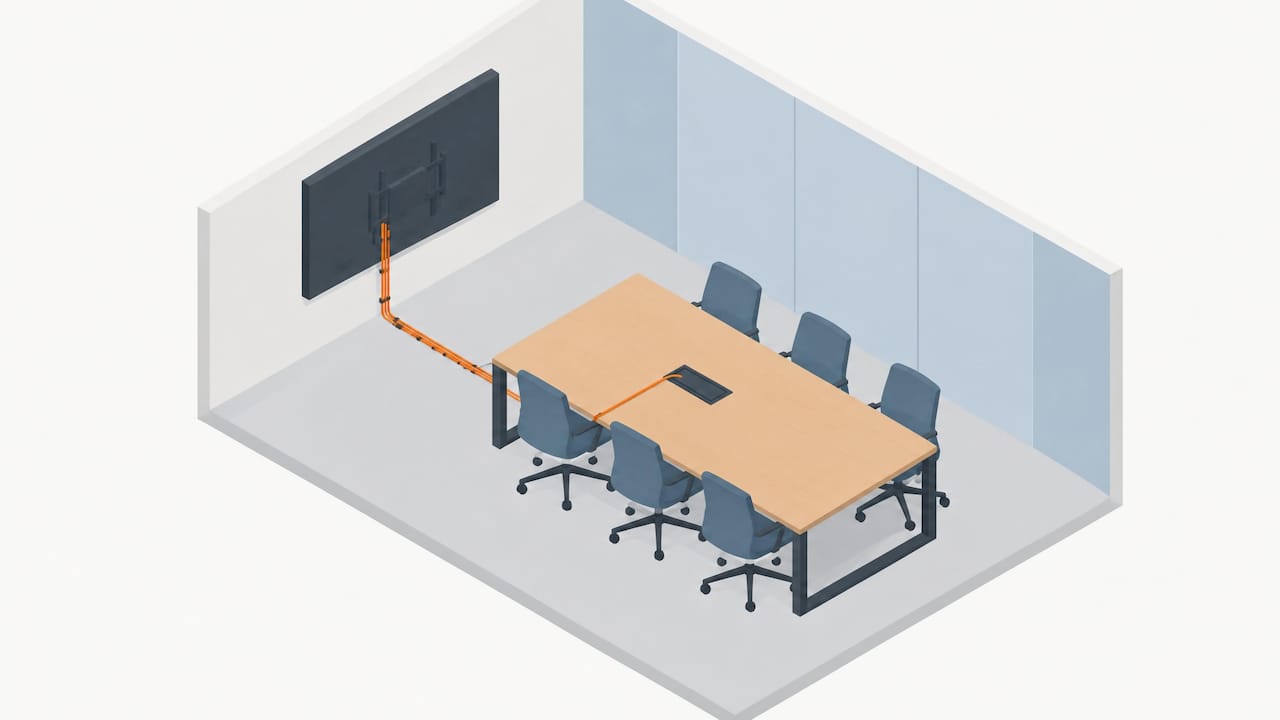
The shape gets most of the attention, but the finish decides how the table looks after two years of daily use.
Laminate and veneer tops hold up well in corporate boardrooms, while wipe-clean laminates or solid-surface tops tend to suit hospitality settings better, where spills and heavier foot traffic are routine. Edge detail matters too: a softened or bullnose edge is more comfortable for anyone leaning on the table through a long meeting, which HSE seating and workstation guidance treats as part of a wider set of checks on comfortable, safe working surfaces.
A clear sequence turns a vague brief into an order-ready specification.
| Checklist stage | What to confirm |
|---|---|
| Room measurement | Clear floor area and fixed obstructions |
| Headcount | Current users plus three to five year growth |
| Shape and capacity | Edge-per-person or arc allowance for the chosen shape |
| Accessibility | Wheelchair turning space and clearance on at least one side |
| Finish and tech | Material, edge profile, power and cable routing |
| Commercial terms | Delivery, warranty and returns policy |
For rooms that must support a wheelchair user, our wheelchair accessible meeting tables specification guide walks through the measurements in more detail, and a partner guide to Doc M turning circle requirements is a useful cross-check for building compliance.
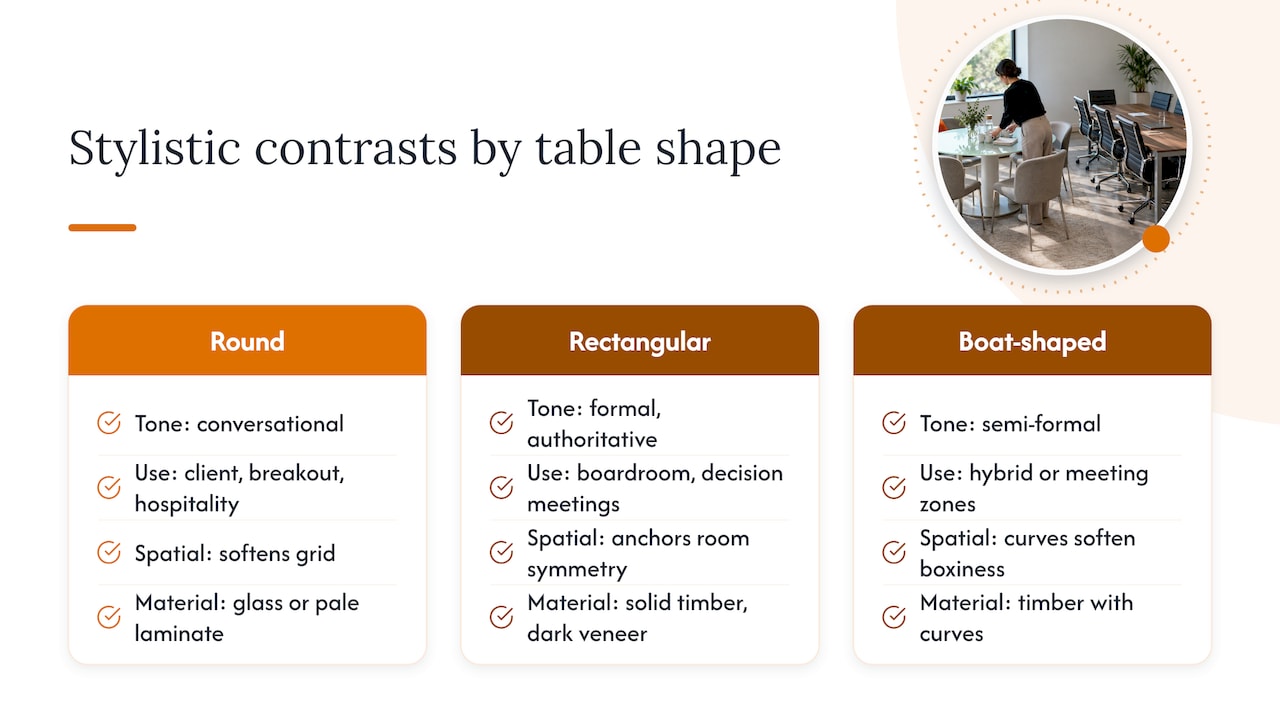
Shape sends a message before anyone sits down. A long rectangular table in a dark veneer reads as traditional and formal, the kind of room where decisions get made and minutes get taken. A round or oval table in a lighter finish softens that impression and tends to suit client-facing spaces, breakout zones and hospitality areas where the goal is conversation rather than authority.
Rectangular tables also tend to anchor a room’s visual symmetry, lining up neatly with windows, ceiling grids and wall panelling, which is partly why they dominate traditional boardrooms. Round tables break that grid intentionally, and in a smaller room a round top can make the space feel less corridor-like than a long rectangle crammed into the same footprint.
Material choice reinforces the message: a glass or pale laminate round table reads as contemporary and approachable, while a solid timber rectangular table reads as established and formal. Boat-shaped tables sit stylistically between the two, offering the gravitas of a rectangle with curves that stop the room feeling boxy.
None of this overrides the space and accessibility rules above. A striking round table that cannot seat the required headcount, or that leaves no room for circulation, fails the brief regardless of how it photographs. Aesthetic choice works best as the final filter applied after shape, size and clearance are already settled.
Shape affects price mainly through material use and manufacturing complexity rather than seating capacity alone. A round or oval top generally uses more board per seat than a straight-edged rectangular top of equivalent capacity, since curved cutting produces more waste and the shape needs a wider diameter to seat the same number of people comfortably. Boat-shaped tables, with their curved sides, typically sit at the higher end of the price range because the tooling and finishing involved cost more than a straight-edged rectangle.
Budget planning should also account for what sits underneath the top: a rectangular table with a straightforward leg frame is usually the most economical option, while tables with integrated power modules, cable trays or modular reconfiguration add cost regardless of shape. For a hospitality venue ordering multiple smaller tables, the per-unit cost difference between shapes tends to matter more than it does for a single large boardroom purchase, where the dominant cost driver is overall size rather than shape.
Our meeting room range includes both shapes and a variety of finishes, enabling procurement teams to compare options before budgeting, with pricing considerations for larger fit-outs requiring multiple rooms.
We supply meeting room and boardroom tables across both round and rectangular shapes, alongside complementary chairs, desks and storage, allowing coordination of a whole room setup rather than just the table. Delivery options to UK mainland and pricing considerations for larger orders support procurement teams working on multi-room projects, with a returns policy that offers some flexibility if a size or finish is unsuitable once the table is installed.
The compromise we see most often is procurement choosing the longest table that technically fits the room, leaving no circulation space once chairs are pushed back. Checking clearance against the measurements above before ordering avoids that outcome.
— Furniture
We carry round, oval, rectangular and boat-shaped meeting tables built for daily commercial use, allowing choice of shape alongside durability and lead time considerations. Pricing considerations apply to multi-room fit-outs, delivery options support UK mainland orders, and returns provide flexibility if site measurements differ from expectations.
Get in touch with our team or place your order directly through the meeting room category page to get pricing for your fit-out.
Rectangular tables suit most boardrooms because they seat people efficiently along a long room and align well with video conferencing and presentation screens. A round or oval table works better for a boardroom that doubles as a smaller, informal meeting space rather than a large formal one.
You need clearance between the table edge and the nearest wall for chair push-back and circulation, with a wider allowance on at least one side for wheelchair access, as set out in sizing guidance. Checking this clearance before ordering avoids a table that technically fits the room but leaves no usable circulation space.
Round or oval tables often suit small meeting rooms better because they avoid the corridor-like feel a long rectangle can create in a tight space. A rectangular table can still work in a small room if it is sized correctly against the clearance rules rather than stretched to the room’s full length.
Round tables generally need more floor area per seat than rectangular tables, so for the same room footprint a rectangular table typically seats more people. The trade-off is that round tables improve sightlines and give every seat equal standing, which suits consensus-style meetings better than raw capacity.
Meeting tables should allow wheelchair users enough turning space and a clear approach to a seat, with reference to building compliance guidance such as Doc M turning circle requirements. HSE guidance on seating and workstation checks also applies, covering comfortable elbow height and legroom for every seat at the table.
For verifying clearance, seating and workplace design figures before you order, these references are worth bookmarking alongside your supplier’s own specification sheets.

Phone: 0330 043 4114
VAT no. GB 991 8681 60
Company no. 07250570