Most squeaks disappear once you diagnose the noisy joint, tighten the loose fixings, clear out debris, and apply the right lubricant. Silicone spray for plastic parts and casters, white lithium grease for metal pivots. Never puncture or dismantle a gas lift cylinder, and never soak a mechanism hoping it fixes itself. Test the chair, then work through the steps below in order.
TL;DR:
- Most squeaks can be fixed with proper diagnosis, tightening loose fittings, cleaning debris, and applying targeted lubricants like silicone spray or white lithium grease.
- Identifying the exact source of the squeak requires load testing, such as swiveling, leaning, or pressing down, preferably recorded for precise diagnosis.
- Regular maintenance, including quarterly tightening and cleaning, along with annual lubrication and inspection, can prevent most squeaks from recurring.
- Caster wheel buildup is a common cause of rolling squeaks, easily fixed by cleaning and lubricating or replacing worn wheels, especially on delicate flooring.
- If squeaks persist after cleaning and lubrication, the part is likely worn out and needs replacement, with heavy-duty office parts being more durable than household components.
You can solve the vast majority of office chair squeaks with a kit that fits in a small toolbox. Gather these before you start:
On lubricants, stock silicone spray for plastic-on-plastic contact and caster wheels, white lithium grease for metal pivots and springs, and a penetrating spray such as WD-40 purely to free a seized bolt or strip old residue before regreasing. Skip cooking oils and multipurpose household oils. They attract dust, gum up over weeks, and often make the noise worse than before you started.
You cannot fix what you cannot locate, and most people guess wrong on the first try. The noise usually only shows up under load, which is why testing an empty chair rarely tells you anything useful.
A colleague sitting in the chair while you kneel underneath, or filming the movement on a phone, catches intermittent noises that vanish the moment you try to inspect them directly. As a rough guide: squeaking while rolling points to the casters, squeaking on recline points to the tilt mechanism, and squeaking on swivel points to the base or cylinder collar.
Pro Tip: Record a short video the moment the squeak happens. Play it back in slow motion and you will often hear exactly which part of the swivel or recline motion triggers the sound.
Loose fittings cause more squeaks than dry mechanisms, and tightening costs nothing. Turn the chair upside down or lay it on its side so you can see the base plate, tilt mechanism, and armrest brackets clearly.
Stripped threads from overtightening are one of the few mistakes that turns a five-minute fix into a replacement job, so stop as soon as the fitting feels secure.
Getting the right product on the right joint matters more than how much you apply. Match the material, not the location, and you avoid the trial-and-error most people go through.
Quantity is where most people go wrong. Technicians consistently report that small, targeted dabs outlast heavy soaking, because excess lubricant becomes a magnet for office dust and grit, which then grinds against the joint and recreates the exact squeak you just fixed. Apply sparingly, work the mechanism to spread it internally, and wipe away anything sitting on the surface.
Caster noise is usually the fastest fix on this list, and often the one facility teams overlook because the wheels look fine from above.
If a caster still grinds or wobbles after cleaning, replace it rather than fighting it further. For offices with delicate flooring, anti-marking or soft-rolling castors are worth the small upgrade over standard hard wheels, and standardising the replacement castors across a chair fleet makes spares management far simpler for whoever handles procurement.
The gas lift cylinder itself is sealed and pressurised, and it should stay that way. Never puncture, drill, or attempt to open it. Most gas lift noise actually comes from the connection points around the cylinder, not the sealed unit itself.
Wipe the exposed shaft clean, apply a light spray of silicone to the column, and add a small dab of white lithium grease at the top connection where the cylinder meets the seat mechanism. Cycle the height adjustment lever several times to work the lubricant through. If the seat still sinks under weight, rocks side to side, or keeps squeaking after this, the cylinder is failing internally and needs replacing rather than further treatment.
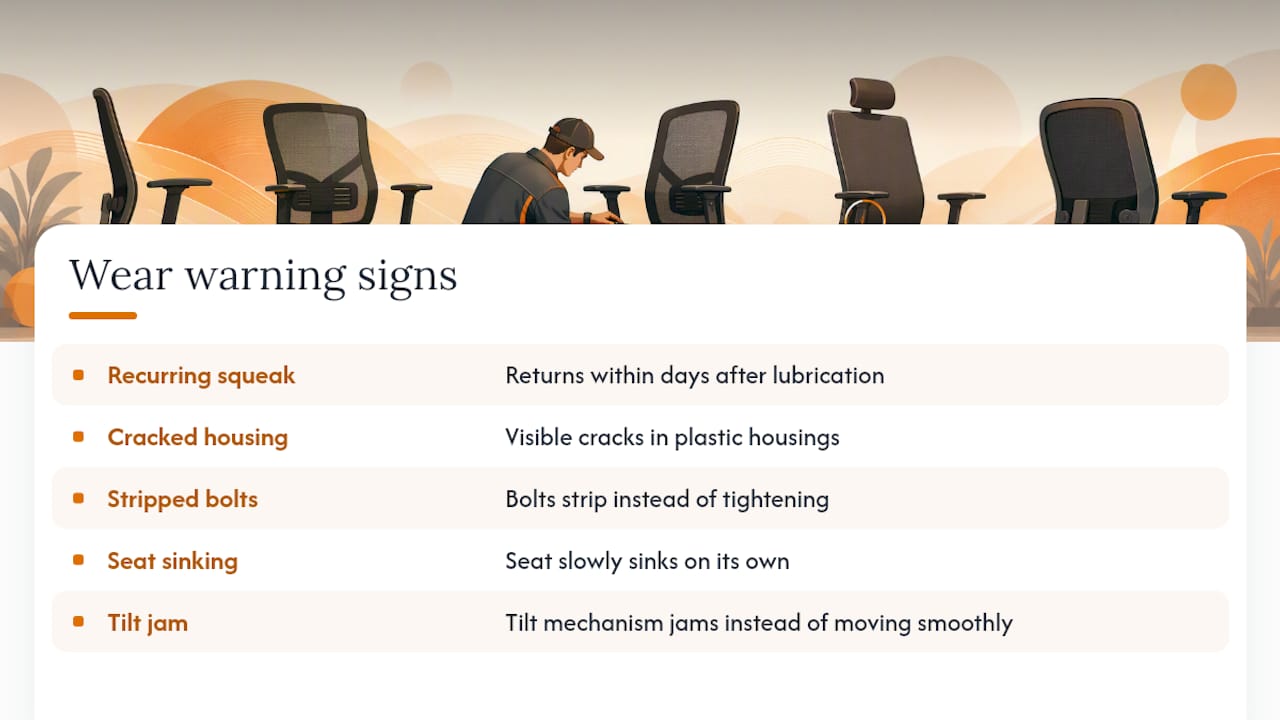
Some squeaks are not a maintenance problem, they are a wear problem, and no amount of grease fixes a part that has actually failed. Watch for a squeak that returns within days of proper cleaning and lubrication, visible cracks in plastic housings, bolts that strip rather than tighten, a seat that slowly sinks on its own, or a tilt mechanism that jams instead of moving smoothly. Any one of these means the part is worn rather than simply dry.
Before contacting a manufacturer or technician, film the chair reproducing the noise and note exactly which movement triggers it. This alone speeds up diagnosis considerably and stops a supplier sending the wrong part.
For facility managers running several chairs of the same model, it is usually cheaper to batch-order replacement gas lifts or castors than to repair one at a time, and worth checking whether the original chairs are still under warranty before you buy anything.
A chair that gets a five-minute check every few months rarely develops a serious squeak at all. Build this into a routine rather than waiting for the noise to start.
Consistent quarterly checks and a light annual service are what prevent most squeaks from returning in the first place, and they take far less time than tracking down the noise a second time. Keeping the surrounding area free of dust and debris helps too. A pest-free, clean workspace reduces the grit and fibre that end up inside caster housings in the first place.
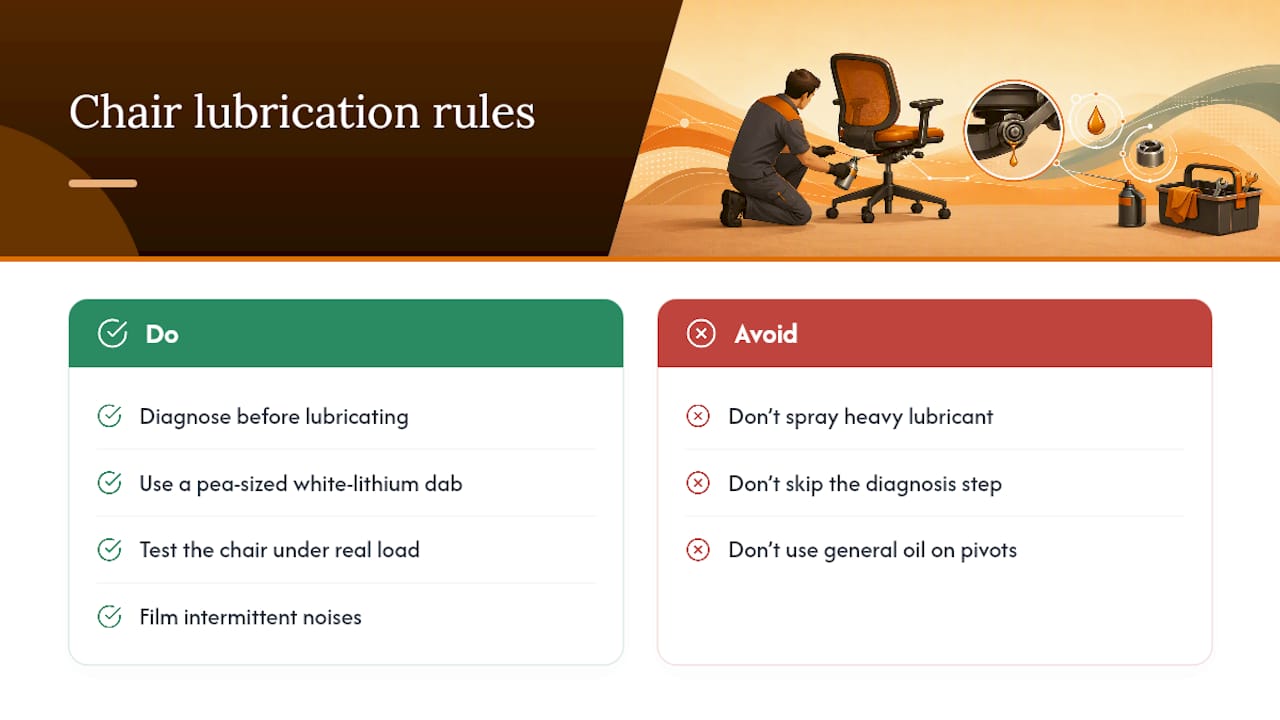
Diagnose before you lubricate. Skipping straight to the grease can can mask which joint is actually failing, and you end up treating the wrong part while the real fault gets worse. The small dab principle holds for every mechanism we have looked at: a pea-sized amount of white lithium worked into a pivot outlasts a heavy spray every time.
Three habits worth keeping: test the chair under real load, not empty. Film anything intermittent rather than trying to catch it live. And default to white lithium grease over general oil for any metal pivot, because it stays put rather than dripping away within a week.
— Furniture
Sometimes the diagnosis is straightforward: the tilt mechanism is worn, the gas lift has failed, or the casters have chewed through the carpet one too many times. When that happens, office chairs, replacement casters, and gas lifts built for daily commercial use are available, not the lighter-duty parts found in most home office chairs.

If you are procuring for a whole floor rather than a single desk, bulk pricing and free delivery to the UK mainland make replacing several worn chairs at once far more straightforward than sourcing parts chair by chair. Browse the full office chairs range to compare task, operator, and executive models, or get in touch for a quote if you need matched replacements across a whole team.
This guide draws on practical repair advice from Office Furniture Plus on diagnosing squeaks under load, Sit Smart Guide on lubricant application technique, WD-40’s own guidance on tilt mechanism access, and Expert Reviews on preventative maintenance frequency.

Phone: 0330 043 4114
VAT no. GB 991 8681 60
Company no. 07250570