A wheelchair accessible meeting table is a height-adjustable, open-frame table without crossbars beneath the surface, giving enough knee and toe clearance for a wheelchair user to pull in close. For UK buyers, the practical move is to specify a model with a manual or electric height range, request the spec sheet and UKCA/CE declaration, and check eligibility for HMRC VAT relief before ordering. Get those three details right and the rest of the purchase falls into place.
TL;DR:
- Confirm the table’s height range covers around 60 to 90 cm, and check the under-table clearance is wide enough for a wheelchair footrest and knees.
- Choose open-frame tables without crossbars to ensure adequate toe and knee clearance for wheelchair users, regardless of height adjustment.
- Ask suppliers for UKCA or CE documentation and a declaration of conformity before purchase, and confirm if VAT relief applies based on eligibility.
- Consider manual or electric height adjustment options based on reconfiguration needs, and check lockable castors may increase the minimum height by 6 to 8 cm.
Start with the height range. Most accessible meeting tables adjust to a height range that generally covers wheelchair users comfortably and also suits seated and standing attendees, which covers standing colleagues, seated staff, and wheelchair users comfortably. That range is common across supplier product lines, though buyers should always confirm figures against the exact model’s datasheet rather than assuming every table in a catalogue hits the same span.
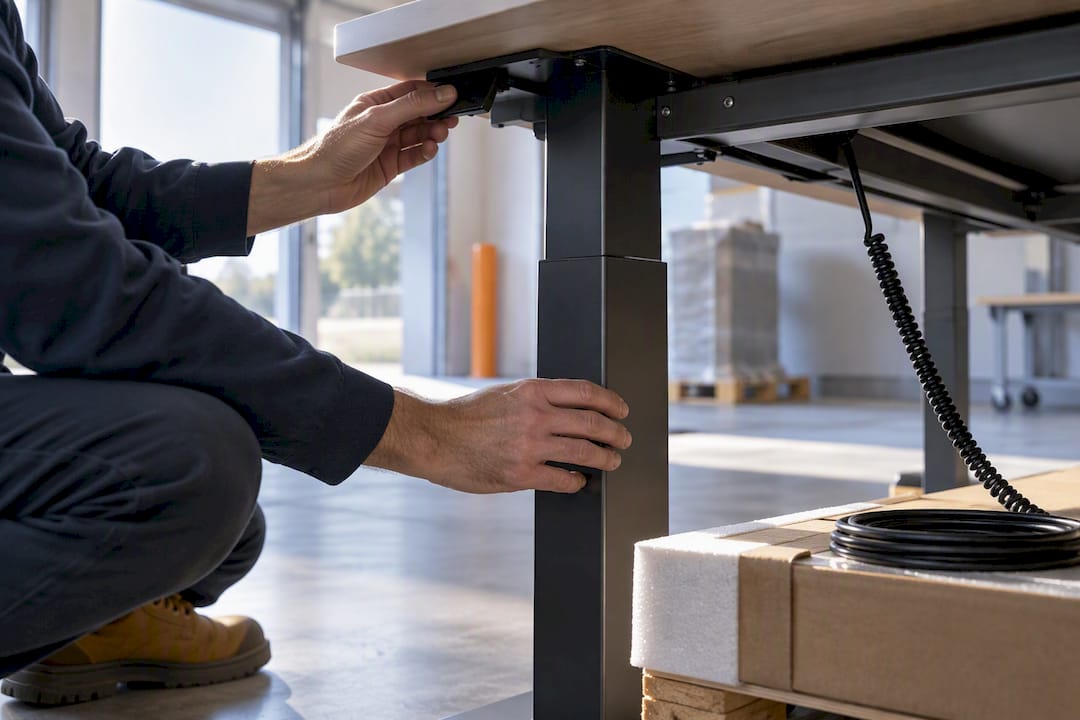
Manual crank or lever adjustment costs less and needs no power supply nearby, but it is slower to reset between meetings and can be awkward for anyone with limited grip strength. Electric adjustment is quicker, usually push-button, and better suited to rooms that get reconfigured throughout the day. The trade-off is price and a cable run to manage.
Under-table clearance matters just as much as the height range. Open-frame designs without crossbars let a wheelchair user pull in close enough to actually use the table, rather than sitting at arm’s length because a support bar blocks the footplate. This is one of the most overlooked specification points, and it’s why open-frame leg design without crossbars gets flagged repeatedly in procurement guidance.
A few other checks worth running before you commit to an order:
Pro Tip: If you’re specifying castors for mobility between rooms, check the locked height again once the wheels are fitted. Lockable castors typically add 6 to 8 cm to the minimum height, which can push a table above what a wheelchair user needs at its lowest setting.
A perfectly specified table still fails if the room around it can’t accommodate a wheelchair. Get the layout wrong and the table becomes furniture nobody can actually use.
Venue accessibility guidance consistently makes the point that room layout and flexibility matter as much as the furniture itself, and that capacity for wheelchair users shifts depending on how many attend and what the egress routes look like on the day. Wider guidance on meeting room accessibility and inclusive space design backs this up, pointing to clear routes and flat-floor setups as the baseline, not the exception. For inspiration on how other UK workplaces have handled this, our examples of inclusive office spaces round up real layout approaches worth borrowing.
VAT relief is where a lot of buyers leave money on the table, literally. HMRC’s guidance confirms that certain equipment for disabled people can qualify for VAT relief on disability-related purchases, though eligibility depends on the specific product and the purchaser’s circumstances. It’s not automatic, and it’s not universal across every accessible table on the market, so verify eligibility with the supplier or HMRC directly before assuming the relief applies to your order.
UKCA and CE marking should appear on the product documentation for any table sold in the UK, alongside a declaration of conformity. Ask for this before you order, not after delivery. A reputable supplier will hand it over without hesitation.
A few things that change the final cost:
Guidance from accessibility retailers notes that VAT relief can significantly reduce the purchase price on qualifying mobility and disability products on qualifying mobility and disability products, which makes the eligibility check worth the ten minutes it takes.
Before you send a purchase order, get the specification down on paper. A clear spec sheet stops arguments later about whether the delivered table actually matches what was promised.
Ask suppliers to confirm, in writing:
Beyond the spec sheet, a short conversation with the supplier’s sales team should cover warranty length, spare parts availability, and whether they’ll provide a sample or exemplar unit before you commit to a bulk order. Our guide on choosing conference tables for UK offices covers the wider decision process if you’re specifying an entire meeting room rather than a single table.
On delivery day, check the datasheet and compliance paperwork match the invoice, test the height controls through their full range, and inspect the surface and frame for transit damage before signing off. For larger fit-outs, build accessibility acceptance criteria into your purchase order and test one exemplar table against your checklist before rolling out the same model across multiple rooms.
Pro Tip: Ask for delivery to UK mainland as standard when comparing supplier quotes. Some quietly charge extra for anything outside the M25, and it rarely shows up until the invoice lands.
Accessible furniture pays for itself in participation, not just compliance. A colleague who can pull a wheelchair right up to a boardroom table joins the conversation properly instead of sitting at the edge of it, and that changes how meetings actually run. The best accessible tables also don’t look clinical. A well-designed height-adjustable table like the Oslo Oval Boardroom Table reads as a smart, contemporary piece of office furniture first and an accessibility feature second, which matters more than most specification sheets admit. Support includes site surveys, bulk pricing on multi-room fit-outs, and exemplar products to test before committing. If your project has specific requirements, we’d rather talk it through than let you guess.
— Furniture
This is a practical route to accessible meeting-room furniture without the guesswork of comparing a dozen unfamiliar suppliers. Our meeting room collection includes height-adjustable, open-frame tables, with models like the Oslo Oval Boardroom Table giving you an example of the design standard to expect, and every product page carries the spec sheet you’ll need for your accessibility checklist.
Free delivery to UK mainland is offered, along with bulk and bundle pricing for multi-room refurbishments, and returns within 14 days if a model doesn’t suit your space once it arrives. Warranty details are provided alongside the dimensions to help procurement teams match height range and clearance against requirements before ordering. For multiple rooms or site surveys to confirm door widths and floor access, it is possible to request an exemplar table or a downloadable spec sheet before committing to an order.
There’s no single fixed legal minimum, but most accessible tables need to adjust low enough for wheelchair armrests and knees to fit underneath comfortably, typically down to around 60 cm. Always check the exact clear under-table depth on the supplier’s spec sheet rather than relying on the overall height figure alone.
ADA is US legislation and doesn’t apply directly in the UK. British buyers should instead reference the Equality Act 2010 and BS8300 design guidance, alongside supplier UKCA/CE documentation, when checking a table meets accessibility expectations.
The strongest options combine an open frame with no crossbars, a height range covering roughly 60 to 90 cm, and either manual or electric adjustment depending on how often the room gets reconfigured. Furniture For Business’s meeting room range includes models built to this specification, including the Oslo Oval Boardroom Table.
Possibly, depending on the specific product and the purchaser’s circumstances, under HMRC’s VAT relief guidance for disabled and older people. Confirm eligibility with the supplier or HMRC before you order, since it isn’t automatic on every accessible table.
Circulation space is a practical target where the room allows it, plus a clear turning space large enough to allow a wheelchair user to manoeuvre comfortably. Door widths wide enough for standard wheelchairs and step-free routes matter just as much as the clearance around the table itself.

Phone: 0330 043 4114
VAT no. GB 991 8681 60
Company no. 07250570