TL;DR:
- A proper office setup ensures safety, compliance, and ergonomics, tailored to your business needs.
- Legal checks, including landlord consent and fire risk assessments, must be completed before furniture installation.
- Ongoing reviews of workstation risks and staff training are essential to maintain long-term compliance and productivity.
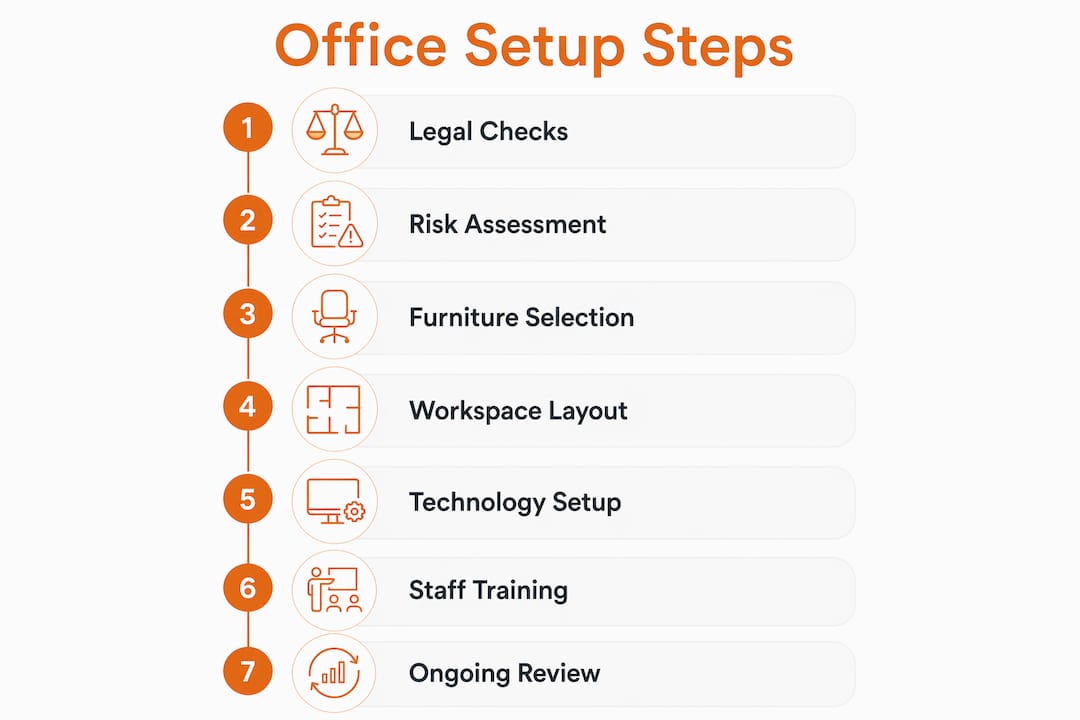
A step by step office setup is a systematic process that produces a workspace that is safe, legally compliant, ergonomic, and built around your business’s specific needs. For UK business owners and office managers, this means satisfying obligations under Display Screen Equipment (DSE) regulations, the Regulatory Reform (Fire Safety) Order 2005, and standard health and safety law before a single desk is placed. Getting the sequence right matters. Businesses that follow a structured office setup guide avoid costly retrofits, compliance failures, and the kind of musculoskeletal problems that drive up absenteeism. This article walks you through every stage, from legal groundwork to long-term maintenance.
Office fit-out compliance requires landlord consent, planning permission, building regulation checks, and clear contract arrangements before any design or construction spending begins. Skipping these steps is the single most common and costly mistake in UK office projects. Delays, remedial work, and insurance disputes follow when businesses start spending before the paperwork is settled.
Start with these four checks before committing any budget:
Once those foundations are in place, move to your risk assessment programme. Office risk assessments follow a five-step process: identify hazards, identify who may be harmed, evaluate risks and decide on controls, record and implement findings, then review regularly. Most UK offices adopt an annual review cycle as good practice, though any significant change to layout or staffing triggers an immediate reassessment.
Contract management with designers, contractors, and suppliers is equally critical. Define scope, payment schedules, timelines, and responsibilities in writing before work starts. Document every approval and keep detailed records. This reduces disputes and gives you a clear audit trail if questions arise later.
Pro Tip: Create a single compliance folder at the outset containing your lease consent, planning approvals, fire risk assessment, and DSE assessment records. Inspectors and insurers will ask for these documents, and having them organised from day one saves significant time.
UK employers must perform a DSE risk assessment covering the whole workstation, including screen, keyboard, mouse, chair, desk, and environment, for every DSE user. This is not optional guidance. It is a legal duty, and it applies equally to office, home, and hybrid workers.
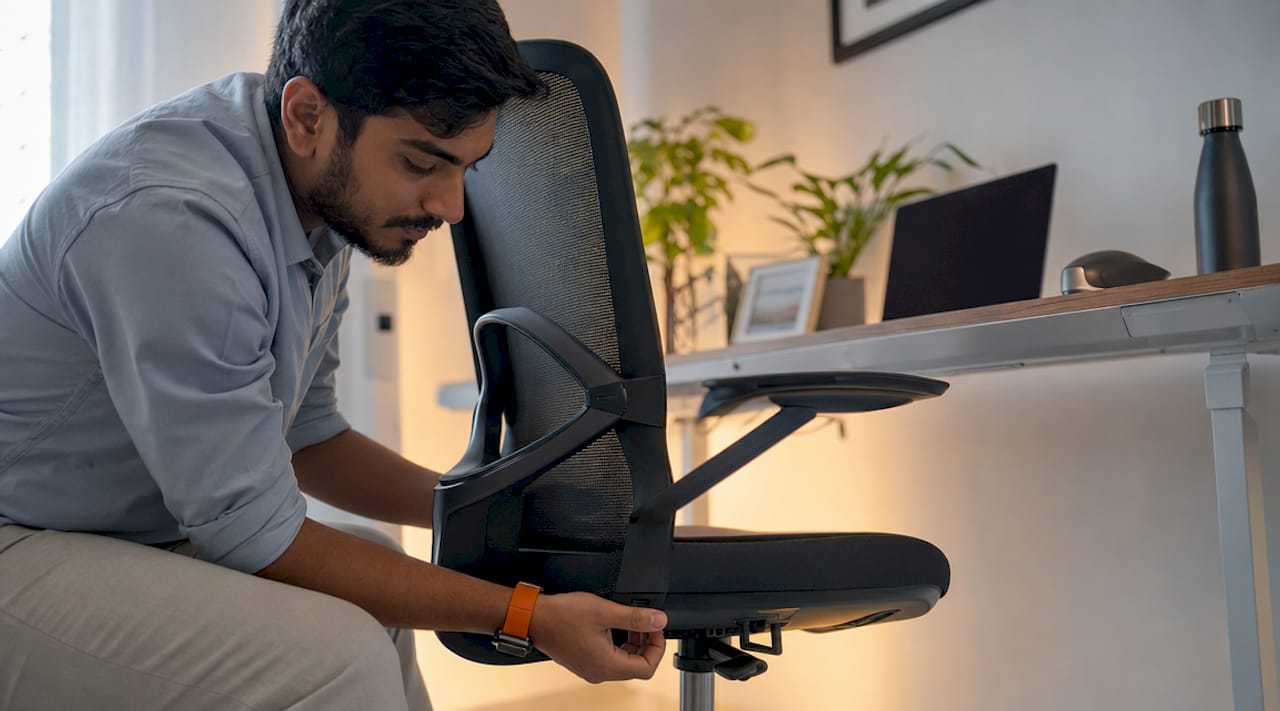
The assessment drives your furniture specification. Each workstation must support correct posture, appropriate screen positioning, and comfortable reach distances. The table below summarises the key furniture items, their compliance function, and what to look for when purchasing.
| Furniture item | Compliance function | Key specification |
|---|---|---|
| Adjustable task chair | Supports neutral spine posture | Seat height, lumbar support, armrest adjustment |
| Height adjustable desk | Reduces static posture risk | Electric or manual lift, stable at all heights |
| Monitor arm or stand | Correct screen height and distance | Eye-level positioning, tilt and swivel adjustment |
| Keyboard and mouse tray | Neutral wrist and forearm position | Flat or slightly negative tilt, proximity to screen |
| Footrest | Supports shorter users | Non-slip surface, adjustable angle |
Height adjustable desks and ergonomic chairs significantly reduce musculoskeletal discomfort and increase productivity for UK office workers. This matters commercially as well as legally. Musculoskeletal disorders are among the leading causes of workplace absence in the UK, and the Health and Safety Executive consistently identifies poor workstation setup as a contributing factor.
When selecting furniture, measure your floor space before ordering. A standard desk footprint of 1,600mm by 800mm suits most users, but open-plan arrangements require additional circulation space of at least 1,200mm between workstations. For guidance on matching furniture to your specific workflow, the modern office furniture workflow guide from Furnitureforbusiness covers this in detail.
UK employees are entitled to employer-funded eye tests on request, with periodic reviews triggered by workstation changes, new starters, or reported discomfort. If a test reveals that corrective appliances are specifically needed for DSE work, the employer must provide them. This is a distinct obligation from general prescription eyewear reimbursement, and the two should not be conflated in your HR policy.
Pro Tip: Run individual self-assessment questionnaires for each workstation user before finalising your furniture order. Users know their own physical requirements better than any generic specification, and their input prevents expensive post-installation adjustments.
Space planning is where compliance and productivity intersect. A well-designed layout supports workflow, reduces physical strain, and makes fire evacuation straightforward. Effective workspace organisation includes optimising layout, lighting, storage solutions, and environmental conditions to enhance productivity and comfort. Proper cable management also reduces trip hazards and supports compliance.
Consider these layout principles when drawing up your floor plan:
Hybrid working adds a further dimension to layout planning. Hybrid workers require the same DSE assessment and equipment provision as office-based staff. Employers cannot transfer compliance responsibilities to home workers. If your team splits time between office and home, your layout must accommodate hot-desking arrangements with adjustable furniture, and your compliance programme must extend to each home workstation.
For practical storage solutions that keep your office tidy and compliant, Furnitureforbusiness offers a range of office storage options suited to teams of all sizes.
Technology installation and staff training are the final two stages of the setup process, and both must align with the ergonomic and compliance framework you have already established. Follow this sequence:
Employers must provide training on correct workstation setup, safe equipment use, the importance of regular breaks, and recognising early signs of discomfort. Training must be refreshed whenever equipment or working arrangements change. A new hire, a desk relocation, or a switch to a standing desk all trigger a training review.
Fire safety training is a separate but parallel requirement. Under the Regulatory Reform (Fire Safety) Order, the responsible person must train all staff on evacuation procedures and conduct regular drills. Records of training dates and drill outcomes must be kept.
Use this checklist to confirm readiness before staff occupy the office:
Prioritising ergonomic furniture and workspace layout early in the setup prevents costly retrofitting and supports higher employee satisfaction and lower absenteeism rates. The cost of getting it right at installation is a fraction of the cost of remedial work six months later.
The most frequent errors in office setup are not design failures. They are process failures. Businesses spend on furniture and technology before securing landlord consent, skip DSE assessments for remote workers, and treat the initial setup as a permanent solution rather than a baseline for ongoing review.
Avoid these specific pitfalls:
For long-term compliance, build a review calendar into your office management schedule. Annual DSE and fire risk assessment reviews are the minimum. Add trigger-based reviews for new hires, equipment changes, office reconfigurations, and any reported discomfort or near-miss incidents. Keeping your office clean and well-maintained also supports safety standards. Professional office cleaning services can form part of your ongoing maintenance programme.
Pro Tip: Set calendar reminders for your annual DSE and fire risk assessment reviews at the point of initial setup. Compliance failures almost always happen because reviews are deferred, not because businesses are unwilling to conduct them.
A compliant, productive office setup requires legal groundwork, ergonomic furniture, structured layout planning, and ongoing staff training to succeed long term.
| Point | Details |
|---|---|
| Legal checks come first | Secure landlord consent, planning permissions, and assign the responsible person before spending anything. |
| DSE assessment is mandatory | Every workstation user, including home and hybrid workers, requires a documented DSE risk assessment. |
| Ergonomic furniture prevents retrofitting | Height adjustable desks and adjustable task chairs reduce musculoskeletal risk and avoid costly post-installation changes. |
| Layout planning supports compliance | Cable management, lighting, and zoning all contribute to fire safety and DSE compliance, not just aesthetics. |
| Reviews must be scheduled | Annual DSE and fire risk assessment reviews, plus trigger-based reassessments, keep your office compliant as it evolves. |
The businesses that struggle most with office setup are not the ones with the smallest budgets. They are the ones that treat compliance as a box-ticking exercise rather than a design principle. When you build DSE requirements and fire safety obligations into your layout from the start, rather than retrofitting them afterwards, the whole project becomes simpler and cheaper.
One pattern we see repeatedly at Furnitureforbusiness is businesses investing in premium furniture but skipping the self-assessment stage for individual users. A well-specified height adjustable desk does nothing for a user who does not know how to set it correctly. Training and furniture are inseparable. Neither works without the other.
The hybrid working shift has also changed what a compliant office looks like. Your office floor plan is now only part of the picture. Every home workstation in your team is, legally speaking, your responsibility. The businesses that have adapted well are the ones that extended their compliance frameworks outward, not just inward.
Finally, do not underestimate the value of good documentation. A well-maintained compliance folder is not bureaucracy. It is your defence against enforcement action, your evidence of due diligence, and your roadmap for future reviews. Build it on day one and keep it current.
— Furnitureforbusiness
Furnitureforbusiness supplies commercial office furniture to businesses across the UK, with free delivery to the UK mainland. Whether you are fitting out a new office or refurbishing an existing one, the product range covers every stage of your workspace setup checklist.

Browse ergonomic office chairs designed to meet DSE requirements, or explore the full range of height adjustable desks that support both sitting and standing work. For teams that need meeting room furniture or office storage solutions, Furnitureforbusiness offers bulk order pricing and tailored packages for teams of 5 to 500. Every product is selected with UK health and safety standards in mind, so your compliance framework and your furniture specification work together from day one.
A step by step office setup covers legal and safety checks, furniture selection and layout planning, technology installation, and staff training. Each stage must be completed in sequence to produce a workspace that is compliant, ergonomic, and fit for purpose.
The employer is responsible for DSE compliance, including conducting workstation risk assessments for all DSE users and covering the cost of eye tests. This duty extends to home and hybrid workers under the same regulations that apply to office-based staff.
Most UK offices conduct annual reviews as good practice, but any significant change, such as new hires, equipment changes, or reported discomfort, triggers an immediate reassessment. The five-step risk assessment process applies to both DSE and general office hazards.
Yes. Home and hybrid workers fall under the same DSE regulations as office staff, and employers cannot transfer compliance responsibilities to the individual. A documented assessment and appropriate equipment provision are both required.
UK DSE regulations require an adjustable chair, a desk at the correct height, a monitor positioned at eye level, and a keyboard and mouse arrangement that supports neutral wrist posture. Height adjustable desks are strongly recommended to reduce static posture risk across the working day.

Phone: 0330 043 4114
VAT no. GB 991 8681 60
Company no. 07250570