TL;DR:
- Sit-stand desks offer ergonomic benefits but require proper implementation for effectiveness.
- Successful rollout depends on staff training, policy, and workspace adjustments.
- They are tools to support wellbeing, not solutions to sedentary culture alone.
The assumption that a fixed desk and a decent chair is all your team needs is quietly being challenged across UK offices. Sit-stand desks, once considered a niche perk for tech start-ups, are now appearing in corporate environments of every size. As an office manager or HR professional, you are likely fielding questions about them already. Understanding what these desks actually do, how they work, and whether the investment is justified will help you make confident, evidence-based decisions for your workforce.
| Point | Details |
|---|---|
| Definition clarified | A sit-stand desk allows users to switch between sitting and standing, boosting comfort. |
| Weigh benefits and limits | While sit-stand desks offer flexibility, results depend on individual and implementation factors. |
| Smart selection matters | Choosing the right sit-stand desk requires matching features to employee needs and budgets. |
| Integration is crucial | Effective office adoption involves policy, training, and ongoing staff feedback for success. |
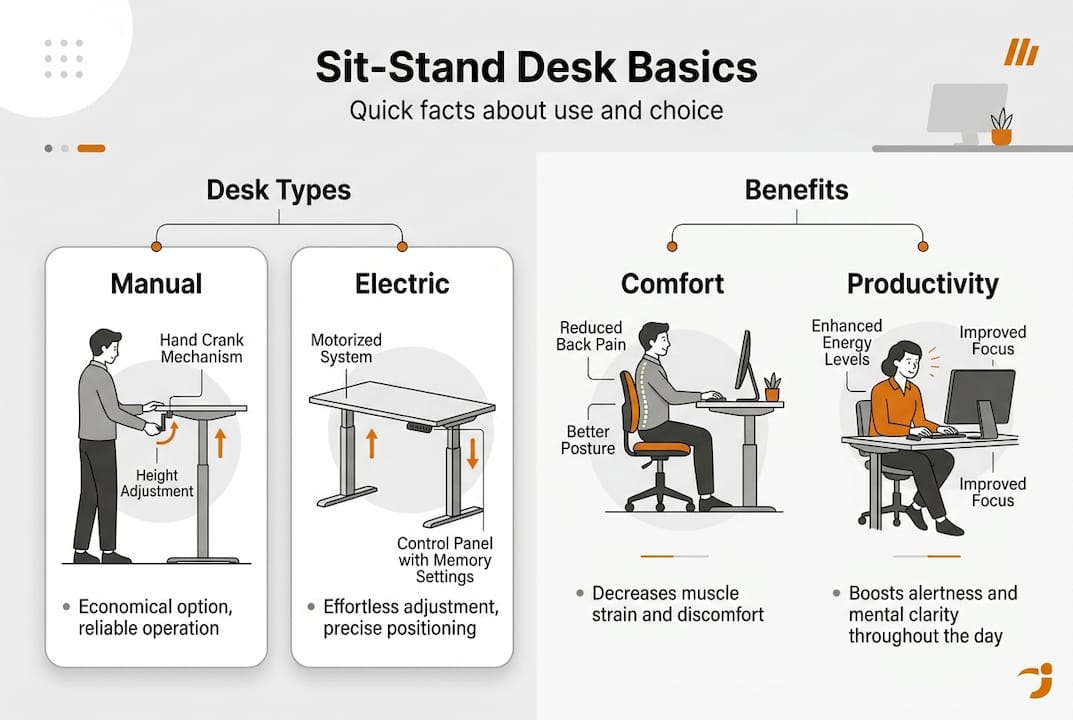
A standing desk is a desk designed to allow users to work while sitting or standing by adjusting its height. The term covers a broad family of products, from simple desktop converters to full motorised workstations. What unites them is the ability to raise and lower the work surface so the user is not locked into a single posture throughout the day.
There are four main types you will encounter when sourcing for a commercial office:
| Type | How it adjusts | Best suited for |
|---|---|---|
| Fixed-height standing desk | Does not adjust | Dedicated standing zones |
| Manual crank desk | Hand crank mechanism | Budget-conscious teams |
| Electric sit-stand desk | Motor-driven, button-operated | High-frequency users |
| Desktop converter | Sits on existing desk surface | Retrofit without replacing furniture |
Electric models are the most popular choice in corporate settings because the adjustment takes seconds and requires no physical effort. Many include programmable height memory, so each user can save their preferred sitting and standing positions. Manual crank desks are a practical option for smaller budgets, though they are slower to adjust and less likely to be used consistently throughout the day.
When evaluating any model, focus on these key features:
Pro Tip: Before committing to a full rollout, pilot a small number of electric models alongside desktop converters. This gives you real user feedback on which type suits your team’s working patterns before you place a bulk order. Our height adjustable desk setup guide walks you through the practical steps of getting the configuration right from day one.
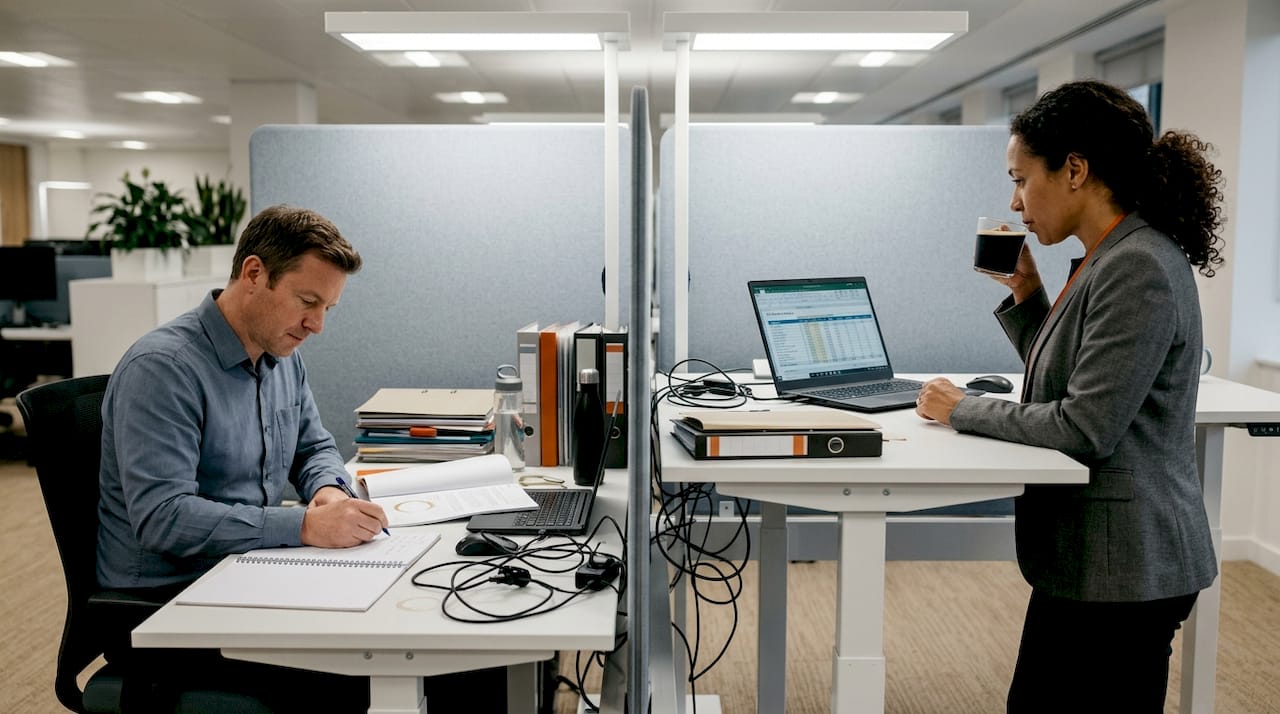
The appeal of sit-stand desks in a UK office context is straightforward. Prolonged sitting is associated with discomfort, reduced circulation, and lower energy levels across the working day. Giving employees the freedom to alternate between sitting and standing introduces movement without requiring them to leave their workstation.
The primary benefits reported by organisations that have adopted these desks include:
These benefits for UK offices are meaningful, but it is important to be realistic about what the research actually supports.
| Advantage | Limitation |
|---|---|
| Reduces prolonged static sitting | Evidence for sitting reduction is mixed in quality |
| Supports musculoskeletal comfort | Some studies show no change in fatigue levels |
| Perceived productivity improvement | Productivity gains are not consistently measurable |
| Adaptable for hybrid working setups | Higher upfront cost than standard desks |
| Supports wellbeing initiatives | Requires training and policy to be effective |
A notable caution worth raising: low-quality evidence questions the magnitude of sitting reduction, with some studies finding no significant fatigue changes and noting that responses differ between student populations and office workers. This does not mean sit-stand desks are ineffective. It means the results depend heavily on how they are implemented and whether staff actually use them correctly.
To address the most common limitations in practice, consider these steps:
With a clear picture of what these desks offer, the next step is matching the right product to your specific environment. Not every desk suits every setting, and a poor match wastes budget without delivering the intended benefits.
Start with these essential selection factors:
Matching desk type to use case matters too. Hot-desking environments benefit from electric models with programmable height memory, so multiple users can switch quickly between their saved positions. Personal workstations for employees who spend the full day at a single desk justify a higher specification and investment. Executive offices may warrant wider surfaces with integrated cable management for a clean aesthetic.
Budgeting is a common sticking point. Entry-level manual desks start around £200, mid-range electric models sit between £400 and £600, and premium commercial-grade options can reach £800 or more per unit. Volume discounts are available from most commercial suppliers, so the per-unit cost falls meaningfully on orders of ten or more.
Pro Tip: Pair your sit-stand desk investment with a review of your seating. A height-adjustable desk used with the wrong chair undermines the ergonomic benefit entirely. Reviewing best ergonomic seating options alongside your desk selection ensures the two work together effectively.
Purchasing the desks is the straightforward part. Getting your team to use them correctly and consistently is where most rollouts either succeed or quietly fail.
Follow this implementation roadmap to give your investment the best chance of delivering results:
Common mistakes to avoid during rollout:
As one workplace wellbeing consultant put it: “The desks themselves are only half the solution. The other half is the culture and communication around them. Teams that are shown how to use sit-stand desks and encouraged to do so see far better outcomes than those where the desks simply appear one Monday morning.”
The evidence on fatigue reinforces this point. Results vary significantly based on implementation quality, not just product quality. Supporting office comfort through thoughtful rollout, paired with complementary elements like appropriate lighting and window treatments that manage glare, creates the conditions for sit-stand desks to perform as intended. Research into workplace productivity factors consistently shows that environmental comfort is as important as the furniture itself.
We have seen a lot of office managers invest in sit-stand desks with high expectations, only to find half the team reverts to sitting within a month. That is not a product failure. It is an implementation failure.
The honest truth is that sit-stand desks are a tool, not a transformation. They will not fix a sedentary culture on their own, and they will not deliver measurable productivity gains simply by being present in the room. What they do offer is genuine value when employees are engaged, trained, and supported in using them well.
Many articles overstate the health benefits by drawing on research conducted in controlled settings that bear little resemblance to a busy open-plan office. We would rather you go in with realistic expectations and a solid rollout plan than invest heavily based on inflated claims.
Pro Tip: Before you order, define what success looks like. Is it reduced musculoskeletal complaints? Improved staff satisfaction scores? Lower absence rates? Set a baseline, measure it, and revisit it at six months. That discipline will tell you far more than any product specification sheet.
If you are ready to move from research to action, we can help you find the right solution for your team’s size, budget, and working style.
At Furniture for Business, we supply a wide range of office desks including height-adjustable models suited to everything from hot-desking environments to executive suites. Our height adjustable desk setup guide gives you a practical framework for getting the configuration right, and our ergonomic seating range ensures your desks are paired with chairs that genuinely support your team. We offer free delivery to the UK mainland and bulk order pricing for larger projects. Get in touch to discuss your requirements.
Most employees benefit from sit-stand desks, but individual comfort and medical needs should always be considered. Responses vary between individuals, so a trial period with staff feedback is advisable before a full rollout.
Budgets typically range from £200 for entry-level manual models to £800 or more for premium electric desks, with volume discounts available on larger orders. Factor in accessories such as anti-fatigue mats and monitor arms when calculating the total cost per workstation.
A widely used recommendation is a roughly equal split, alternating between sitting and standing every 30 to 60 minutes throughout the day. A height-adjustable desk makes this practical without interrupting workflow.
Sit-stand desks may boost perceived productivity and alertness, but the evidence for significant, measurable gains is mixed. Some studies find no consistent fatigue reduction, reinforcing that implementation and usage habits matter as much as the desk itself.
Phone: 0330 043 4114
VAT no. GB 991 8681 60
Company no. 07250570