TL;DR:
- Modular seating allows flexible, tool-free reconfiguration for evolving office needs.
- It supports hybrid work by enabling quick space changes and multi-purpose zones.
- Compared to traditional furniture, modular systems offer better long-term value and adaptability.
Fixed seating arrangements once felt like the sensible default for UK offices. You ordered a set of chairs, bolted them to the floor (metaphorically, at least), and called it done. But with hybrid working now shaping how teams actually use office space, that logic no longer holds. More UK businesses are discovering that the furniture they chose during a fit-out three years ago is already working against them. Modular seating offers a fundamentally different approach: one that lets your workspace evolve alongside your team, your headcount, and your working patterns, without requiring a full refurbishment every time something changes.
| Point | Details |
|---|---|
| Ultimate flexibility | Modular seating allows offices to adapt spaces swiftly for meetings and collaborative or focused work. |
| Lower reconfiguration costs | Businesses can change layouts without buying new furniture or dealing with significant downtime. |
| Enhanced team collaboration | Creative modular layouts support teamwork, informal discussions, and agile project spaces. |
| Supports hybrid working | Easily adjust office layouts to match shifting occupancy and hybrid work schedules. |
At its core, modular seating consists of adaptable, interlocking seating units that can be arranged into countless configurations. Rather than buying a fixed sofa or a rigid row of chairs, you purchase individual components, such as seats, backrests, corner units, and connecting elements, that clip or join together in different ways. The result is a seating system you can reshape without specialist tools or contractors.
Think of it like building blocks for grown-up workspaces. A Monday morning might call for a horseshoe arrangement around a low table for a team catch-up. By Thursday, those same units could form a relaxed lounge area for informal one-to-ones. No new furniture required, just a quick reconfiguration.
The key components you will typically find in a modular range include:
The Brixworth modular range is a strong example of how these components work in practice, offering a variety of units that combine to suit different space sizes and layout needs.
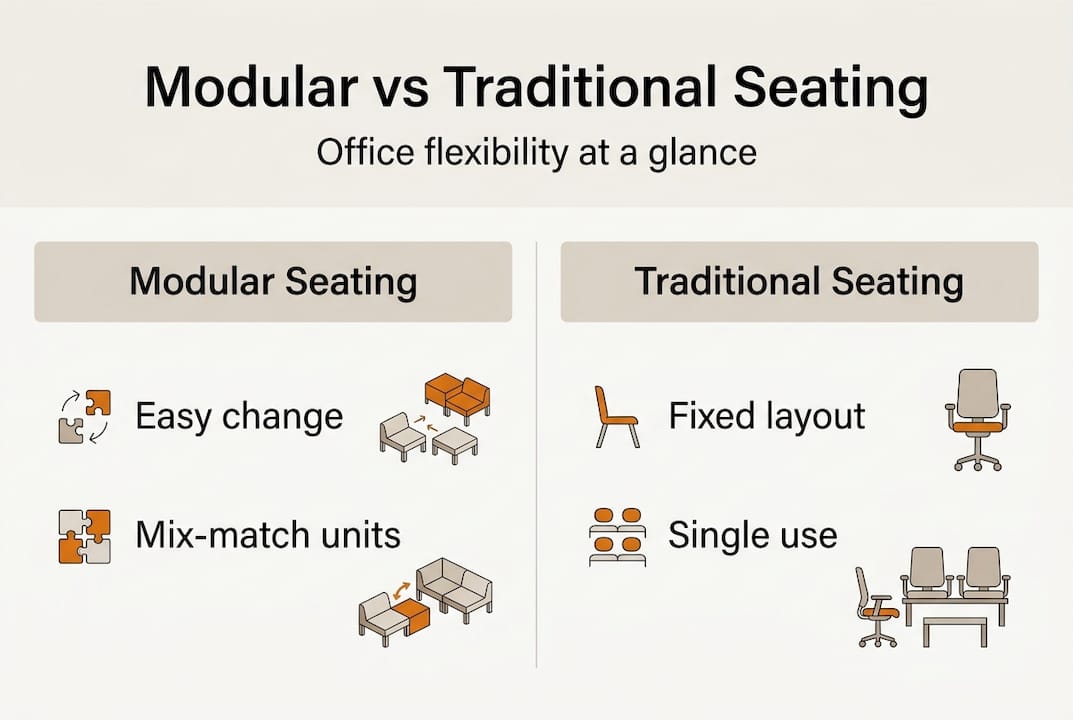
Modular vs traditional seating at a glance
| Feature | Modular seating | Traditional seating |
|---|---|---|
| Reconfiguration | Easy, tool-free | Requires new purchase |
| Layout options | Near-unlimited | Fixed |
| Long-term cost | Lower (reusable) | Higher (replace often) |
| Space efficiency | High | Moderate |
| Suitable for hybrid work | Yes | Rarely |
The table above makes it clear why procurement teams are increasingly favouring modular options. The upfront investment is comparable, but the ongoing flexibility is where modular seating genuinely earns its place.
Modern UK offices are no longer used the same way every day. Teams rotate in and out, headcounts shift, and the same space might host a client presentation in the morning and a focused working session in the afternoon. Modular seating enables quick space reconfiguration for meetings, solo work, or collaboration, which is precisely what a hybrid office demands.
The practical benefits are significant:
For offices running rotational or hot-desking models, this kind of adaptability is not a luxury. It is a practical necessity. When 60% of your team is in on Tuesdays and Wednesdays but only 30% on Fridays, having seating that can contract and expand accordingly saves both money and floor space.
Modular seating also supports the modern office workflow by enabling different zones to serve different purposes simultaneously. A collaboration cluster in one corner, a quieter lounge arrangement in another, and a semi-enclosed pod for video calls, all using the same system of components.
“The best office layouts are not designed once and forgotten. They are designed to be redesigned. Modular seating is the tool that makes that possible.” — Workplace design consultant
Pro Tip: When selecting modular seating, prioritise ranges where all units are cross-compatible. This means you can mix and match pieces purchased at different times without worrying about mismatched connectors or discontinued components.
When justifying a furniture investment to senior stakeholders, you need more than a list of features. You need a clear framework for comparing options. Unlike fixed seating, modular designs save cost and reduce downtime when reconfiguring offices, which is a compelling argument when you factor in the hidden costs of traditional furniture.
Here is what to weigh up when making the decision:
Side-by-side comparison
| Consideration | Modular seating | Traditional seating |
|---|---|---|
| Upfront investment | Moderate | Moderate to high |
| Layout change cost | Minimal | High |
| Operational disruption | Low | High |
| Adaptability to growth | Excellent | Poor |
| Replacement frequency | Low | High |
The Brixworth corner unit is a practical illustration of how individual modular components can anchor a layout and be repositioned as needs change, something a traditional corner sofa simply cannot do.
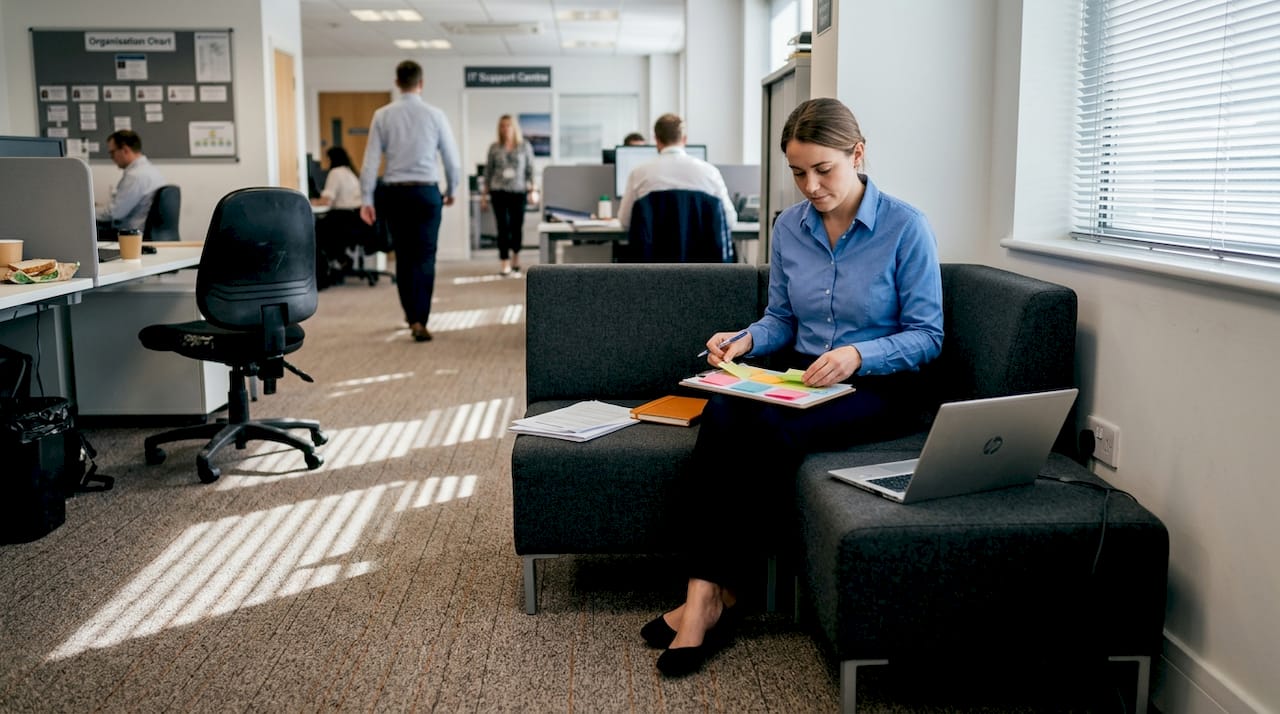
For procurement teams managing multiple sites or planning phased fit-outs, the ability to standardise on a single modular system and then scale it across locations is a significant operational advantage.
Knowing the theory is one thing. Knowing how to actually use modular seating to improve your office is another. Modular seating can define breakout zones, lounge areas, or meeting pods in ways that fixed furniture simply cannot replicate, and the design strategies for soft seating you choose will shape how your team actually uses the space.
Here are some practical zone ideas to consider:
The Brixworth left unit is a useful starting point for building out an L-shaped or curved configuration, giving you a defined edge to anchor the layout.
Pro Tip: Pair modular seating with lightweight movable accessories such as portable screens, rolling side tables, and clip-on power modules. This combination gives you the maximum range of configurations without any fixed infrastructure.
The key is to think in zones rather than rows. Traditional offices organise seating in lines. Modern productive offices organise seating around activities, and modular systems are built precisely for that purpose.
Here is an uncomfortable truth: most office redesigns in the UK are not actually designed for flexibility. They are designed to look flexible. A handful of soft seating pieces scattered near the kitchen, a couple of high stools by a window, and the rest of the floor filled with fixed desks. That is not a flexible office. That is a fixed office with decorative gestures.
Real flexibility means anticipating change before it happens. It means choosing furniture systems that allow you to respond to a team restructure, a new working policy, or a sudden increase in headcount without ordering new stock or hiring a fit-out contractor. Modular seating is one of the few furniture categories that genuinely delivers on this promise, but only if it is placed at the centre of the layout strategy rather than bolted on as an afterthought.
The smarter approach, and one we advocate strongly, is to start from a modular zoning plan and build outward. Identify the activities your team needs to support, assign zones to those activities, and then select modular components that can serve multiple purposes. For practical office workflow advice, this means treating your floor plan as a living document rather than a fixed blueprint. Offices that do this well spend less on furniture over time and report higher staff satisfaction with their workspace.
If this article has prompted you to rethink your current seating setup, the next step is straightforward. Explore our modular seating ranges to see how individual units can be combined into layouts that genuinely work for your team size, your floor plan, and your working patterns.
We also supply a full range of complementary workspace products to support a complete office refresh. Browse our office storage solutions to keep reconfigured spaces tidy and functional, explore our office desks for height-adjustable and flexible workstation options, and take a look at our office accessories to finish the space with practical, design-led additions. Free delivery to the UK mainland is included as standard, and our team is on hand to help with bulk orders or bespoke layout planning.
Modular seating is made up of individual units such as seats, arms, backs, and connecting elements that can be arranged in various configurations to suit different spaces and purposes.
The initial investment is often comparable, but modular designs reduce reconfiguration costs over time, making them the more cost-effective choice across a typical office lifecycle.
Modular seating enables rapid layout changes, making it straightforward to adapt spaces for varying team sizes, collaboration needs, or remote work patterns on any given day.
Yes. Modular configurations scale up or down to fit the available space, meaning they work just as effectively in a compact city-centre office as in a large open-plan corporate environment.
Phone: 0330 043 4114
VAT no. GB 991 8681 60
Company no. 07250570