TL;DR:
- Desking pods are modular workstations with privacy screens and integrated power designed for open-plan offices. They reduce noise by approximately 33dB, improving focus and collaboration. Proper planning of infrastructure and placement ensures flexibility, cost-efficiency, and long-term adaptability.
A desking pod is a modular desk cluster that combines privacy screens, acoustic panels, and integrated power and data infrastructure to create a defined workstation zone within an open-plan office. The term “desking pod” is widely used in workplace planning, though the recognised industry term is workstation pod or workstation cluster. Both refer to the same concept: a semi-enclosed, tech-ready grouping of desks that supports focused individual work and small-team collaboration without the cost of permanent construction.
Background noise in open-plan offices reduces productivity by up to 66%, making the case for desking pods compelling for any office manager running a hybrid team. For a team of ten, that lost productivity can cost up to £500 per day. Furnitureforbusiness works with UK businesses across sectors to address exactly this problem through well-specified furniture layouts that include modular desk solutions, ergonomic seating, and acoustic panel integration.
A desking pod is a permanent yet modular cluster of desks engineered for tech-heavy daily use without the walls of a fully enclosed office. Unlike meeting pods, which are self-contained booths for short calls or private conversations, desking pods are open-sided or screen-divided workstation zones where staff spend their full working day.
The physical structure typically includes:
Pods function like Lego for offices: modular, scalable, and easy to reconfigure without costly retrofits. If a floor plan cannot be reconfigured in under four hours, it is likely too permanent for a modern hybrid office.
Materials matter too. Quality desking pods use steel frames for structural integrity, high-density foam or mineral wool within acoustic screens, and laminate or solid-surface desk tops rated for commercial use. The combination delivers durability alongside the flexibility that rapidly changing teams need.

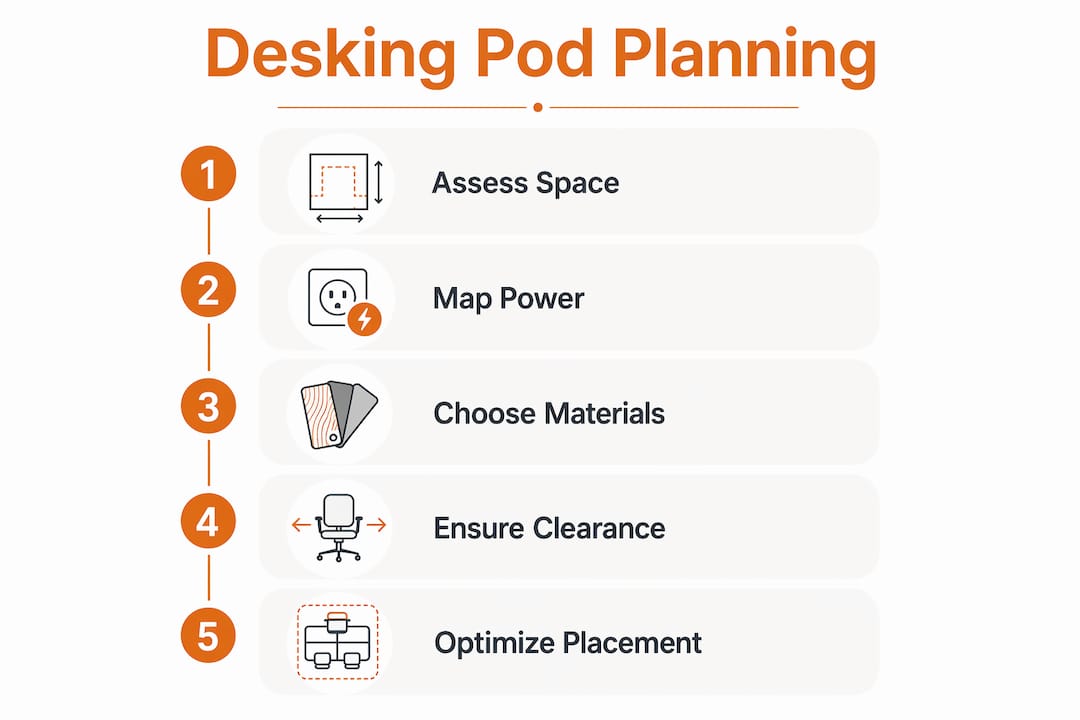
Pro Tip: Before specifying a pod configuration, map your existing floor box and power socket positions. Aligning pod clusters with existing infrastructure avoids expensive core drilling and keeps installation costs predictable.
Desking pods deliver measurable productivity gains by addressing the single biggest complaint in open-plan offices: noise. Pods achieve around 33dB attenuation under the ISO 23351-1 speech privacy standard. That level of reduction moves ambient noise from distracting to manageable, which is the point at which deep-focus work becomes sustainable.
Pods are not silent boxes. They are controlled acoustic environments designed to support concentration without the unnatural feel of total sound isolation. Staff in fully silent rooms often report discomfort and reduced creativity. The 33dB attenuation sweet spot preserves enough ambient sound to feel natural while eliminating the conversational noise that fragments attention.
The advantages of desking pods extend well beyond acoustics:
The return on investment calculation is direct. If noise costs a ten-person team £500 per day in lost productivity, recovering even a fraction of that through a pod layout pays for the furniture within a single financial year. That argument lands well with procurement teams and finance directors who need a clear justification for capital expenditure.
Placement is the most underestimated factor in a desking pod project. Workspace planning experts recommend clearance of at least 1,500mm–1,800mm for primary circulation paths around pods. That clearance satisfies fire safety requirements and ensures comfortable movement without staff feeling crowded.
HVAC and sprinkler systems create a separate constraint. Pods placed directly beneath sprinkler heads or adjacent to HVAC diffusers can obstruct smoke detection and interfere with air distribution. Coordinate with your building facilities manager before finalising pod positions. Pairing pod placement with a review of HVAC ventilation requirements prevents costly repositioning after installation.
Delivery logistics are a frequent source of budget overruns. Failure to assess service lift access leads to unexpected costs inflating project budgets by 10–15%. Pods too large for a service lift require crane hire or partial disassembly on site, both of which add time and cost. Measure lift dimensions, door widths, and stairwell access before placing an order.
| Planning factor | Office impact |
|---|---|
| Circulation clearance (1,500mm–1,800mm) | Meets fire safety standards and prevents crowding |
| HVAC and sprinkler coordination | Avoids obstruction of safety systems |
| Delivery route assessment | Prevents budget overruns from access complications |
| Power and data capacity | Avoids functional failures and expensive retrofits |
| Modular configuration choice | Supports future reconfiguration without structural work |
Pro Tip: Account for “circulation drift” when drawing your floor plan. Staff naturally take wider paths than the minimum clearance, and storage items accumulate around desk clusters over time. Build in an extra 200mm–300mm beyond the minimum clearance to keep aisles genuinely clear.
Distinguishing between desking pods and acoustic meeting pods is critical for making the right purchasing decision. Confusion between the two is a common source of wasted budget and suboptimal office layouts.
A desking pod is a daily workstation cluster. Staff sit in it for hours at a time. It requires ergonomic furniture, full power and data provision, and acoustic treatment calibrated for sustained work. It is open-sided or screen-divided, not enclosed.
An acoustic meeting pod is a self-contained booth, typically seating two to six people for short-duration private calls, video conferences, or focused conversations. It is fully enclosed, ventilated independently, and not designed for all-day occupation.
A traditional cubicle sits between the two. It offers more enclosure than a desking pod but less acoustic performance than a meeting pod, and its fixed partitions make reconfiguration expensive.
Scenarios best suited to desking pods:
Scenarios better served by acoustic meeting pods or enclosed booths:
Understanding this distinction before specifying furniture saves significant money. The modular furniture benefits that make desking pods attractive do not transfer to enclosed pods, which are fixed structures with different installation requirements.
Desking pods are the most cost-effective way to recover focus time in open-plan offices, combining acoustic treatment, modular flexibility, and integrated technology in a single reconfigurable workspace unit.
| Point | Details |
|---|---|
| Core definition | A desking pod is a modular, screen-divided workstation cluster with built-in power, data, and acoustic panels. |
| Acoustic performance | Pods achieve around 33dB attenuation under ISO 23351-1, reducing noise to a manageable level for deep work. |
| Productivity ROI | Recovering lost focus time can deliver payback within 12 months for a typical office team. |
| Planning essentials | Maintain 1,500mm–1,800mm circulation clearance and assess delivery routes before purchase. |
| Pod type clarity | Desking pods are for daily workstation use; acoustic meeting pods are for short-duration private calls. |
The most common mistake I see is treating a desking pod as a furniture purchase rather than an infrastructure decision. Teams spend weeks choosing screen colours and desk finishes, then discover on installation day that the floor boxes are in the wrong position, the service lift is 50mm too narrow, or the power circuit cannot handle the load of six docking stations running simultaneously.
Power and data spine design is the technological backbone of desking pods. Inadequately planned infrastructure is the single most common failure point, and it is almost always invisible until the furniture is already in the building. The aesthetic decisions are easy. The infrastructure decisions are where projects succeed or fail.
The second mistake is buying for today’s headcount. Modularity and easy reconfiguration are critical for agile, rapidly evolving teams. A pod cluster specified for eight people that cannot expand to twelve without a new order is a planning failure. The whole point of modular desking is that it grows with you.
My honest recommendation: start with a power and data audit, then choose your configuration, then choose your finishes. That order feels backwards to most people, but it is the order that prevents expensive surprises. A well-specified desking pod workspace, planned in that sequence, will outlast two or three office refurbishments and adapt to headcount changes without a single structural alteration.
— Furniture
Furnitureforbusiness supplies commercial-grade office furniture to UK businesses, with free delivery to the UK mainland. Whether you are fitting out a new floor or reconfiguring an existing open-plan space, the range covers everything a desking pod cluster needs.

The office desks range includes height-adjustable options with integrated cable ports, ideal for tech-heavy pod clusters where power and data management are priorities. Pair them with ergonomic office chairs selected to match your desk height and user profile, and add office storage solutions to keep the circulation space around your pods clear. Furnitureforbusiness offers bulk order pricing and easy returns, making it straightforward to specify and procure a full pod setup in a single order.
A desking pod is a modular cluster of desks with integrated privacy screens, acoustic panels, and built-in power and data ports. It creates a defined workstation zone within an open-plan office without requiring permanent walls or construction.
Single-person acoustic desking pods typically cost in the region of £5,000–£7,000 depending on specification and supplier. The investment can deliver payback within 12 months through recovered productive hours in noisy open-plan environments.
A desking pod is modular and reconfigurable, with acoustic screens and integrated technology designed for modern hybrid working. A traditional cubicle uses fixed partitions that are expensive to move and offer less acoustic performance than a purpose-built pod.
Workspace planning guidance recommends at least 1,500mm–1,800mm of clearance on primary circulation paths around pod clusters. This satisfies fire safety requirements and ensures comfortable movement for staff throughout the working day.
Desking pods are not fully soundproof. They achieve around 33dB attenuation under the ISO 23351-1 speech privacy standard, which reduces ambient noise to a manageable level for focused work while maintaining a natural acoustic environment.

Phone: 0330 043 4114
VAT no. GB 991 8681 60
Company no. 07250570