Under the Equality Act 2010, employers must make reasonable adjustments that remove or reduce a substantial disadvantage faced by a disabled worker, and furniture such as ergonomic chairs, height-adjustable desks and adapted workstations very often qualifies. Whether a specific item counts as reasonable depends on how effective it is, how practical it is to provide, and the cost weighed against the organisation’s resources. Support routes like Access to Work can also cover part or all of the cost.
TL;DR:
- Furniture adjustments are generally considered reasonable if they effectively reduce disadvantage, are practical to source and install, and are proportionate to the organization’s resources.
- The cost of ergonomic chairs, sit-stand desks, and other adaptions is often covered by support schemes like Access to Work, with many suppliers offering trial periods and bulk discounts for easy accessibility.
- Employers must promptly acknowledge and carefully document all adjustment requests, considering safety, effectiveness, and alternative measures before declining any proposals.
- Failure to provide reasonable furniture adjustments can lead to legal claims, with tribunals emphasizing the importance of timely, documented responses and avoiding delays or poor communication.
- Adjustments should be integrated with broader workplace design factors such as layout and lighting to maximize their benefits and prevent additional accessibility challenges.
Section 20 of the Equality Act 2010 sets out the duty to make reasonable adjustments. It applies whenever a disabled worker, job applicant or contract worker faces a substantial disadvantage compared with someone who is not disabled, because of the way the workplace is run, a physical feature, or a lack of an auxiliary aid. The duty is triggered the moment an employer knows, or reasonably ought to know, that someone is disabled, or that an adjustment might help. That trigger can come from a request, an occupational health referral, or simply a manager noticing someone is struggling.
Schedule 4 of the Act adds an important technical point: furniture, furnishings and equipment are not treated as “physical features” of a building. A wall, a step, or a fixed doorway counts as a physical feature and comes with its own set of rules around landlord consent and structural alteration. A chair or a desk does not. That distinction matters, because it means furniture adjustments generally sit within the employer’s direct control, without the added complexity of negotiating with a landlord over the building fabric.
Coverage under section 20 of the Equality Act 2010 extends to:
Most requests HR teams see fall into a handful of recognisable categories, though the exact specification always depends on the individual. Furniture counts as a reasonable adjustment when it functions as an auxiliary aid removing a disability-related disadvantage, and guidance on auxiliary aids treats adapted seating and workstation equipment as falling squarely within that definition.
Common examples include:
Requests are highly individual. Two employees with the same diagnosis can need entirely different specifications, which is why a one-size-fits-all “accessible desk” rarely works well in practice.
Short-term situations deserve attention too. Someone attending an interview, returning from surgery on a phased basis, or recovering from a temporary injury may only need furniture for a few weeks. Many suppliers offer trial or short-term hire arrangements precisely for this reason, and it is worth checking height-adjustable desk options that can flex between temporary and permanent use.
Pro Tip: Keep a small pool of adjustable chairs and a spare sit-stand desk in reserve. It turns a typical procurement delay into a same-day fix for interviews, phased returns or sudden medical need.
“Reasonable” is not a subjective feeling. It is an objective legal test, and the EHRC is explicit that cost alone cannot be used as a blanket reason to refuse. Employers weigh several factors together, not in isolation.
HSE guidance is blunt about the balance most employers get wrong: making an adjustment is usually far cheaper than losing and replacing a skilled employee, yet cost objections still dominate refusal conversations. If an employer does decide to refuse a request, documenting the reasoning at the time, not retrospectively, is what protects them if the decision is later challenged at tribunal.
Health and safety checks belong in this stage too. A new chair or desk should not introduce a trip hazard or breach weight-rating limits, so any assessment needs a basic safety sign-off alongside the accessibility one.
A request for a furniture adjustment should move through a clear sequence, and the timescales matter almost as much as the outcome.
Recordkeeping deserves particular care. A written adjustment passport prevents the same conversation happening from scratch every time a line manager changes, and it is often the single piece of evidence that demonstrates an employer acted reasonably if a dispute later reaches a tribunal.
Cost is rarely the barrier employers assume it to be. Access to Work can fund equipment and workplace adaptations, and both employers and employees can apply, with the scheme covering items ranging from specialist chairs to full workstation assessments depending on individual eligibility.
Beyond Access to Work, a few other routes are worth checking before assuming an item is unaffordable:
None of this removes the underlying duty. It simply means cost objections deserve far more scrutiny than they typically get.
Getting the specification right the first time avoids a second round of trial-and-error, and that starts with writing a brief that describes function, not just furniture type.
Pro Tip: Ask any supplier for a written return or exchange window before ordering seating for a specific employee. A 14 or 30-day trial removes almost all of the risk that comes with specifying a chair from a catalogue photo.
Document every trial and every review date. It is the same record that supports an adjustment passport, and it is the evidence that shows a considered process rather than a box-ticking exercise.
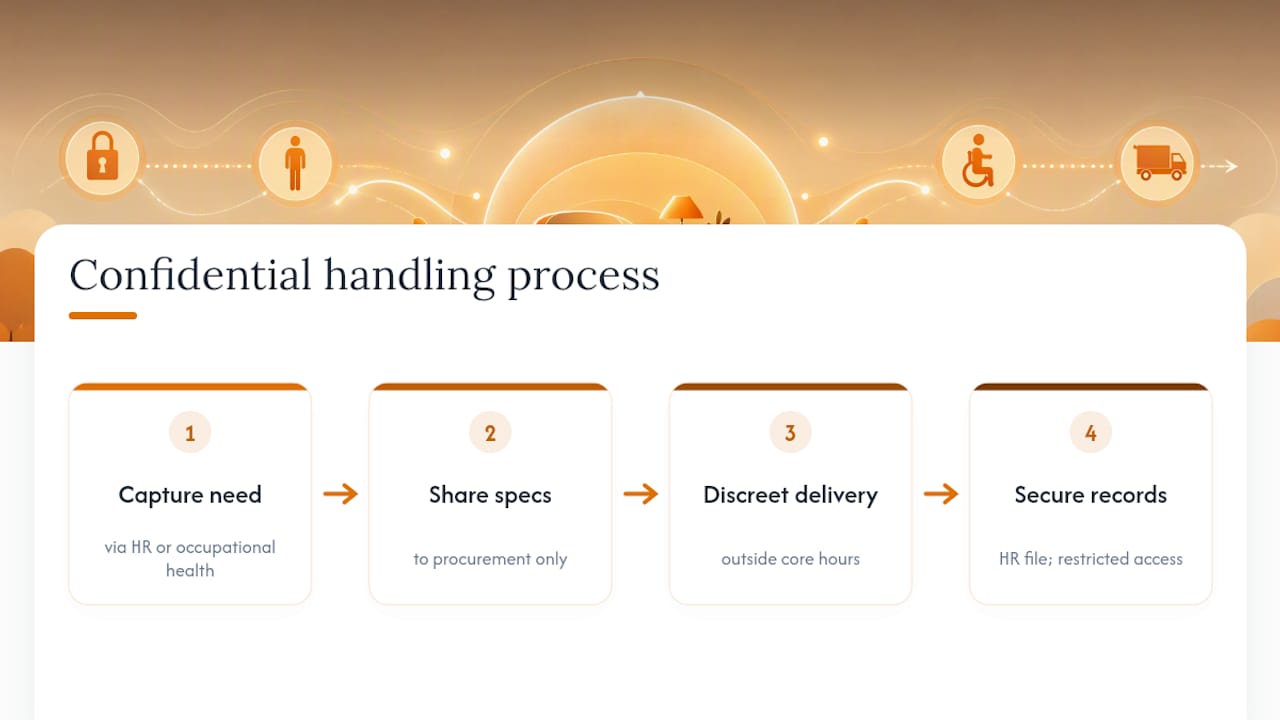
Health information tied to a furniture request is sensitive personal data, and it needs to be treated that way from the first conversation. An employee asking for a specialist chair or a sit-stand desk is often disclosing something about a health condition they have not shared widely, sometimes not even with their immediate team.
Good practice starts with limiting who needs to know. A line manager and HR may need to understand the functional impact to arrange the right equipment, but the specific diagnosis rarely needs to travel further than that. Occupational health referrals should be handled through a formal, confidential channel rather than informal email threads that copy in facilities or IT unnecessarily.
Delivery and installation logistics create their own privacy risk. A distinctive piece of equipment arriving at a desk can broadcast a health condition to the whole floor before anyone has said a word. Where possible, arrange installation outside core hours, or frame any necessary explanation to colleagues around function (“this desk adjusts height”) rather than health status.
Adjustment records should sit in a secure HR file, separate from general personnel notes, with access restricted to those who genuinely need it. When a line manager changes, the adjustment passport should transfer through HR rather than being explained afresh by the employee each time, which both protects privacy and reduces the burden of repeated disclosure.
Failing to make a reasonable adjustment is a form of disability discrimination under the Equality Act, and it can be brought as a claim at an employment tribunal. Unlike many other discrimination claims, there is no cap on the compensation a tribunal can award for a successful reasonable adjustments claim, because it falls under the discrimination provisions rather than unfair dismissal rules.
Tribunals look closely at what the employer knew, when they knew it, and what steps they took, or failed to take, once they had that knowledge. An employer that ignored a request, delayed for months without explanation, or dismissed a request without proper consideration is in a far weaker position than one that engaged, assessed, and made a reasoned decision, even if that decision was ultimately to decline a specific item in favour of an alternative.
Beyond the direct legal risk, there is a reputational and retention cost. Losing a tribunal claim over an unaddressed furniture request is the kind of story that travels through an industry, and it makes future recruitment harder. The far more common outcome, though, is simply losing a good employee who resigns rather than fight for basic equipment, a cost that never appears on a compliance spreadsheet but shows up in recruitment fees and lost institutional knowledge within a year.
Employers that document their process, respond promptly, and can show a considered rationale for any refusal are in a materially stronger position if a dispute does arise.
Tribunal decisions involving furniture adjustments tend to turn on the same recurring issue: delay and poor communication, rather than the cost of the item itself. Cases brought under the reasonable adjustments provisions frequently involve an employer who was aware of a condition, received a request, and then simply failed to act within a reasonable timeframe, or acted only after the employee raised a formal grievance.
A recurring theme in employment law commentary is that staff resistance or workplace disruption is not, on its own, a valid reason to refuse an adjustment. An employer who worries that providing a specialist chair or a sit-stand desk will prompt complaints from colleagues still needs to manage that internal dynamic rather than use it as grounds for refusal. Tribunals have consistently taken the view that an employer’s obligation runs to the disabled worker first, and managing team reaction is a separate management task, not a legal escape route.
The practical lesson for HR teams is straightforward: the paper trail matters more than the outcome. An employer who trialled a chair, documented the review, and made a considered decision to try an alternative is in a defensible position, even if the employee later disagrees with that decision. An employer with no record of ever engaging with the request has almost no defence, regardless of how reasonable their eventual intentions were.
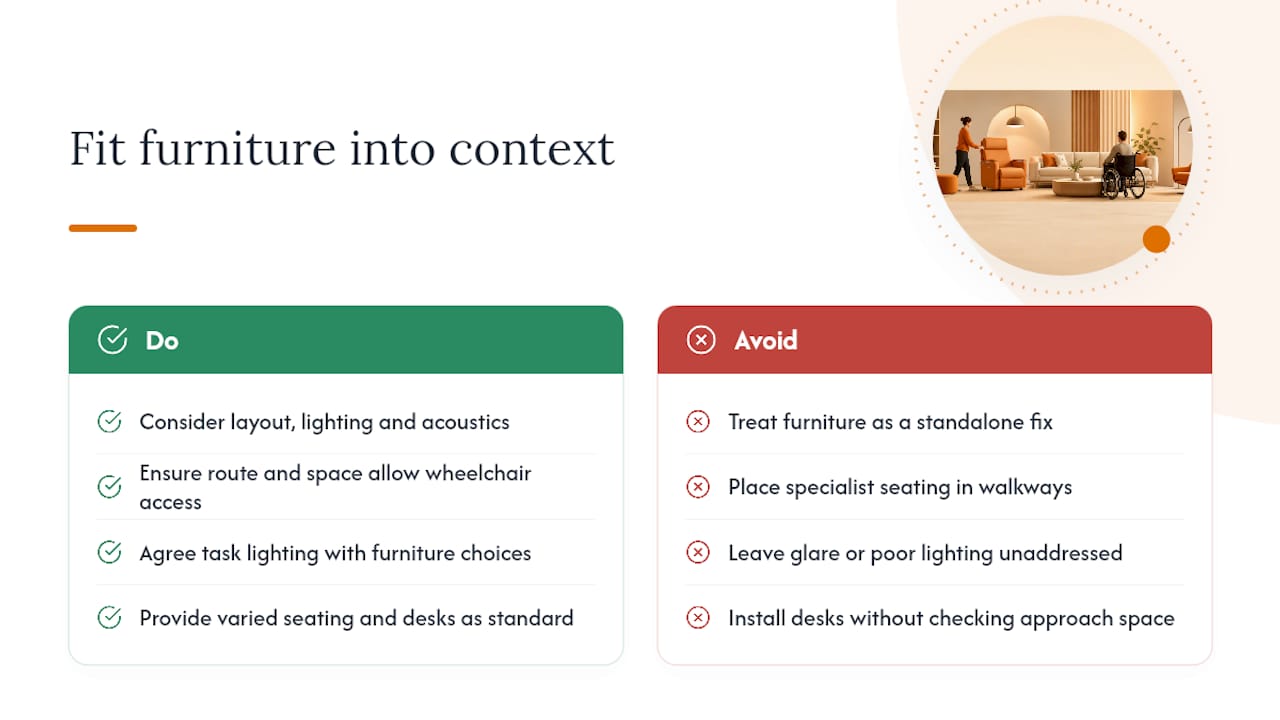
Furniture rarely solves a problem in isolation. A height-adjustable desk paired with poor overhead lighting still leaves someone with a visual impairment struggling, and a specialist chair positioned in a high-traffic walkway defeats its own purpose. Reasonable adjustments work best when furniture is considered alongside layout, lighting and acoustics rather than treated as a standalone fix.
Layout matters particularly for wheelchair users and people with mobility conditions. A knee-clearance desk is only useful if the route to it, and the space around it, allows a wheelchair to turn and approach comfortably. That often means revisiting desk spacing across a whole floor, not just the one workstation being adjusted.
Lighting adjustments frequently travel alongside furniture requests for employees with migraines, visual impairments or neurological conditions. Task lighting at a height-adjustable desk, or repositioning a desk away from glare-heavy windows, often needs to be agreed at the same time as the furniture itself, not as an afterthought once the desk has already arrived.
There is a broader design principle worth adopting here: offering a genuine variety of furniture across the workplace, rather than one standard chair and one standard desk for everyone, reduces how often individual adjustment requests arise in the first place. Building flexibility into the baseline office fit-out, through a mix of seating types and height-adjustable desking as standard, makes the whole workplace more accessible before anyone has to make a formal request. That kind of thinking connects directly to broader inclusive office design principles that go beyond furniture alone.
Furniture adjustments get filed under compliance far too often, and that framing undersells what they actually deliver. An employee with the right chair or desk is not just legally accommodated, they are more productive, less likely to take sickness absence, and considerably more likely to stay. Retention alone tends to outweigh the cost of almost any single piece of adjustable furniture, especially once recruitment and onboarding costs for a replacement are factored in.
The employers who get this right do not wait for a request to land on an HR desk. They build flexibility into the office before anyone has to ask, keeping a stock of adjustable chairs and sit-stand desks on hand so the first response to a request is “we have that ready,” not “let us look into it.” A simple audit of current stock, cross-checked against the business case for ergonomic investment is a good place to start this quarter.
— Furniture
Specialist suppliers provide ergonomic chairs, height-adjustable desks and storage that HR teams reach for once a furniture-related adjustment has been agreed, avoiding the wait times that come from sourcing one-off specialist items through a medical supplier.
The office chairs range covers adjustable lumbar support, seat depth and arm height across multiple price points, while the office desks collection includes motorised sit-stand options suited to knee-clearance and phased-return requirements. Free delivery to the UK mainland and bulk or bundle pricing make it practical to keep a small reserve of adjustable furniture ready for future requests, rather than procuring reactively each time. Returns within 14 days give HR teams room to trial a chair or desk with the employee before treating the order as final, which matters given how individual seating comfort really is. For larger fit-outs or multiple simultaneous adjustments, request a tailored quote or site survey through Furnitureforbusiness to get accurate specifications before you commit to an order.
Yes. Section 20 of the Equality Act 2010 places a legal duty on employers to make reasonable adjustments that remove or reduce a substantial disadvantage faced by a disabled worker, applicant or contract worker.
Section 20 defines the duty to make reasonable adjustments, covering physical features, workplace practices and the provision of auxiliary aids like furniture. The Act makes clear that a failure to comply with that duty is itself an act of discrimination, which is what allows an employee to bring a tribunal claim.
The Equality Act groups adjustments into three broad categories: changes to how things are done, such as working hours or duties; changes to physical features of a building; and providing auxiliary aids or services, which is where furniture such as ergonomic chairs and height-adjustable desks sits, since Schedule 4 excludes furniture from the physical-features category.
A very expensive bespoke item that offers only a marginal benefit over a cheaper alternative, or one that a smaller employer genuinely cannot fund even after checking Access to Work support, could reasonably be declined in favour of that alternative. The employer still needs to document why the cheaper option was chosen and show it still removes the disadvantage.
Furnitureforbusiness supplies ergonomic chairs and height-adjustable desks suited to reasonable adjustment requests, with free UK mainland delivery and bulk pricing for larger fit-outs. Current prices are listed on the site for each product range.

Phone: 0330 043 4114
VAT no. GB 991 8681 60
Company no. 07250570