
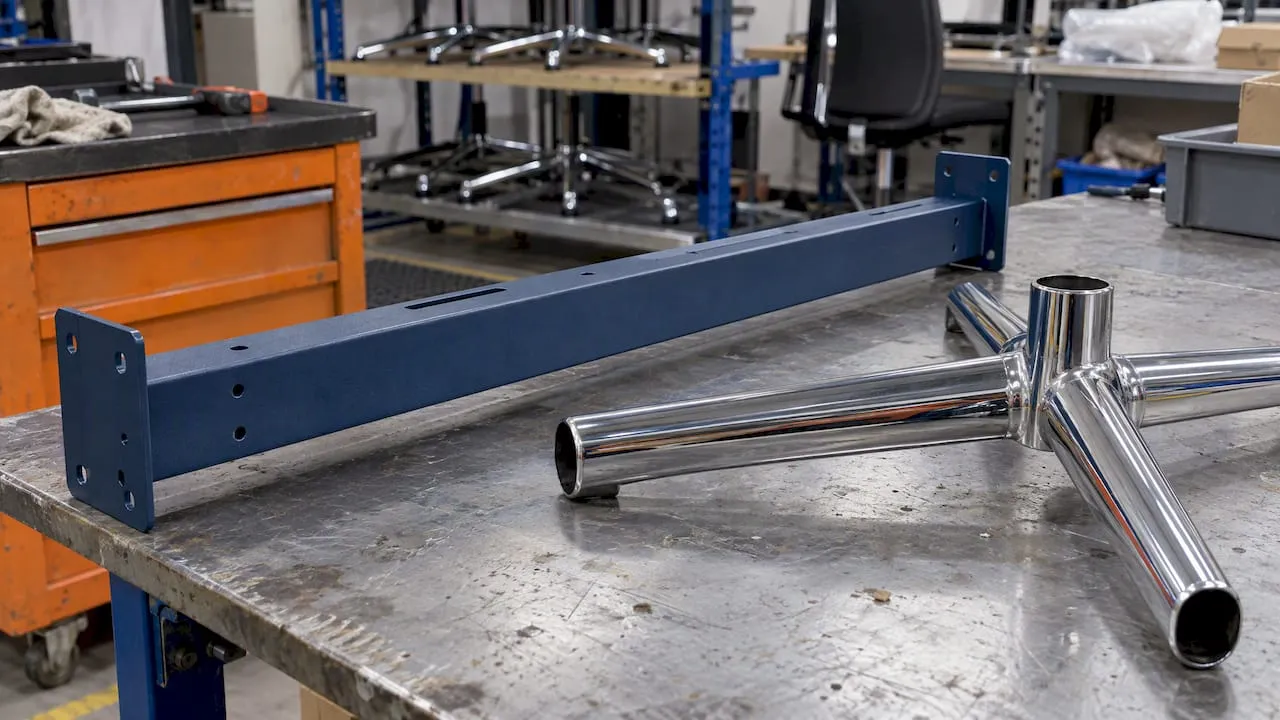
Powder coating typically outperforms chrome plating on durability and corrosion resistance, with a film build of 60 to 120 microns against decorative chrome’s far thinner 0.25 to 0.5 microns, while chrome still wins on authentic mirror appearance. Chrome’s use is also shaped by UK REACH authorisation conditions, which affect where and how affordably it’s offered. Your choice comes down to appearance, durability, cost, and what the piece is actually used for.
TL;DR:
- Buyers should specify powder coating for office furniture handled daily and reserve chrome for rarely struck decorative parts or authorized sanitaryware applications.
- Ask suppliers to confirm coating thickness, adhesion and salt spray test results, warranty terms, and current UK REACH authorization for chrome plating.
- Chrome plating is typically costlier because chromium trioxide requires UK REACH authorization, exposure monitoring, and documentation, while powder coating is generally cheaper at volume.
- Powder coating can be touched up on site, but damaged chrome usually needs stripping and replating, so check repair costs and service turnaround before ordering.
Table of Contents
- What powder coating is and how it performs
- What chrome plating is and how it performs
- Direct comparison: appearance, thickness, durability, corrosion resistance and cost
- Which finish works best for common applications
- Environmental and regulatory considerations
- How to choose: supplier questions, testing and specification checks
- Impact of powder coating and chrome plating on office furniture ergonomics and comfort
- Longevity expectations specifically in office environments with daily usage patterns
- Compatibility of powder coating and chrome finishes with common office furniture materials
- Availability of custom colour options and design flexibility for office furniture
- Effects on recyclability and sustainability of furniture at end of life
- Health and safety implications in workplaces relating to different finishes
- Publisher perspective: why finish choice matters for business furniture
- How Furniture for Business can help you choose the right finish
- FAQ
- Sources
What powder coating is and how it performs
Powder coating is an electrostatic process: dry polymer powder, usually polyester, epoxy or a hybrid resin, is sprayed onto a charged metal surface and then cured in an oven, where it melts and fuses into a continuous film. There’s no liquid carrier to evaporate, which is part of why the finish builds up so thick compared with wet paint or plated metal.
That film typically measures 60 to 120 microns, and the thickness is what gives powder coating its practical edge: a film that substantial can absorb knocks, resist scuffing and shrug off the daily wear that office furniture takes without cracking through to the metal underneath.
Appearance options have broadened well beyond flat colour:
- Solid gloss, matt or satin finishes in almost any colour reference.
- Textured finishes that hide minor surface imperfections and fingerprints.
- Bonded metallic powders that add a silver or bronze shimmer, though they can’t fully replicate chrome’s mirror depth.
- Two-tone or layered effects for branded or design-led furniture ranges.
When powder coating does fail, it’s usually through chipping at an edge or corner, or gradual abrasion in a high-contact spot like a chair arm or desk leg. Routine maintenance is simple: a damp cloth and mild detergent, with any chips touched up before bare metal is left exposed to moisture.
What chrome plating is and how it performs
Decorative chrome plating isn’t a single layer. It’s built as a stack: a copper base layer for levelling, a nickel layer for brightness and corrosion resistance, and finally a very thin chromium layer on top that gives the finish its name and its shine.
That top chromium layer is startlingly thin, around 0.25 to 0.5 microns, and that thinness has consequences:
- The chromium layer is brittle and can crack under impact rather than flex.
- Once cracked, moisture reaches the nickel layer beneath, and corrosion can begin from the inside out, showing as bubbling or flaking.
- The mirror finish and cool, tactile metallic surface are genuinely hard to replicate with any coated alternative.
- Chrome remains specified for legacy and highly decorative parts, including classic vehicle restoration, where an authorised use has been granted for components where no practical alternative finish was found.
Damaged chrome is usually stripped back and replated rather than patched, which means service turnaround and cost are worth checking before you commit to chrome on anything that takes regular knocks. Our chrome 5-star base is one example of where chrome still earns its place: a chair base that’s rarely struck directly and benefits from the authentic metallic look at floor level.
Direct comparison: appearance, thickness, durability, corrosion resistance and cost
Side by side, the two finishes trade strengths in predictable ways once you look at the numbers rather than just the sample swatch.
| Factor | Powder coating | Chrome plating |
|---|---|---|
| Appearance | Solid colours, textures, metallic powders | True mirror finish, authentic metallic depth |
| Film thickness | 60 to 120 microns | 0.25 to 0.5 microns |
| Impact resistance | Absorbs knocks without cracking | Brittle, can crack on impact |
| Corrosion resistance | Resists penetration while film is intact | Vulnerable once chromium layer cracks |
| Cost and process | Generally cheaper at volume | Costlier where authorised processes apply |
| Repairability | Touch-up or local recoat | Usually strip and replate |
Powder coating builds roughly 60 to 120 microns of film, against roughly 0.25 to 0.5 microns for decorative chrome. That substantial difference in film thickness helps explain the practical gap between the two finishes in daily use.
On corrosion, the mechanism differs rather than simply the outcome. Chrome’s thin chromium layer protects by being chemically stable, but once it’s breached, the nickel and steel beneath have little defence and corrosion can spread under the surface before it’s visible. Powder coating’s thicker polymer film works more like a barrier: as long as it stays intact, moisture simply can’t get through, and even small surface scratches tend to stay localised rather than lifting and spreading.
Cost follows the same logic as thickness and chemistry. Chrome processes that use chromium trioxide operate under UK REACH authorisation, which brings monitoring, exposure benchmarks and audit obligations that add to operating cost for the platers involved. Powder coating, run at volume with standard resin systems, is typically the cheaper route for batches of chairs, desk frames or storage units, which is a large part of why it dominates commercial furniture ranges.
Maintenance costs tell a similar story over a furniture lifecycle. A scuffed powder-coated leg can be touched up on-site. A chipped chrome base usually needs to come off the product and go to a specialist for stripping and replating, which means downtime and a line item that’s harder to plan for in a busy office.
Which finish works best for common applications
The right finish depends heavily on what the piece does and how often it’s touched, knocked or exposed to moisture.
- Office furniture (chairs, table bases, storage units): powder coating usually wins because it’s repairable in place and shrugs off daily contact without the brittleness risk chrome carries.
- Automotive trim and classic vehicles: authentic chrome is still often specified for restoration work, where an authorised use exists for legacy components with no accepted substitute finish.
- Sanitaryware and plumbing fittings: chromium plating remains used in some authorised contexts where its hardness and water resistance at small scale justify the process.
- Outdoor fittings and high-wear areas: powder coating is generally the more sensible choice, since its thicker film and lower repair cost make it easier to maintain over years of weather exposure, a principle that also shows up in how outdoor structures hold their finish over time.
Environmental and regulatory considerations
Chromium trioxide, the chemical used in hexavalent chrome plating, is hazardous, and its industrial use is strictly controlled under UK REACH. Businesses that plate with it need an active authorisation, and those authorisations come with binding conditions.
- Authorised users must meet exposure benchmarks, including a monitoring benchmark of 5 µg/m³ as an 8-hour time-weighted average, alongside biological monitoring and documentation requirements.
- Decision reports reviewing specific authorised uses, including legacy vehicle parts, set defined review periods and require evidence that no feasible alternative exists for that particular application.
- Powder coating typically avoids chromium trioxide altogether, which is one reason it carries a lighter regulatory burden, though metallic powder alternatives still have their own limits on exact colour match and application uniformity.
UK REACH authorisation decisions set monitoring and exposure conditions specifically for chromium trioxide electroplating. That regulatory overhead is part of why decorative chrome tends to cost more and comes from a narrower pool of specialist suppliers than powder coating.
How to choose: supplier questions, testing and specification checks
Before you commit to a finish across a bulk order, a short set of supplier questions saves far more time than it costs.
- Ask for the expected film thickness in microns and how it’s measured on their line.
- Request evidence of adhesion testing and, where corrosion resistance matters, salt-spray test results.
- For chrome, ask for evidence of current authorisation and compliance with schemes such as Fit4Chrome.
- Get a physical sample finish rather than relying on a digital colour reference.
- Clarify warranty terms and what counts as normal wear versus a defect.
As a rule of thumb, specify powder coating for anything handled daily and chrome only for smaller decorative elements where the mirror look is the whole point.
Pro Tip: Keep a few spare feet, castors or trim pieces on hand for high-traffic furniture, so a single damaged finish never takes a whole chair or table out of service.
Impact of powder coating and chrome plating on office furniture ergonomics and comfort
Finish choice rarely changes how a chair or desk is engineered, but it does affect the details people notice through daily contact. A powder-coated armrest or desk edge has a slightly textured, warmer feel than polished chrome, which some users find more comfortable against skin during long hours at a desk. Chrome surfaces conduct heat faster, so a chrome armrest or chair base can feel noticeably cooler to the touch in an air-conditioned office, which isn’t a defect but is worth considering for shared workspaces.
Grip is another small but real factor. Textured powder coatings offer more friction underhand, which matters on height-adjustable desk levers or chair controls that get adjusted repeatedly. Chrome’s smooth, glossy surface can become slippery when hands are damp, a minor point but one procurement teams sometimes overlook when specifying control mechanisms rather than purely decorative parts.
Neither finish changes the underlying ergonomics of a chair or desk, those come from frame design, adjustability and materials like foam density or mesh tension, but the finish does shape the everyday tactile experience of furniture that staff touch dozens of times a day.
Longevity expectations specifically in office environments with daily usage patterns
Office furniture faces a particular kind of wear: not heavy industrial impact, but constant, low-level contact from chairs being pushed back, desks being leaned on and storage units being opened repeatedly. Powder coating’s thicker film handles this pattern well, since the coating is built to absorb exactly this kind of repeated light contact without cracking through to bare metal.
Chrome in an office setting tends to perform well on parts that see limited direct contact, such as a chair base that mostly stays on the floor, but shows wear faster on anything regularly touched or knocked, like armrests or desk frame edges. Once the thin chromium layer is breached in a high-contact spot, corrosion can start developing underneath before it becomes visible on the surface.
For furniture expected to last several years under daily office use, powder coating generally offers more predictable, visible wear, a scuff you can see and touch up, rather than the hidden corrosion risk that can develop under a cracked chrome surface.
Compatibility of powder coating and chrome finishes with common office furniture materials
Steel is the most common substrate for both finishes in office furniture, and both processes bond well to it when surface preparation is done properly. Powder coating needs a clean, often chemically pre-treated steel surface to achieve full adhesion, while chrome plating requires the copper and nickel underlayers to build correctly before the final chromium layer is applied.
Aluminium, often used in desk frames and lightweight storage components, takes powder coating readily with the right pre-treatment, though it needs a different chemical preparation than steel to avoid adhesion problems. Chrome plating on aluminium is less common in furniture because the process is more technically demanding and typically reserved for specialist applications rather than everyday office pieces.
Plastics and composite components, increasingly used in chair shells and desk accessories, generally aren’t suited to either traditional powder coating or chrome electroplating in their standard forms, since both processes rely on heat-curing or electrical conductivity that plastic substrates don’t support in the same way metal does. Where a metallic look is wanted on plastic parts, manufacturers typically use alternative processes such as vacuum metallising rather than true powder coating or chrome plating.
Availability of custom colour options and design flexibility for office furniture
Powder coating offers far more design flexibility than chrome for office furniture ranges. Because the powder is simply a different resin and pigment blend, suppliers can offer colour matching to brand palettes, interior schemes or even a single accent panel in a different shade from the rest of a desk frame.
Chrome, by contrast, offers essentially one appearance: the mirror metallic finish itself. There’s no equivalent to choosing a custom shade, since the whole point of chrome is its distinctive silver brightness. Bonded metallic powders can introduce a shimmer or metallic tone into a powder-coated finish, but they sit closer to a textured effect than a true reflective surface, so they work as a complement to chrome rather than a direct substitute.
For an office fit-out where colour consistency across chairs, desks and storage matters, powder coating gives procurement teams a much wider practical choice, while chrome remains a deliberate accent decision for specific components like chair bases or trim.
Effects on recyclability and sustainability of furniture at end of life
When furniture eventually reaches end of life, the finish affects how straightforward recycling is. Steel and aluminium frames with a powder-coated finish can generally still be recycled through standard metal recycling routes, since the polymer coating is typically removed or burned off during the recycling process without major complication.
Chrome-plated components are more involved to recycle cleanly because the multilayer structure, copper, nickel and chromium, means separating the metals for proper recovery takes more specialist processing than a single-layer coated part. This doesn’t make chrome unrecyclable, but it does mean furniture with substantial chrome plating may need to go through a more specialised waste stream rather than general scrap metal recycling.
For businesses thinking about the full lifecycle of a furniture purchase, particularly where corporate sustainability reporting matters, specifying powder-coated frames and reserving chrome for smaller trim pieces can make end-of-life processing simpler without sacrificing the overall look of the range.
Health and safety implications in workplaces relating to different finishes
Once furniture is finished and in use, both powder coating and properly cured chrome plating are stable, inert surfaces that pose no ongoing exposure risk to the people sitting in or around them. The health and safety considerations that matter are mostly upstream, at the point of manufacture, where hexavalent chromium used in plating is classified as hazardous and strictly controlled under UK REACH, with authorised platers required to meet exposure benchmarks and monitoring obligations to protect their own workforce.
For a business buying finished furniture rather than doing any plating itself, this translates into one practical check: choosing suppliers who source from platers operating under current authorisation, since that’s the mechanism that keeps the hazardous part of the process properly controlled before the product ever reaches your office.
Powder coating carries a lighter manufacturing hazard profile, since it doesn’t involve chromium trioxide, though like any industrial coating process it still requires standard workplace controls such as ventilation and dust management at the application stage. For the end user in an office, neither finish presents a day-to-day health risk once the furniture is installed and in service.
Publisher perspective: why finish choice matters for business furniture
We weigh durability and serviceability heavily when selecting furniture for commercial environments, because a chair or storage unit in daily office use faces a very different wear pattern to a decorative item handled occasionally. That’s why chrome-finished components, like our chrome 5-star base, tend to appear on parts that take the look without taking the knocks. If you’re specifying finishes across a bulk order, it’s worth requesting sample swatches or a specification sheet before you commit.
— Furniture
How Furniture for Business can help you choose the right finish
We stock furniture across both finish types, so you don’t have to choose a supplier based on which coating they happen to specialise in. Our office chairs range includes options in different finishes, our office storage and steel storage collections offer storage solutions, and our office accessories range covers finishing details.

- Browse office chairs and office desks to compare options directly on product pages.
- Check meeting room furniture for a polished, formal look.
- Get in touch for bulk order pricing and specification details before you place a fit-out order.
Free delivery across the UK mainland and easy returns make it straightforward to order and see a finish in person before you commit to a full office fit-out.
FAQ
Is chrome plating better than powder coating?
Neither finish is universally better: chrome gives an authentic mirror metallic look, while powder coating’s much thicker film generally gives better impact resistance and corrosion protection for furniture in daily use. The right choice depends on whether appearance or durability matters more for that specific part.
What are the downsides of powder coating?
Powder coating can’t fully replicate chrome’s mirror brightness, even with bonded metallic powders, and it’s still subject to chipping at edges under hard impact. These are limits compared with chrome’s appearance, not durability failures, since the thicker film generally resists wear better overall.
Is it true that powder coat looks like chrome?
Metallic powder coatings can introduce a silver or bronze shimmer, but they don’t achieve true chrome’s reflective, mirror-like depth. They’re a reasonable complement to a design scheme rather than a direct visual substitute for plated chrome.
Is chrome powder coat worth it?
A metallic powder finish is worth considering when you want a silver tone with powder coating’s durability and lower cost, but it won’t deliver an authentic chrome mirror appearance. For parts where that genuine reflective look matters most, actual chrome plating remains the only way to achieve it.