
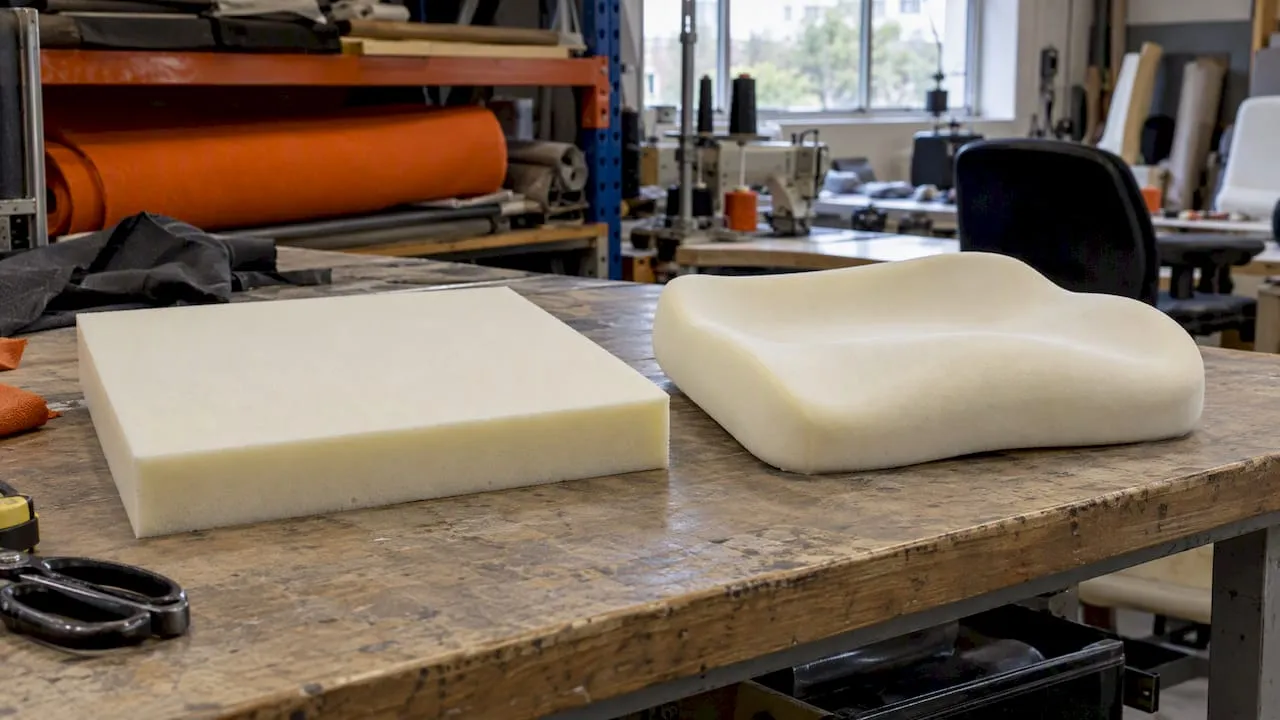
For chairs used all day, every day, moulded foam is usually the better buy. It holds its shape longer, it is consistent from one chair to the next, and it carries a protective skin that cut foam lacks. Cut foam is cheaper and more flexible, which makes it a sensible choice for light use, low volumes or unusual shapes. Either way, the foam must meet UK fire safety rules, and that matters more than the manufacturing method.
This guide explains how each type is made, where each one wins, what to ask a supplier before you place a bulk order, and how to check the foam without a laboratory.
TL;DR
- Moulded foam is poured into a shaped tool, so it keeps its form and suits chairs used for full working days by many people.
- Cut foam is sliced from large blocks, so it costs less and suits simple shapes, light use and one-off jobs.
- Foam in both types must comply with the Furniture and Furnishings (Fire) (Safety) Regulations 1988, so ask for documentation, not assurances.
- Density, firmness and the chair’s test certification tell you more than the label “moulded” or “cut” alone.
- For 5 to 500 seats, buy on cost per year of service, not unit price.
Table of Contents
- How the two types of foam are made
- Moulded vs cut foam at a glance
- Durability: where the gap shows
- Comfort and ergonomics
- Cost: what you actually pay
- Which type for which room
- Fire safety comes first, whatever the foam
- Density and firmness: read the numbers
- A practical checklist before a bulk order
- Our view: specify the use, not the label
- Choosing chairs for your team
- FAQ
- Sources
How the two types of foam are made
The difference starts in the factory, long before anyone sits down.
Cut foam. A liquid polyurethane formula is poured into large pans and left to rise. The huge blocks, often called buns, are then sliced and cut to size, with shapes refined in stacks on a band saw, as Seating Inc’s foam guide describes. Because it comes from a block, the cushion is a cut-out of a larger piece of material. Shapes are simple: flat, angled or gently bevelled slabs, sometimes glued in layers.
Moulded foam. The liquid mixture is injected into a closed, shaped tool and reacts inside it. The part comes out in its final three-dimensional form. Flexible moulded polyurethane seating foam has been made industrially since 1961, when the first production line came on stream, and it has since become the standard in professional seating. Because the chemistry happens inside the tool, manufacturers can control it closely. According to the European association of moulded polyurethane manufacturers, that lets them create zones of different hardness and density within one cushion, something hand-cutting cannot match at volume.
The moulding process also forms a skin on the surface. Practitioners writing for Covestro describe this skin as a protective barrier that cut slabs do not have, which leaves cut foam more exposed to dust, moisture and gradual breakdown.
Moulded vs cut foam at a glance
| Factor | Moulded foam | Cut foam |
|---|---|---|
| Made by | Injected into a shaped tool | Sliced from a large block |
| Shape | Contoured, 3D, can include zones of different firmness | Flat or simply angled, sometimes glued in layers |
| Durability under daily use | Generally higher | Generally lower, especially at pressure points |
| Consistency chair to chair | Identical parts | Depends on cutting and gluing |
| Surface | Integral skin | Open, exposed cut faces |
| Upfront cost | Higher, driven by tooling and volume | Lower, no tooling needed |
| Best for | Task, operator and executive chairs in full-time use | Occasional seating, prototypes, simple or bespoke shapes |
Treat the table as a tendency, not a guarantee. A well-specified cut foam cushion can outlast a poorly specified moulded one. What decides the outcome is the foam’s grade, the way it is built into the chair and how the chair is used.
Durability: where the gap shows
Office seats take a particular kind of punishment: the same body, in the same position, for six to eight hours, five days a week. The areas under the sit bones and thighs are compressed again and again.
In that setting, moulded foam is generally the more resilient option. One manufacturer’s technical presentation notes that moulded foam for demanding seating is often specified at 50 to 65 kg/m³ and is designed to hold its shape under intensive use, limiting wrinkling and “bottoming out”, the point at which you feel the hard base through a flattened cushion.
Cut foam tends to break down sooner at those pressure points. Seating Inc explains that cut parts come from pre-poured blocks without the integral skin that moulded parts form. Glued layers add a second weakness: the bond lines can separate over time.
This is a general pattern from manufacturers and trade bodies, not a lab result for any specific chair. Treat it as a reason to ask questions, not as proof that every cut foam cushion will fail early.
Comfort and ergonomics
Comfort is not only softness. A cushion that feels plush in a showroom can leave a person sore by mid-afternoon if it lets the pelvis sink and rotate.
The Health and Safety Executive’s guidance, Seating at work (HSG57), says the seat, armrests and backrest should be well padded so the worker’s body does not press uncomfortably on the frame, and that corners and edges should be padded too. Both foam types can meet that brief in principle. Moulded foam has the edge in delivering it consistently, because the shape, the thickness at the edges and the firmness zones are built into the tool rather than depending on how a cutter trimmed each piece.
For staff who sit for long periods, pair the seat foam with proper back support. Our guide to lumbar support types that work for long office hours covers that half of the equation, and our checklist of DSE chair features UK employers must specify shows where seat padding sits among the other requirements.
Cost: what you actually pay
Cut foam is cheaper to start with because there is no tooling. That is why it dominates short runs, replacements and bespoke jobs. Experts quoted by the Polyurethane Foam Association say budget, rapid prototyping and low-volume customisation are the main reasons cut foam gets chosen, while moulded foam is the investment where parts must be identical and reliable over a long life.
For a buyer, the useful sum is cost per year of service:
- Take the unit price of the chair.
- Estimate how many years the cushion will stay comfortable under your usage pattern.
- Add the cost of disruption: a chair taken out of service, the time of whoever raises the request, and the replacement order.
- Divide by the years.
Worked example, with illustrative figures only: a chair at £100 that needs a new seat after three years costs about £33 a year before any replacement cost. A chair at £140 that lasts six years costs about £23 a year. The dearer chair is cheaper to own. Your own figures will differ, so run the sum with real quotes and a realistic service life for your workplace.
The reverse also holds. A meeting room used twice a week, a waiting area or a training room that is mostly empty does not need premium seat foam. Spending less there is good procurement, not a compromise.
Which type for which room
Open-plan desks and operator seating (8 hours a day). Choose moulded foam, or a cut foam of proven high grade from a documented source. These chairs carry the heaviest loads and the longest hours. Our explanation of what operator seating is shows what these chairs should offer beyond the cushion.
Executive and management chairs. The seat is as much about appearance as support, so a clean, wrinkle-free upholstered finish matters. Moulded foam helps there. Check the adjustments too, using our list of executive chair adjustments to require.
Meeting and boardroom chairs. Use is shorter, but meetings can run for hours. Cut foam in a good grade is often adequate for occasional rooms, while a busy boardroom benefits from moulded. Our buyer’s guide to meeting chairs goes through the other features worth comparing.
Soft seating and reception. Sofas and lounge pieces often use cut foam in layers because of their size and shape. Here the quality of the grade and the fabric matter most. See our soft seating page for the style options.
Cafes, bistros and other hospitality venues. Seats are used by many different people through the day and cleaned often. Fire documentation becomes the priority, which we cover next.
Fire safety comes first, whatever the foam
In Great Britain, upholstered furniture supplied in the course of business must comply with the Furniture and Furnishings (Fire) (Safety) Regulations 1988. That applies to moulded and cut foam alike. The method of manufacture does not exempt a cushion, and neither does the fact that it sits inside a chair.
In practice, foam sold for seating in the UK is usually specified as combustion-modified (CMHR) and should come with documentation. A UK supplier’s data sheet, such as eFoam’s SF38 datasheet, describes the grade it calls the trade default for quality seating cushions, and shows what a proper specification looks like: grade, density, firmness and fire performance in one document.
If you run a cafe or similar venue, the paperwork has its own checklist. Read the four documents UK cafe owners must keep to prove furniture is fire safe. For a concrete example of a fire-rated product page, see the Phoenix Fire Fighter Fire Safe chair.
The chair structure has its own standard. BS EN 1335-2 sets safety requirements for office work chairs, and BS EN 1335-1 covers dimensions and how to measure them. Treat compliance with those as the baseline for any chair used for professional work, then compare foam on top of it.
Density and firmness: read the numbers
Two labels sound similar but mean different things.
- Density is the weight of foam per cubic metre (kg/m³). Higher density usually means more material in the cushion and longer life.
- Firmness is how hard the foam feels when pressed, and it is not the same as density. A foam can be dense and soft, or lighter and firm.
A supplier that can state both for the seat cushion, and the fire grade, is telling you the cushion has been specified rather than improvised. eFoam’s grade guide is a clear UK reference on how those grades differ. For moulded seating, the figure to note from the research above is the 50 to 65 kg/m³ range quoted for demanding use. For cut foam, ask for the specific grade instead of accepting “high density”, which has no fixed meaning.
A practical checklist before a bulk order
For a team of 5 or 500, the same questions apply. Put them in the purchase order.
- Which foam type is in the seat and back? Moulded, cut, or a mix. Ask for both parts separately.
- What are the density and firmness figures? Ask for numbers, not adjectives.
- Is the foam CMHR and covered by fire test documentation? Keep a copy on file.
- Is the chair tested to BS EN 1335? Ask which parts and what weight rating.
- Is the cushion replaceable? A chair with a replaceable seat pad can be refreshed at a fraction of the price of a new chair.
- Are samples available? Have three or four people sit in the shortlisted chairs for a full afternoon.
- What is the returns window? A trial is the best test of any foam.
It also helps to think about hybrid working. If desks are shared, several people with different body shapes will use the same seat, so a cushion that suits a wide range of users and keeps its shape matters more than a cushion tuned to one person. Our piece on the right office storage solutions is useful when you are planning the rest of a shared layout.
Our view: specify the use, not the label
We supply commercial furniture to UK businesses, from small teams to large offices, and the same conversation comes up often. A buyer asks whether moulded or cut foam is better, when the better question is how hard the chair will be used.
Our advice is simple. If a chair is someone’s main seat for the working day, favour moulded foam or a documented high-grade alternative and judge it on cost per year. If the seat is occasional, do not pay for performance it will never use. Whichever you choose, ask for the fire documentation and keep it. Buying for a business means being able to show you chose well.
That is also why we offer bulk pricing and bundles, free delivery to the UK mainland and returns within 14 days. Sit on the chairs, check them with your team and send back what does not suit.
— Furniture
Choosing chairs for your team
If you are fitting out an office or replacing worn seating, browse our office chairs, from task and operator seating to executive models. Furnishing the rest of the space? See our office desks and meeting room furniture too. For larger orders, ask about bulk and bundle pricing before you check out.
FAQ
What is moulded foam?
Moulded foam is polyurethane that is injected into a shaped tool and reacts inside it, so the cushion comes out in its final 3D form with a skin on the surface. Because the process is controlled, a single cushion can have areas of different firmness. It is the standard approach in professional seating.
Is moulded foam always better than cut foam?
No. Moulded foam is generally better for heavy, all-day use, but cut foam is a sensible, cheaper choice for light use, short runs and unusual shapes. A good grade of cut foam can outperform a poor moulded cushion, so judge the specification, not just the method.
Does the type of foam affect fire compliance?
No. In the UK, upholstered furniture supplied for business use must meet the 1988 fire safety regulations whichever process made the foam. Ask the supplier for fire test documentation and keep it on file.
Which type of foam is best for a sofa?
Sofas and lounge seating commonly use cut foam, often in layers, because of their size and shape. Choose a high-grade, fire-compliant foam and check the firmness, because a sofa cushion that is too soft will flatten quickly in a busy reception or breakout area.
How do I tell which foam is in a chair?
Check the product specification first and ask the supplier if it is missing. Moulded seats usually have a smooth, continuous shape with no visible glued layers, but you cannot reliably tell by looking, so a written specification is the only safe answer.
Sources
- The Furniture and Furnishings (Fire) (Safety) Regulations 1988, legislation.gov.uk
- Foam, Seating Inc
- Seating guide, Euro-Moulders
- Moulded flexible foam, Covestro
- Moulded foam seating presentation, Figueras
- Seating at work HSG57, HSE
- InTouch newsletter, Polyurethane Foam Association
- SF38 product data sheet, eFoam UK
- Foam grades and datasheets, eFoam UK
- BS EN 1335-2:2018, BSI Knowledge
- BS EN 1335-1:2020, BSI Knowledge