There is no official ladder of “filing cabinet security levels” for ordinary office furniture. In practice you are choosing between three tiers: a standard cabinet with a factory cam lock, the same cabinet upgraded with a locking bar or better lock, and a cabinet independently tested for burglary resistance under BS EN 14450. Which tier you need depends on what is in the drawers, who can reach the room, and what a loss would cost you.
This guide explains each tier in plain terms, how the common lock types compare, when keyed alike or keyed different makes sense, and where fire and water fit in. It is written for office managers and procurement teams buying for teams of 5 to 500.
TL;DR
- Most office filing cabinets ship with a basic cam lock. That is a deterrent against casual access, not protection against a determined attempt.
- The only recognised graded benchmark for lower-risk secure cabinets is BS EN 14450, which has two grades, S1 and S2. Ordinary storage standards do not test for burglary resistance.
- UK GDPR sets no single cabinet specification. It expects “appropriate” measures, and for personal paper records that normally means locked storage in a secured room.
- The cabinet body matters as much as the lock. Thin steel, weak drawer runners and no anti-tilt mechanism undermine a good lock.
- For 10 or more cabinets, a master-keyed system usually beats pure keyed alike or keyed different.
Table of Contents
- The three practical tiers of filing cabinet security
- Why a standard storage standard is not a security standard
- What UK GDPR expects of paper records
- Filing cabinet lock types compared
- Keyed alike vs keyed different
- The cabinet body counts as much as the lock
- Fire and water: the risk people forget
- How to choose: a five-step process
- Our perspective
- Find lockable storage for your office
- FAQ
- Sources
The three practical tiers of filing cabinet security
Think of security as a sliding scale, and match each store of paper to a point on it.
| Tier | What it is | Good for | Limits |
|---|---|---|---|
| 1. Standard locking cabinet | Steel cabinet with a factory cam lock | General admin files, low-risk paperwork, keeping out casual browsing | Rarely designed to withstand determined manual attack |
| 2. Upgraded cabinet | Standard cabinet plus locking bar, better lock or locked room | Staff records, client files, finance paperwork | Still not tested or certified for burglary resistance |
| 3. Certified secure cabinet | Cabinet type-tested to BS EN 14450 (grade S1 or S2) | High-value or highly sensitive records, higher-risk premises | Costs more, heavier, and usually holds less per footprint |
Most offices need tier 1 or 2 for most of their paper, and tier 3 for a small number of items. Buying tier 3 for everything is rarely sensible, and buying tier 1 for everything is how breaches happen.
Tier 1: the factory cam lock
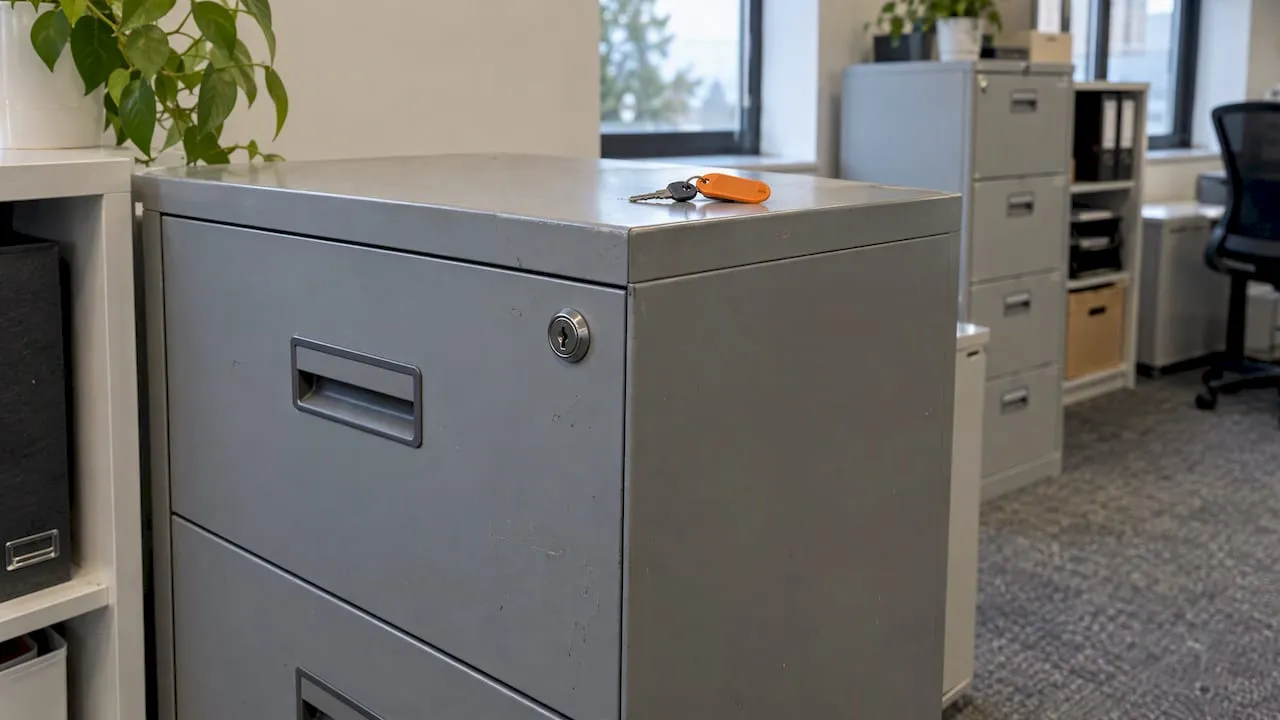
The lock on a typical office cabinet is a small cylinder, often called a cam lock. SecureOne’s guide to file cabinet locks notes that most cabinets ship with a basic lock that copes with low-risk situations, but that much better options exist. That is a fair summary. A cam lock stops a colleague idly opening a drawer. It is not meant to stop someone who arrives with tools and time.
That does not make it useless. Many risks in an office are casual: a cleaner, a visitor left alone for five minutes, a contractor during a refit. A working lock, with the key kept somewhere sensible, handles those.
Tier 2: upgrades that raise the level cheaply
If you already own the cabinets, the cheapest step up is often a locking bar: a vertical metal bar through the drawer handles, secured with a padlock. The same guide describes this as often the most cost-effective way to lift an existing cabinet beyond its factory defaults. Other upgrades are moving the cabinet into a room that locks, fixing it so it cannot be walked out, and controlling who holds keys.
When you buy new, look at the whole build rather than the lock alone. Our filers range and steel storage are the places to compare lockable steel options for general office use.
Tier 3: BS EN 14450 secure cabinets
BS EN 14450 is the European standard that sets out requirements, classification and test methods for secure cabinets designed to resist burglary. It covers products for situations where the resistance needed is lower than that measured by EN 1143-1, the standard for full safes, so these are for lower-risk situations. Cabinets are classified into two grades, S1 and S2, with S2 the higher.
The practical point: a cabinet carrying an EN 14450 grade has been tested, and its security level is verified. A cabinet that merely looks sturdy has not. If a supplier says “secure”, ask for the test grade and certificate.
Why a standard storage standard is not a security standard
A common buying mistake is to assume that any lockable steel cabinet meets a data security standard. Standards for general office storage, such as BS EN 14073, deal with furniture performance, not burglary resistance. The iTeh catalogue entry for EN 14450 sets out what the burglary standard does cover, and that is where the verified protection levels come from.
So when a tender or policy says “secure storage”, pin down what it means. Is it a locked cabinet in a locked room? Or a cabinet with a stated EN 14450 grade? Writing that into the purchase specification avoids an argument after delivery.
What UK GDPR expects of paper records
UK data protection law does not give a single “filing cabinet security level”. The Information Commissioner’s Office instead expects appropriate technical and organisational measures. Its physical security guidance suggests identifying and risk assessing areas that may need more security, testing physical controls regularly, and using a mixture of controls at entry points.
Translated into furniture decisions:
- Work out what personal data you hold on paper. HR files, payroll, occupational health notes, client financial records and medical histories are the usual suspects.
- Rate the risk. A cabinet in an open-plan area near reception needs more than one in a locked back office.
- Layer the controls. Locked cabinet, locked room, controlled keys, and a clear-desk habit work together. None is enough alone.
- Check the controls work. Try the locks. Count the keys. Do it on a schedule.
The risk is real in smaller practices too. An article on GDPR and data protection for dental practices lists paper records in an unlocked filing cabinet, with a risk of unauthorised access, and storage that is not fireproof, as two of its flagged risks. For a checklist aimed at office storage, see our guide to GDPR-compliant office storage. If your obligations are specific to your sector, take advice from your data protection officer or the ICO.
Filing cabinet lock types compared
Lock choice is the part of the “security level” most buyers can see. The main options:
| Lock type | How it works | Security level | Watch out for |
|---|---|---|---|
| Cam lock | Key turns a small cam that blocks the drawer | Basic | Cheap and common; many cabinets share key patterns, so check how yours are keyed |
| Tubular (radial pin) lock | Round key with pins arranged in a ring | Basic to moderate | Fine for general use; still depends on the cabinet body |
| Gate or locking bar | Bar across the drawer fronts, padlocked | Moderate | Strong upgrade for existing cabinets; the padlock quality sets the limit |
| Combination lock | Code instead of a key | Moderate | No keys to lose, but codes get shared and need changing when staff leave |
| Electronic or keypad lock | Code or card entry, often with battery power | Moderate to high | Needs battery management and a manual override plan |
| Biometric lock | Fingerprint recognition | Highest personalisation | Adds cost and a failure mode if power or sensors fail |
The overview of filing cabinet lock types from JWM describes key locks as among the most common, relying on a physical key and being simple and affordable, with cam and tubular variants. Electronic and biometric options give audit trails and personal access, but they add dependencies, so weigh them against what your team will actually manage.
Keyed alike vs keyed different
This is where office managers often make the choice by default rather than on purpose.
Keyed alike means one key opens every cabinet in the set. It is convenient and cheap to manage: one key per authorised person. The downside is obvious. Anyone with that key can open everything, and losing it means every lock is exposed.
Keyed different means each cabinet has its own key. A lost key exposes one cabinet. The downside is admin: a facilities manager may be left with a drawer of keys and no easy way to get into a cabinet when its holder is off sick or has left.
Master-keyed is the middle route. Each cabinet has its own key, but a master key opens the lot. UK lock specialists advise that organisations with 10 or more cabinets should look beyond simple keyed alike or keyed different systems towards a master-keyed suite, so supervisors or facilities managers can get in during an emergency while individual security stays intact for staff and departments.
Which one to choose
- Under about five cabinets, one team, one trusted keyholder: keyed alike is usually acceptable.
- Mixed sensitivity, such as HR next to general admin: keyed different, with a key register kept by one person.
- Ten or more cabinets, or several departments: master-keyed, with the master key held by a named person and stored securely, not in a desk drawer.
Whatever you choose, write down who holds which key, and add “return keys” to your leaver checklist. When ordering, tell your supplier how you want the cabinets keyed before they ship, because changing it afterwards costs time.
The cabinet body counts as much as the lock
It is easy to fixate on the lock. Industry advice, such as guidance from a commercial locksmith on choosing a cabinet lock, makes the point that security is the sum of the components: a strong lock fitted to thin-gauge steel can be pried or punctured. Check these before you buy:
- Steel thickness and rigidity. Press on the drawer front and the side panel. Flex suggests weakness.
- Drawer runners. Heavy files in daily use wreck cheap slides, and a drawer that no longer closes cannot be locked.
- Gaps around the drawer fronts. Wide gaps give tools a way in.
- Anti-tilt mechanisms. These let only one drawer open at a time, which stops a loaded cabinet toppling. It is a safety feature first, but it also keeps the cabinet stable and in one piece. See our anti-tilt filing cabinet buying guide.
- Fixing options. A cabinet nobody can carry out of the door is harder to take away and break open elsewhere. For secure cabinets, standards cover anchoring too.
If you are comparing options on several of these points, our guide to why lockable office storage matters for UK workplace security covers the wider picture.
Fire and water: the risk people forget
Theft gets the attention, but paper is lost far more often by accident. Fire and water are the usual causes. A burglary rating does not mean a cabinet will survive a fire, and a fire-rated cabinet is not automatically burglar-resistant. They are separate properties.
If you hold records that cannot be replaced, such as signed contracts, original certificates or historic client files, identify them and keep them in a cabinet with a stated fire rating from a recognised test, ideally with water-resistant seals to cope with sprinklers and hoses. Read the test certificate rather than the marketing line, and check how long protection lasts. For most records, though, the cheaper answer is to scan them, keep the copy somewhere off site, and hold the paper in your ordinary locked cabinet. If your team backs up scans to local devices, a checklist of essential office electronics is a handy reference when kitting out that side of the office.
How to choose: a five-step process
- List what you store. Group paper into general, confidential, and irreplaceable.
- Match each group to a tier. General goes in tier 1, confidential in tier 2, and a small amount of high-value material in tier 3 or a fire-rated unit.
- Decide on keys before you order. Alike, different or master-keyed, and who holds what.
- Check the build. Steel gauge, runners, anti-tilt, fixings, and whether any security grade comes with paperwork.
- Place it well. Away from reception, out of sight of windows, ideally in a room that locks when unattended. The ICO guidance expects layered controls, and a locked room is one of the cheapest layers.
The layout also matters. Cabinets need clear space to open drawers safely, so check clearances early. Our small office furniture planning guide explains what to allow for before you buy.
Our perspective
We supply furniture to offices, and the same mistake turns up again and again: the lock gets chosen, the cabinet does not. Buyers compare key types for ten minutes and then order the cheapest steel body on the page.
Our advice is to be honest about the tier you need. Most of what an office files away is not high risk, and a sturdy lockable steel cabinet in a room that locks, with keys under control, is a sound answer. Spend the extra on the small number of items that would genuinely hurt to lose, and ask any supplier for evidence, including test grades, rather than adjectives.
We would also rather you took the time to decide on keys than treated them as an afterthought. A master-keyed set with a key register costs little and saves a great deal of fuss on the day someone leaves with the only key to the payroll drawer.
— Furniture
Find lockable storage for your office
If you are fitting out or refreshing an office, our office storage range covers filers, steel storage and more for UK businesses, with free delivery to the UK mainland, easy returns within 14 days, and special pricing on bulk and bundled orders. Browse the range, check each product’s specification for locking and construction details, and order for your whole team in one go.
FAQ
Can a lock be added to a filing cabinet?
Yes. If the cabinet has no lock, a locking bar secured with a padlock is a common retrofit, and it is often the cheapest way to raise the security of an existing cabinet. Some cabinets also accept a replacement lock core. Check the model before buying parts.
What is the difference between keyed alike and keyed different?
Keyed alike cabinets all open with the same key, which is simple but means one lost key exposes everything. Keyed different cabinets each have their own key, which limits the damage from a loss but creates more key admin. A master-keyed system gives each cabinet its own key plus a master key for authorised managers.
Does UK GDPR require a specific type of filing cabinet?
No. The ICO expects appropriate technical and organisational measures, and does not name a cabinet specification. For personal paper records, a locked cabinet in a secured room, with controlled keys, is the usual starting point, as the ICO’s physical security guidance suggests risk assessing and layering controls.
Is a lockable filing cabinet the same as a secure cabinet?
No. A lockable cabinet has a lock. A secure cabinet has been type-tested and classified for burglary resistance, for example to BS EN 14450. Ask for the grade and the test evidence if you need verified protection.
Sources
- SecureOne: 6 types of file cabinet locks
- EN 14450:2017+A1:2023 secure cabinets standard (iTeh)
- ICO: Physical security
- Dentistry: GDPR and data protection, how safe is your practice?
- JWM: Different types of filing cabinet locks
- Lockstation: Keyed alike vs keyed different
- Driscoll Lock and Key: choosing a filing cabinet lock