Choose synchronous (synchro) mechanisms for balanced desk work, dynamic or float mechanisms for people who need active sitting, and knee-tilt or single-point mechanisms for simpler, budget-conscious roles. Whatever you pick, the chair must meet DSE minimums: adjustable seat height and a backrest that adjusts in both height and tilt, as set out in the DSE Regulations.
TL;DR:
- Mechanisms with independent seat and backrest control, such as asynchronous, are better suited for varied work tasks than fixed or synchronized types.
- Dynamic and float chairs increase small movements but require careful design to avoid excessive sway that can impair ergonomic benefits and monitor alignment.
- Meeting minimum DSE requirements involves verifying adjustability of seat height, backrest height, and tilt, along with proper load ratings, warranty, and safety standards.
- Common repairs mainly involve tightening bolts, replacing gas-lift cylinders correctly, and ensuring parts match specifications to avoid unnecessary costs.
- Bulk orders should include trials, documentation of DSE compliance, and consideration of spare parts availability and warranty terms over mechanism type alone.
A synchronous or synchro-tilt mechanism links the seat and backrest so they move together at a set ratio, typically around two or three degrees of backrest recline for every degree the seat tips back. This keeps your hips and spine in a more consistent relationship as you lean, which suits anyone alternating between typing, reading and talking on the phone through the day.
Single-point tilt mechanisms pivot the whole seat and back as one unit from a point near the front of the chair. They are simpler and cheaper to manufacture, which is why you find them on entry-level task chairs and visitor seating rather than on chairs built for eight-hour use.
Knee-tilt mechanisms move the pivot point further forward, closer to the knees, so your feet stay planted and your lower legs do not lift as you recline. This suits taller users or anyone who reclines frequently without wanting their feet to leave the floor.
Asynchronous mechanisms let you control the seat and backrest independently, often with separate levers and multiple lock positions. This independence benefits people who switch between focused typing and collaborative, leaned-back conversation and want to lock each position precisely.
Permanent contact back (PCB) mechanisms keep the backrest in constant contact with your spine through the full range of recline, rather than letting it swing free. This holds lumbar support in place as you move, which matters for anyone with lower back sensitivity.
Float, 3D and dynamic mechanisms allow small, continuous movements in several directions rather than a single recline motion, aiming to support what is often called active sitting. These appear mostly on premium ergonomic and posture-focused ranges rather than basic operator chairs.
In practice, our office chairs range spans most of these mechanism types, and our guide to types of office chairs for ergonomic workspace productivity breaks down which category each mechanism tends to appear in.
Dynamic seats are designed to increase small movements rather than lock you into one posture, but the evidence on how much that helps is mixed and depends heavily on the specific design. A study of dynamic chairs found that chair sway was observed to increase during task transitions, but trunk muscle activation changes were small and selective rather than a sweeping improvement. Separate research into the physiological motion axis for dynamic seats recommends positioning that axis near the 11th thoracic vertebra, allowing the pelvis to move laterally while the upper body stays stable, a detail that varies between chair models rather than being a given feature of anything labelled “dynamic”.
A study of dynamic office chairs found increased chair sway during task transitions alongside only small, selective changes in trunk muscle activity, meaning the ergonomic benefit depends on how the chair is engineered, not simply on whether it moves.
The trade-off is real: too much movement undermines the stable upper-body posture you need for close screen work and accurate typing, while too little defeats the purpose of a dynamic mechanism. A chair that sways excessively can also shift your eye line away from the monitor, which works against the point of buying ergonomic seating in the first place.
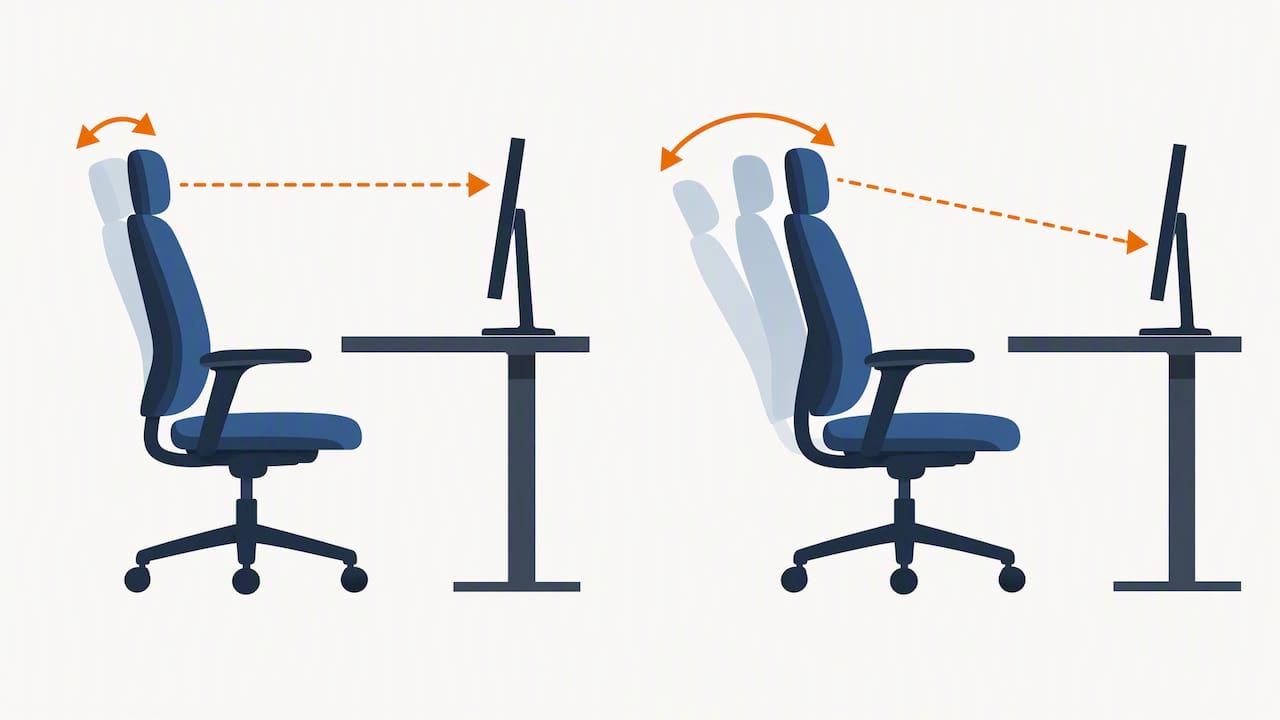
Pro Tip: Pair any dynamic or float mechanism with a fixed desk height and monitor position, so the chair’s movement does not pull your eyes or hands away from a comfortable working line.
Start with the non-negotiables. The DSE Regulations require every work chair to offer adjustable seat height and a backrest that adjusts in height and tilt, and HSE guidance recommends using a workstation checklist to confirm staff can actually use those adjustments correctly. Our own DSE chair requirements guide maps these minimums against a full purchase order specification.
Reject any spec that cannot confirm independent seat height and backrest adjustment, since that fails the DSE baseline before any other feature matters.
Most mechanism faults fall into three categories: a seat that slowly sags under weight, a recline that will not lock, or a creak that appears under load. A sagging seat usually points to a failing gas-lift cylinder, a stuck recline often means a seized tension knob, and creaking is frequently a loose bolt rather than a mechanism failure.
Pro Tip: Keep the model number and mechanism type on file for every bulk order, so replacement parts can be matched without having to dismantle a chair to identify them.
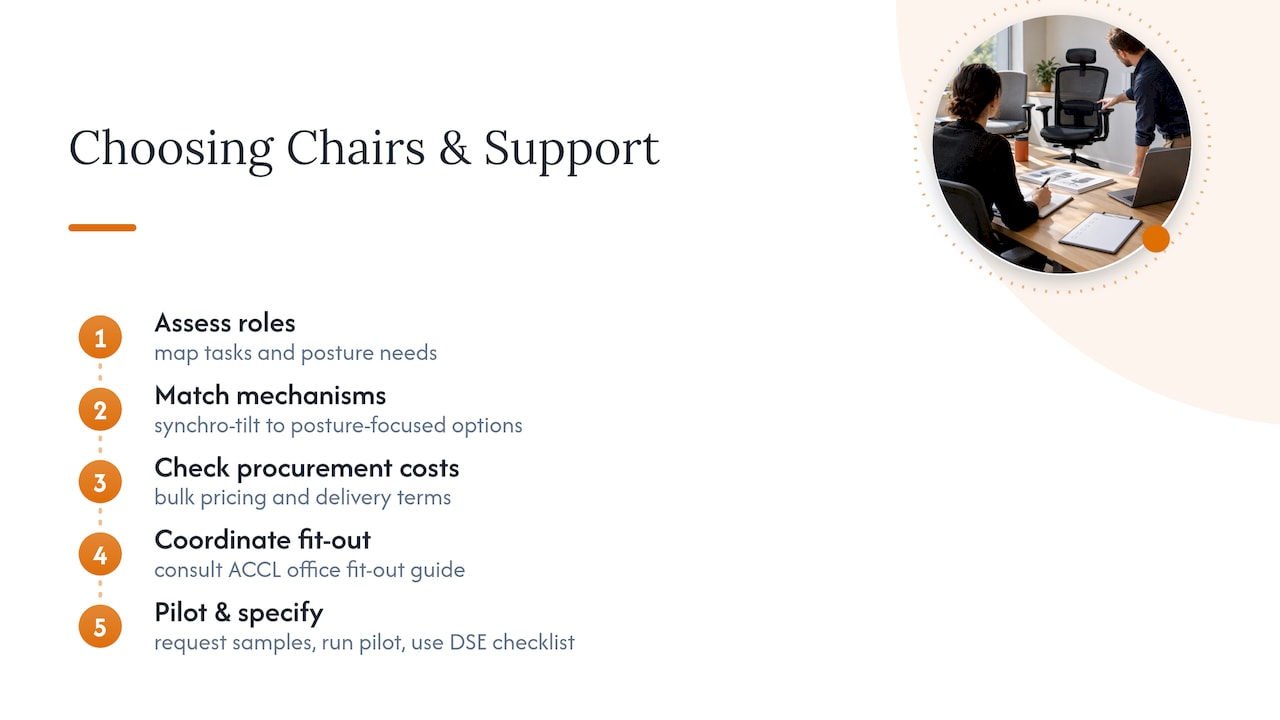
Supplying ergonomic seating in bulk has shown us that spare-part availability and warranty terms often decide a specification faster than the mechanism type itself. We recommend trialling a small pilot group of chairs, documenting DSE assessments against them, before signing off a bulk order across an entire floor.
— Furniture
We stock mechanism types across our office chairs range, from straightforward synchro-tilt task chairs to dynamic and posture-focused options, so you can match seating to each role rather than buying one chair for everyone.

Bulk pricing and bundle deals can reduce costs when fitting out multiple desks; delivery terms vary by supplier and may be relevant for procurement budgets. If seating is part of a wider refurbishment, our partners at ACCL’s office fit-out guide cover the cabling and infrastructure side of the project alongside furniture planning.
Get in touch to request a sample chair or set up a pilot group for your team, or head straight to our office chairs category to start specifying mechanisms against your DSE checklist.
A mechanism sits beneath the seat and connects it to the gas-lift column, controlling how the seat and backrest move when you lean back. Depending on the type, it may move the seat and back together at a fixed ratio, independently, or allow small multi-directional movement for active sitting.
A gas-lift cylinder that no longer holds height usually needs replacing rather than repairing, and this should follow the manufacturer’s fitting instructions since the cylinder is pressurised. Minor recline or tension faults are often fixable by tightening bolts or adjusting the tension knob before assuming the cylinder has failed.
The main parts are the base and castors, the gas-lift cylinder, the mechanism beneath the seat, the seat pan, the backrest, and armrests where fitted. Our guide to adjusting your office chair walks through how each part interacts with the others.
Confirm the bolt pattern and lever positions match the original mechanism exactly, since mismatches can make a replacement unusable even if it fits the same chair brand generally. Checking with the supplier before ordering avoids a wasted part and extra delay.

Phone: 0330 043 4114
VAT no. GB 991 8681 60
Company no. 07250570