Most commercial poseur tables in the UK typically stand around a height commonly used by venues for standing receptions and networking events because it suits a standing adult’s natural leaning posture and pairs comfortably with poseur stools. The common commercial range is generally understood to cover a height span that affects guest comfort, service flow and how tables pair with seating.
TL;DR:
- Most poseur tables in the UK measure between 1000mm and 1100mm in height, with 1100mm being the retail default and most common choice.
- A proper measurement involves checking the distance from the floor to the tabletop surface and the underside clearance to ensure stool pairing and guest comfort.
- Tall tables encourage short, mobile interactions, making them suitable for brief networking or quick service settings rather than prolonged standing.
- The ideal stool height creates a 250mm to 350mm gap between the seat and the underside of the table, with footrests at knee height to reduce fatigue.
- Stability depends on a weighted or broad base, especially for taller tables, and all furniture should meet general safety, accessibility, and hygiene standards.
UK suppliers and trade listings generally quote poseur tables within a similar range, often specifying a taller portion of that range, with certain heights appearing commonly as the retail default. That range sits well above standard dining height and gives standing guests a natural surface to rest a drink or plate without stooping.
When you measure a table, two reference points matter:
To check an installed table on site, stand it on a flat, level section of floor, measure from the floor to the top surface at the centre, then repeat at the underside near the table edge. A difference of more than a few millimetres between the two measurements usually points to tabletop thickness rather than a fitting fault, which matters when you are matching tables to stools across a venue.
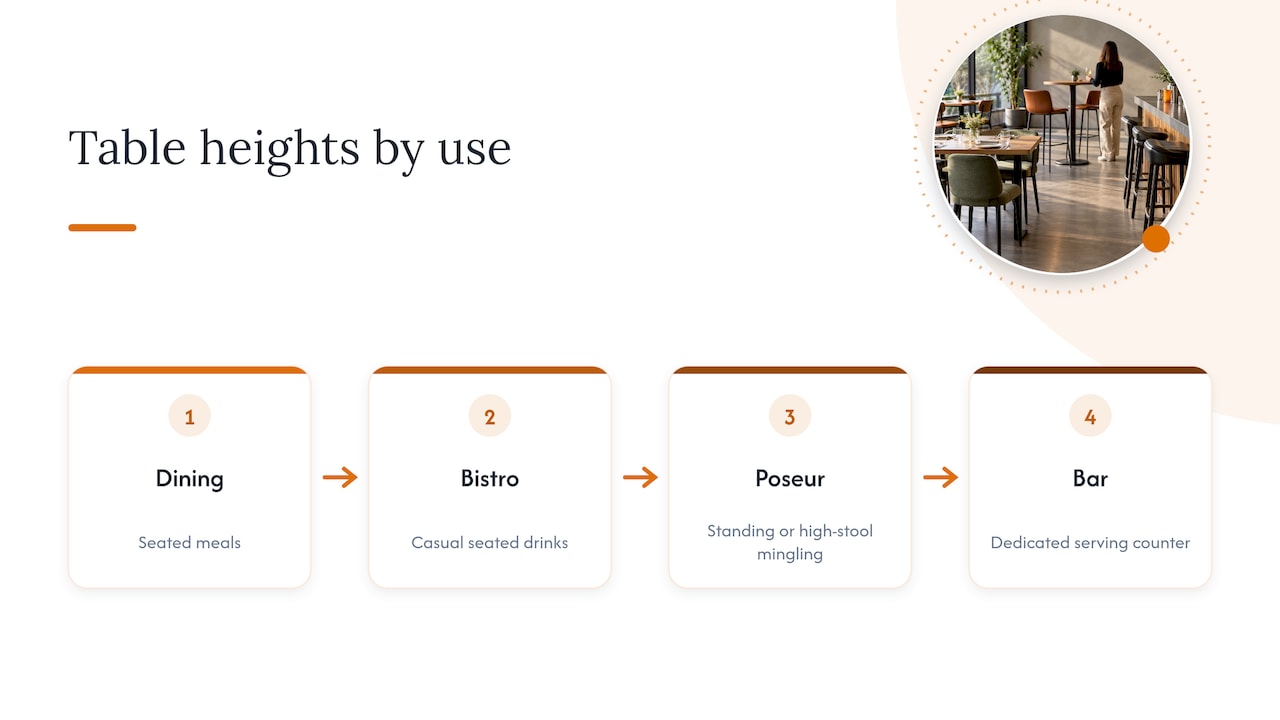
Dining tables sit at typical dining heights, bistro tables are somewhat taller, poseur tables fall into a higher range used for standing or high-stool mingling, and full bar counters reach heights suitable for serving counters rather than guest seating. Each height serves a different purpose: dining height suits seated meals, bistro height suits casual seated drinks, poseur height suits standing or high-stool mingling, and bar height suits a dedicated serving counter rather than guest seating.
Taller tables tend to encourage shorter, more mobile interactions, which is why poseur height dominates receptions and networking events where organisers want guests circulating rather than settling in.
The right height depends on how long guests will stand, how the room is laid out and what happens around the tables afterwards.
Pro Tip: Order one sample table before committing to a bulk purchase and trial it with your usual stool stock for a full shift.
Getting the height right matters less than getting the pairing right. A poseur table without the correct stool height can leave guests perching awkwardly or straining to reach the top.
Specifying tables for a venue means balancing stability, capacity and upkeep against budget and storage.
Pro Tip: Standardise on one top diameter across a venue where possible, since mixed sizes complicate linen and decor ordering for events.
Poseur table clusters need enough surrounding space to keep walkways usable, particularly in venues open to the public. Approved Document M sets out minimum corridor and passageway widths for accessibility and fire egress, and those figures are a useful reference point when planning table layouts even though the guidance targets building fabric rather than furniture arrangement directly.
As a rule of thumb, leave generous circulation space around each poseur cluster rather than packing tables tight to maximise numbers, since narrow gaps slow service and make it harder for guests using mobility aids to move through the room. For any fixed or permanent poseur installation, such as a bolted-down table in a redesigned bar area, check with building control before work begins rather than relying on general guidance alone.
Our Italia Square poseur table and Italia Slimline poseur table sit within the commercial height range venues expect, giving procurement teams a stocked option rather than a custom order. We provide options for bulk orders, delivery to UK mainland, and returns if a sample does not suit your space.
Poseur tables themselves are not governed by a single dedicated British Standard the way, say, fire safety for upholstered furniture is. Instead, the relevant obligations fall under general workplace and public safety duties that apply to any furniture used in a commercial setting.
Under general health and safety duties, venue operators are responsible for providing furniture that is fit for purpose and stable enough not to present a trip or tip hazard. This means choosing a poseur table with a base rated for its height and intended footfall, rather than assuming any table marketed as “poseur height” is automatically suitable for a crowded bar area. A taller table carries a higher centre of gravity, so the base design matters more as height increases.
Fire safety regulations that apply to upholstered stools and seating paired with poseur tables are separate from the table specification itself, and venues should check that any soft furnishings used alongside poseur tables meet the usual flammability requirements for commercial premises.
Electrical safety becomes relevant where poseur tables incorporate charging points or lighting, a feature increasingly common in exhibition and conference settings; any such fitting should be checked and certified as part of routine portable appliance testing rather than assumed safe because the table itself looks standard.
Venues hosting food and drink service around poseur tables should also consider surface material under food hygiene good practice, since a porous or easily scratched top can be harder to keep clean between sittings.
Poseur tables turn up across a wide range of UK settings, and the right choice often depends on how long guests linger and the arrangement suited for food and drink, as outlined in Coffee Service for Meetings: A UK Planner’s Guide. In hospitality, pubs and bars use poseur tables to create standing zones that encourage turnover without the commitment of a full seated table, while hotels often place them in lobby and bar areas for guests waiting or having a quick drink.
Exhibitions and conferences rely heavily on poseur height for networking breaks between sessions, since the format supports brief conversations while delegates hold a drink or a plate in one hand. Event hire companies stock poseur tables as a standard item for weddings and corporate functions, typically dressed with linen to suit the occasion.
Retail and leisure venues, including shopping centre food courts and cinema bars, use poseur tables where floor space is tight and quick turnover matters more than lingering comfort. Home use has grown too, particularly for garden bars, home cinema rooms and kitchen breakfast bars where the height suits casual standing use rather than formal dining.
Across all these settings, the core appeal is the same: poseur height keeps guests upright, mobile and circulating, which suits venues that want higher footfall through a space rather than guests settling in for an extended seated stay.
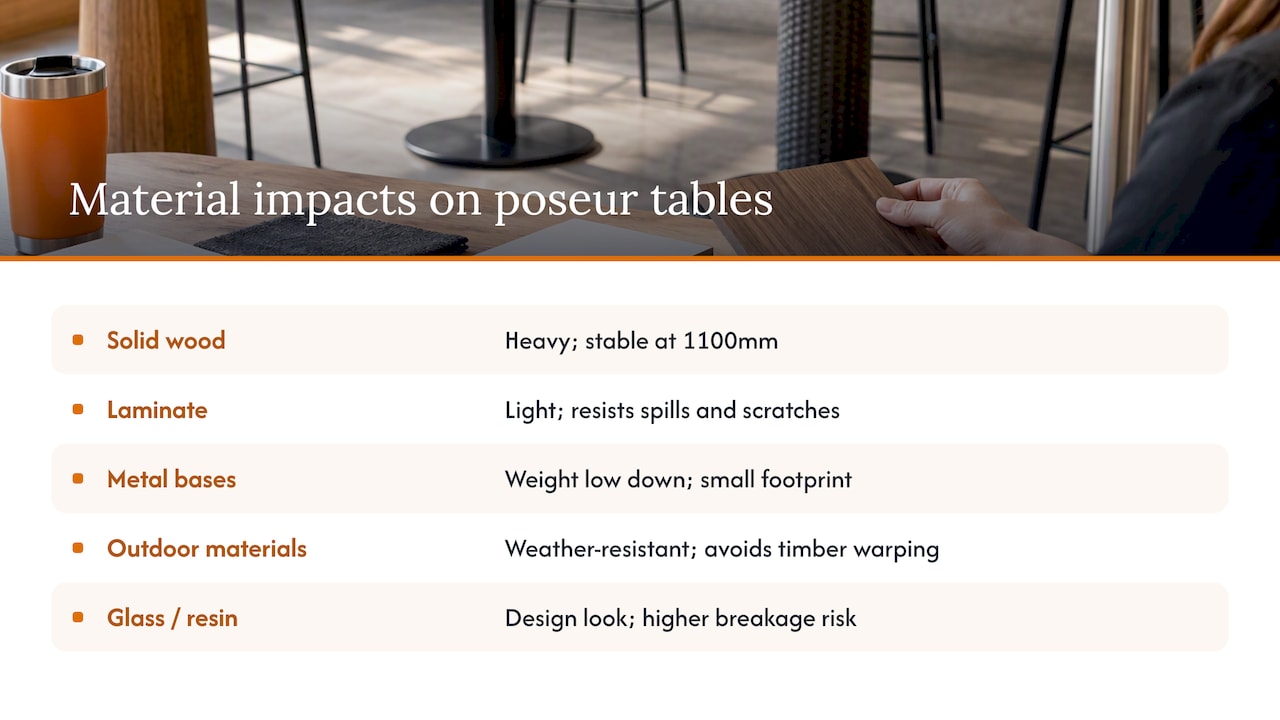
The material a poseur table is made from affects both how it performs at height and how long it lasts under commercial use. Solid wood tops offer a premium look and good durability but add weight, which can be an advantage for stability at 1100mm since a heavier top resists tipping under a leaning guest.
Laminate tops are the most common commercial choice because they resist spills, scratches and heat marks well, holding their finish through repeated cleaning cycles better than painted or veneered surfaces. Laminate also tends to be lighter than solid wood, so venues using laminate tops often need a wider or weighted base to maintain the same stability at poseur height.
Metal-framed bases, typically steel or cast iron, are standard for poseur tables because they combine a small footprint with enough weight low down to counter the higher centre of gravity that comes with taller tables. A narrow metal base paired with a heavy top can still be stable, but venues should check the manufacturer’s footprint recommendation rather than assuming any base suits any height.
Outdoor and semi-outdoor poseur tables, common in beer gardens and smoking areas, often use weather-resistant materials such as powder-coated metal or weatherproof laminate, since timber tops exposed to the elements warp and degrade faster, which can shift the table slightly off its intended height over time.
Glass and resin tops appear in more design-led venues but need a sturdier base to compensate for their weight profile, and venues should factor breakage risk into high-traffic standing areas where tables are more likely to be knocked.
Fixed-height poseur tables cover most commercial needs, but adjustable and custom options exist for venues with specific requirements. Height-adjustable poseur tables, often using a gas-lift or crank mechanism similar to adjustable desks, let one table serve both bistro and poseur height depending on the event, which suits venues that host a mix of seated and standing functions without the budget for two separate table stocks.
Custom-height orders are common for venues integrating poseur tables into a fixed bar run or a built-in feature, where the table needs to match an existing counter or architectural element rather than a standard retail height. Bespoke orders typically take longer to source than stocked models and may carry a price premium, so they tend to suit permanent installations rather than hired event furniture.
For most UK venues, though, a fixed 1100mm or 1050mm table bought as a stocked commercial item is the simpler and more cost-effective route, with adjustable or custom tables reserved for venues with a genuine mixed-use need.
Lighter, stackable tables save storage space but sacrifice some stability compared with heavier solid bases. For most UK venues, a 1100mm fixed table on a weighted base remains the simplest choice to specify and maintain.
— Furniture
We stock poseur tables at commercial heights with options for bulk orders and delivery to the UK mainland. Browse our meeting room furniture range to specify tables alongside complementary pieces for your next fit-out.
Most UK commercial poseur tables stand between 1000mm and 1100mm, with 1100mm the most common retail default. This height suits standing guests leaning to rest a drink or plate without stooping.
Standard dining tables in the UK typically sit well below poseur height. Poseur, bistro and bar tables each follow their own separate height conventions depending on whether guests sit, perch or stand.
A dining table around 780mm sits higher than some dining tables but is too low to function as a poseur table, which starts at around 1000mm.
Bedside table height is not covered by the commercial poseur standards discussed in this guide and varies by bed and mattress height rather than a fixed industry figure. It falls outside the scope of hospitality and venue furniture specification covered here.

Phone: 0330 043 4114
VAT no. GB 991 8681 60
Company no. 07250570